



Ever wondered how scientists separate tiny particles in seconds? It’s all thanks to the centrifuge.
A centrifuge is a high-tech tool that uses centrifugal force to sort out different densities. It spins samples fast, creating a strong gravitational field. This helps researchers pull out specific parts from complex mixes.
Centrifugal separation is key in many sciences. It’s used in medical research and environmental studies. The centrifuge helps us understand complex biological and chemical interactions.
The main idea behind the centrifuge is its ability to create strong rotational forces. These forces push heavier particles down and lighter ones up. This makes for a quick and accurate way to separate particles.
Key Takeaways
- Centrifuges use rotational force to separate substances
- Critical tool in scientific research and medical diagnostics
- Works by creating powerful gravitational fields
- Enables quick and precise separation of particles
- Used across multiple scientific disciplines
Understanding the Centrifuge and Its Functionality
Centrifuges are key tools in labs and medical fields. They use density separation and sedimentation to analyze biological samples with great detail.
A centrifuge works by spinning samples fast to create strong centrifugal force. This force is stronger than gravity, helping to separate materials by density.
Definition of a Centrifuge
A centrifuge is a device that separates liquids and solids through fast rotation. It does this by:
- Generating high-speed rotational movement
- Creating significant centrifugal force
- Separating components based on density differences
Basic Working Principle
Centrifuges use science to separate materials. When spinning fast, heavier particles move out, and lighter ones stay in. This makes it easy to separate and study different parts of a sample.
| Centrifuge Type | Speed Range | Maximum G-Force |
|---|---|---|
| Low-Speed Centrifuge | 0-7,500 RPM | 7,000 x g |
| High-Speed Centrifuge | Up to 26,000 RPM | 70,000 x g |
| Ultracentrifuge | 60,000-150,000 RPM | 1,000,000 x g |
Applications in Laboratory Settings
Centrifuges are used in many scientific areas. They help researchers:
- Separate blood components
- Isolate cellular organelles
- Purify biological samples
- Concentrate protein solutions
“The centrifuge transforms complex mixtures into distinct, analyzable components through the power of rotational force.” – Scientific Research Quarterly
Today’s centrifuges are a big step in science. They let researchers study biological systems in detail and quickly.
Types of Centrifuges Used in Laboratories
Laboratory centrifuges vary in design, each suited for different research and diagnostic needs. Knowing about different types helps scientists pick the best equipment for their studies. The speed and special features of each centrifuge are key for processing and analyzing samples.
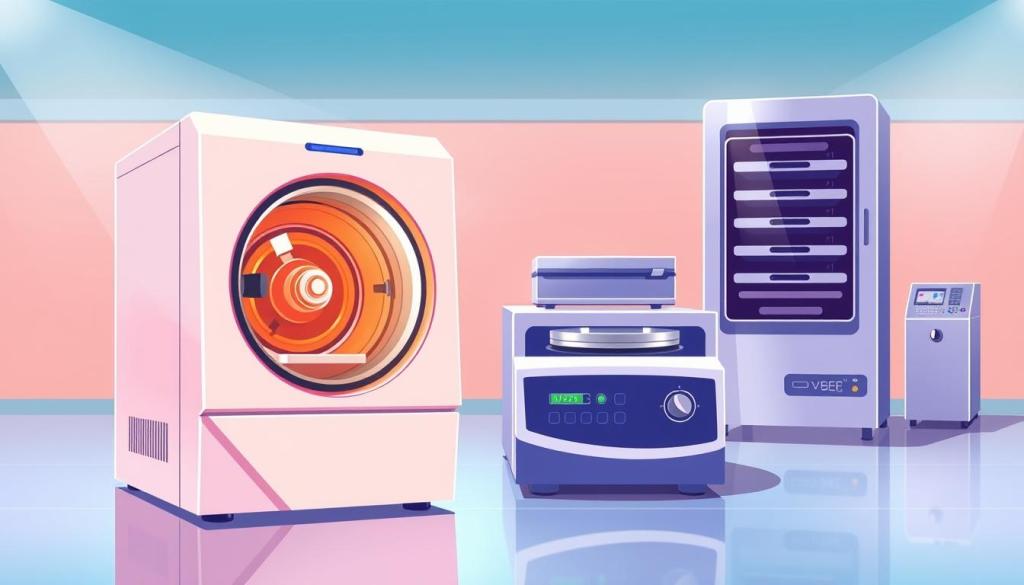
Scientists use various centrifuges to separate substances accurately. The main types include:
- Fixed-Angle Centrifuges
- Swinging-Bucket Centrifuges
- Microcentrifuges
Fixed-Angle Centrifuge
Fixed-angle centrifuges keep sample tubes at a fixed angle while spinning. They run at speeds from 4,000 to 5,000 RPM, making them good for separating particles. Fixed angle rotors help particles settle faster because of the longer path they follow. This makes them great for both clinical and research work.
Swinging-Bucket Centrifuge
Swinging-bucket centrifuges have rotors that swing to a horizontal position during fast spinning. They are good for separating clear supernatants because they keep the sample tube upright. They are versatile and work well with different sample sizes and density gradient separations.
Microcentrifuge
Microcentrifuges are made for small samples, from 0.5 to 2 µL. They spin at speeds of 12,000 to 13,000 RPM. These small but powerful centrifuges are crucial for molecular biology, genetics, and clinical diagnostics. They can quickly process tiny samples.
Choosing the right centrifuge depends on specific research requirements, sample volume, and desired separation efficiency.
Key Components of a Centrifuge
Centrifuges are complex tools used to separate materials. They work by using relative centrifugal force. Knowing their parts helps scientists improve how they separate materials.
Rotor Types and Configurations
Rotors are key parts that affect a centrifuge’s performance. Each design is made for different separation methods:
- Fixed-angle rotors: Keep tube angles steady during spin
- Swinging-bucket rotors: Let tubes swing out during spin
- Vertical rotors: Best for density gradient separations
Drive Mechanism Explained
The drive mechanism turns electrical energy into precise rotation. Modern centrifuges use advanced motors. These motors help reach speeds from 3,000 to 1,000,000 g.
| Motor Type | Speed Range | Application |
|---|---|---|
| Standard Electric Motors | 3,000-60,000 g | Clinical and Research Labs |
| Ultracentrifuge Motors | 100,000-600,000 g | Advanced Scientific Research |
Essential Safety Features
Centrifuges have safety features to protect people and equipment:
- Automatic lid locks
- Imbalance detection systems
- Overspeed protection
- Temperature monitoring
Understanding centrifuge parts is key to safe and accurate lab work.
The Science Behind Centrifugation
Centrifugation is a key scientific method. It uses centrifugal force to separate particles with great precision. This technique relies on physics to help in complex research in many fields.
Principles of Centrifugal Force
Centrifugal force is what makes centrifuges work. When a sample spins around a center, particles move outward. This movement depends on several things:
- Rotation speed
- Radius of rotation
- Particle density
- Solution viscosity
Differential Centrifugation
Differential centrifugation helps separate cells based on how fast they settle. By increasing the speed, scientists can separate different parts of cells.

Density Gradient Centrifugation
Density separation is key when particles have the same mass but different densities. This method uses a gradient medium. It lets particles separate based on their density.
“Centrifugation transforms complex mixtures into distinct, analyzable components through strategic acceleration and gravitational manipulation.”
| Centrifugation Type | Speed Range | Typical Application |
|---|---|---|
| Low-Speed | Less than 10,000 × g | Cell culture separation |
| Super-Speed | 40,000-60,000 × g | Subcellular fractionation |
| Ultracentrifugation | Up to 150,000 rpm | Molecular research |
Knowing about sedimentation helps scientists improve separation techniques. This leads to new discoveries in many fields.
Choosing the Right Centrifuge for Your Needs
Choosing the right centrifuge is key for great research results. Lab experts must look at many factors. This ensures they pick the best centrifuge for their needs.
When picking a centrifuge, researchers should think about a few important things. These things affect how well the centrifuge works:
- Sample volume requirements
- Maximum rotational speed needed
- Temperature sensitivity
- Separation precision
Critical Evaluation Factors
Different research needs call for different centrifuges. Centrifuge types range from microcentrifuges to high-speed ultracentrifuges. Each is made for specific research tasks.
| Centrifuge Type | Speed Range | Primary Applications |
|---|---|---|
| Microcentrifuge | 10,000-15,000 x g | Molecular biology research |
| Benchtop Centrifuge | 3,000-20,000 x g | Routine laboratory procedures |
| Ultracentrifuge | 50,000-100,000 x g | Subcellular fractionation |
Application-Specific Requirements
Lab experts need to carefully think about their research needs. Important factors include rotor compatibility, sample sensitivity, and needed separation precision.
Choosing the right centrifuge is about matching technical specifications with research objectives.
Safety features like imbalance detection and electronic lid-locks are crucial. Modern centrifuges have advanced tech. This tech boosts efficiency and keeps research samples safe.
Maintenance and Care for Centrifuges
Keeping centrifuges in good shape is key for reliable separation and speed. Lab equipment needs regular care to work well and last longer.
Regular Maintenance Practices
Good centrifuge care includes several important steps:
- Do annual checks on rotor speed and temperature
- Check seals every month
- Clean ventilation slots every six months
- Keep a detailed maintenance log
Critical Inspection Protocols
Lab techs should watch for these key maintenance points to avoid breakdowns:
| Inspection Area | Frequency | Key Actions |
|---|---|---|
| Rotor Condition | Monthly | Check for corrosion, scratches, damage |
| Electrical Components | Quarterly | Verify wiring and control systems |
| Seals and Gaskets | Monthly | Inspect for deterioration |
Cleaning and Disinfection Protocols
Cleaning well is crucial for keeping centrifuges efficient. Follow these steps:
- Use neutral cleaners to avoid corrosion
- Wipe surfaces with a cloth, not spray
- Clean spills right away to stop salt crystals
- Autoclave rotors at 121°C for 15-20 minutes when needed
Preventive maintenance is key to avoiding costly equipment downtime and ensuring consistent laboratory performance.
Troubleshooting Common Issues
Spotting problems early can save your equipment from damage. Look out for signs like unusual vibrations, overheating, or slower speed. Wait 30 minutes after a tube break before opening the centrifuge to let aerosols settle.
Proper care extends the life of your centrifuge and maintains the integrity of your scientific research.
Safety Protocols When Using a Centrifuge
Working with complex scientific equipment is risky. Centrifuges, which use a lot of centrifugal force, need careful handling. Following strict safety rules is key to avoid accidents and get the best results.
Personal Protective Equipment (PPE)
When using centrifuges, wearing the right safety gear is essential. It helps protect against the risks of high-speed forces and potential dangers from samples.
- Safety glasses with side shields
- Laboratory coat
- Chemical-resistant gloves
- Closed-toe shoes
Safe Sample Loading Techniques
It’s important to load samples correctly to avoid damage and get accurate results. Here are some important tips:
- Check tubes for cracks or damage before use
- Ensure sample tubes are compatible with centrifuge specifications
- Balance tubes precisely, with mass differences less than 0.1 grams
- Use appropriate rotors for specific sample types
Emergency Procedures
Knowing how to handle emergencies is crucial with high-speed lab equipment. If something unexpected happens, follow these steps:
- Immediately stop the centrifuge if unusual sounds occur
- Wait 10 minutes after centrifugation before opening
- Wear additional PPE when handling potentially contaminated samples
- Report any equipment malfunctions to supervisory staff
According to OSHA, most centrifuge accidents result from user error, emphasizing the importance of comprehensive safety training.
By following strict safety rules, we can keep researchers safe and ensure the quality of scientific research. This is especially important when working with equipment that uses centrifugal force.
Innovations in Centrifuge Technology
The world of centrifuge technology is changing fast. New breakthroughs are making a big impact in labs and industries. These changes are making centrifuges better for many scientific fields.

Automation in Centrifugation
Centrifuge tech is moving towards automation. New control systems offer better precision in separating materials. These updates bring many advantages:
- Less need for human help
- More consistent results
- Work gets done faster
- Results can be checked in real-time
“Automation is the future of centrifuge tech. It lets researchers get better and more reliable results.” – Laboratory Technology Research Institute
Eco-friendly Centrifuge Models
Now, making centrifuges more eco-friendly is a big goal. New models use less energy and are better for the planet. Key features include:
- Less power needed
- Less harm to the environment
- Better cooling systems
- Greener materials
Centrifuges are getting more popular, with some using 70% less energy than old ones. These green centrifuges are a big step forward in lab tech.
Research keeps going, aiming to make centrifuges smarter and greener. They’re working on adding advanced analytics and eco-friendly features for all kinds of scientific uses.
Common Misconceptions About Centrifuges
Centrifuges are complex lab tools that often confuse researchers and students. Knowing what a centrifuge is and how it works can clear up many myths. These myths surround these essential scientific tools.
Laboratory experts often face many misconceptions about centrifuges. Let’s look at the most common myths and set the record straight.
Myths vs. Facts About Centrifugation
- Myth: All centrifuges work exactly the same way
Fact: Different centrifuges are made for different tasks. Microcentrifuges, ultracentrifuges, and floor models each have their own use.
- Myth: Centrifuges can separate any type of mixture
Fact: Separation by centrifugation depends on the density and size of particles. Not every mixture can be separated this way.
- Myth: Higher speed always means better results
Fact: The best results come from the right speed for the sample. Speeds must match the sample’s needs.
Clarifying Critical Misunderstandings
Centrifuge performance is more than just speed. Modern centrifuges can reach high relative centrifugal force (RCF) levels. Ultracentrifuges can go up to 1,000,000 g.
“Understanding your centrifuge’s capabilities is key to obtaining accurate scientific results.”
| Centrifuge Type | Max RCF | Typical Sample Size |
|---|---|---|
| Microcentrifuge | 30,000 g | 0.2-2.0 ml |
| Regular Laboratory | 100,000 g | Up to 50 ml |
| Ultracentrifuge | 1,000,000 g | Specialized research volumes |
When using centrifuges, safety and precision are crucial. Proper training and understanding the equipment’s limits are key. Following established protocols helps avoid mistakes in research.
Future Trends in Centrifuge Research and Development
The world of centrifuge technology is changing fast. New discoveries are making density separation better in many fields. This includes molecular biology, healthcare, and environmental science. New centrifuge systems are being made with advanced materials and smart designs.
Centrifuges are getting smaller and more portable. This means scientists can do quick tests anywhere. Artificial intelligence and machine learning are also changing things. They could make experiments faster and more accurate.
Emerging Technologies
New materials like carbon fiber and nanomaterials are making centrifuges better. They make the devices stronger and lighter. New shapes for rotors could make centrifuges faster and hold more samples.
Automation and digital tools are making centrifuges easier to use. This makes them more precise and user-friendly.
Expected Advancements in Applications
Centrifuge technology is set to get even better. More people are working together on these projects. This includes scientists, engineers, and industry experts.
New ways to separate biomolecules are being developed. Portable centrifuges are being used in healthcare, environmental monitoring, and food safety. This shows how versatile these tools are becoming.
FAQ
What is a centrifuge and how does it work?
A centrifuge is a device used in labs to separate materials. It spins samples at high speeds. This creates a force that separates heavier particles from lighter ones.
What are the primary applications of centrifuges in scientific research?
Centrifuges are key in many fields like medicine and biochemistry. They help separate blood components and isolate cells. They also purify proteins and prepare DNA and RNA samples.
What types of centrifuges are commonly used in laboratories?
There are several types of centrifuges used in labs. These include fixed-angle, swinging-bucket, and microcentrifuges. Each is designed for different tasks, with varying speeds and capacities.
How do scientists measure centrifuge performance?
Scientists use relative centrifugal force (RCF) and speed to measure performance. RCF shows the force applied to samples. Speed is measured in RPM, helping choose the right settings for separation.
What safety precautions are necessary when using a centrifuge?
Wearing PPE and balancing samples are crucial. Using the right rotors and avoiding overloading are also important. Regular maintenance and following guidelines prevent accidents and contamination.
What is the difference between differential and density gradient centrifugation?
Differential centrifugation separates by size and density. It uses increasing speeds. Density gradient centrifugation uses a medium for precise separation of complex mixtures.
How do recent technological innovations impact centrifuge design?
New technologies include automated systems and energy-efficient designs. These advancements improve accuracy and reduce time. They also open up new areas like nanotechnology and personalized medicine.
What factors should be considered when selecting a centrifuge?
When choosing a centrifuge, consider sample volume and speed. Also, think about temperature needs and the type of sample. The application of the centrifuge is also important.
Can centrifuges be used in non-laboratory settings?
Yes, centrifuges are used outside labs too. They are used in food processing, petroleum, and pharmaceuticals. They help separate substances by density.
What maintenance practices are crucial for centrifuge longevity?
Regular cleaning and lubrication are key. Check electrical connections and balance rotors. Inspect seals and follow service schedules. This ensures the centrifuge works well and lasts long.






Leave a Comment
Your email address will not be published. Required fields are marked *