


Ever wondered how scientists measure tiny liquid amounts with such precision? The secret lies in a remarkable tool called the pipette.
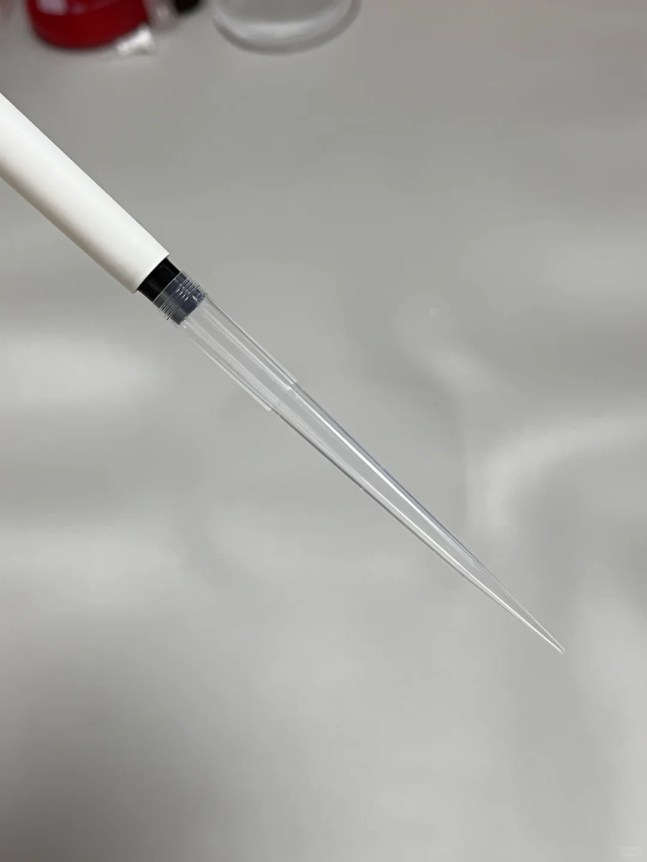
Pipettes are advanced tools for moving and measuring small liquid amounts with great accuracy. They do more than just move liquids; they are key in chemical, biological, and medical studies.
In labs everywhere, from high school to top research centers, pipettes are a must. They help scientists handle tiny amounts of chemicals or biological samples. This lets scientists work with volumes as small as 0.1 microliters.
Key Takeaways
- Pipettes enable precise liquid measurement and transfer in scientific research
- They are essential tools in chemical, biological, and medical laboratories
- Modern pipettes offer accuracy within 3% of specified volumes
- Various types of pipettes exist for different scientific applications
- Proper technique is crucial for maintaining pipette accuracy
Introduction to Pipettes
Laboratory pipettes are key tools in science. They help scientists move tiny amounts of liquid with great care. This is important in many areas of study.
Scientists use different pipettes for liquids from 1μL to 20μL. This shows how versatile they are in labs. These tools have changed how we measure things in science.
Definition and Purpose
Laboratory pipettes are special tools for measuring and moving liquids. They do many important things:
- They measure liquids very precisely.
- They move tiny amounts of samples.
- They help get the same results over and over.
- They reduce mistakes when handling liquids.
Importance in Laboratory Settings
Pipettes are more than just for moving liquids. They are key to:
- Keeping experiments accurate.
- Supporting complex scientific studies.
- Helping with detailed medical tests.
- Doing precise chemical tests.
“Precision is the essence of scientific measurement, and pipettes are the tools that make this precision possible.” – Scientific Research Journal
Modern pipettes have changed a lot since the 1950s. The micropipette patent by Heinrich Schnitger was a big step. It made a safer, more accurate way to handle liquids.
When using pipettes, researchers must follow strict rules. This includes changing tips and using the right technique. It helps avoid contamination and ensures reliable results.
Types of Pipettes
Laboratory professionals use different types of pipettes for precise liquid handling. Knowing the types helps researchers pick the right tool for their needs.
Air Displacement Pipettes
Air displacement pipettes are the most used in science. They use an air cushion to draw and dispense liquids with great precision. This makes them perfect for many scientific tasks.
- Ideal for handling aqueous solutions
- Provide exceptional accuracy for micropipetting
- Available in single and multi-channel configurations
Positive Displacement Pipettes
Positive displacement pipettes handle liquids in a special way. They use a piston to directly touch the liquid. This is great for hard-to-handle samples like thick or volatile liquids.
| Pipette Type | Volume Range | Best Applications |
|---|---|---|
| P2 Micropipette | 0.2-2 µL | Molecular biology techniques |
| P200 Micropipette | 20-200 µL | PCR preparations |
| P1000 Micropipette | 100-1000 µL | Cell culture experiments |
Specialty Pipettes
Volumetric pipettes are a key type for precise measurements. They deliver a fixed volume with high accuracy. This makes them essential in analytical chemistry and research labs.
“Precision is the hallmark of scientific excellence, and the right pipette can make all the difference in research outcomes.” – Laboratory Science Quarterly
- Blood pipettes for clinical diagnostics
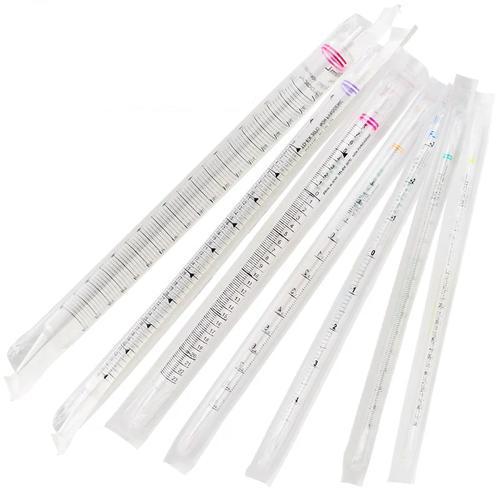
- Serological pipettes for larger volume transfers
- Electronic pipettes for advanced laboratory automation
Researchers need to choose volumetric pipettes carefully. They should think about the volume needed, the sample’s characteristics, and the precision required.
How Pipettes Work
Laboratory precision relies on advanced tools that make scientific measurement exact. Pipettes lead this technological wonder, allowing researchers to handle tiny liquid volumes with great accuracy.
Mechanism of Operation
Pipettes work through a complex air displacement mechanism. When pressed, air is pushed out of the tip. Then, by releasing the plunger, a vacuum pulls liquid into the tip with high precision.
- Air displacement creates precise suction
- Volume ranges from 0.1 μL to 1,000 μL
- Electronic models offer enhanced accuracy
Calibration and Accuracy
Pipette accuracy is key and needs regular calibration. Labs suggest calibrating every six months for best results. Pipettes usually hit 3% of the specified value accuracy.
“Precision is not a luxury, it’s a necessity in scientific research.” – Laboratory Standards Institute
Operating Procedures
Calibrating pipettes involves testing volume delivery. Researchers must follow the maker’s rules, use certified weights, and keep detailed records.
- Clean pipette tips before use
- Check volume consistency
- Record calibration results
- Replace worn components
Knowing about pipette accuracy and strict calibration ensures reliable results in various research settings.
Applications of Pipettes
Laboratory pipettes are key in science and medicine. They help measure and move tiny amounts of liquid with great accuracy. This is important in many scientific fields.
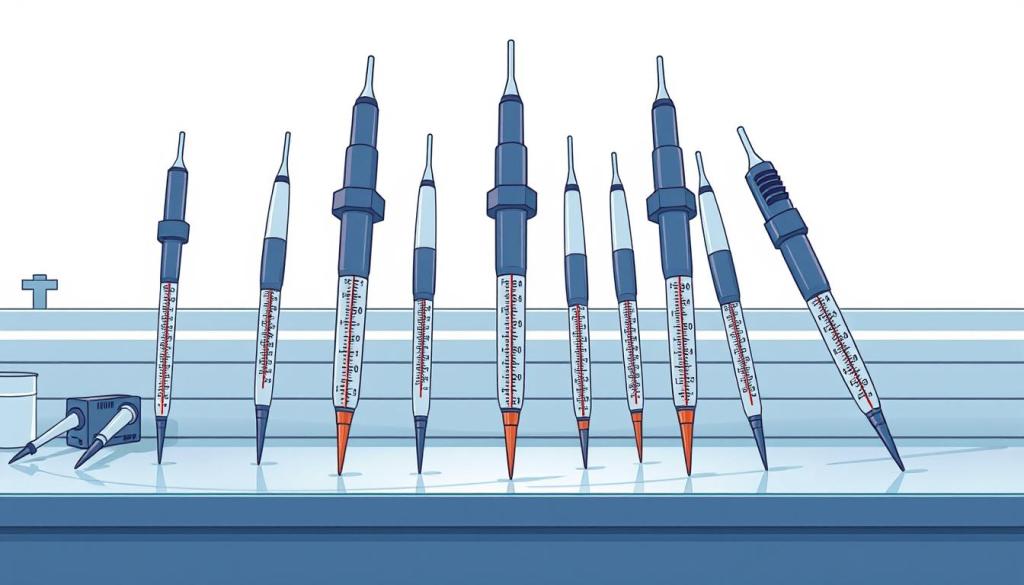
Pipettes are used in many important areas of science. They show how versatile and vital they are in today’s research and medical studies.
Biological Research Applications
In biology, pipettes are essential for many tasks:
- DNA and protein analysis
- Cell culture techniques
- Microbiological studies
- Genetic engineering experiments
Chemical Analysis Techniques
Chemical labs use pipettes for precise work:
- Solution preparation
- Conducting titrations
- Spectrophotometric measurements
- Chemical compound dilutions
Medical Laboratory Applications
Medical labs use pipettes for important tests and research:
- Diagnostic test preparation
- Blood analysis
- Drug discovery processes
- Pathological sample handling
| Research Domain | Specific Pipette Applications | Volume Range |
|---|---|---|
| Molecular Biology | Gene sequencing | 0.1-10 µl |
| Clinical Diagnostics | Blood testing | 10-1000 µl |
| Pharmaceutical Research | Drug formulation | 100-5000 µl |
“Precision is the cornerstone of scientific discovery, and pipettes are the tools that make such precision possible.” – Scientific Research Journal
Pipettes are vital for scientific progress and better health care. They help us understand the world and improve treatments.
Advantages of Using Pipettes
Pipettes are key tools in science, bringing big benefits to labs. They are precise and flexible, making them vital for accurate liquid handling.
Precision and Accuracy in Liquid Handling
Pipette accuracy is crucial for science. Today’s pipettes can measure with up to ±1% error. This ensures reliable results for scientists.
They help reduce mistakes and keep data quality high.
- Volumetric precision within ±0.1% range
- Reduction of experimental error by up to 20%
- Consistent liquid measurement across various volumes
Versatility in Laboratory Applications
Pipettes are used in many fields. They fit into various research needs. Positive-displacement pipettes are great for tricky liquids like:
- Viscous solutions
- Foaming liquids
- Volatile substances
Ergonomic Design and Ease of Use
Today’s pipettes focus on comfort and efficiency. They are designed to reduce fatigue and errors. Electronic models also improve precision by reducing manual work.
Accurate pipetting is not just a technique, but a cornerstone of reliable scientific research.
Choosing the right pipette and using it correctly can greatly improve lab results.
Common Pipette Techniques
Mastering pipetting techniques is key for lab professionals. It’s about precision and reliability in their work. Skill, knowledge, and attention to detail are needed.

Laboratory researchers must know how to handle pipettes safely and accurately. These techniques can greatly improve results:
Proper Handling and Grip
- Maintain a vertical position while pipetting
- Use a relaxed but firm grip to minimize hand tremors
- Keep the pipette tip clean and undamaged
- Ensure consistent hand positioning during dispensing
Techniques for Accurate Dispensing
Getting precise liquid measurements requires specific techniques:
- Pre-wet pipette tips for improved accuracy
- Use reverse pipetting for viscous solutions
- Select appropriate tip depth (approximately 1 cm)
- Control plunger release speed carefully
Tips for Avoiding Contamination
Preventing contamination is vital for keeping experiments valid. Here are some tips:
- Change pipette tips between different samples
- Use sterile techniques consistently
- Avoid touching tip exteriors
- Dispose of tips properly after single use
“Precision in pipetting is not just a technique, it’s a scientific discipline.”
Knowing these techniques ensures accurate handling and safety. It helps in reliable research across many fields.
Maintenance and Care
Keeping pipettes in good shape is key for accurate science work. Lab experts need a solid plan for cleaning, calibrating, and checking pipettes often.
Cleaning Procedures
Cleaning pipettes right is the first step. Labs have to use the right cleaning methods for their needs:
- Wipe the outside with 70% alcohol
- Use special cleaners for molecular work
- Don’t soak the whole pipette in cleaners
- Make sure it’s dry to avoid rust
Calibration Schedule
Calibrating pipettes keeps measurements accurate. Labs should set up a regular calibration plan. This depends on how often they use it and what the maker says.
- Calibrate it when you first get it
- Do a full check-up every year
- Check high-use ones more often
- Keep records of all calibrations
Recognizing Wear and Tear
Checking pipettes often helps spot problems early. Look out for these signs:
- If it’s not delivering the right amount
- Damage to seals or O-rings
- Hard to attach tips
- It makes strange noises
“Preventive maintenance is the key to reliable scientific measurements”
With good pipette care and calibration, labs can get precise results. This also makes these important tools last longer.
Troubleshooting Common Issues
Laboratory professionals face many challenges with pipettes. These issues can affect the accuracy and reliability of their work. It’s important to know how to solve these problems to keep scientific research precise.
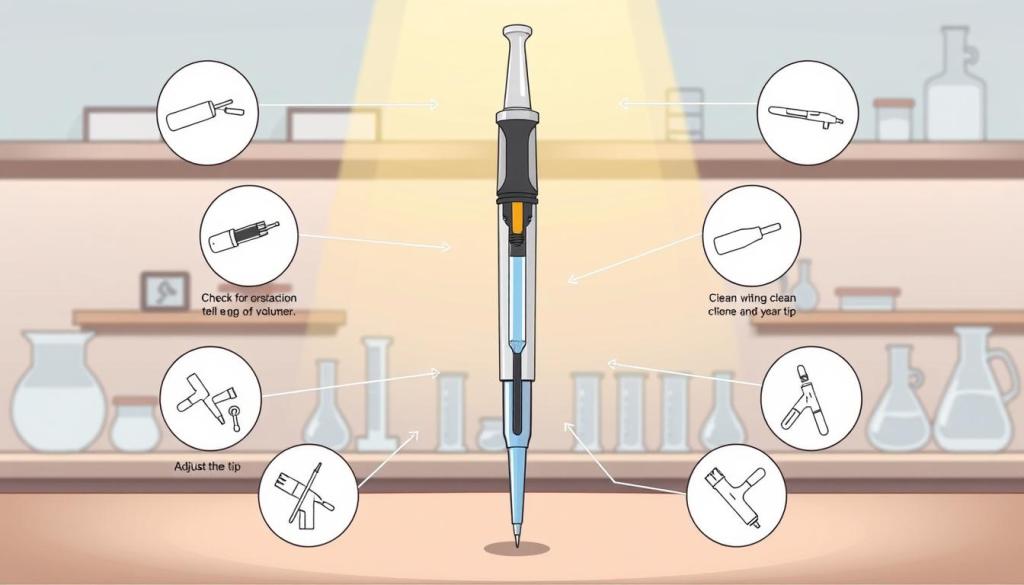
Using the right pipetting techniques is key to avoiding errors. Scientists need to identify and fix common problems to keep their work consistent.
Inconsistent Volume Dispensing
There are several reasons for inconsistent volume dispensing:
- Worn pipette seals
- Improper calibration
- User technique variations
- Environmental temperature fluctuations
Air Bubbles and Their Impact
Air bubbles can greatly affect pipette accuracy. Here are some important strategies for dealing with air bubbles:
- Slow, controlled pipetting motion
- Pre-wetting pipette tips
- Checking tip attachment carefully
- Using appropriate viscosity-matched techniques
Resolving Pipette Malfunctions
When pipettes don’t work right, follow these steps:
- Conduct regular calibration checks
- Inspect seals and moving parts
- Clean pipette components thoroughly
- Consult manufacturer guidelines
“Precision in pipetting is not just about the equipment, but understanding its nuanced operation.”
Temperature and humidity can also affect pipette performance. Keeping the lab environment stable is crucial for maintaining equipment and accuracy.
Conclusion
Pipettes do more than just move liquids around. They are key in science, helping researchers work with tiny amounts accurately. They are used in many fields, from biology to making new medicines.
Keeping pipettes in good shape is very important. They need to be checked and used right to avoid mistakes. Even small changes can affect the results of a study.
New technology has made pipettes even better. Now, they can work automatically, making things more precise and faster. By learning how to use pipettes well and keeping them in top shape, scientists can make new discoveries.
Key Takeaways in Pipette Usage
Knowing how to use pipettes helps scientists get better results. These tools are used in many areas of science. They help us learn more and make new discoveries.
FAQ
What is the primary function of a pipette in a laboratory?
A pipette is a tool for precise liquid handling. It’s used in biology, chemistry, and medical research. Its main job is to transfer and measure small volumes of liquids accurately.
What are the main types of pipettes used in laboratories?
There are several types of pipettes. Air displacement pipettes are the most common. They’re used for standard lab work. Positive displacement pipettes are best for thick or volatile liquids.
How often should pipettes be calibrated?
Pipettes need calibration at least once a year. But, it depends on how often they’re used. Labs usually calibrate them annually.
What are the key techniques for accurate pipetting?
Accurate pipetting requires a few key steps. Hold the pipette right, use the correct tip, and keep the room temperature steady. Practice smooth movements and avoid air bubbles.
How do I maintain my laboratory pipettes?
To keep pipettes in good shape, clean them regularly. Store them properly and avoid extreme temperatures. Use the right tips and calibrate them often.
What are common issues that can affect pipette accuracy?
Issues like worn seals and wrong calibration can affect accuracy. So can user technique, temperature changes, and the wrong tip. Air bubbles and bad technique are big problems too.
Can pipettes be used for different types of liquids?
Yes, different pipettes are for different liquids. Air displacement pipettes are good for most liquids. But, positive displacement pipettes are better for thick or volatile liquids. There are also specialty pipettes for special needs.
What safety precautions should be taken when using pipettes?
When using pipettes, wear protective gear and use sterile techniques. Avoid spills and follow lab rules. Use fresh tips and keep your area clean.
How do electronic pipettes differ from manual pipettes?
Electronic pipettes are more precise and easier to use. They have digital displays and can handle repetitive tasks better. They’re great for research and diagnostics.
What should I do if my pipette is not dispensing accurately?
If your pipette isn’t working right, check for damage and ensure the tip is on correctly. Clean it well and check for worn parts. If it still doesn’t work, get it checked by a pro.




Leave a Comment
Your email address will not be published. Required fields are marked *