



Ever thought about how scientists separate tiny particles with amazing precision? The role of a centrifuge is a true marvel. It makes complex separation easy.
A centrifuge is a high-tech device that separates substances by density through fast spinning. It uses strong forces to pull apart parts in a liquid. This lets researchers get specific elements very accurately.
Scientists use centrifuges in many areas. They help collect cells, purify parts of cells, and separate proteins. These machines can create forces up to 1,000,000 times stronger than gravity.
Key Takeaways
- Centrifuges separate substances based on density differences
- They are critical tools in scientific research and medical diagnostics
- Rotational speeds can range from 3,000 to 1,000,000 x g
- Used in multiple fields including biology, chemistry, and medicine
- Enables precise isolation of microscopic particles
Introduction to Centrifugation
Centrifugation is a key method for separating substances with different densities. It uses centrifugal force. Scientists use it to isolate parts in complex mixtures in many fields.
Understanding Centrifugation
Centrifugation works by spinning a container fast. This creates strong forces. These forces help separate particles by:
- Density
- Size
- Shape
- Molecular weight
Historical Development of Centrifuge Technology
The history of centrifuge technology started in the mid-19th century. Important milestones include:
- 1864: Antonin Prandtl made the first commercial centrifuge for dairy cream
- 1869: Friedrich Miescher used lab centrifuges for cell organelle isolation
| Centrifuge Type | Maximum Speed (rpm) | G-Force Range |
|---|---|---|
| Ultracentrifuge | 150,000 | 300,000 – 1,000,000 × g |
| Super-speed Centrifuge | 60,000 | 40,000 – 60,000 × g |
| Microcentrifuge | 30,000 | 14,000 – 30,000 × g |
The evolution of centrifuge technology continues to push the boundaries of scientific research and industrial applications.
Centrifugal force makes precise separation possible. It’s vital in research, medical diagnostics, and industry. This method has greatly changed many scientific fields.
How a Centrifuge Works
Centrifuges are advanced machines that use powerful science to separate substances with great accuracy. They turn simple gravity into a fast process. This process efficiently handles density and sedimentation rates.
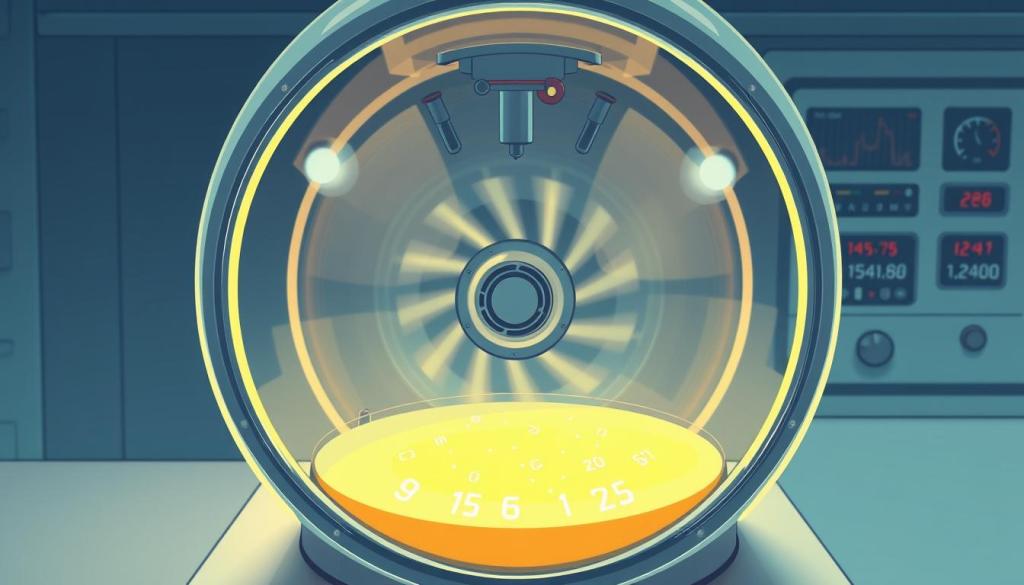
A centrifuge works by creating strong centrifugal force. This force speeds up the natural separation of particles. By spinning samples fast, centrifuges make forces hundreds to thousands of times stronger than Earth’s gravity.
The Principle of Centrifugation
Centrifugation is based on a key scientific idea: particles with different densities separate when spun. The process involves:
- Spinning samples at speeds up to 26,000 RPM
- Creating strong centrifugal acceleration
- Enabling precise particle separation
Types of Motion in Centrifuges
Centrifuges use different motions for the best separation:
| Motion Type | Characteristics | Typical Application |
|---|---|---|
| Fixed-Angle Rotation | Tubes held at constant angle | Clinical diagnostics |
| Swinging-Bucket Rotation | Tubes swing outward during rotation | Research laboratories |
| Vertical Rotation | Tubes aligned vertically | High-speed separations |
“The magic of centrifugation lies in its ability to separate what nature keeps combined.” – Scientific Research Quarterly
Knowing about sedimentation rate and density differences is key for using centrifuges well. Scientists can adjust speed and sample mix for precise separations in many fields.
Applications of Centrifuges in Laboratories
Centrifuges are key in today’s science labs. They help prepare samples for research in many fields. These machines separate substances with great accuracy, crucial for chemistry and biology studies.
Separating Substances in Chemistry
In chemistry labs, centrifuges help sort out complex mixes. Scientists use them to:
- Isolate solids from liquids
- Get specific compounds
- Split liquids that can mix but have different weights
- Study big molecules
“Centrifugation transforms complex mixtures into precisely separated components.” – Scientific Research Quarterly
Use in Biological Research
Biological research relies a lot on centrifuges for preparing samples. They help researchers to:
- Clean up cell parts
- Get viruses
- Extract proteins
- Separate DNA and RNA
By using centrifuges, scientists can break down cells into their parts. This lets them study cell structures and how molecules work together.
Centrifuges are vital in forensic science and medical testing. They help scientists make new discoveries and understand many research areas.
Medical Applications of Centrifuges
Centrifuges are key in biomedical fields, changing how we do tests and research. They make it easier and more precise to work with biological samples.
Medical tests and research depend on centrifuges a lot. They help separate complex biological samples fast, which is crucial for healthcare today.
Blood Sample Separation
Blood analysis is a big use of centrifuges. The steps include:
- Collecting whole blood samples
- Applying specific rotational speeds
- Separating distinct blood components
- Isolating serum and plasma for further testing
Centrifugation lets doctors get the exact parts they need for tests. By spinning blood, red cells go to the bottom. This leaves plasma or serum for tests.
Use in Diagnostic Testing
“Centrifugation transforms complex biological samples into analyzable components, driving medical innovation.”
Diagnostic labs use centrifuges for many tests, like:
- Urine analysis
- Cerebrospinal fluid examination
- Microbiological pathogen isolation
- Protein and cellular research
Centrifuges help scientists find tiny particles for detailed research. By changing speeds and times, they improve test methods.
Industrial Uses of Centrifuges
Industrial centrifuges are key in today’s manufacturing and processing. They use the centrifugation process for complex separation tasks in many fields.
These machines are versatile and efficient in different settings. They quickly and accurately separate materials, making them crucial in production.
Wastewater Treatment Processes
Centrifuges are vital in wastewater management. They can purify water efficiently:
- Solid-liquid separation with up to 90% efficiency on a single pass
- Continuous processing of large water volumes
- Removal of suspended particles and contaminants
“Centrifuges transform wastewater treatment by enabling rapid, precise material separation” – Environmental Engineering Experts
Food Processing and Ingredient Separation
The food industry uses centrifuges to refine ingredients. They are used for:
- Cream separation from milk
- Juice clarification
- Oil extraction
- Protein concentration
High-speed disc stack centrifuges can separate materials over 70% efficiently. This ensures high-quality products and keeps production running smoothly.
Industrial centrifuges are built for continuous, large-scale use. They have advanced designs for better separation in various industries.
Types of Centrifuges
Centrifuges are key in scientific research, with various designs for different needs. Knowing the types helps researchers pick the right lab equipment for their work.
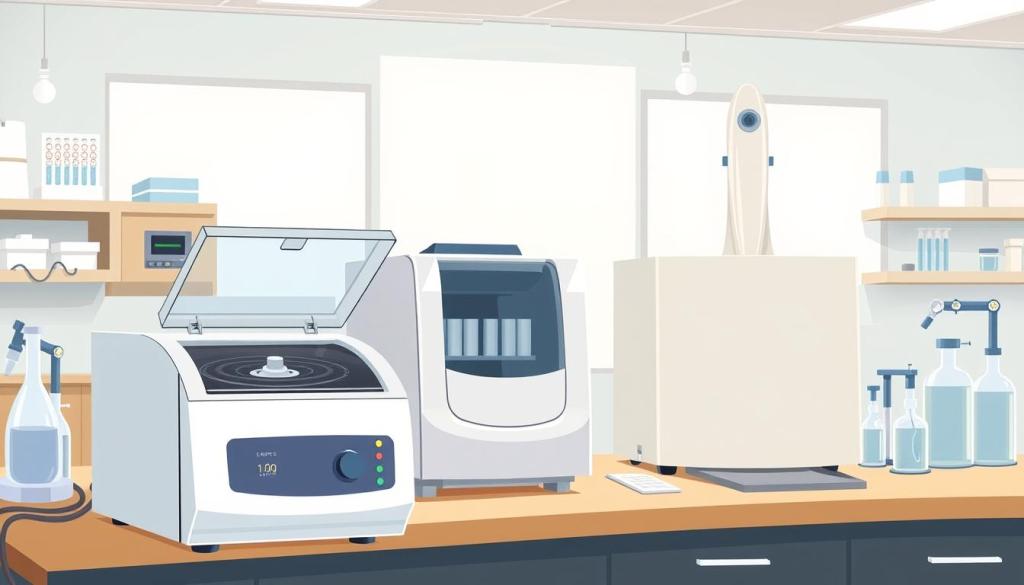
Scientists use different centrifuges to separate substances well. Each type has special abilities for different scientific fields.
Fixed-Angle Centrifuges
Fixed-angle centrifuges have rotors set at fixed angles. They are great for:
- Pelleting dense particles
- Rapid sample separation
- Consistent sedimentation processes
The relative centrifugal force in these devices ranges from 4,000 to 15,000 RPM. This makes them useful for many research areas.
Swinging-Bucket Centrifuges
Swinging-bucket centrifuges offer special benefits in sample processing:
- Accommodate larger sample volumes
- Enable gradient density separations
- Allow particles to settle horizontally during rotation
Swinging-bucket rotors excel at maintaining sample integrity during complex separations.
Microcentrifuges
Microcentrifuges are for very small samples, important in molecular biology and biochemistry. They are small but can spin up to 12,000-13,000 RPM. This allows for precise work with tiny samples.
Researchers choose centrifuges based on their specific needs. This ensures the best sample preparation and analysis in various fields.
Safety Considerations When Using Centrifuges
Using lab equipment like centrifuges needs careful safety steps. The process involves complex systems that can be dangerous if not used right. It’s key to follow safety rules to keep people safe and the equipment working well.
Lab workers must stick to detailed safety rules when using centrifuges. This helps avoid accidents and keeps the equipment in good shape.
Proper Operating Procedures
Here are important steps for using centrifuges safely:
- Carefully balance sample loads to prevent equipment imbalance
- Use tubes rated for specific speed and temperature requirements
- Inspect equipment before each use
- Wear appropriate personal protective equipment
Common Hazards and Mitigation Strategies
Centrifuges can have safety risks, but they can be managed:
| Potential Hazard | Mitigation Strategy |
|---|---|
| Mechanical Failure | Conduct regular maintenance and annual stress tests |
| Sample Spillage | Use sealed safety cups and compatible tube materials |
| Aerosol Generation | Wait 10 minutes after operation before opening lid |
Safety is crucial in labs where centrifuges are key for many scientific tasks.
Proper training and sticking to safety rules can stop up to 90% of centrifuge accidents.
Lab workers should always be careful, keep the equipment in good shape, and follow safety rules. This ensures safe and effective use of centrifuges.
Innovations in Centrifuge Technology
The world of centrifuge technology is changing fast. New designs, materials, and smart systems are leading the way. These advancements are making analytical methods and research better than ever.
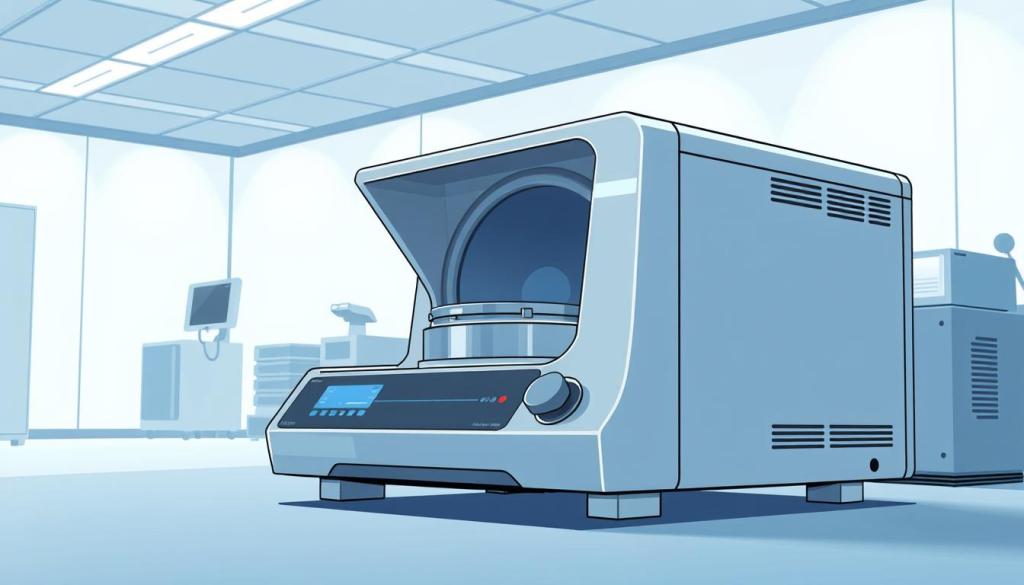
New features are making centrifuges more precise and efficient. This is a big deal for science.
Advancements in Design and Materials
Today’s centrifuges are made with strong materials. This is thanks to:
- Advanced aluminum alloys and titanium constructions
- Enhanced durability for high-speed applications
- Lightweight yet strong rotor designs
Automation and Smart Centrifugation
Digital tech has changed how centrifuges work. Now, we have:
- Touchscreen interfaces for easy control
- Automated adjustments
- Remote monitoring
*”The future of centrifuge technology lies in intelligent, adaptive systems that can optimize research processes with minimal human intervention.”*
| Feature | Performance Specification |
|---|---|
| Maximum Centrifugal Force | 32,531 xg |
| Cooling Speed | Target temperature in 4 minutes |
| Speed Precision | ±10 rpm |
| Temperature Control | ±1°C accuracy |
These new technologies are changing how we do research, medicine, and industry. They make things more automatic and precise. This is raising the bar in science.
Conclusion: The Importance of Centrifuges in Various Fields
Centrifuges are key tools in many scientific and industrial areas. They do more than just separate things. They play a big role in research, medical tests, and new technologies. These devices help us understand and analyze samples better than ever before.
Centrifuges are used in many ways. In labs, they help separate complex mixtures with great accuracy. They handle everything from blood to DNA. About 90% of advanced biological studies use centrifuges, showing how crucial they are in research.
Summary of Key Functions
Centrifuges can spin at speeds from 300 RPM to over 100,000 RPM. This makes them essential for scientific studies. The market for centrifuges is growing fast, thanks to more use in biotech and pharma. They help separate particles, purify samples, and support important research.
Future Trends in Centrifuge Applications
Centrifuge technology is getting better. We’re seeing smaller devices for quick tests, more automation, and working with new analytical methods. As scientists find new uses, like in space missions and medical research, centrifuges will keep leading the way in science.
FAQ
What is the primary function of a centrifuge?
A centrifuge is a device used in labs to separate substances by density. It spins samples fast, making heavier particles settle quicker. This helps in separating different parts in science and industry.
How does a centrifuge work?
Centrifuges spin samples at high speeds. This creates a force that separates particles by density and size. Denser substances move away from the center faster, making precise separation possible.
What are the main types of centrifuges?
There are mainly three types of centrifuges: fixed-angle, swinging-bucket, and microcentrifuges. Each is for different uses, like separating cells or handling small samples in biology.
Where are centrifuges commonly used?
Centrifuges are used in many fields. They help in medical tests, biological research, and in food and chemical labs. They’re also used in industrial settings for separating and purifying substances.
What safety precautions are important when using a centrifuge?
When using a centrifuge, balance your samples well. Wear protective gear and check the rotor. Avoid overloading and follow the maker’s instructions to prevent accidents.
How do medical professionals use centrifuges?
In medicine, centrifuges are key for testing and separating blood parts. They’re used for urine and cerebrospinal fluid tests, and for isolating pathogens.
What recent innovations exist in centrifuge technology?
New advancements include digital interfaces and smart systems. There are also high-speed rotors, touchscreen controls, and sensors for better separation.
Can centrifuges be used in food processing?
Yes, centrifuges are used in food processing. They separate cream from milk, clarify juices, and extract ingredients. This improves food quality and efficiency.
What determines the effectiveness of a centrifugation process?
The success of centrifugation depends on several things. These include speed, force, sample size, particle density, and rotor type. The substances being separated also play a role.
How have centrifuges evolved over time?
Centrifuges have changed a lot. From simple tools in the dairy industry to advanced scientific devices, they’ve evolved. Now, they have digital technologies and precise controls for various uses.





Leave a Comment
Your email address will not be published. Required fields are marked *