


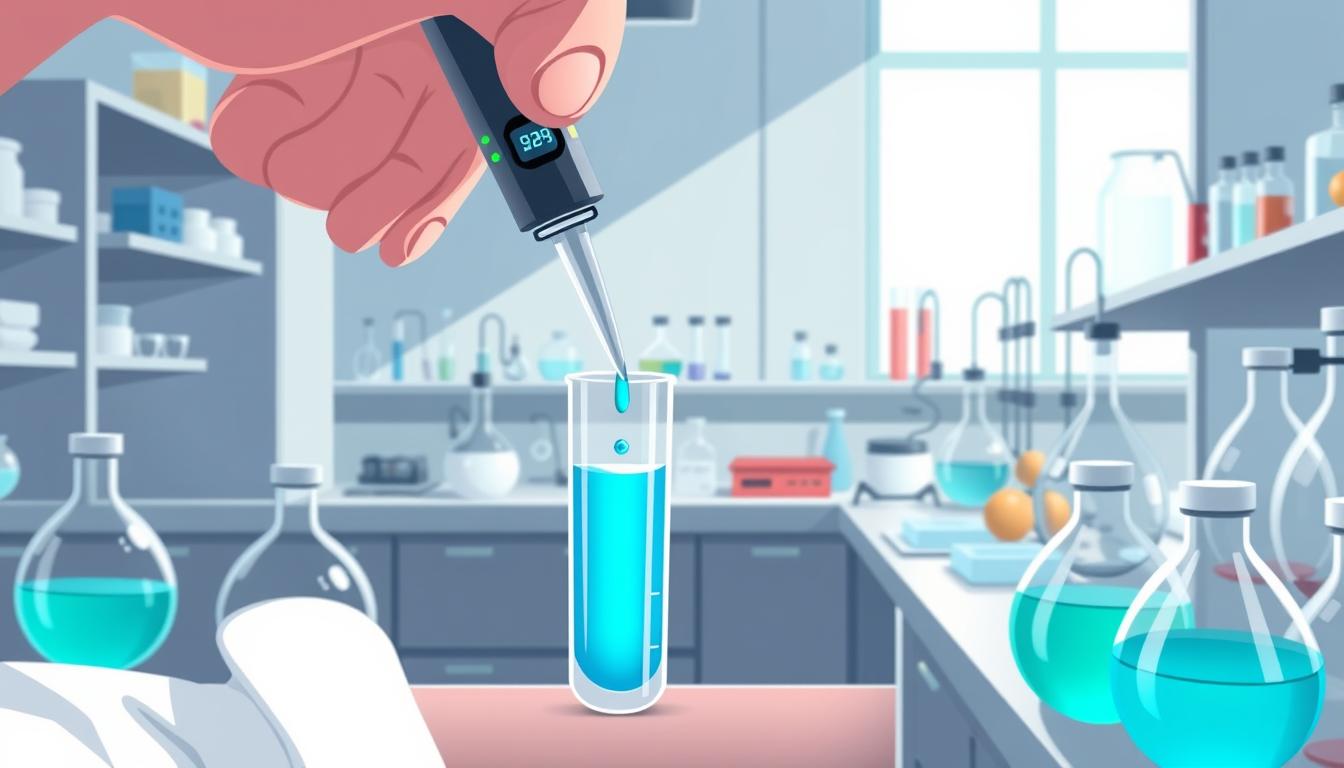
Ever wondered how scientists measure tiny liquid amounts with such precision? The secret lies in the pipette, a key tool that changes how we handle liquids in science.
Pipettes are essential lab tools for moving and measuring liquids with great accuracy. They help scientists work with tiny amounts of liquid in many fields. These tools are vital for precise work.
In schools and research labs, using pipettes is a must for scientists. Air displacement pipettes are the most popular, showing their importance in labs.
Today’s pipettes come with features like disposable tips to avoid contamination. They can measure liquids with almost perfect accuracy. This makes them crucial for keeping experiments reliable.
Key Takeaways
- Pipettes enable precise liquid measurement across scientific disciplines
- Accuracy is crucial in scientific research and experimentation
- Multiple pipette types exist for different laboratory needs
- Disposable tips help prevent sample contamination
- Proper pipette technique is essential for reliable results
Overview of Pipettes in Laboratory Settings
Liquid handling pipettes are key tools in science. They help measure and move small liquid amounts in labs. These tools are crucial for accurate and reliable results in experiments.
Science labs use various pipettes for different needs. Knowing about these types helps pick the right one for each experiment.
Definition of Pipettes
A pipette is a precise tool for measuring and moving liquids. It ranges from simple glass Pasteur pipettes to high-tech electronic ones.
Key Pipette Characteristics
- Measures from 0.1 μL to 10 mL
- Can be accurate up to 4 significant digits
- Available in single or multiple channel options
- Designed for specific research tasks
Types of Pipette Classifications
There are many pipette types for different lab needs:
- Manual Pipettes: Work with a thumb press
- Electronic Pipettes: Run on battery power
- Single-Channel Pipettes: Use one tip at a time
- Multi-Channel Pipettes: Handle multiple tips at once
“Precision in liquid handling is the cornerstone of scientific discovery.” – Laboratory Research Principles
Choosing the right pipette depends on several factors. These include the volume needed, how accurate it must be, and the experiment’s specifics. Fields like molecular biology and biochemistry greatly benefit from precise pipettes for consistent results.
The Importance of Accurate Liquid Handling
Scientific research needs precision, and liquid handling is key. Pipette accuracy is crucial for reliable results in many fields.
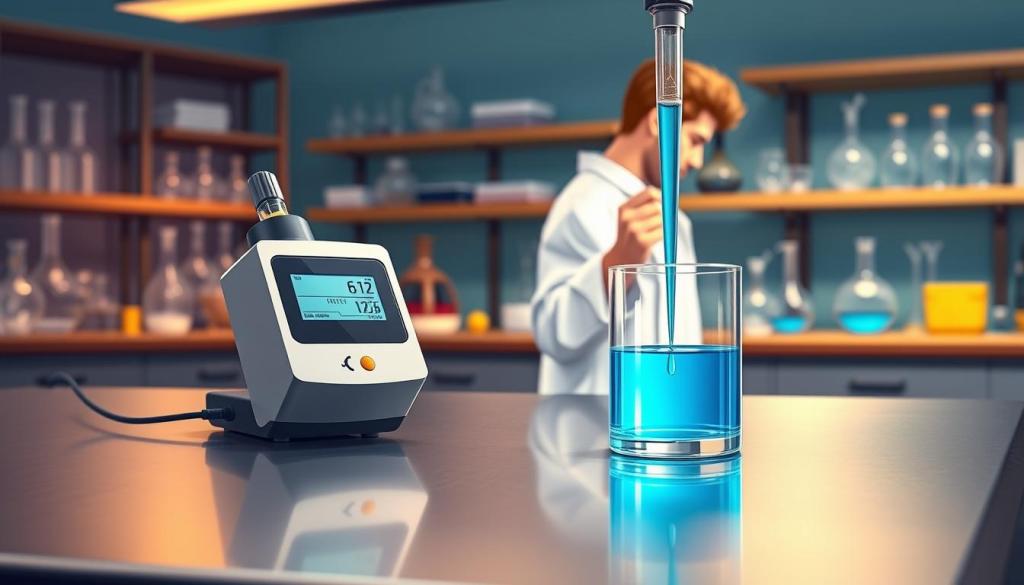
Labs use advanced tools for precise liquid transfers. Air displacement pipettes are main tools, handling liquids from 0.1 μl to 10 mL.
Role in Scientific Research
Pipette technique is vital for good science. Researchers must learn specific skills for accuracy:
- Consistent pipetting angle
- Proper tip selection
- Understanding liquid characteristics
- Minimizing user-induced variations
“Precision is the essence of scientific measurement” – Scientific Research Principles
Impact on Experiment Results
Accurate liquid handling affects experiment results. Small mistakes can ruin a whole project. So, pipette accuracy is very important.
Different pipettes tackle different challenges:
- Air displacement pipettes work best with water-like liquids
- Positive displacement pipettes handle complex substances
- Electronic pipettes reduce human error
Modern labs use automated systems for better results. These advances show the need for precision in science.
Key Components of a Pipette
Precision liquid handling starts with understanding the intricate design of pipettes. These essential laboratory instruments combine sophisticated engineering with remarkable accuracy. Each component plays a critical role in ensuring reliable scientific measurements.
Laboratory professionals rely on pipettes to transfer precise liquid volumes with exceptional accuracy. The first micropipette was patented in 1957, revolutionizing scientific research and measurement techniques.
Core Structural Elements
A typical pipette consists of several key components that work together seamlessly:
- Barrel: The main body housing internal mechanisms
- Plunger: Controls liquid aspiration and dispensing
- Tip attachment system
- Calibration mechanism
Volumetric Pipette Precision
Volumetric pipettes excel in delivering exceptional accuracy. These specialized instruments can achieve measurements up to 4 significant digits, making them crucial for high-precision research.
| Pipette Component | Function | Precision Range |
|---|---|---|
| Barrel | Liquid containment | 0.1 μL to 1000 μL |
| Plunger | Volume control | Manual force up to 3 cm |
| Tip | Liquid transfer | Disposable, prevents contamination |
Pipette Calibration Essentials
Proper pipette calibration is fundamental to maintaining measurement integrity. Experts recommend calibration intervals based on usage:
- Regular laboratory use: Every six months
- Drug/food industries: Quarterly
- Research applications: Monthly
- Educational settings: Annually
“Precision in liquid handling starts with understanding and maintaining your pipette’s critical components.”
The intricate design of pipettes ensures researchers can consistently and accurately transfer minute liquid volumes, supporting groundbreaking scientific discoveries.
Types of Pipettes and Their Functions
Laboratory professionals use different pipettes for precise liquid handling. Each type has unique features. This helps researchers pick the right tool for their experiments.

There are many pipette types for various scientific needs. Each one has its own benefits for specific tasks.
Manual Pipettes
Manual pipettes are the traditional choice. They’re used for tasks that need some precision. They have:
- Volume range from 1μL to 1000μL
- Single-channel design for individual sample transfers
- Cost-effective solution for basic liquid handling
Electronic Pipettes
Electronic pipettes use advanced technology. They reduce user fatigue and improve accuracy. Their key features are:
- Ability to measure volumes as small as 0.1μL
- Digital volume control
- Reduced physical strain during repetitive tasks
Multichannel Pipettes
Multichannel pipettes are great for high-throughput research. They allow for simultaneous liquid transfers. They’re efficient in complex setups.
| Pipette Type | Volume Range | Primary Applications |
|---|---|---|
| Manual Pipettes | 1-1000μL | Standard laboratory procedures |
| Electronic Pipettes | 0.1-1000μL | Precision research, complex experiments |
| Multichannel Pipettes | 10-300μL | High-throughput screening |
“Selecting the right pipette is crucial for maintaining experimental integrity and achieving reproducible results.” – Laboratory Research Quarterly
Choosing the right pipette is key for good research. Consider the sample volume, experiment complexity, and precision needed.
How to Use a Pipette Effectively
Mastering pipette technique is key for accurate scientific research. Lab professionals need precise liquid handling for reliable results. Knowing how to use a pipette well can greatly improve scientific work quality.
Proper pipette handling needs attention to detail and practice. Scientists must follow a systematic approach to avoid errors and keep experiments reliable.
Step-by-Step Pipetting Instructions
- Select the right pipette for your needs
- Check the pipette is calibrated
- Choose the correct pipette tip size
- Set the volume you need precisely
- Attach the pipette tip securely
- Hold the pipette vertically while taking liquid
- Immerse the tip just below the liquid surface
- Release the plunger smoothly and consistently
Common Pipetting Mistakes to Avoid
- Inconsistent plunger pressure
- Incorrect tip immersion depth
- Failing to pre-rinse tips for viscous liquids
- Using damaged or contaminated tips
- Ignoring ergonomic techniques
Approximately 75% of pipetting errors come from bad technique, showing how crucial careful practice is.
Getting good at pipette technique takes ongoing training and careful practice. Lab professionals should focus on consistent practice and attention to detail.
| Technique | Accuracy Impact |
|---|---|
| Proper Tip Selection | Reduces volume errors by 10-20% |
| Consistent Plunger Movement | Improves measurement precision |
| Pre-rinsing Tips | Enhances volume uniformity |
Precision in pipette usage is not just a skill—it’s a critical scientific discipline that separates successful experiments from unreliable research.
Calibration and Maintenance of Pipettes
Precision in scientific research depends on the right care of lab equipment. Pipette calibration and maintenance are key to getting accurate results.
Keeping pipettes in good shape is crucial. It protects samples and keeps equipment working well. Scientists must follow strict protocols to ensure the best results.
Importance of Regular Calibration
Calibrating pipettes is vital for accurate measurements. Experts say to calibrate them regularly to avoid mistakes:
- Calibrate every six months for often-used pipettes
- Do a full check after big experiments
- Use standard weights to check accuracy
“Precision is the heart of scientific measurement” – Laboratory Quality Management Principle
Best Practices for Pipette Maintenance
Good pipette care involves several important steps:
- Clean them well after each use
- Keep them upright to avoid contamination
- Use the right cleaning method for each sample
In molecular biology, 100% contamination prevention is essential. Certain cleaning methods are used:
- UV radiation cleaning (300 nm for 15 minutes)
- Ultrasonic bath cleaning at 50°C for 20 minutes
- Chemical cleaning for special samples
Lab experts should do the cleaning. This keeps pipettes accurate and prevents leaks or damage.
Safety Considerations When Using Pipettes
Laboratory safety is crucial when using pipettes. Researchers must follow key safety rules to protect themselves and ensure accurate results. It’s more than just how you handle the pipette.
Chemists used to use mouth pipetting, which is now seen as a big health risk. Today, labs focus on safety to avoid risks when handling liquids.
Personal Protective Equipment (PPE)
Using pipettes right means wearing the right gear:
- Safety goggles to protect eyes from splashes
- Disposable gloves
- Protective lab coat
- Closed-toe shoes
Handling Hazardous Liquids
Working with dangerous liquids needs strict safety rules:
- Work in a safe area
- Wear chemical-resistant gloves
- Check if the pipette tip fits
- Dispose of waste correctly
| Risk Factor | Potential Consequence | Prevention Strategy |
|---|---|---|
| Broken Pipette | Potential Glass Cuts | Regular Equipment Inspection |
| Overfilled Pipette | Chemical Spillage | Careful Volume Management |
| Repetitive Motion | Potential Strain Injury | Ergonomic Technique |
Most pipetting problems come from bad technique or not keeping equipment in good shape. It’s key to focus on pipette safety and use the right pipette technique all the time.
“Safety in the laboratory is not an option, but a necessity.” – Laboratory Safety Experts
Regular breaks, keeping equipment in good shape, and ongoing training can greatly lower the risks of using pipettes in labs.
Pipettes vs. Other Liquid Handling Tools
Laboratory scientists use many tools for handling liquids, but pipettes are key. They are precise instruments. Knowing the differences between pipettes and other tools helps scientists choose the right one for their work.
Comparative Analysis of Liquid Handling Methods
Pipettes have big advantages over old ways of moving liquids. They are precise and versatile, making them crucial in science.
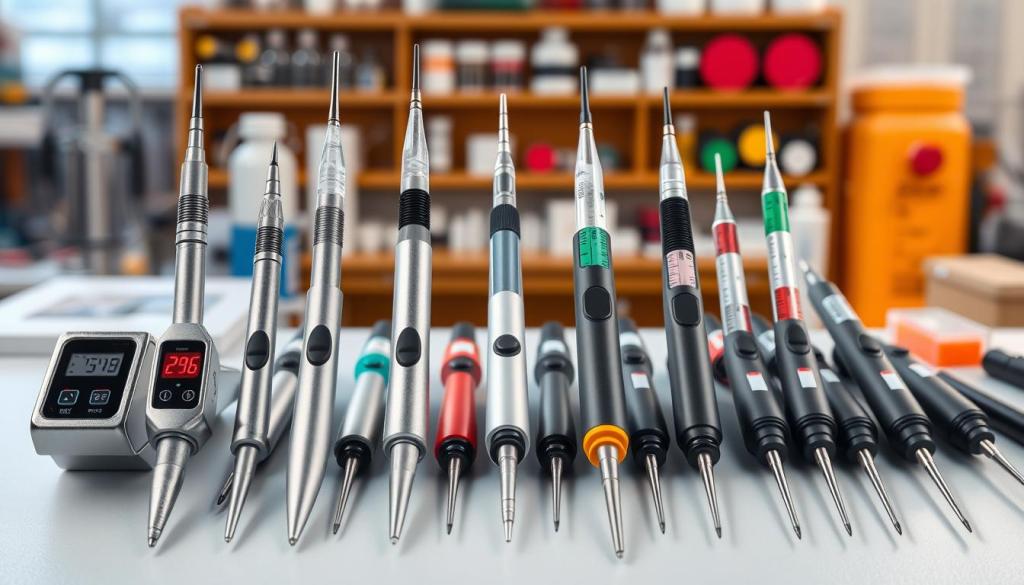
Pipettes vs. Syringes
Pipettes outperform syringes in several ways:
- They are more accurate with volume
- They reduce the risk of contamination
- They make measuring easier
- They are less tiring for repetitive tasks
Advantages Over Droppers
Scientists choose pipettes for their high precision. Droppers can’t match the precision of modern pipettes.
| Feature | Pipettes | Droppers |
|---|---|---|
| Volume Precision | High (0.1-1000 μL) | Low (Approximate) |
| Calibration | Precise | Minimal |
| Repeatability | Excellent | Poor |
“Precision is the hallmark of scientific excellence.” – Research Laboratory Standard
Today’s pipettes give scientists unmatched control. They are the top choice for accurate volume transfer and measurement.
Innovations in Pipette Technology
The world of pipette technology is changing fast. It’s bringing new tools that make science better. Now, scientists and lab workers have tools that are more precise and efficient.
Design Breakthroughs in Modern Pipettes
New pipettes focus on two big things: how they feel and how they work. Today’s pipettes are designed to be easy on your hands. They also have cool electronic features.
- Ergonomic handles reducing user strain
- Lightweight materials minimizing fatigue
- Advanced electronic volume control
- Programmable protocol settings
Future Trends in Liquid Handling
New tech is changing how pipettes work. Automated systems are coming. They promise to make science even more precise and reliable.
| Technology | Key Benefits |
|---|---|
| Automated Dispensing | Increased precision, reduced human error |
| Cloud-Connected Systems | Enhanced data management, workflow integration |
| Miniaturized Reaction Platforms | Reduced sample volumes, improved efficiency |
“The future of laboratory research lies in intelligent, interconnected liquid handling technologies.”
Science labs are entering a new era. Pipettes are getting smarter and more user-friendly. These changes will make science more accurate and easier to manage.
Conclusion: The Role of Pipettes in Advancing Science
Pipettes have changed science by making it possible to handle liquids with great precision. Since 1961, scientists have been able to measure and move tiny amounts of liquid with high accuracy. This has greatly improved their work.
Pipettes are key to making sure labs work well. They have moved from simple glass tools to advanced electronic ones. This change has cut down on mistakes. Now, scientists use these tools for very precise work, like in genomic research and environmental studies.
Summary of Key Points
Today’s pipetting methods have made science better. They help find tiny contaminants and do complex genomic studies with great precision. Being able to handle tiny amounts accurately is crucial for big scientific discoveries.
Encouraging Best Practices
Lab workers should keep pipettes in good shape, calibrate them often, and use them correctly. Knowing how important accurate liquid handling is helps scientists avoid mistakes. This leads to better research results. Pipette technology keeps getting better, helping scientists discover more.
FAQ
What is the primary function of a pipette in a laboratory?
A pipette is a tool for measuring and moving small amounts of liquid. It’s key for precise work in labs. This includes research and medical tests.
How do I choose the right type of pipette for my research?
Choosing the right pipette depends on several things. Look at the volume you need, the liquid type, and how precise you need it. Manual micropipettes work for most lab tasks. Electronic ones are more accurate and easier on your hands. Multichannel pipettes are best for handling lots of samples at once.
How often should I calibrate my pipette?
Pipettes need regular checks to stay accurate. Most makers say to calibrate once a year. But, if you use it a lot or in tough conditions, you might need to do it more often. Calibrating yearly keeps your results reliable.
What are the most common mistakes when using a pipette?
Some common mistakes include uneven pressure, wrong tip depth, not rinsing tips, and not holding it straight. These errors can mess up your results.
How can I improve my pipetting technique?
To get better, practice steady pressure and the right tip attachment. Keep the right angle and depth. Move smoothly. Training and knowing the right way are key for good results.
What safety precautions should I take when using pipettes?
Wear gloves and lab coats for safety. Use careful technique to avoid spills. Work in a well-ventilated area. Dispose of tips safely. Good technique also prevents injuries.
What is the difference between manual and electronic pipettes?
Manual pipettes need you to do the work. Electronic ones use motors and can remember settings. They’re more precise and easier on your hands.
How do I maintain my pipette to ensure its longevity?
Keep your pipette clean and store it right. Avoid extreme temperatures and use the right tips. Get it serviced yearly. Don’t drop it and use gentle pressure.
Can pipettes be used with different types of liquids?
Pipettes work with many liquids, but be careful with harsh or thick ones. Some need special tips or settings. Always follow the maker’s advice and use safety gear.
What recent innovations have improved pipette technology?
New pipettes are more comfortable to use and have cool features. They might connect to your phone or lab systems. They’re more accurate and easier to use, thanks to new materials and designs.






Leave a Comment
Your email address will not be published. Required fields are marked *