


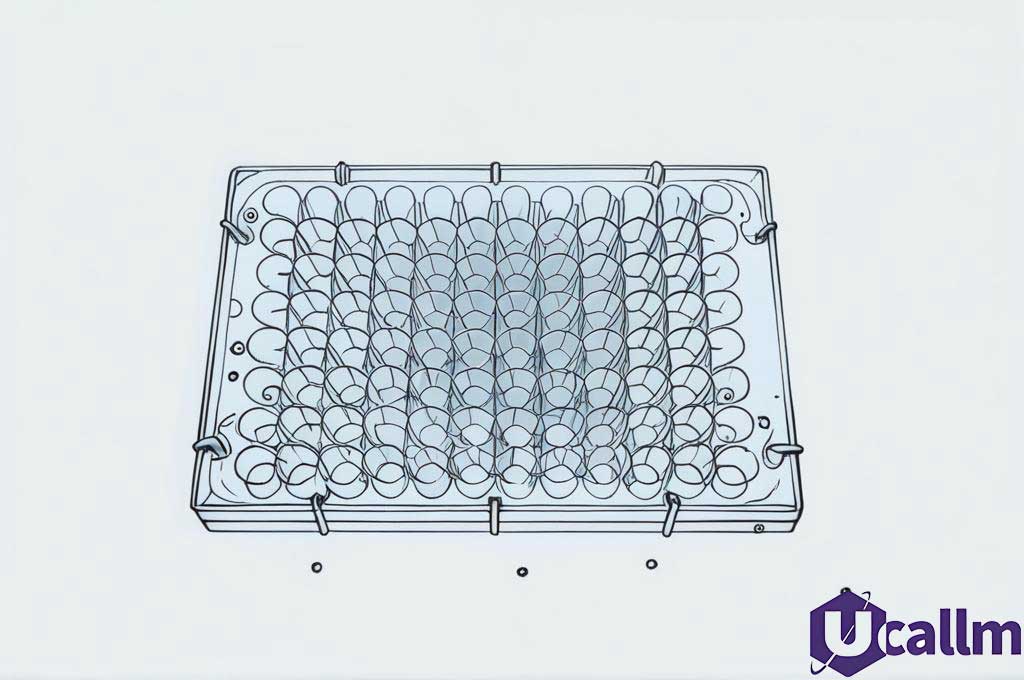
Ever thought about how a small microplate can change science? The 96-well plate is key in labs, leading to big discoveries. It uses precise microplate dimensions for this.
The 96-well plate has a surface area of 0.32 cm² per well. It’s small but mighty for science. It’s used for many things like testing cells and doing complex biology tests.
Scientists pick these plates for their exact sizes. This ensures their results are always the same. The 96-well plate has 8 rows and 12 columns. It lets scientists test many things at once.
Key Takeaways
- Standard 96-well plate surface area is exactly 0.32 cm² per well
- Designed with 8 rows and 12 columns for maximum experimental flexibility
- Critical for high-throughput screening in biological research
- Enables simultaneous testing of multiple samples
- Standardized dimensions ensure consistent experimental results
Understanding 96-Well Plates
96-well plates are key tools in biomedical research. They offer a standard way to do many experiments at once. This makes research more precise and efficient in many fields.
These plates are designed for high-throughput screening. They let scientists test many samples at once. This saves materials and time.
Defining the 96-Well Plate
A 96-well plate is a rectangular plate with 96 wells in an 8×12 grid. Each well has:
- Surface area of 0.32 cm² per well
- Can hold about 0.04 x 10⁶ cells
- Standard volume of around 200 µL
Applications in Biotechnology
These plates are vital in many research areas, especially in high-throughput screening. They are used for:
- Cell culture experiments
- Enzyme-linked immunosorbent assays (ELISA)
- Molecular biology research
- Drug discovery processes
The standard design of 96-well plates works well with automated lab tools. This boosts research speed and accuracy.
Physical Characteristics of 96-Well Plates
Researchers in biological sciences use 96-well plates for precise experiments. The design of these plates is key to their success. Knowing the details helps scientists improve their research.
Detailed Well Dimensions
A standard 96-well plate has specific features. These include:
- Standard well diameter: About 6.4 mm
- Well depth: Between 10-15 mm
- Total surface area per well: Approximately 0.32 cm²
Surface Area Calculation
To find the total surface area of a 96-well plate, multiply the area of one well by 96. This gives about 30.72 cm². This is important for cell culture and enzyme assays.
The Society for Biomolecular Screening set standards in 1998. This ensures all plates are the same. This makes it easier to compare results and keep experiments consistent.
Practical Implications
The design of 96-well plates affects many things. This includes:
- How cells grow and multiply
- How much reagent is needed
- How big the experiment can be
- How accurate the data is
Scientists need to think about these factors when choosing 96-well plates. This helps them get the best results for their research.
Importance of Surface Area in Experiments
Knowing the 96 well plate surface area per well is key for good biological research. The surface affects how experiments turn out, especially in cell culture and assay optimization.
Researchers need to think about how surface area affects cells and results. The standard 96-well plate is a vital tool for detailed scientific studies.
Effects on Cell Growth and Viability
Cell growth relies a lot on the well surface area. Important points include:
- Surface area of 0.32 cm² per well supports about 0.01 x 10⁶ cells
- Right surface area helps cells stick well
- Different cells need specific surface conditions
Implications for Assay Development
Optimizing assays needs careful attention to surface area. Researchers must look at many factors to make experiments reliable.
| Well Geometry | Surface Area (mm²) | Cell Suspension Volume (μl) |
|---|---|---|
| Flat Wells | 94.6 | 100 |
| Round Wells | 85.5 | 117 |
| V-Shaped Wells | 76.2 | 123 |
The well geometry chosen affects cell behavior, how reagents mix, and the experiment’s accuracy. Choosing the right surface area is crucial for successful assay development.
Material Composition of 96-Well Plates
Choosing the right material for 96-well plates is key in science. The material affects the results, especially in cell studies and screening tests. It’s important to think about the surface and shape of the wells when picking a material.
Typical Materials in Microplate Manufacturing
The material used in making 96-well plates shapes the plate’s size and well design. Common materials include:
- Polystyrene
- Polypropylene
- Glass
- Cyclic olefin copolymer (COC)
Surface Properties and Material Characteristics
Each material has its own surface traits that affect the results:
| Material | Key Characteristics | Typical Application |
|---|---|---|
| Polystyrene | Excellent cell adhesion | Cell culture |
| Polypropylene | Low protein binding | Molecular biology |
| Glass | Superior optical clarity | Fluorescence imaging |
The surface treatment can change a material’s traits, like how well it holds onto cells. Scientists can pick treated plates to get better results and improve the well’s performance.
Factors Influencing Material Selection
Scientists look at several things when picking a 96-well plate material:
- What the experiment needs
- If the cells work well with it
- If it’s clear for viewing
- If it can handle heat and chemicals
Knowing the differences in materials helps scientists pick the best one for their research.
Types of 96-Well Plates
Researchers in biological sciences use various 96-well plate configurations for their work. These microplates have changed a lot since 1955. Now, they help with high-throughput screening in many fields.
96-well plates come in different types, each with its own benefits. Scientists pick the right plate for their needs. This choice affects how well the experiment works.
Standard vs. Specialized Plate Configurations
Plate types have special features that matter for research:
- Flat-bottom plates: Great for cell cultures that stick to the plate
- U-bottom plates: Best for cells that don’t stick
- V-bottom plates: Good for collecting and spinning samples
- Treated surface plates: Help cells grow better
Microplate Variations and Applications
Each microplate design is made for certain screening methods. Researchers can pick plates with special coatings or optical features. These improve how well the experiment works.
With over 700 types of microplates from 26 vendors, scientists have lots of choices. They can find the perfect plate for their experiments.
Applications in Biochemistry and Molecular Biology
The 96-well plate has changed how we do research in biochemistry and molecular biology. It gives scientists a powerful tool for detailed studies. These plates help with precise tests in many areas, thanks to their standard size.
High-Throughput Screening Techniques
High-throughput screening (HTS) uses 96-well plates to speed up finding new things. Scientists can test many things at once, making their work more efficient. The plates’ size of 84 cm² per well is perfect for:
- Rapid genetic library screening
- Pharmaceutical compound testing
- Cell-based assay development
Enzyme-Linked Immunosorbent Assay (ELISA) Applications
ELISA techniques get a big boost from 96-well plates. The plates’ uniform size means results are always the same. This helps scientists make their tests more accurate by choosing the right plate surface.
| Research Domain | Key Application | Significance |
|---|---|---|
| Immunology | Antibody Detection | High precision screening |
| Molecular Biology | Protein Interaction | Comprehensive analysis |
| Pharmaceutical Research | Drug Screening | Rapid compound evaluation |
The 96-well plate’s flexibility keeps pushing the limits of biochemical research. It gives scientists a solid base for tackling complex questions.
Considerations for Choosing a 96-Well Plate
Choosing the right 96-well plate is key for good results. Researchers need to look at many to get the best results for their work.
The shape and size of the wells are very important. Scientists must think about what they need for their research when picking a plate.
Compatibility with Various Assays
Each research method needs its own special plate. Important things to think about include:
- What cells need to grow
- The specific steps of the test
- How sensitive the test is
Importance of Surface Treatments
How the plate’s surface is treated can change the results. Microplate dimensions and surface treatments work together. They affect how cells grow and the results of the test.
| Surface Treatment | Typical Application | Cell Interaction |
|---|---|---|
| Tissue Culture Treated | Adherent Cell Culture | Enhanced Cell Attachment |
| Poly-D-Lysine Coated | Neuronal Research | Improved Neuronal Adhesion |
| Non-Treated | Suspension Cells | Minimal Surface Interaction |
Knowing about well geometry helps pick the best plate. The standard area of 0.32 cm² per well is good for many cell types and test sizes.
Maintenance and Handling of 96-Well Plates
Keeping 96-well plates in good condition is key for reliable results. Scientists must follow certain steps to keep these tools working well.
Sterilization Best Practices
There are several ways to sterilize 96-well plates for cell culture and research. Important methods include:
- Gamma irradiation
- UV light exposure
- Autoclave treatment
- Chemical disinfection
Each method changes the plate’s surface in different ways. It’s important to pick one that keeps the surface area right and prevents germs.
Storage Recommendations
Storing plates right is key for keeping them in top shape. Here’s what to do:
- Keep plates in sealed, clean packaging
- Store at a steady temperature (20-25°C)
- Keep them away from direct sunlight
- Avoid too much humidity and extreme temperatures
Handling plates with care helps avoid damage. Good storage keeps them clean and working well.
Volume Management Considerations
Knowing how much liquid each well can hold is vital. Most 96-well plates can hold 0.1 to 0.2 mL per well. Scientists need to manage this carefully for accurate results.
Analyzing Data from 96-Well Plates
High-throughput screening needs precise data analysis. It uses the standard 96 well plate surface area. Researchers use advanced methods to find important insights from complex data.
Understanding 96-well plate experiments is key. The same surface area in each well helps develop strong analysis strategies. This makes experiments more reliable.
Methods for Data Interpretation
Good data analysis involves several steps:
- Normalization techniques to adjust for well variations
- Statistical analyses that consider surface area limits
- Quality control metrics for checking experiment validity
Software Tools for Analysis
Modern high-throughput screening uses advanced software. These tools make complex analysis easier. They give researchers detailed insights.
| Software Tool | Key Features | Best For |
|---|---|---|
| GraphPad Prism | Advanced statistical analysis | Biological research |
| MATLAB | Complex mathematical modeling | Engineering applications |
| Gen5 Microplate Reader Software | Direct plate data integration | High-throughput screening |
Researchers must pick the right analysis tools. They need to match their specific needs. This ensures accurate results from 96-well plate experiments.
Innovations in 96-Well Plate Technology
The world of scientific research is always changing. New advances in microplate dimensions and assay optimization are leading the way. Now, scientists have access to top-notch 96-well plate technologies. These technologies are changing how we explore biology.
Advanced Surface Coatings
Today’s 96-well plates have special surface coatings. These coatings are made to make experiments better. They include:
- Specialized polymer modifications
- Biomimetic surface treatments
- Enhanced cell adhesion properties
- Improved protein binding capabilities
These surface coatings let scientists create perfect environments for cells. Microplate dimensions stay the same, but the coatings make experiments much better.
Automation Integration Solutions
The newest 96-well plates work well with advanced automation systems. These systems help with fast screening and make research easier.
| Automation Feature | Research Impact |
|---|---|
| Robotic Liquid Handling | Enhanced precision and reproducibility |
| High-Content Imaging | Comprehensive cellular analysis |
| Automated Cell Tracking | Improved experimental efficiency |
These new technologies help scientists do better assay optimization. They help in many scientific fields.
Future Trends in 96-Well Plate Usage
The world of biological research is changing fast. 96-well plates are becoming key tools for deep scientific study. They help researchers do more in one experiment than ever before.
These plates are getting smarter, allowing for more detailed research. They’re helping scientists study complex topics in new ways.
Personalized medicine is a big area where 96-well plates are making a difference. They help create cell cultures and test drugs for each patient. The plates’ design makes it easy to grow cells and test treatments.
Emerging Applications in Biomedical Research
New designs in plates are changing what scientists can do. Microfluidic and 3D-printable plates are making experiments more detailed. They let scientists study cells in ways that were impossible before.
This means scientists can learn more about diseases and find new treatments. It’s a big step forward in understanding and treating illnesses.
Technological Innovations on the Horizon
The future of 96-well plates is bright. New technologies are making them even better. They’re getting special coatings and can sense things better.
These advancements will help scientists learn more about life and find new treatments. 96-well plates will be at the heart of these discoveries.
References and further readings:
Xu, Q., & Zhang, J. (2022). Surface area effects on 96-well plate based assays for nanomaterial studies. Materials Science and Engineering C, 115, 111060.
https://www.sciencedirect.com/science/article/pii/S0928493120310882?via%3Dihub
FAQ
What is the standard surface area per well in a 96-well plate?
A 96-well plate has a standard surface area of 0.32 cm² per well. This area is key for standardizing experiments in biology, high-throughput screening, and cell culture.
What are the primary uses of 96-well plates in biotechnology?
96-well plates are used in many areas like high-throughput screening, cell culture, and drug discovery. They are also used in ELISA and molecular biology. They offer a way to run many experiments at once with precise control over volume and area.
What materials are typically used to manufacture 96-well plates?
Polystyrene, polypropylene, and glass are common materials for 96-well plates. Each has its own benefits, like how well cells stick, how clear it is, and how resistant it is to chemicals. This makes them good for different research needs.
How do surface treatments affect 96-well plate performance?
Treatments like tissue culture-treated or hydrophobic modifications can change how cells grow and stick. These treatments help meet specific research needs and make experiments more reliable.
What are the different types of 96-well plate bottom geometries?
There are flat bottom, round bottom, and V-bottom 96-well plates. Each design is best for different uses, like cell culture or protein crystallization. The shape affects how much liquid a well can hold and how well an experiment works.
How should 96-well plates be sterilized and stored?
Plates are usually sterilized by autoclaving or UV light. To keep them in good shape, store them in a clean, dry place away from sunlight and extreme temperatures.
What innovations are emerging in 96-well plate technology?
New things include better surface coatings and working with robots. There’s also high-content imaging and microfluidic tech. These aim to make assays better, increase speed, and improve data quality in research.
How do researchers choose the right 96-well plate for their experiment?
Choosing the right plate means looking at surface treatment, material, shape, and how it works with assays. It’s important to match the plate to the experiment for the best results.
What are the future trends in 96-well plate applications?
Future uses include personalized medicine and drug screening. There’s also talk of 3D-printed plates and microfluidic integration. These could make 96-well plates even more useful.
How important is understanding the surface area per well in experimental design?
Knowing the 0.32 cm² surface area per well is key for many things. It helps with cell seeding, controlling volumes, and making experiments reliable. This is important for high-throughput screening and understanding data in biology.
Leo Bios
Hello, I’m Leo Bios. As an assistant lecturer, I teach cellular and
molecular biology to undergraduates at a regional US Midwest university. I started as a research tech in
a biotech startup over a decade ago, working on molecular diagnostic tools. This practical experience
fuels my teaching and writing, keeping me engaged in biology’s evolution.





Leave a Comment
Your email address will not be published. Required fields are marked *