



Ever thought about how scientists separate tiny particles with great care? They use a device called a centrifuge. It makes complex tasks simple by just spinning things around.
Centrifuges are key for separating mixtures based on their density and size. They work by spinning things fast. This helps experts quickly find specific parts they need.
Centrifugation is more than just spinning. It’s a precise method used in many fields, like medicine and making drugs. It lets researchers get important samples with high accuracy.
Key Takeaways
- Centrifuges use rotational force to separate mixtures based on density
- Separation techniques can range from 300 g to 1 million g
- Modern centrifuges offer digital controls and advanced safety features
- Applications span research, medical, and industrial sectors
- Precision and speed are critical in effective centrifugation
Understanding the Centrifuge: Definition and Functionality
Centrifuges are key in science and industry for separating things. Since 1864, they’ve changed how we separate complex mixtures with great accuracy.
The process uses physics to separate particles by density and molecular size. This method helps scientists isolate substances very efficiently.
What is a Centrifuge?
A centrifuge is a device that spins liquids to separate particles. It uses strong forces to move particles based on their weight and density.
- Separates mixtures based on particle density
- Generates forces significantly stronger than gravity
- Utilizes rotational speeds ranging from 3,000 to 1,000,000 g
How Does a Centrifuge Work?
It works by spinning samples fast, creating a force that pushes heavier particles out. This method separates different molecular weights with precision.
| Centrifuge Type | Speed Range (g-force) | Typical Applications |
|---|---|---|
| Bench Centrifuge | 3,000 – 7,000 | Basic sample preparation |
| High-Speed Centrifuge | 60,000 | Molecular biology research |
| Ultracentrifuge | 1,000,000 | Subcellular component isolation |
“Centrifuges transform scientific inquiry by enabling unprecedented microscopic separation techniques.” – Scientific Research Quarterly
Today’s centrifuges use advanced tech for precise separation. They’re crucial in many scientific and industrial fields.
Types of Centrifuges: An Overview
Centrifuges are a wide range of scientific tools. They use speed and force to separate substances. Each type is made for different needs in science and industry.
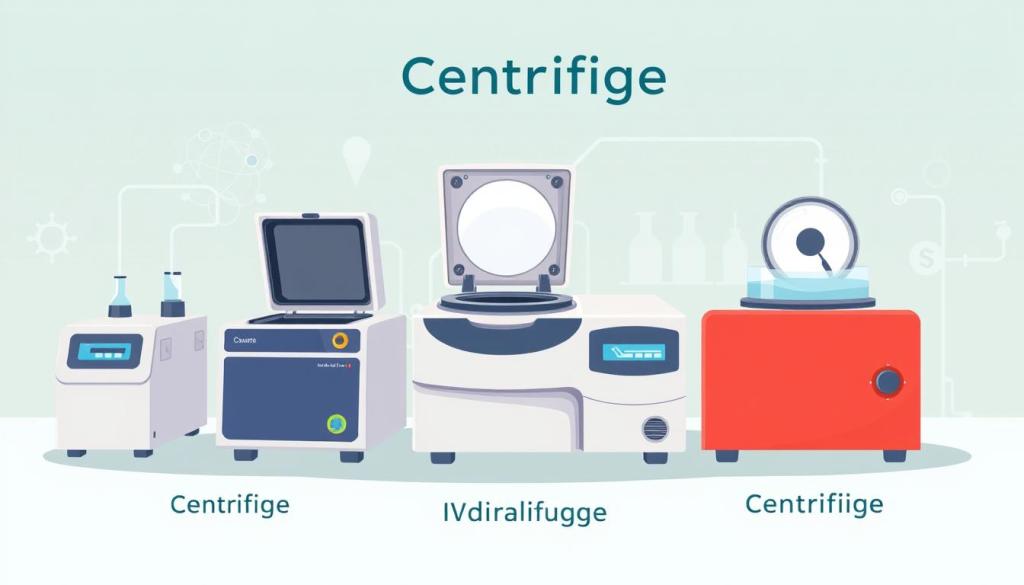
There are many kinds of centrifuges, each with its own features and uses:
Laboratory Centrifuges
Laboratory centrifuges are small but strong. They are used in research and testing. Most can go up to 14,000 RPM and create a force of 18,624.
- Benchtop models for general research
- Microcentrifuges for small sample processing
- Ultra-low temperature centrifuges
Industrial Centrifuges
Industrial centrifuges are big and strong. They handle a lot of material with great efficiency. They use advanced techniques for separation.
| Centrifuge Type | Speed Range (RPM) | Primary Application |
|---|---|---|
| Continuous Flow | 3,000-6,000 | Manufacturing Processes |
| Batch Centrifuges | 4,000-10,000 | Chemical Processing |
Clinical Centrifuges
Clinical centrifuges are key in medical tests. Models like hematocrit centrifuges can go up to 11,000 RPM. This helps in quick and accurate sample separation.
“Precision is the hallmark of clinical centrifugation” – Medical Laboratory Professionals Association
Special Purpose Centrifuges
These machines are for special research and needs. Ultracentrifuges, for example, can spin over 20,000 RPM. They are crucial for advanced scientific studies.
- Ultracentrifuges for molecular research
- Gas centrifuges for isotope separation
- High-speed refrigerated models
Applications of Centrifuges in Various Industries
Centrifuges are key scientific tools in many fields. They help purify biomolecules and separate complex materials. This makes them vital in research, production, and analysis.
Centrifuges can separate materials based on density. This makes them essential in many professional areas.
Research and Development
In research labs, centrifuges are crucial. Scientists use them for:
- DNA extraction techniques
- Protein purification methods
- Cell isolation procedures
- Molecular biology research
Pharmaceutical Production
The pharmaceutical industry heavily relies on centrifuges. They are used for:
- Separating complex molecular compounds
- Purifying pharmaceutical ingredients
- Ensuring product consistency
- Validating drug formulations
Food and Beverage Industry
Centrifuges are vital in food processing. They help purify biomolecules and separate components. Key uses include:
- Milk fat separation
- Juice clarification
- Oil extraction processes
- Wine and beer production
“Centrifuges transform complex mixtures into refined, high-quality products across industries.” – Industrial Engineering Quarterly
| Industry | Primary Centrifuge Application | Key Benefit |
|---|---|---|
| Research | Molecular Isolation | Precise Separation |
| Pharmaceuticals | Drug Compound Purification | Quality Control |
| Food Processing | Component Separation | Product Refinement |
Modern centrifuges keep getting better. They offer advanced separation techniques. This drives innovation in many sectors.
The Science Behind Centrifugation
Centrifugation is a key scientific method. It uses centrifugal force to sort particles by density and size. This technique is vital in many fields, helping to separate particles with great precision.

Centrifugation works by creating strong gravitational forces. Scientists adjust several factors to improve this process:
- Rotational speed
- Rotor radius
- Particle characteristics
Understanding Centripetal Force Dynamics
When an object spins around a center, centrifugal force pushes particles outward. The force grows faster as the spin speed increases. Doubling the spin speed can quadruple the force applied.
“Centrifugation transforms gravitational limitations by creating powerful artificial gravitational environments.”
Speed and Radius: Critical Separation Factors
Two main factors affect how well particles settle: the spin speed and the rotor size. Bigger rotors and faster spins mean better separation. Modern centrifuges can spin up to 150,000 rpm, leading to very precise results.
| Centrifuge Type | Speed Range (rpm) | Typical Application |
|---|---|---|
| Microcentrifuge | 14,000 – 30,000 | Laboratory Research |
| Ultracentrifuge | 100,000 – 150,000 | Advanced Molecular Separation |
By grasping these complex scientific concepts, researchers can fine-tune centrifugation. This ensures accurate and reliable separation of particles in various scientific fields.
Key Components of a Centrifuge
A centrifuge is a complex machine with several critical components. These parts work together to perform the centrifugation process. Understanding these elements helps researchers and professionals optimize their work.
Rotors: The Heart of Centrifugation
Rotors are key in the centrifugation process. They come in different designs to meet various research needs:
- Fixed-angle rotors: Hold tubes at specific angles (14-40°)
- Swinging-bucket rotors: Allow tubes to move during rotational speed changes
- Vertical rotors: Ideal for specific sample processing techniques
Buckets and Tubes: Sample Containment
Precise sample containment is crucial for effective centrifugation. Different tube sizes and materials meet various research needs:
- Microcentrifuge tubes: Capacity up to 2.0 ml
- Specialized centrifuge tubes: Designed for specific sample types
- Material variations: Glass, plastic, and specialized polymers
Control Systems: Precision and Safety
Modern centrifuges have advanced digital control systems. These systems manage critical parameters:
- Rotational speed control: Ranges from 4,000 to 30,000 RPM
- Temperature regulation: From -40°C to ambient temperatures
- Safety mechanisms: Imbalance detection and automatic shut-off
“The precision of a centrifuge’s control system determines the quality of scientific and industrial separations.”
These sophisticated components work together. They ensure accurate and efficient sample processing in various scientific and industrial applications.
Safety Measures in Centrifuge Operations
Working with centrifuges requires top-notch safety. Knowing the risks and following safety steps can avoid accidents. This keeps researchers safe from dangers linked to centrifugal forces and speed.
Common Hazards to Recognize
Centrifuge use comes with big safety challenges. OSHA says most accidents happen because of user. This shows how key training and knowing the risks are.
- Mechanical failure due to rotor imbalance
- Sample spillage risks
- Potential aerosol generation
- Equipment stress from excessive rotational speed
Essential Safety Practices
Good safety steps can lower risks in centrifuge use. It’s crucial for researchers to prepare samples well and follow the maker’s rules.
- Always balance samples within 0.1 grams
- Use appropriate personal protective equipment
- Inspect equipment before each use
- Follow recommended rotational speed limits
“Prevention is always better than cure in laboratory settings.”
Today’s centrifuges have cool safety features like automatic lid locks and imbalance detection. These techs help lessen risks from centrifugal forces and unexpected breakdowns.
Maintenance and Troubleshooting of Centrifuges
Keeping centrifuges in top shape is key for their best performance and life span. The process of centrifugation needs precise mechanical work. Regular care is vital for steady results. Ignoring maintenance can cause big problems and expensive fixes.
Having a solid maintenance plan can make centrifuges more reliable. Studies show that regular upkeep can:
- Lower the chance of equipment failure by 30-50%
- Make centrifuges last 25% longer
- Reduce downtime by up to 80%
- Save on repair costs by 10-20%
Regular Maintenance Procedures
Keeping centrifuges in good shape involves several important steps. It’s crucial to keep the rotational speed right and fix mechanical problems fast. Key steps include:
- Cleaning the rotor and parts every day
- Doing a full check-up once a week
- Examining critical parts closely every month
- Getting a professional check-up once a year
Identifying Common Issues
Spotting problems early can stop big damage to your centrifuge. Issues that need quick action include:
| Issue Type | Occurrence Rate | Potential Consequences |
|---|---|---|
| Vibration | 30% of cases | Unbalanced rotors, bearing wear |
| Overheating | 15% of issues | Blocked air vents |
| Speed Inconsistencies | 40% efficiency impact | Separation process disruption |
| Leakage | 10-15% of problems | Seal and gasket failures |
“Prevention is always more cost-effective than repair in centrifuge operations.”
By sticking to a maintenance plan and watching for speed issues, labs can boost centrifuge performance and dependability.
Choosing the Right Centrifuge for Your Needs
Choosing the right centrifuge is important for scientific and industrial research. The right tools can greatly improve your results and make your work more efficient.

When looking at centrifuges, there are key things to think about. These include how well it performs and how reliable it is. Knowing what you need for your research is crucial for making the best choice.
Essential Factors to Consider
- Sample volume and type
- Required centrifugal force range
- Speed specifications
- Temperature control needs
- Rotor compatibility
Performance and Cost Analysis
Finding a balance between cost and performance is important. Modern centrifuge technologies offer many options for different research needs.
| Centrifuge Type | Speed Range (RPM) | Temperature Range | Typical Application |
|---|---|---|---|
| Microcentrifuge | 10,000 – 16,000 | -10°C to 40°C | Small sample volumes |
| Refrigerated Centrifuge | 5,000 – 15,000 | -20°C to -40°C | Biological samples |
| Ultracentrifuge | 50,000 – 100,000 | Variable | Advanced research |
“Invest in a centrifuge that not only meets current needs but provides flexibility for future research expansion.”
The best centrifuge has many features. It should have precise control, safety, and fit your specific needs. Look at warranties, noise levels, and extra features to make the best choice.
Key Purchasing Recommendations
- Assess your specific research requirements
- Compare manufacturer specifications
- Consider long-term maintenance costs
- Review safety features
- Validate warranty and support options
By carefully looking at these points, you can find a centrifuge that improves your work. It will help you with your scientific research.
Innovations in Centrifuge Technology
The world of centrifuge technology is changing fast. This change is bringing big improvements in how we purify biomolecules. New research and development are making these machines do more than ever before.
Emerging Technologies in Centrifugation
Today’s centrifuge innovations focus on key areas:
- Advanced control systems with easy-to-use touchscreens
- Remote operation options
- IoT for constant monitoring
- Automated logging and analysis
Future Trends in Centrifugation
The future of centrifuge technology looks bright. We can expect big changes in how we purify biomolecules. Some trends include:
- Smaller, more energy-saving designs
- AI to optimize separation methods
- Better rotor materials for better performance
- Easy connection with lab automation systems
“The next generation of centrifuges will revolutionize scientific research and industrial processing through unprecedented precision and efficiency.” – Bioengineering Research Institute
| Technology Feature | Performance Impact |
|---|---|
| AI-Driven Control Systems | Increased separation accuracy |
| IoT Monitoring | Real-time performance tracking |
| Advanced Rotor Materials | Reduced wear, enhanced durability |
| Automated Protocols | Improved reproducibility |
These new technologies will change the game in research, medicine, and industry. They promise unmatched precision and efficiency in biomolecule purification.
Centrifuges in Medical Laboratories
Medical labs use centrifuges to improve their diagnostic tools. These machines are key for separating biological samples. They do this by using precise techniques to settle particles.
Centrifuges help scientists and doctors study complex biological materials. They create density gradients to separate parts with high accuracy. This makes it fast and easy to process different samples.
Sample Preparation Techniques
Medical labs use special centrifuges for many tasks:
- Blood component separation
- Microorganism concentration
- Cellular component isolation
- Plasma and serum extraction
Importance in Diagnostics
Centrifuges are crucial for diagnostics. They make it possible to:
- Analyze blood chemistry accurately
- Test urine precisely
- Do advanced molecular diagnostics
- Quickly spot cell problems
“Centrifugation transforms complex biological samples into analyzable components with unparalleled efficiency.” – Laboratory Research Institute
Clinical centrifuges are built to meet strict medical standards. They ensure reliable separation for various tests.
Environmental Impact of Centrifuge Use
Laboratories and industries are now looking at the environmental effects of centrifuges. Big centrifuges running all day use a lot of energy. This has led to the creation of greener options. Research in centrifuge technology is showing big steps forward in saving energy and cutting down waste.
New centrifuges have designs that help the planet. For example, Thermo Scientificâ„¢ Eco-Spinâ„¢ rotors can save up to 64% of energy compared to old models. They also have features that save energy when not in use and make separation more efficient.
It’s not just about saving energy. Centrifuges are also being made with eco-friendly packaging. This packaging uses over 75% recycled materials and is biodegradable. The use of safe refrigerants and smart cooling systems shows a big effort to lower carbon emissions.
Today, labs and industries are choosing to be green. By picking energy-saving centrifuges, they can cut down on their environmental impact. This doesn’t mean they have to sacrifice performance in their work.
FAQ
What exactly is a centrifuge?
A centrifuge is a device that uses spinning to separate mixtures. It spins samples at high speeds. This creates a force greater than gravity, helping particles separate by density and size.
How does a centrifuge work?
Centrifuges spin samples around a fixed axis at high speeds. This generates a force that pushes particles outward. Heavier particles settle at the bottom, while lighter ones stay near the top.
What are the main types of centrifuges?
There are many types of centrifuges. These include laboratory, industrial, clinical, and special purpose centrifuges like ultracentrifuges. Each type is designed for specific uses and has unique features.
Where are centrifuges commonly used?
Centrifuges are used in many fields. These include scientific research, pharmaceutical development, medical diagnostics, food and beverage production, and biotechnology. They are key for tasks like DNA extraction and blood separation.
What safety precautions are necessary when using a centrifuge?
Important safety steps include balancing samples and using the right rotors and tubes. Wear protective gear and follow manufacturer guidelines. Regular maintenance is also crucial. Modern centrifuges have safety features like lid locks and imbalance detection.
How do I choose the right centrifuge?
Choosing a centrifuge depends on several factors. Consider the types of samples, required speed, volume, and frequency of use. Also, think about temperature control needs and budget. Look at both current and future needs.
What is the difference between RPM and RCF?
RPM measures the rotation speed. RCF or g-force shows the actual force on the sample. The relationship between RPM and RCF depends on the rotor’s radius.
How do environmental factors impact centrifuge use?
Centrifuges can consume a lot of energy and generate waste. Modern makers are making more energy-efficient models. They also focus on sustainable practices, like design improvements and recycling.
What recent innovations exist in centrifuge technology?
New innovations include digital control systems, touchscreen interfaces, and remote operation. There’s also IoT integration and AI for optimizing separation. These advancements aim to improve efficiency, user-friendliness, and safety.
How important is centrifuge maintenance?
Regular maintenance is key for performance and longevity. Clean rotors, check for wear, and lubricate parts. Address any unusual noises or vibrations. Keeping a maintenance log and following manufacturer guidelines can prevent issues.






Leave a Comment
Your email address will not be published. Required fields are marked *