


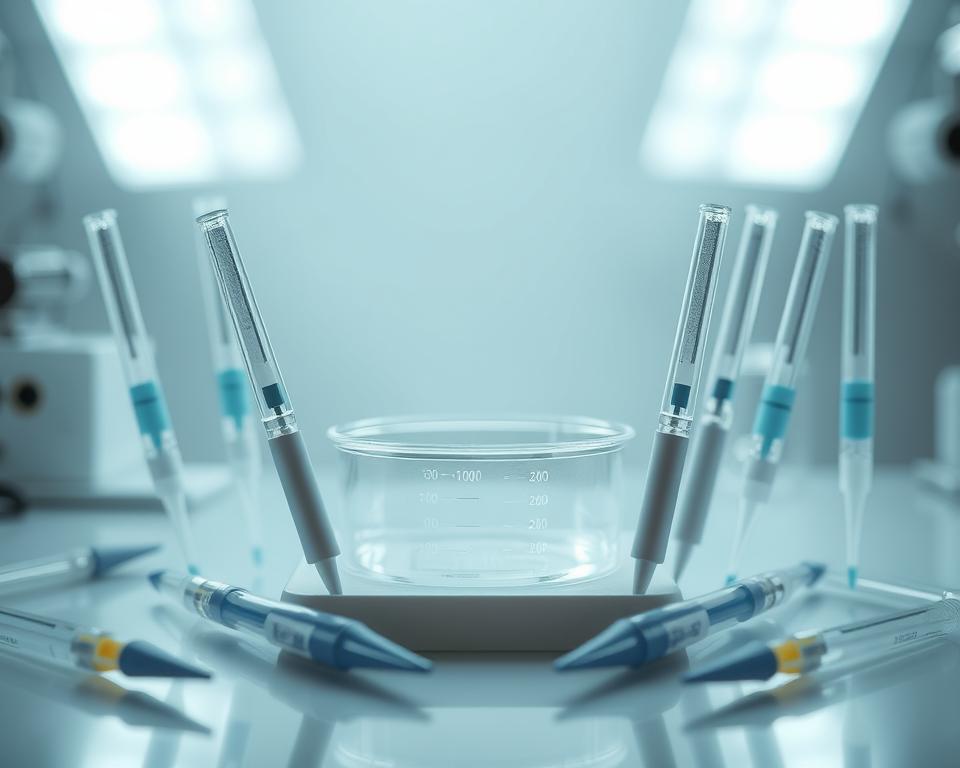
The title highlights the importance of matching cell culture dishes with pipettes and sealing films for the best lab results. It’s crucial to know that these components must work well together. The right match helps in keeping experiments consistent and improving research outcomes.
Choosing the right cell culture dish, pipettes, and sealing films is key. It ensures that experiments are reliable and can be repeated. This is essential for making progress in lab research.
Key Takeaways
- Compatibility among cell culture dishes, pipettes, and sealing films is vital for experimental success.
- Proper matching ensures reproducibility in laboratory results.
- Understanding the materials and types of equipment enhances research effectiveness.
- Optimal lab results can lead to significant advancements in scientific inquiry.
- Selection of appropriate equipment directly impacts the efficiency of cell culture practices.
Understanding Cell Culture Dishes: An Overview
Cell culture dishes are key in lab research. They come in many types to fit different needs. Knowing about their materials, sizes, and formats helps pick the best for your work.
Types of Cell Culture Dishes
We group cell culture dishes into a few categories:
- Tissue culture dishes
- Cell culture plates
- Cell culture flasks
Each type has its own use in research. They differ in size, volume, and whether they support cells that stick or float.
Material Composition
The material of cell culture dishes matters a lot. Common ones are:
- Polystyrene for basic dishes
- Polycarbonate for toughness
- Glass for clear view and heat safety
Picking the right material helps cells grow well and stick right, matching your research needs.
Sizes and Formats
Dishes come in many sizes and shapes for various research needs:
| Type | Size | Format |
|---|---|---|
| Tissue Culture Dishes | 35 mm, 60 mm, 100 mm | Single and multi-well |
| Cell Culture Plates | 6-well, 12-well, 24-well | Flat, multi-well |
| Cell Culture Flasks | 125 mL, 250 mL, 500 mL | vented and non-vented |
Importance of Proper Equipment Matching
Proper equipment matching is key in lab work, especially in cell culture. Making sure cell culture dishes, pipettes, and sealing films match improves both the quality of results and the cost of research.
Effects on Experimental Results
The right equipment choice is crucial for accurate and reliable results. If equipment doesn’t match, problems like contamination and sample damage can happen. This means researchers can keep their experiments safe and get trustworthy data.
This data is vital for further research or product development. It helps scientists make new discoveries and improve existing ones.
Cost-Effectiveness
Choosing the right equipment saves time and money in the long run. When equipment fits well, resources are used wisely, cutting down on waste and errors. This approach helps keep research costs low and encourages new ideas in experiments.
Matching Cell Culture Dishes with Pipettes
It’s important to match cell culture dishes with the right pipettes for good results. Different lab tasks need specific pipette sizes and techniques. This helps avoid contamination and damage to cells.
Compatible Pipette Volumes
Choosing the right pipette volume is key for cell culture dishes. Pipettes come in sizes from 10 µL to 1 mL. This depends on the dish’s size and type.
Small volumes are best for micro-well plates. Larger volumes work well for cell culture flasks. Using the right volume helps keep cells healthy and intact.
Pipetting Techniques for Different Dishes
Using the right pipetting techniques is crucial for cell culture success. Here are some tips:
- For small volumes: Use a single-channel pipette with a low retention tip for precision.
- For larger volumes: Multi-channel pipettes are efficient for moving media between dishes.
- Ensuring consistent technique: Keep the pipette at a vertical angle for smooth flow and less air bubbles.
Selection of Sealing Films
Choosing the right sealing films is key to better cell culture experiments. Different films offer benefits for various research goals. Knowing these options helps researchers make the best choices for their work.
Types of Sealing Films Available
Researchers have many sealing film types to choose from. Each is made for different lab needs. The main types are:
- Breathable sealing films: Allow gas exchange while keeping out contaminants.
- Foil sealing films: Reduce evaporation, great for long studies.
Both can be easily pierced by pipette tips. This makes it simple to access samples while keeping conditions right.
How Sealing Films Affect Cell Culture
The type of sealing film used greatly affects cell culture. Good sealing controls humidity and gas levels, vital for cell health. For example, breathable films help with gas exchange for aerobic cells. Foil films keep liquids stable, perfect for delicate studies.
Common Applications for Cell Culture Dishes
Cell culture dishes are key in many scientific fields. They help in lab research, making medicines, and in medical studies. Their ability to control environments makes them essential for scientists and experts.
Laboratory Research
In labs, cell culture dishes are used for many things. They help study how cells act under different situations. This lets researchers test drugs and study cells closely.
Leo Bios
Hello, I’m Leo Bios. As an assistant lecturer, I teach cellular and molecular biology to undergraduates at a regional US Midwest university. I started as a research tech in a biotech startup over a decade ago, working on molecular diagnostic tools. This practical experience fuels my teaching and writing, keeping me engaged in biology’s evolution.
By changing conditions, scientists can see how cells react. This knowledge is crucial for moving science forward.
Biomanufacturing
Biomanufacturing uses cell culture dishes to make things like vaccines and enzymes. These dishes help make production bigger and keep cells healthy. They let makers watch how cells grow and adjust conditions to get better results.
This precision helps make high-quality products in the biomanufacturing field.
Clinical Applications
Cell culture dishes also play a big part in medical research. They help in making new treatments and understanding diseases better. Doctors can study cells from patients to find new ways to help them.
This research leads to treatments that work better for each person. It opens doors to new ways to heal.
Analyzing User Needs in Cell Culture
Understanding what users need in cell culture is key. This involves looking at user needs to build effective lab practices. With a basic understanding of terms and concepts, users can handle cell culture’s complexities confidently.
Basic Cognition and Terminology
Knowing the basics is essential for cell culture work. Terms like “adherent” and “suspension” cultures are crucial. They affect how you do your work and what you get out of it. Knowing these terms helps plan and do experiments better, making research more efficient.
Application Scenarios
Every lab setting has its own needs for cell culture. Looking at these needs helps set up workflows and pick the right tools. For instance, biomanufacturing focuses on large-scale processes, while clinical labs need strict cleanliness. Knowing these differences helps choose the right approach for each goal.
Industry Standards for Cell Culture Equipment
Knowing the importance of industry standards in cell culture equipment is key. It ensures top performance and follows established norms. Regulatory guidelines help keep labs safe and quality high during cell culture work. Understanding these standards helps labs stay at the top of their game.
Regulatory Guidelines
Following specific rules is essential for lab standards. Groups like ISO and GLP set safety rules for cell culture equipment. These rules check the quality of equipment and the results of experiments. For more on these practices, check out this resource.
Best Practices
Using the best cell culture techniques makes experiments reliable and repeatable. It’s important to use sterile pipettes and keep areas clean with laminar flow hoods. Also, make sure all equipment and surfaces are properly sterilized. Following these tips reduces contamination risks and meets industry standards, leading to successful cell culture.
Comparison of Brands and Products
Choosing the right cell culture dishes is crucial for your research. Knowing the differences between brands can greatly affect your results. By comparing brands, you can find the best fit for your needs.
Popular Brands in Cell Culture Dishes
Many manufacturers are known for their reliable products. Here’s a look at three top brands, their strengths, and what they offer:
| Brand | Key Features | Common Applications | Pricing |
|---|---|---|---|
| Corning | High-quality tissue culture treated surfaces | Cell growth and expansion | $ |
| Greiner Bio-One | Innovative design for optimal gas exchange | Long-term cell cultures | $$ |
| Thermo Fisher | Clear vision for microscopic observation | Applications in research and diagnostics | $$$ |
Evaluating Quality and Performance
When evaluating cell culture dishes, consider a few key factors:
- The consistency of product dimensions
- Surface treatment technologies
- Supplier reputation and certifications
- Feedback from the scientific community
Looking into these areas helps you make a smart choice. It ensures you get the right dishes for your research.
Case Studies: Successful Cell Culture Practices
Many case studies show how good cell culture practices help science move forward. They show that the right tools, like cell culture dishes and pipettes, make experiments better. This makes labs work more smoothly and improves research.
Research Implementations
Choosing the right equipment is key in cell culture research. Studies prove that the right tools can greatly improve results. For example, using special dishes and pipettes can make cells grow better.
Innovations and Findings
New ideas in lab work are changing cell culture. Researchers are using new materials and designs to make discoveries. These changes are making old ways of growing cells better and more reliable.
Expert Insights on Setting Up Cell Cultures
Setting up cell cultures well needs a deep understanding of the best practices. This section will share valuable insights from industry leaders and look at future trends. Knowing this is key to making your lab more efficient and ensuring your experiments are reliable.
Recommendations from Industry Leaders
Experts say getting thorough training is crucial for cell culture setup. You must know the needs of the cell type and the equipment. Also, validating your methods regularly is vital for keeping research honest.
Keeping your protocols up to date with the latest advice is important. It helps get the best results and avoids mistakes in your experiments.
Future Trends in Cell Culture Techniques
The world of cell culture is changing fast, with new trends that will improve techniques. Some of these trends include:
- Automation and Robotics: Using machines makes the process more accurate and efficient.
- 3D Cell Cultures: Moving to 3D models helps better mimic real-life conditions.
- Bioprinting: New bioprinting tech allows for precise cell placement, improving tissue engineering.
- Smart Sensors: Sensors for real-time monitoring help control the culture environment better.
Using these insights will make your cell culture setup better. It will also put you ahead in scientific innovation.

| Trend | Description | Impact on Research |
|---|---|---|
| Automation and Robotics | Use of machines to conduct repetitive tasks in cell culture. | Increases precision and consistency in sample handling. |
| 3D Cell Cultures | Techniques allowing cells to grow in three dimensions. | Better mimicry of natural biological systems. |
| Bioprinting | Additive manufacturing techniques for cell placement. | Enhances tissue engineering potential and applications. |
| Smart Sensors | Technologies that monitor cell culture conditions in real time. | Enables timely adjustments for optimal growth conditions. |
Conclusion: Optimizing Your Cell Culture Setup
Optimizing your cell culture setup means choosing the right dishes, pipettes, and sealing films. It’s important to know if they work well together. This ensures your lab results are reliable and consistent.
Following industry standards and being careful with your choices can improve your research. This way, you can get better results in studying cells.
Key Takeaways
When setting up your cell culture, focus on matching your equipment. This makes your work better and more consistent. Making smart choices about your lab supplies is key to getting good data.
By paying attention to these details, you can do better in your scientific work. This leads to better results in your research.
FAQ
What types of cell culture dishes are available?
There are many types of cell culture dishes. These include tissue culture dishes, cell culture plates, and cell culture flasks. Each has its own purpose in research. They vary in size, volume, and what kind of culture they support.
How does the matching of cell culture dishes with pipettes and sealing films affect experimental outcomes?
Matching dishes with pipettes and sealing films is key. If they don’t match, it can cause problems. This can lead to contamination and damage to samples, affecting the results.
References and further readings:
1.Kim, S. Y., Kim, J. H., & Park, S. H. (2020). Optimization of Pipetting Techniques for Precise Cell Seeding in Cell Culture Dishes. Journal of Laboratory Automation, 25(5), 487 – 494.2.Li, X., Wang, Y., & Zhang, Y. (2021). Selection and Application of Sealing Films in Cell Culture: A Comprehensive Review. Cell Culture and Biotechnology, 12(3), 156 – 165.
3.Smith, J. A., Johnson, L. M., & Brown, R. E. (2019). Considerations for Pairing Pipettes and Cell Culture Dishes in High – Throughput Cell – Based Assays. Assay and Drug Development Technologies, 17(6), 455 – 463.
What pipette volume ranges are recommended for different cell culture dishes?
Pipettes should match the dish size. They range from 10 µL to 1 mL. Choosing the right one helps protect the cells.
What types of sealing films are commonly used in cell culture?
There are breathable and foil sealing films. Breathable ones let gases pass through, while foil ones stop evaporation. The right choice depends on the experiment’s needs.
What are the common applications for cell culture dishes?
Cell culture dishes are used in many areas. They are key in research, biomanufacturing, and clinical tests. They help study how cells react in controlled settings.
Why is understanding basic terminology important in cell culture?
Knowing basic terms is essential. It helps in understanding the differences between types of cultures. This knowledge is crucial for working effectively in cell culture.
What are the regulatory guidelines relevant to cell culture work?
Following industry standards is important. This includes ISO and GLP guidelines. They ensure safety and quality in cell culture work.
Which brands are recognized for their quality in cell culture dishes?
Top brands include Corning, Greiner Bio-One, and Thermo Fisher. They offer high-quality labware for various research needs.
Can you provide examples of recent advancements in cell culture techniques?
Recent studies show great progress. Using the right dish and pipette combinations has led to breakthroughs. These have been in fields like oncology and regenerative medicine.
What recommendations do industry experts give regarding laboratory equipment?
Experts stress the need for training and validation. They say this improves research integrity and success in cell culture.




Leave a Comment
Your email address will not be published. Required fields are marked *