


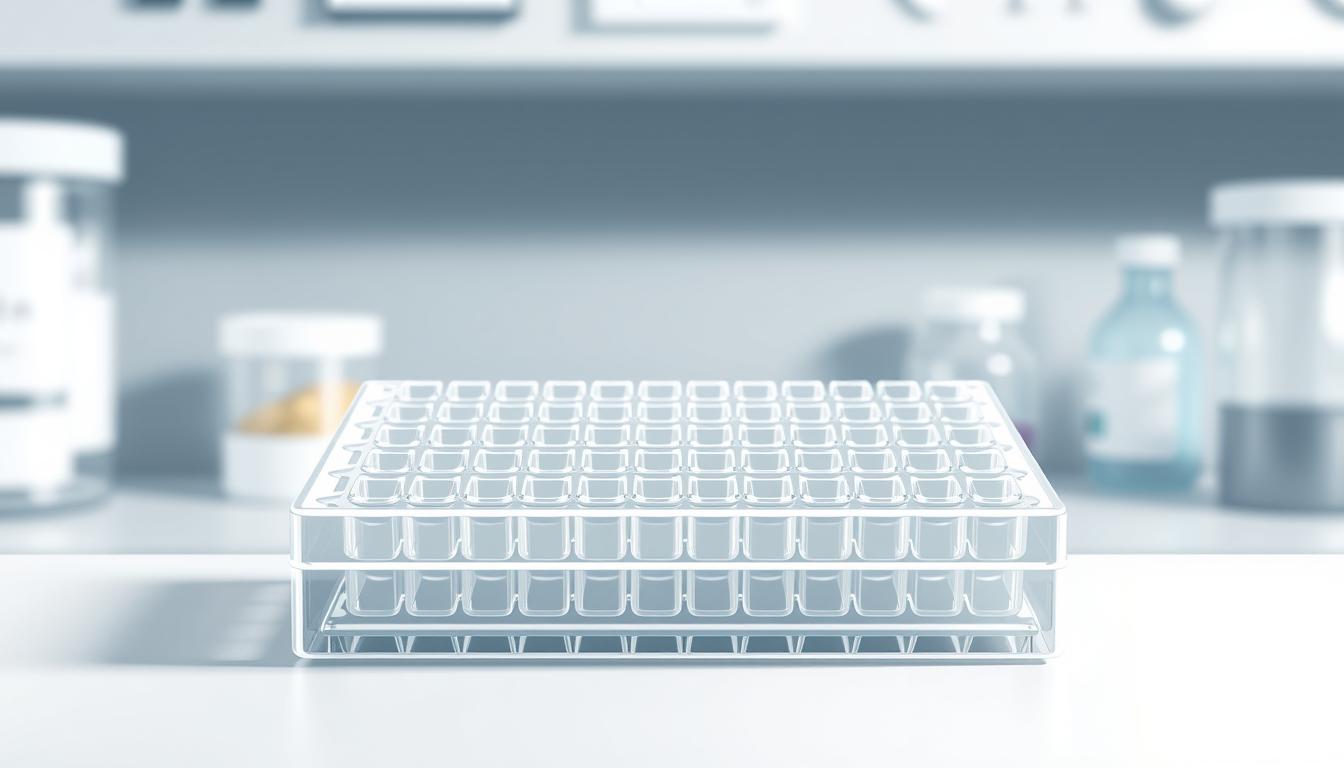
Ever thought about how a small microplate can change science? The 96 well plate dimensions are key. They help make big discoveries in many fields of science.
Microplates have changed lab work a lot. They offer a standard way to do complex tests. These plates are 127.76 mm x 85.48 mm. They meet strict ANSI/SLAS standards for consistent results in many scientific tasks.
Scientists use these plates for many things. They help with fast testing, studying cells, and analyzing molecules. The same size makes it easy to work with machines and tools in labs.
Key Takeaways
- Standard 96 well plate dimensions are 127.76 mm x 85.48 mm
- Microplate specifications enable precise scientific measurements
- Standardization supports advanced research techniques
- Compatible with multiple laboratory instruments
- Critical for high-throughput experimental protocols
Overview of 96 Well Plates
96 well plates are a big deal in science. They let researchers do lots of experiments at once with great accuracy. These microplates have changed how labs work, making it easier to do lots of tests at once.
These plates are super useful in many areas of research. Scientists use them for important tasks like:
- Enzyme-linked immunosorbent assays (ELISA)
- Cell culture experiments
- Genomic research
- Protein analysis
- Drug discovery screening
Purpose and Applications
Knowing how to measure assay plates is key to using 96 well plates. They are a standard size, 127.76 mm long and 85.48 mm wide. This makes them work well with different lab tools.
“The 96 well plate has become as essential to modern research as the microscope was to earlier scientific investigations.” – Dr. Elizabeth Roberts, Research Biochemist
Importance in Laboratory Settings
96 well plates are designed to make lab work easier. They help reduce mistakes by automating some steps. This lets researchers test many samples at once, making their work faster and more reliable.
There are many types of plates to choose from, like clear, black, and white. This lets scientists pick the best one for their needs, improving their results.
- Standardized dimensions enable seamless equipment integration
- Supports high-throughput scientific methodologies
- Reduces experimental variability
- Facilitates complex multi-step research protocols
Dimensions of Standard 96 Well Plates
Knowing the exact size of a 96 well plate is key for lab workers. These plates are vital in science, with exact sizes for the best results.
The 96 well plate has a special shape to help scientists work better. Important sizes include:
- Total plate length: 127.76 mm ± 0.5 mm
- Total plate width: 85.48 mm ± 0.5 mm
- Corner radius: 3.18 mm ± 1.6 mm
Length and Width Specifications
Lab workers need plates that fit perfectly with their tools. The standard sizes make sure plates work well with machines and robots.
Well Depth and Volume Capacity
How much liquid a well can hold depends on the experiment. Common sizes are:
| Plate Type | Well Volume | Growth Area |
|---|---|---|
| Standard Plate | 360 µL | 0.32 cm² |
| Half-Area Plate | 190 µL | 0.16 cm² |
The precision of 96 well plate dimensions ensures reproducibility and consistency across scientific research platforms.
Knowing these details helps scientists pick the right plate for their work. This makes their research more efficient and accurate.
Common Materials Used in 96 Well Plates
Laboratory researchers use special materials for 96 well plates. This is to get the best results in different experiments. The shape of the microwell plate is key in picking the right material.
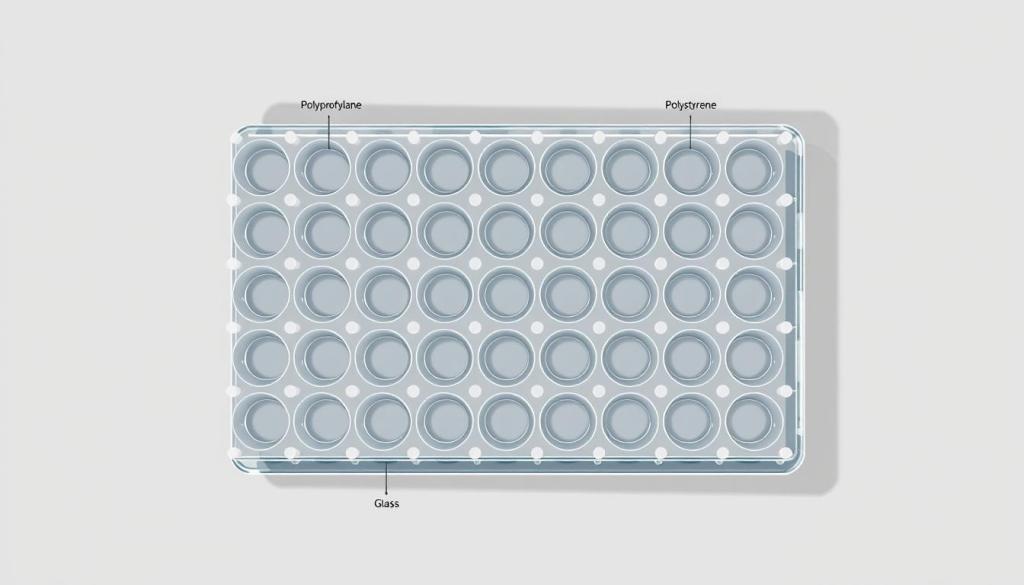
Many materials are used in multi-well plates. But, polystyrene and polypropylene are the top picks for science.
Polypropylene: Versatile Laboratory Material
Polypropylene is a top choice for 96 well plates, especially for PCR and molecular biology. It’s known for:
- Chemical resistance
- Temperature stability
- Low binding properties
- Cost-effectiveness
Polystyrene: Standard for Cell Culture
Polystyrene is the go-to for cell culture plates. It’s clear and works well with cells. It’s great for:
- Cell adhesion studies
- Immunological assays
- Tissue culture applications
Surface Treatments
Surface treatments make plates better for certain experiments. There are different types, like:
| Treatment Type | Primary Application |
|---|---|
| Tissue Culture Treated | Cell Attachment Promotion |
| Low Binding | Protein and Cell Resistance |
| Hydrophobic | Water Repellent Surface |
“The right material and surface treatment can dramatically improve experimental outcomes and reproducibility.” – Laboratory Research Experts
Choosing the right materials and treatments helps scientists get accurate and reliable results. This is true for many scientific fields.
Types of 96 Well Plates
Researchers use different 96 well plate types for various experiments. Knowing the details of each type is key to better research results. This is true for high-throughput screening plates and microplate specifications.
Standard Plate Configurations
Standard 96 well plates are the most used in labs. They usually have:
- Rectangular well arrangement
- Standardized dimensions of 127.76 mm x 85.48 mm
- Well capacity ranging from 0.1 to 0.2 mL
Low-Profile Plate Designs
Low-profile plates have special benefits for certain uses. Their shorter height helps with:
- Enhanced thermal transfer
- Faster temperature equilibration
- Improved optical clarity for imaging
High-Throughput Screening Variants
Advanced high-throughput screening plates have special well designs. These designs help make experiments more efficient:
| Well Shape | Typical Application | Volume Range |
|---|---|---|
| U-bottom | Cell culture | 0.1-0.5 mL |
| V-bottom | Immunoassays | 0.05-0.2 mL |
| F-bottom | Protein binding | 0.2-0.3 mL |
Choosing the right plate type is crucial for research success. It ensures the best performance in microplate specifications and experimental workflows.
Precision in plate selection can dramatically improve research reproducibility and efficiency.
Compatibility with Laboratory Equipment
The design of 96-well plates is key to scientific precision and versatility. These microplates are made to work well with many lab instruments. This ensures they perform well in automated liquid handling.
Today’s labs use standardized microplate sizes to boost efficiency. The consistent size of 96-well plates makes them easy to use with different scientific tools.
Fit for Pipettors and Automated Systems
Automated systems need precise plate sizes. The standard 96-well plate dimensions help:
- Work smoothly with robotic pipetting platforms
- Ensure accurate sample transfer
- Lower the chance of human errors
Compatibility with Centrifuges
Centrifugation is another important area for microplate compatibility. Researchers need to think about a few things when choosing plates for centrifugation:
| Plate Characteristic | Centrifugation Considerations |
|---|---|
| Material Strength | High-quality polystyrene that can handle up to 4000g |
| Wall Thickness | Even construction to avoid deformation |
| Rim Design | Even load distribution |
Choosing the right 96-well plates is crucial for good performance with many lab tools. It helps make scientific research more reliable.
Considerations for Choosing the Right Plate
Choosing the right 96-well plate is key for lab success. It’s important to look at many factors for the best results. The right size and measurements of the plate can greatly affect your findings.
- What your experiment needs
- How much sample you have
- If it works with your detection method
- Your budget
Experimental Needs and Sample Types
Each experiment has its own needs. Sample volume ranges help choose the right plate size:
- Over 200 µl: Deep well plates recommended
- 60-200 µl: Standard 96-well plates
- 15-60 µl: 384-well plates
- 2.5-15 µl: Low dead volume plates
Cost-Effectiveness
It’s important to find a balance between quality and cost. Prices for plates vary a lot:
| Plate Type | Average Cost | Best Use |
|---|---|---|
| Corning Assay Plates | $7 each | Standard applications |
| Labcyte PP Plates | $10 each | General research |
| Labcyte LDV Plates | $15 each | Specialized experiments |
“Choosing the right plate is not just about cost, but about ensuring the most accurate and reproducible results for your specific research needs.”
Researchers should think about what their experiment needs. Look at things like optical properties, sterility, and instrument compatibility. By carefully choosing, scientists can get the best results and quality data.
Comparative Analysis of 96 Well Plates
Researchers face many challenges when picking the best 96 well plate for their studies. The market has many options, each with its own strengths and weaknesses. It’s important to carefully choose to get reliable results.
It’s key to understand the differences between brands. The capacity of each plate well can vary a lot. This makes it crucial to compare them all.
Manufacturer Variability Insights
Lab experts need to look at several things when comparing 96 well plates:
- Surface treatment quality
- Material composition
- Manufacturing precision
- Dimensional consistency
Performance Metrics Evaluation
Researchers can check how well plates perform with specific metrics:
| Performance Metric | Evaluation Criteria | Importance |
|---|---|---|
| Uniformity | Consistency across wells | High |
| Signal-to-Noise Ratio | Data clarity and reliability | Critical |
| Reproducibility | Repeated experimental accuracy | Essential |
Choosing the right microplate requires careful comparison and understanding of each brand’s features.
“Not all 96 well plates are created equal” – Laboratory Research Protocol
It’s vital to test plates from different makers. This keeps experiments reliable and results trustworthy.
Environmental Impact and Disposal
The research and lab world is now focusing on being green. They see the need to manage microplate footprint better. Multi-well plates bring both challenges and chances to be more eco-friendly.
Lab workers are working hard to cut down on plastic waste. They’re finding new ways to deal with the problem of disposable labware.
Recycling Strategies for Laboratory Plates
Some companies are starting recycling programs for lab plates. For example, Nunc Edge 2.0 96-Well Plates are a big step forward:
- They make 4-9% less plastic waste per plate
- They hold 37.5% more
- They cut down plastic waste by up to 23 kg a year
Best Disposal Practices
There are rules to follow when getting rid of used plates:
- Make sure plates are clean before recycling
- Sort plates by material
- Look up recycling programs from the maker
Sustainable lab practices are key for taking care of our planet.
| Plate Type | Annual Material Usage | Waste Reduction |
|---|---|---|
| Nunc Edge 2.0 | 30.9 kg | 43% |
| Eppendorf | 53.7 kg | 40% |
| Corning | 51.4 kg | 35% |
Choosing green disposal methods can greatly lessen the environmental impact of science.
Innovations in 96 Well Plate Design
The world of microplate technology is changing fast. It’s making big steps in science and health tests. High-throughput screening plates are getting new features thanks to new tech.
New designs in microwell plates are changing lab work in many fields. Scientists are making plates that work better and are more precise.
Cutting-Edge Technological Advances
- Integrated sensor technologies for real-time monitoring
- Advanced optical coatings for improved fluorescence detection
- Specialized surface treatments for complex cell culture applications
- Microfluidic integration capabilities
Future Research Trends
The next 96 well plates will be smarter and do more. They will have sensors that can:
- Watch over experiments as they happen
- Collect data right away
- Help with automatic analysis
“The future of scientific research lies in the precision and adaptability of our laboratory tools.” – Dr. Research Innovator
| Innovation Category | Key Features | Potential Impact |
|---|---|---|
| Smart Plate Technology | Embedded sensors | Enhanced experimental monitoring |
| Optical Improvements | Advanced fluorescence coatings | Increased detection sensitivity |
| Microfluidic Integration | Seamless system connectivity | Streamlined research workflows |
These new ideas will change high-throughput screening plates. They will help scientists find new medicines and do better research in biology.
Best Practices for Using 96 Well Plates
Laboratory experts need to be very precise when using 96 well plates. This is key for accurate and reliable results. Handling these plates correctly is essential for keeping science honest.
Researchers must follow important rules to keep samples safe and clean:
- Always wear the right protective gear
- Use clean, sterile techniques when handling plates
- Wear clean, lint-free gloves
- Keep plates away from too much heat
Critical Handling Techniques
When measuring assay plates, technicians must use smart methods. Gentle handling is crucial to avoid damaging cells and get consistent results. Here are some tips:
- Place the plate in the center when pipetting to avoid edge issues
- Use pipettes that are calibrated for exact volume
- Avoid touching the wells directly
- Keep the pipetting angle consistent
Contamination Prevention Strategies
To stop contamination, you need to be very careful with liquid handling. Here are some steps to take:
| Strategy | Purpose |
|---|---|
| Use sterile tips | Stop samples from mixing |
| Regularly sterilize equipment | Get rid of bacteria |
| Use separate pipette sets for each experiment | Reduce contamination between tests |
“Precision in handling is the hallmark of exceptional scientific research.” – Laboratory Research Institute
By following these best practices, scientists can greatly improve the trustworthiness of their 96 well plate research.
Storage and Maintenance
Keeping microplate specifications in good condition is key for lab work. It’s important to store 96 well plates right to keep them working well. Researchers need to watch how they store these tools closely.
- Keep the temperature steady between 15-25°C
- Avoid direct sunlight
- Store in a clean, dust-free spot
- Protect from humidity and big temperature changes
Optimal Storage Conditions
Lab experts know that most 96 well plates last 1-2 years when stored right. Where you store them is very important. It helps keep the plates in good shape and stops problems in your experiments.
Shelf Life and Expiration Considerations
It’s important to keep track of your plates and use them in order. Use a system to check how old the plates are. Most makers say to:
- Look at the manufacturing dates
- Track how long they’ve been stored
- Replace them when they’re near expiration
Storing them right can make them last longer and avoid research problems.
For storing them for a long time, you need special conditions. Some high-quality polypropylene plates can handle -86°C to 100°C. This makes them flexible for different research needs.
Conclusion and Summary of Key Points
The world of 96 well plate dimensions is key for modern science. These plates, with a standard size of 127.76 mm x 85.48 mm, have changed lab work. They help scientists do many experiments at once, very efficiently and accurately.
Knowing about 96 well plate dimensions is more than just knowing their size. These plates let scientists work on up to 96 samples at once. They can handle volumes from 50 μL to 200 μL per well. They work well with automated systems and advanced lab tools, making them essential for research in many areas.
Choosing the right 96 well plate is important. It depends on what you need for your research, the material, and how you plan to use it. The size and design of the plate can affect your results. As technology gets better, these plates will too, helping with even more complex research.
Recap of Dimensions and Usability
The standard 96 well plate is a key part of today’s lab work. It gives scientists a strong and flexible tool for many experiments. Its standard size and design help drive new ideas in science.
Final Thoughts on Selection and Application
Choosing a 96 well plate needs careful thought. You should think about the material, surface treatments, and what you need for your experiment. By knowing what these plates can do, scientists can improve their work and discover new things.
FAQ
What are the standard dimensions of a 96 well plate?
A standard 96 well plate is 127.76 mm x 85.48 mm (length x width). It’s about 14.35 mm tall. The wells are arranged in an 8×12 grid, making them fit with lab equipment.
What materials are commonly used to manufacture 96 well plates?
Most plates are made of polypropylene or polystyrene. Polypropylene is durable and resistant to chemicals. Polystyrene is great for cell culture and fluorescence assays because of its optical properties.
How do I choose the right 96 well plate for my experiment?
Think about your assay type, sample volume, and surface treatment needs. Also, consider the plate’s optical properties and lab equipment compatibility. There are standard, low-profile, and high-throughput plates for different research needs.
What are the different well bottom shapes available?
There are U-bottom, V-bottom, and F-bottom (flat-bottom) wells. U-bottoms are best for immunological assays. V-bottoms are good for precipitation reactions. F-bottoms are used for cell culture and microscopy.
How should 96 well plates be stored?
Keep plates in a cool, dry place away from sunlight. Store them at consistent temperature and humidity. Protect from dust and follow the manufacturer’s storage advice to keep them in good condition.
Are 96 well plates environmentally friendly?
Traditional 96 well plates are plastic, but eco-friendly options are emerging. Some plates are recyclable or biodegradable. It’s important to dispose of them properly.
What surface treatments are available for 96 well plates?
Plates can have cell culture treatments, protein binding enhancements, or low-binding surfaces. These improve cell adhesion, reduce non-specific binding, or meet specific experimental needs.
How do I prevent contamination when using 96 well plates?
Use aseptic techniques, wear protective gear, and work in a clean area. Use sterile tips and handle plates carefully to avoid contamination.
What innovations are emerging in 96 well plate technology?
New developments include better optical properties and specialized coatings for 3D cell culture. There are also microfluidic integration and “smart” plates with sensors for real-time monitoring.
How are 96 well plates compatible with laboratory equipment?
The standard dimensions of 96 well plates make them work with many lab tools. This includes pipettors, automated systems, plate readers, and centrifuges. It makes lab work more efficient.





Pingback: How to Select Cell Viability Assay Kits Compatible with 96 - Well Plate Templates?