



Ever wondered how scientists manage thousands of samples in one small device? The 96-well plate is a big leap in lab tech. It helps researchers work more efficiently and accurately.
The 96 well plate is a key tool in today’s science. It has exact sizes for high-speed testing in many fields. Its standard size is 127.76 mm long and 85.48 mm wide. This makes it great for standardizing and repeating experiments.
Knowing the microplate specs is vital for picking the right lab tools. Each plate has 96 wells in an 8×12 grid. This lets scientists run many tests at once.
Key Takeaways
- Standard 96 well plate dimensions enable precise scientific research
- Microplate specifications support high-throughput experimental techniques
- Consistent well sizes promote experimental reproducibility
- 96 well plates accommodate diverse research applications
- Standardized design allows seamless integration with laboratory equipment
Introduction to 96 Well Plates
Microtiter plate measurements have changed science a lot. They give researchers a standard tool for complex work. The 96 well plate is a big step in lab tech, making sample handling precise and quick.
A 96 well plate is a flat plate with wells for different research uses. These plates let scientists do many experiments at once. This makes research much faster.
What is a 96 Well Plate?
The 96 well plate meets certain size rules set by ANSI/SLAS 1-2004. It has:
- A standard size of 127.76 mm × 85.48 mm
- 9 mm space between wells
- Well sizes from 0.1 to 0.3 mL
- Works with lab machines
Applications of 96 Well Plates
Scientists use 96 well plates in many fields, like:
- Biochemistry
- Microbiology
- Drug discovery
- Genetics
- Cell culture
Importance of Standardization
Standardization in microtiter plates is very important for science. It helps with:
- Automated sample handling
- Consistent results
- Easy machine use
- Better data comparison
“Standardization is the foundation of precision in scientific research.” – Laboratory Innovation Magazine
The 96 well plate is a big tech leap. It helps make new discoveries in labs all over the world.
Dimensions of a Standard 96 Well Plate
Knowing the dimensions of a 96 well plate is key for scientists. These tools are vital in today’s labs. They help standardize experiments.
Overall Plate Specifications
The 96 well plate is a must-have in labs. Its exact size makes it work with many lab tools and setups.
- Length: 127.76 mm ± 0.5 mm
- Width: 85.48 mm ± 0.5 mm
- Height: 14.10 mm
Individual Well Characteristics
Each well in a 96 well plate is made for different research needs. Its design helps with handling and measuring samples.
| Well Parameter | Typical Specification |
|---|---|
| Well Bottom Shape | F-bottom, U-bottom, V-bottom options |
| Well Volume Range | 50-300 µL depending on design |
| Well Diameter | 6.4 mm standard |
Well Depth and Volume Considerations
Choosing the right well plate size is crucial. Half Area microplates can cut sample volume in half. This is great for when you have little sample.
“Precision in well plate dimensions translates directly to experimental reliability and reproducibility.” – Laboratory Automation Experts
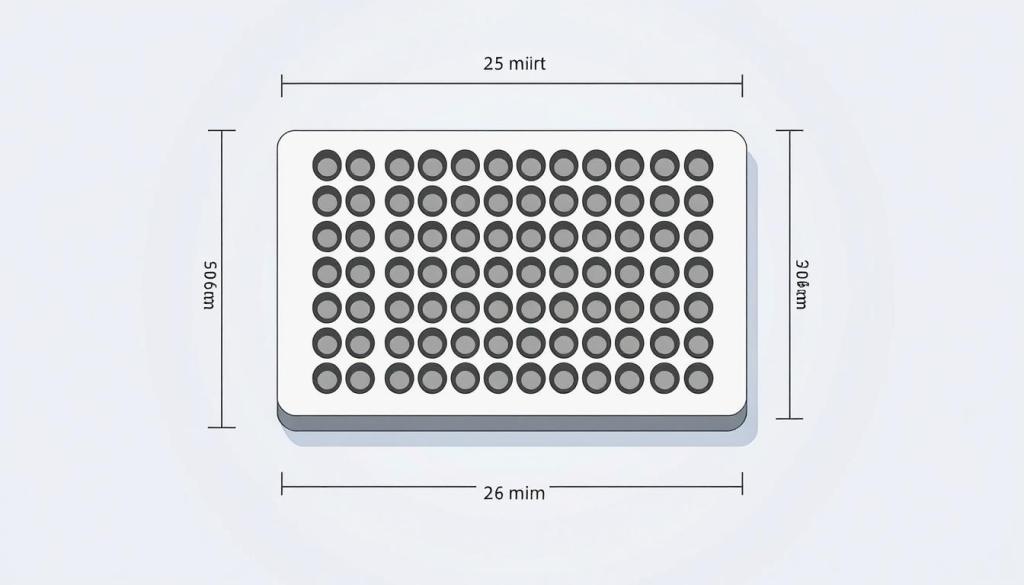
The Society for Laboratory Automation and Screening (SLAS) sets strict standards for these tools. This ensures they work well everywhere, no matter who makes them.
Material Specifications for 96 Well Plates
Choosing the right material for lab tools is key in biotechnology. The material affects the results and how precise the research can be.
Scientists pick 96 well plates based on certain material features. The main materials used are:
- Polystyrene
- Polypropylene
- Cycloolefin
Common Materials and Their Characteristics
Polystyrene is the top choice for 96 well plates. USP Class VI virgin polystyrene has great qualities for lab use:
- Excellent optical clarity
- High chemical resistance
- Consistent thermal stability
Impact of Material on Experimental Results
The material used affects how well experiments work. Different treatments can make plates better for certain research:
- Non-treated surfaces for suspension culture
- Specialized coatings for cell adhesion
- Unique surface chemistries for specific assays
Biocompatibility Considerations
Biocompatibility is very important in choosing lab equipment. Researchers need to check if the material is safe for cells and growth:
- Minimal cellular toxicity
- Consistent cell growth conditions
- Reduced risk of experimental contamination
“The right material can make or break your scientific investigation.”
There are many color options (clear, black, white) and packaging types. Scientists can find 96 well plates that fit their research needs perfectly.
Types of 96 Well Plates
Researchers use many types of 96 well plates to improve their work. Knowing about the different types helps scientists pick the best plate for their needs.
Bottom Type Variations
96 well plate sizes can change how experiments turn out. Each bottom type has its own benefits for different science tasks:
- Flat-Bottom (F-Bottom): Great for general microscopy and imaging
- V-Bottom: Best for handling liquids and getting samples
- U-Bottom: Helps keep more sample and less liquid
Tissue Culture Treated Plates
Special plates for growing cells have special surfaces. These help cells stick and grow better. They are key for:
- Better cell sticking
- More cell growth
- More reliable results
Deep Well Plate Configurations
Deep well plates let researchers do more with more space. They have:
- Volume ranges: 350µl to 2mL
- Height: 44.4mm
- Material: Virgin polypropylene
Choosing the right 96 well plate can make experiments more precise and efficient.
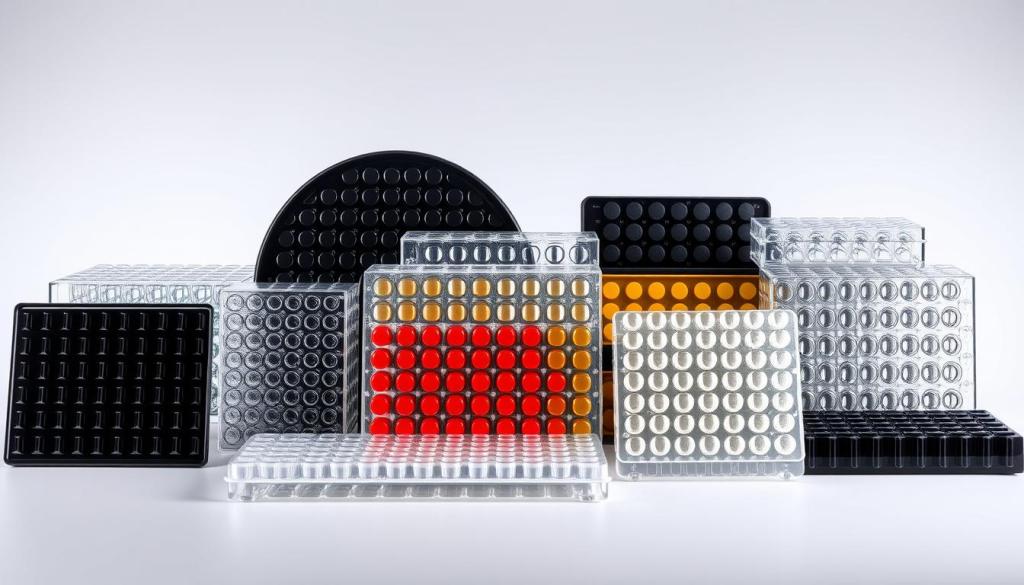
Researchers need to think about their specific needs when picking a 96 well plate. This ensures the best results.
Choosing the Right 96 Well Plate
Choosing the right 96 well plate is key for good lab research. It’s important to look at many factors to get the best results. The right plate can make a big difference in your experiments.
Compatibility with Assays
Each experiment needs a special plate. Here are some important things to think about:
- Absorbance measurements need transparent bottom plates
- Fluorescence top measurements are best with black opaque plates
- Luminescence experiments do well with white plates
- TRF and TR-FRET measurements use opaque plates
“The right plate can make or break your experimental results.” – Laboratory Research Experts
Cost Considerations
Money matters when picking plates. High-quality plates might cost more upfront. But, they can save you money in the long run by avoiding mistakes.
Supplier Reputation
Choosing a trusted supplier is important. Look for ones that:
- Follow ANSI/SLAS standards
- Give good technical support
- Have consistent quality
- Have good references
By looking at size, compatibility, cost, and supplier reputation, you can make smart choices. This will help improve your lab work.
Handling and Storage Guidelines
Proper handling of biotechnology equipment is key for accurate microtiter plate measurements. Researchers must follow specific guidelines. This ensures experimental accuracy and prevents contamination.

Best Practices for Storage
Effective storage of 96 well plates requires careful attention to environmental conditions. The recommended storage parameters include:
- Maintain consistent temperature (typically -80°C for long-term storage)
- Protect plates from direct light exposure
- Store in sealed containers to prevent moisture contamination
- Use clean, dry storage areas with minimal temperature fluctuations
Cleaning Procedures
Cleaning biotechnology equipment demands meticulous techniques to preserve plate quality:
- Use sterile, non-abrasive cleaning solutions
- Rinse thoroughly with molecular-grade water
- Air dry in a clean, dust-free environment
- Inspect for any residual contaminants before reuse
Avoiding Contamination
Contamination prevention is critical in microtiter plate measurements. Key strategies include:
| Contamination Prevention Method | Implementation Technique |
|---|---|
| Aseptic Technique | Use sterile gloves and work in laminar flow hood |
| Equipment Sterilization | Autoclave or use 70% ethanol for surface disinfection |
| Personal Protection | Maintain 6 feet distance during lab work |
“Precision in handling determines the quality of scientific results.” – Laboratory Research Expert
Implementing these guidelines will help researchers maintain the highest standards of experimental integrity and reproducibility in their biotechnology equipment usage.
Benefits of Using 96 Well Plates
Scientific research has been changed by 96 well plates. These tools let researchers do complex experiments better and faster.
High-Throughput Screening Advantages
High-throughput screening plates have changed lab work. They let scientists work on many samples at once. The 96-well plate format helps scientists:
- Test up to 96 samples in one go
- Do less manual work and make fewer mistakes
- Finish research faster
Automated Pipetting Capabilities
The standard size of 96 well plates is perfect for automated pipetting systems. These systems can:
- Move liquids between wells with great precision
- Make fewer mistakes
- Make experiments more reliable
Increased Reproducibility
Researchers love 96 well plates for their reliability. The same size of wells means the same conditions in every lab.
“The 96 well plate is a game-changer in scientific research, providing unparalleled consistency and efficiency.” – Dr. Laboratory Innovations
| Feature | Benefit |
|---|---|
| Standardized Dimensions | Consistent experimental results |
| High-Throughput Capability | Faster research processes |
| Automated Compatibility | Reduced human error |
Using 96 well plates helps researchers work better, save money, and find answers faster.
Challenges Associated with 96 Well Plates
Researchers face many challenges when using 96 well plates. These tools are key in today’s labs, but knowing their limits is vital for good results.
Sample Volume Limitations
Sample volumes in 96 well plates are limited. They can be as small as 25-340 μL, depending on the setup. This can affect how well experiments work and how reliable the results are.
- Small sample volumes can make it hard to detect things
- It’s very important to pipette accurately
- Working with small amounts needs special skills
Evaporation Challenges
Long experiments and high temperatures can cause samples to evaporate. To avoid this, researchers need to take certain steps:
- Use special sealers for the plates
- Keep the environment controlled
- Choose plates that resist evaporation better
Well Blockage and Cross-Contamination
Contamination is a big worry in 96 well plates. Studies show that nearby wells can share microbes or chemicals, which can ruin experiments.
| Contamination Source | Potential Impact |
|---|---|
| Pipetting errors | Sample mixing between wells |
| Automated processing | Increased cross-contamination risk |
| Low-biomass samples | Higher vulnerability to contamination |
“Preventing contamination is not just about technique, but understanding the intricate dynamics of microplate interactions.” – Laboratory Research Insights
By understanding these challenges, researchers can find ways to reduce mistakes. This makes their results more reliable.
Visual Aids and Diagrams for 96 Well Plates
Understanding 96 well plate size and microtiter plate measurements is key for researchers. Visual aids help grasp these complex tools.
Design Features Overview
A standard 96 well plate is vital in science. It has a grid of wells in 8 rows (A-H) and 12 columns (1-12). This setup lets researchers do many experiments at once.
- Total wells: 96
- Row labels: A through H
- Column labels: 1 through 12
- Well identification: Unique alphanumeric codes (e.g., H05, A12)
Examples of Standard Models
Many makers create 96 well plates with special features. Corning, a top maker, offers plates for different research needs. Their microplates are made to high standards for use.
- Bottom types: Flat, round, V-bottom, EasyWash
- Material options:
- Clear polystyrene
- Solid black/white polystyrene
- Polypropylene
Measurements in Practice
Getting the right microtiter plate measurements is crucial. Researchers need to pick plates that fit their assay needs. They must think about well volume, bottom shape, and material.
“Precision in plate selection can significantly impact experimental outcomes and data reliability.” – Laboratory Research Quarterly
Knowing 96 well plate dimensions helps scientists plan better experiments. It reduces mistakes and makes research more efficient.
Future Developments in 96 Well Plate Design
The world of biotechnology equipment is always changing. This brings new ideas to laboratory items like 96 well plates. Scientists and makers are working hard to make better solutions for today’s science problems.
Innovations in Materials
New research is changing what 96 well plates are made of. Here are some big changes:
- Ultra-low binding surface materials
- Polymers that are clearer
- Plates that can break down naturally
Trends in Laboratory Automation
Automation is changing how biotechnology equipment is made. Now, small plate readers can do amazing things:
| Feature | Specification |
|---|---|
| Sampling Rate | Over 100 Hz |
| Optical Density Range | 0.0 – 3.0 OD600 |
| Reading Frequency | 100 times per minute |
Environmental Sustainability Initiatives
Laboratory items are getting greener. Cellulose-based 96 well plates are a big step forward. They offer:
- Fast testing
- Plates you can reuse
- Less plastic waste
“The future of 96 well plates lies in smart, sustainable, and highly efficient design” – Dr. Research Innovator
Conclusion and Recommendations
Knowing about well plate dimensions and high-throughput screening plates is key for researchers. The 96-well plate has changed science, making it more flexible. It’s important to think about well volume, surface treatment, and material for the best results.
Choosing the right 96-well plates is a big deal. Scientists need to think about what they need for their experiments. They should look at the volume, how to avoid losing samples, and how to keep cells healthy. Features like V-bottom and easy wash bottoms can help a lot.
New tech is making microplate research even better. Things like 3D cell cultures and organ-on-a-chip tech are exciting. It’s important for researchers to keep up with these advancements.
Using 96-well plates right can make research better and cheaper. It helps get more data. Keeping up with new ideas and methods is crucial for success.
FAQ
What are the standard dimensions of a 96-well plate?
A standard 96-well plate is 127.76 mm long and 85.48 mm wide. It’s about 14.35 mm tall. The wells are in an 8×12 grid, with 9 mm between each well. Each well is about 6.4 mm in diameter, but sizes can vary.
What materials are commonly used to manufacture 96-well plates?
Most 96-well plates are made of polystyrene. It’s clear, resistant to chemicals, and stable at high temperatures. There are also special plates for cell growth, fluorescence, and high-temperature experiments.
How do I choose the right type of 96-well plate for my experiment?
Choosing the right plate depends on your research needs. Think about the assay type, optical properties, and the plate’s surface. Consider the bottom shape, surface treatment, and material color. Your choice will depend on your specific experiment.
What is the typical working volume for a 96-well plate?
The working volume for a 96-well plate is usually between 50 to 300 μL. Most plates can hold up to 350 μL. Deep well plates can hold up to 2 mL for larger volumes.
How should 96-well plates be stored to maintain their integrity?
Store 96-well plates in a clean, dry place at room temperature or 4°C. Avoid direct sunlight and extreme temperatures. Use sealed containers to protect them from chemicals and mechanical stress.
What are the common challenges when using 96-well plates?
Challenges include evaporation, contamination, and volume limits. Use seals, maintain conditions, and calibrate pipettes. Edge effects and temperature variations can also affect results.
Are there different types of 96-well plates for specific applications?
Yes, there are specialized plates for cell growth, fluorescence, and more. Each type is designed for specific research needs in various fields.
How can I prevent contamination when using 96-well plates?
To prevent contamination, use sterile techniques and wear protective gear. Work in a clean environment and use disposable, sterile tools. Handle plates carefully to avoid contamination.





Pingback: What is the size of a 96 well plate?
Pingback: What is the area of a 96 well plate?
Pingback: What are the dimensions of a 96 well plate?