


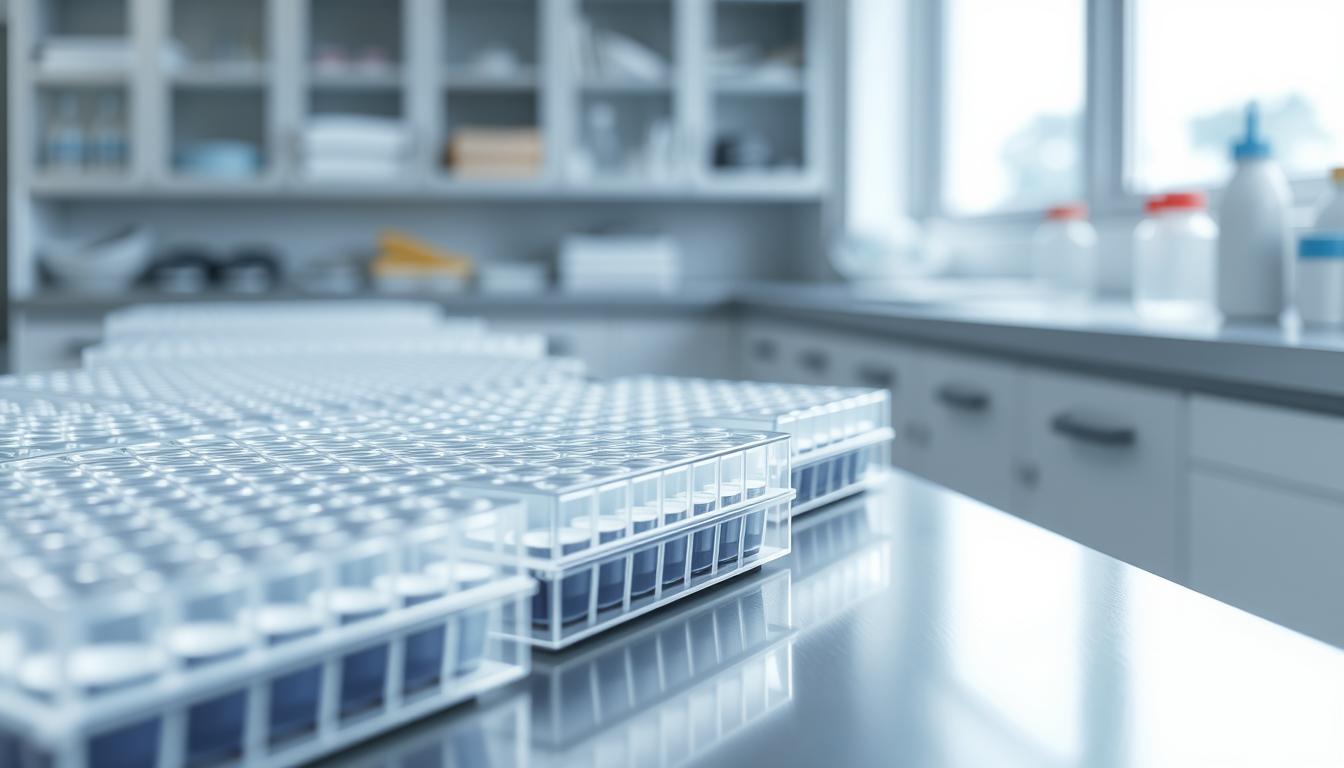
Microplates are a big step forward in science, letting researchers do complex tests faster and better. These 96 well plates come in different shapes like “U”, “V”, and flat bottom. This makes them useful for many kinds of experiments.
Scientists in fields like microbiology and serology use these plates a lot. They help make sample handling easier, cut down on mistakes, and boost research speed. Their 12 x 8 layout helps manage samples well and control experiments closely.
Key Takeaways
- 96 well plates enable high-throughput sample processing
- Multiple plate configurations support diverse research applications
- Standardized design ensures experimental consistency
- Essential tool for modern laboratory research and testing
- Supports advanced scientific methodologies across disciplines
Overview of 96 Well Plates
Microplate readers have changed science by making it faster and more efficient. The 96 well plate is a key tool in labs today. It helps researchers work better and faster.
These tools are made for many scientific tasks. Polystyrene plates are the top choice for research and testing.
Definition and Purpose
A 96 well plate is a special plate with 96 wells in an 8×12 grid. It’s used for many important tasks:
- It helps with fast screening
- It supports cell culture
- It allows for precise sample analysis
- It keeps experiments consistent
Common Materials Used
Polystyrene plates are the most used in labs. They have great qualities:
- They are made from high-quality USP Class VI virgin polystyrene
- They can handle temperatures from -112°F to normal lab temperatures
- They come in different colors like clear, black, and white
Key Features and Specifications
Today’s 96 well plates have amazing features:
| Feature | Specification |
|---|---|
| Well Volume | Ranges from nanoliters to milliliters |
| Manufacturing Method | Precision injection molding |
| Sterility Options | Individual and sleeve sterilization available |
“The 96-well format represents the most versatile platform for scientific research and diagnostic testing.” – Laboratory Research Quarterly
Researchers can pick from different shapes. This includes flat bottom, round bottom, and deep well designs. It makes sure experiments work best.
Applications in Scientific Research
96 well plates have changed scientific research a lot. They offer a flexible way to do many kinds of experiments. These microplates are key in many fields, helping scientists do cell culture assays better and faster.
96 well plates are very useful in labs today. Scientists use them in many areas, making complex research easier.
Cell Culture Studies
Cell culture assays are a big use of 96 well plates. Scientists use these plates to:
- Grow and study different cells
- Do detailed metabolic studies
- See how cells react to certain things
- Quickly check how cells interact
Drug Discovery Initiatives
In drug discovery, 96 well plates are very important. Pharmaceutical scientists use them to:
- Test new medicines
- Check if medicines work well and are safe
- Manage big libraries of compounds
- Make drug development faster
“96 well plates have changed drug discovery. They let researchers test thousands of samples at once.” – Research Innovation Journal
Environmental Testing
Bioassays with 96 well plates also help with environmental testing. These microplates are used for important environmental studies by:
- Finding water pollutants
- Examining soil samples
- Measuring air pollution
- Doing big ecological studies
96 well plates can handle up to 94 samples at once. They make testing faster. So, they are a key tool in many scientific fields.
Types of 96 Well Plates
Research labs use many 96 well plate types to make their work easier. Knowing the differences helps scientists pick the best plates for their studies.
Microplates for High-Throughput Screening
Microplates for high-throughput screening are a big deal in labs. They help process samples fast with automated systems. They have:
- Standardized 127.76 mm x 85.48 mm footprint
- Work with automated screening platforms
- Many well types for different studies
PCR Plates for Molecular Biology
PCR plates are key for molecular biology. They’re made for precise temperature control and genetic studies. They have:
- Great heat transfer
- Thin walls for quick temperature changes
- Work with real-time PCR machines
Flat-Bottom vs. U-Bottom Plates
Choosing between flat-bottom and U-bottom plates matters a lot. Each type has its own benefits:
| Plate Type | Key Features | Recommended Applications |
|---|---|---|
| Flat-Bottom Plates | Best for optical tests | ELISA, spectrophotometry |
| U-Bottom Plates | Great for liquid collection | Immunology, cell culture |
“Choosing the right 96 well plate is key for reliable research results.” – Lab Experts
Scientists need to think about their study needs when picking 96 well plates. This helps make their research more efficient and accurate.
Selecting the Right 96 Well Plate
Choosing the right 96 well plate is key for life sciences research and cell culture assays. It’s important to consider many factors for the best results.

Material Compatibility Considerations
Material choice is vital for success. Each research task needs a specific plate to keep samples safe and prevent contamination.
- Polystyrene is the most common material for 96 well plates
- Surface treatments affect protein and cell adhesion
- Chemical resistance differs among materials
Sample Volume Requirements
Managing sample volume is crucial in cell culture assays. It’s important to pick plates that fit your volume needs.
| Well Type | Volume Range | Recommended Application |
|---|---|---|
| Flat Bottom | 50-300 µL | Standard biochemical assays |
| Deep Well | 1-2 mL | Bacterial/yeast cultivation |
| Low Volume | 10-50 µL | Molecular diagnostics |
Understanding Surface Treatments
Surface modifications greatly affect research outcomes. Different treatments support various scientific methods.
Selecting the right surface treatment can dramatically improve experimental sensitivity and reproducibility.
High-binding plates help proteins stick better. Medium-binding surfaces are good for non-polar molecules. It’s crucial to match surface properties with your experiment’s needs for the best results.
Advantages of Using 96 Well Plates
96 well plates have changed lab work a lot. They make research faster and more flexible. These tools help scientists do lots of tests at once.
Efficiency in Sample Processing
96 well plates are great for handling many samples at once. This saves a lot of time and effort. The main benefits are:
- Quick testing of many conditions
- Less chance of contamination
- Easy to manage sample sizes
Cost-Effective Solutions for Researchers
Using 96 well plates can save money. They use less material but do more tests. This helps labs use their resources better by:
- Spending less on materials
- Lowering labor costs
- Making experiments more reliable
Flexibility in Experimental Designs
96 well plates fit into many kinds of research. They work well in cell studies, finding new drugs, and molecular biology. This makes research easier and more flexible.
- Cell culture studies
- Drug discovery initiatives
- Molecular biology research
Innovative researchers use 96 well plates to speed up discoveries and make experiments more precise.
| Experimental Parameter | Performance Metric |
|---|---|
| Sample Processing Speed | Up to 96 samples at once |
| Reagent Consumption | 80-90% less |
| Experimental Reproducibility | Improved with standard conditions |
Using 96 well plates is a big change in science. It helps researchers work more efficiently and get better results.
Protocols for Using 96 Well Plates
Laboratory researchers need to follow precise protocols when using 96 well plates. This ensures accurate bioassays and the best results with microplate readers. Knowing the right handling and preparation techniques is key to keeping experiments reliable.
Preparing the Plates for Experiments
Effective plate preparation involves several critical steps:
- Inspect each plate for individual packaging integrity
- Verify alpha-numeric position markings
- Check for high-grade polystyrene material
- Confirm optical transmission quality
Recommended Handling Procedures

Proper handling of 96 well plates requires careful attention. Researchers should:
- Use sterile gloves during plate manipulation
- Avoid touching internal plate surfaces
- Store plates in controlled environmental conditions
- Minimize exposure to potential contaminants
Cleaning and Sterilization Guidelines
Maintaining plate cleanliness is crucial for reliable bioassays. The following sterilization protocol ensures optimal performance:
| Step | Process | Recommended Parameters |
|---|---|---|
| Initial Washing | Buffer Rinse | 3x 200 µL S-Trap binding buffer |
| Centrifugation | Speed | 1,500 g for 2 minutes |
| Protein Digestion | Recommended Input | 100-250 µg per well |
“Precision in plate preparation determines the success of scientific experiments.”
When conducting microplate reader experiments, researchers must follow strict protocols. This prevents sample contamination and ensures reproducible results. Careful attention to detail can significantly impact experimental outcomes.
Innovations in 96 Well Plate Technology
The world of life sciences research is changing fast. New breakthroughs in lab equipment are making a big difference. These changes in 96 well plate technology are set to change how we do automated liquid handling and experiments.
Advancements in Material Science
New discoveries in material science have made 96 well plates better. Scientists have created plates that:
- Are clearer for better images
- Are safer for living cells
- Can handle more chemicals
- Interfere less with background signals
Integration of Automation Systems
Automation is changing how we use 96 well plates. These new systems allow for:
- Exact sample pouring
- Less chance of mistakes
- More tests done at once
- Easy data tracking
“The future of lab work is about smart, connected systems that are more efficient and accurate.” – Dr. Elizabeth Miller, Biotechnology Innovations
Future Trends in Laboratory Equipment
New trends in 96 well plate tech aim for smart, flexible tools for science. We can expect to see:
- Nanotech surfaces
- AI in the mix
- Monitoring in real-time
- Greener ways to make them
| Innovation Category | Key Advancement | Potential Impact |
|---|---|---|
| Material Science | Advanced Polymer Compositions | Improved Plate Performance |
| Automation | AI-Driven Liquid Handling | Higher Experimental Precision |
| Data Integration | Cloud-Connected Platforms | Enhanced Research Collaboration |
Major Suppliers of 96 Well Plates
The market for microplates and ELISA plates is led by a few key players. These companies offer essential tools for lab research. Scientists count on these suppliers for top-notch products that meet strict scientific standards.

Choosing the right microplates is a big decision. It requires looking at different manufacturers and what they offer. We’ll dive into the top suppliers in the scientific research equipment field.
Leading Manufacturers in the Market
Here are the top makers of 96 well plates:
- Corning Life Sciences
- Greiner Bio-One
- Thermo Fisher Scientific
- Eppendorf
Comparing Product Offerings
| Manufacturer | Plate Type | Price Range | Special Features |
|---|---|---|---|
| Corning | TC-Treated Standard | $251 – $583 | Low Evaporation Lid |
| Greiner Bio-One | Ultra Low Attachment | $475 – $625 | Advanced Surface Treatment |
| Thermo Fisher | Half-Area Plates | $308 – $532 | 190µL Well Capacity |
Customer Reviews and Ratings
Scientists often highlight the importance of:
- Consistent product quality
- Reliable surface treatments
- Competitive pricing
- Extensive technical support
“Choosing the right microplates is crucial for successful experimental outcomes.” – Dr. Sarah Richards, Research Scientist
When picking ELISA plates or microplates, scientists should look beyond price. They should consider material quality, surface treatment, and how well the plates fit their research needs.
Best Practices for Storage and Maintenance
Keeping 96 well plates in good condition is key for reliable lab work. It’s important to manage temperature, handling, and storage well. This helps protect these important tools from damage and contamination.
Optimal Storage Conditions
Keeping the right temperature is crucial for 96 well plates. Dry PCR plates need to be stored between -20°C and 25°C. This depends on the material, like polypropylene or polystyrene.
For plates with sensitive stuff, use freezers that go from -20°C to -80°C. This keeps things stable and prevents damage.
Managing Plate Longevity
Lab teams should keep storage areas clean and manage inventory well. Plates stored in cold places last longer. Polycarbonate plates can handle temperature better than polystyrene ones.
Cleaning with 70% ethanol and keeping records of plate condition helps a lot. This boosts lab work quality.
Contamination Prevention Strategies
When working with 96 well plates, fix any damage or contamination fast. Check well integrity, clean well, and use sterile lids if you can. Autoclaving at 121°C for 15 minutes adds extra protection.
FAQ
What are 96 well plates primarily used for in scientific research?
96 well plates are key tools in labs. They help with high-throughput screening, cell culture, drug discovery, and ELISA assays. They’re used for many experiments that need to test multiple samples at once.
What materials are typically used to manufacture 96 well plates?
Most are made from high-quality polystyrene. This material is clear, resistant to chemicals, and works well with lab equipment.
How do 96 well plates support high-throughput screening?
They let researchers work on many samples at once. This makes it easier to handle liquids, collect data fast, and save time. Their standard design helps a lot.
What types of 96 well plates are available for different research applications?
There are many types, like flat-bottom, U-bottom, PCR, and cell culture plates. Some have special treatments for life sciences and specific needs.
How should 96 well plates be stored to maintain their integrity?
Store them in a clean, dry place away from sunlight. Keep the temperature steady. Use protective packaging and follow the maker’s storage tips.
What considerations are important when selecting a 96 well plate?
Look at material, volume needs, surface treatment, and optical properties. Also, check for sterility and lab equipment compatibility.
Can 96 well plates be used in different scientific disciplines?
Yes, they’re used in cell culture, molecular biology, drug discovery, and more. They’re useful in many fields.
What are the primary advantages of using 96 well plates?
They make experiments more efficient and save space. They’re cost-effective and work well with microplate readers. They support automated research too.
How do surface treatments impact 96 well plate performance?
Treatments like high-binding surfaces help cells and proteins stick better. This improves results in many research areas.
What emerging technologies are influencing 96 well plate design?
New materials and designs are coming out. They offer better optical properties, biocompatibility, and work with automation. They’re made for specific bioassays and screening needs.




Pingback: Is 96 well plate template the optimal choice for high - throughput cell - based assays?
Pingback: How to choose the right 96 well plate format for molecular biology experiments?
Pingback: What are the dimensions of a 96 well plate?
Pingback: How deep is a 96-well plate?
Pingback: What is the difference between white and black 96 well plates?
Pingback: What is the surface area per well of a 96 - well plate?
Pingback: Understanding 96 Well Plate Volume for Lab Applications