



The 96-well plate is a big step forward in science. Introduced in the 1960s, it’s now key for scientists everywhere. Its small size lets them test many samples at once, very efficiently.
By 2000, labs used over 125 million of these plates each year. This shows how important this tech is. The 96-well plate helps scientists quickly test lots of chemicals. This is crucial in finding new drugs, studying genes, and making tests.
Key Takeaways
- The 96-well plate format revolutionized laboratory research
- Over 125 million microplates were used in laboratories by 2000
- Enables simultaneous testing of multiple samples
- Critical for high-throughput screening in various scientific fields
- Standardized design improves experimental accuracy
Introduction to 96 Well Plates
The 96 well plate is a big step forward in science. It changes how labs do complex tests. This tool lets researchers do many tests at once, making work more efficient.
Defining the 96 Well Plate
A 96 well plate is a key tool in labs. It has a grid of 96 wells. Each well can hold small amounts of liquid, from a few drops to a few milliliters.
Key Applications in Research
Scientists use 96 well plates in many areas. They are important in:
- Enzyme-Linked Immunosorbent Assay (ELISA) techniques
- Cell culture studies
- Drug discovery processes
- Molecular biology experiments
Structural Characteristics
| Specification | Measurement |
|---|---|
| Length | 127.71 mm |
| Width | 85.43 mm |
| Height | 14.10 mm |
| Well Diameter | 6.94 mm |
The design of the ELISA plate makes testing fast and standard. It helps manage samples well. This supports advanced testing methods.
“The 96 well plate has revolutionized scientific research by enabling simultaneous multi-sample analysis.” – Laboratory Research Quarterly
History of the 96 Well Plate
The story of the 96 well plate is a tale of scientific breakthroughs. It changed drug discovery and biomedical research forever. This tool became essential in labs because of medical needs and research methods.

In 1951, Dr. Gyula Takatsy created the first 8 by 12 well microplate. He made it because of a big need for lab tools during the influenza epidemic in Hungary.
Evolution of Laboratory Plates
Important steps in making lab plates include:
- 1953: John Liner made the first disposable 96-well panel from vacuum styrene
- 1974: The first microplate was used for enzyme-linked immunosorbent assay
- 1991: Mass production of 864 well plates started
- 1996: 1536 well plates were introduced
Key Innovators in the Field
Takatsy’s spiral loop method was a big leap. It made doing serial dilutions much faster. This cut down lab work by 30-40%.
The microplate technology has stayed important for over 70 years. It’s a key part of today’s scientific research.
Now, the microplate market is worth USD 1.5 billion. This shows how vital it is in drug discovery and research. The 96-well format is still a must-have for scientists all over the world.
Structure of a 96 Well Plate
The microplate, or microtiter plate, is a key tool in today’s labs. It lets researchers do many experiments at once. This makes their work more efficient.
Scientists use 96 well plates because of their design. Each plate has 96 wells in an 8×12 grid. This setup helps them work faster and better.
Material Composition
These plates are made from special materials. They are designed to work well:
- Polystyrene (PS): Used for most lab work
- Polypropylene: Best for experiments that need to stay cool
- Tissue Culture Treated (TCT) surfaces: Help cells stick better
Well Dimensions and Layout
The 96 well plate has specific details:
- Well diameter: 6.0 mm
- Well spacing: 9 mm between each well
- Volume capacity: 200-300 µL per well
- Temperature tolerance: Works from -80°C to 70°C
Types of Well Plates Available
There are many types of well plates:
- Flat-bottom wells: Best for most tests
- Round-bottom wells: Great for growing cells in suspension
- Conical-bottom wells: Perfect for collecting cell pellets
- Tissue culture treated plates: Made for growing cells
“The 96 well plate’s design represents a quantum leap in laboratory efficiency and experimental precision.” – Laboratory Research Innovation Journal
These well-designed plates help researchers do more in less time. They save resources and keep data quality high.
Advantages of 96 Well Plates
Laboratory researchers are always looking for new tools to make their work easier. 96 well plates are a big step forward. They make drug discovery and lab work much more efficient.
High Throughput Screening Capabilities
96 well plates change how we do experiments. They let us test many samples at once. This means we can do hundreds of experiments at the same time, saving a lot of time and effort.
- Accelerates research timelines
- Increases experimental reproducibility
- Minimizes manual handling errors
Cost-Effectiveness in Research
96 well plates are also good for your wallet. They help you use less of everything, which saves money. This way, you can do more research without spending a lot.
| Plate Type | Approximate Cost | Experimental Capacity |
|---|---|---|
| 6-well plate | $4 | Low throughput |
| 96-well plate | $20-$50 | High throughput |
| 1536-well plate | $50-$100 | Ultra-high throughput |
Versatility in Experimental Applications
96 well plates are great for many kinds of research. They work well for growing cells and for testing molecules. They help make sure experiments are consistent and reliable.
“96 well plates represent a cornerstone technology in modern scientific research, enabling unprecedented experimental precision and scale.” – Dr. Janet Roberts, Biomolecular Research Institute

96 well plates fit well into automated labs. They help scientists make new discoveries faster. They are key to moving research forward in many fields.
Types of Experiments Utilizing 96 Well Plates
The 96 well plate has changed biomedical research a lot. It gives scientists a flexible tool for many kinds of experiments. This tool helps them do detailed studies in different fields.
Scientists use 96 well plates in many ways. Each use has its own benefits for research. The plate’s standard design helps get accurate and reliable results in various studies.
Cell Culture Studies
In cell culture research, 96 well plates are very useful. Scientists can:
- Cultivate many cell lines at once
- Study how cells grow and stay alive
- Try out different treatments
- Quickly check how cells react
Enzyme-Linked Immunosorbent Assays (ELISA)
ELISA plates are great for studying the immune system. They help researchers:
- Find out how proteins interact
- Measure how much antibody is present
- Do detailed tests on the immune system
An ELISA plate is a key tool for understanding complex biological interactions at the molecular level.
DNA Sequencing Processes
Genomic research gets a big boost from 96 well plate technology. High-throughput DNA sequencing becomes easier. This lets researchers work on many genetic samples at once.
These plates are designed to support advanced biomedical research. They offer standardized, efficient ways to do experiments. This helps speed up scientific discovery and understanding.
Challenges in Using 96 Well Plates
Researchers using 96 well plates face many challenges. These can affect their results. Thanks to lab automation, some issues are better managed. But, knowing the risks is key to keeping data reliable.
Contamination Risks in High-Throughput Experiments
Contamination is a big problem in these experiments. The close arrangement of wells in a 96 well plate makes it easy for samples to mix. It’s important to use strict cleaning methods to avoid this.
- Use sterile techniques during sample preparation
- Implement strict handling procedures
- Utilize disposable pipette tips for each sample
Variability in Experimental Conditions
There are many reasons for variability in 96 well plates. Temperature differences and uneven drying rates are big challenges. These can make it hard to get consistent results.
| Source of Variability | Potential Impact |
|---|---|
| Temperature Gradient | Inconsistent cellular responses |
| Evaporation | Altered sample concentration |
| Edge Effects | Reduced data reliability |
Analyte Loss Complications
Long-term studies and those with volatile compounds face big challenges. Analyte loss is a major issue. Lab automation has come up with solutions like special plate designs and careful handling.
“Minimizing analyte loss requires meticulous attention to experimental design and execution.” – Research Laboratory Protocols
Understanding these challenges helps researchers create stronger experiments. They can use the 96 well plate format’s benefits while avoiding its drawbacks.
Best Practices for 96 Well Plate Handling
Researchers must follow strict protocols when working with assay and microtiter plates. This ensures the quality and accuracy of their work. Handling 96 well plates correctly is key to avoiding contamination and keeping samples safe.
Sterilization Techniques
When preparing microtiter plates for experiments, sterilization is crucial. There are several methods available:
- Autoclave sterilization at 121°C for 15-20 minutes
- UV irradiation for surface decontamination
- Chemical disinfection using 70% ethanol
“Cleanliness is next to scientific accuracy in laboratory work.” – Research Laboratory Standard
Proper Sample Storage
Keeping samples in good condition requires careful attention. Assay plates need specific storage to preserve their integrity:
- Store at recommended temperature ranges
- Use sealed containers to prevent evaporation
- Minimize exposure to light and humidity
- Implement precise labeling systems
Usage of Controls
Experimental controls are vital in 96 well plate research. They help confirm results and spot any issues. The main types of controls are:
- Positive controls: Show expected results
- Negative controls: Check for unwanted reactions
- Blank controls: Set baseline measurements
By following these best practices, researchers can ensure their 96 well plate experiments are reliable and repeatable.
Automation in 96 Well Plate Analysis
Laboratory automation has changed the way we do science, especially in high-throughput screening. Today, scientists use advanced robots to make complex experiments easier and more precise. This has greatly improved how we work in labs.
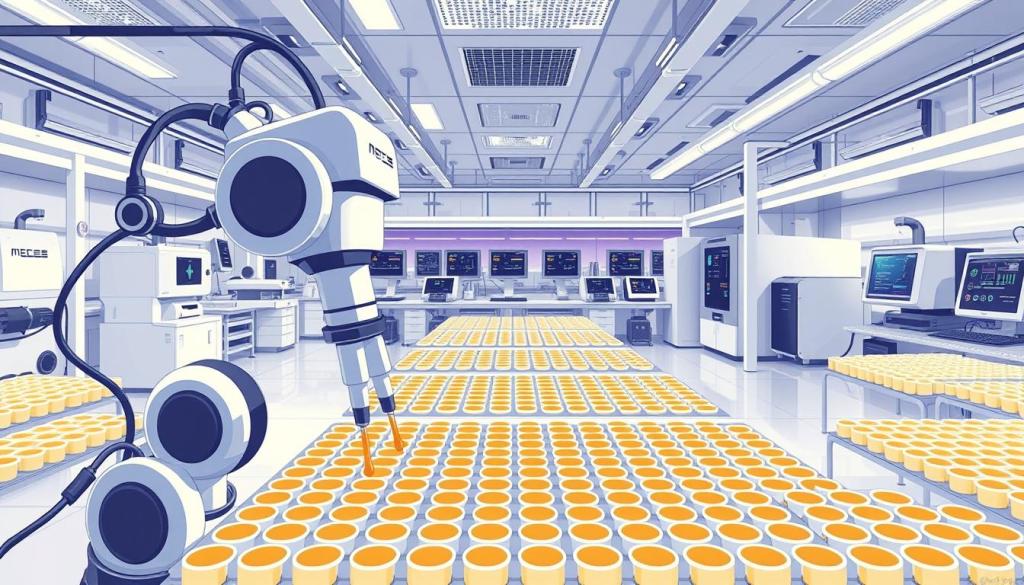
Now, robots can handle 96 well plate analysis like never before. They do detailed tasks quickly and accurately. This has changed how we do research in many fields.
Robotic Systems for High-Throughput Screening
Robots like the FLO i8 are at the top of lab automation. They have:
- 8 fully-independent liquid handling channels
- Precise volume range from 0.5 μL to 1000 μL
- Exceptional transfer precision
- Rapid plate processing capabilities
Software Integration for Data Management
Software is key for handling big data in high-throughput screening. It helps with:
- Automated data collection
- Real-time analysis
- Seamless research documentation
- Enhanced reproducibility
| Robotic System Capability | Performance Metric |
|---|---|
| Plate Processing Speed | 6 minutes per cell plate |
| Imaging Time | 7.5 minutes (full well coverage) |
| Media Exchange | 1 minute full cycle |
| Reagent Switching | 30 seconds between dispensing |
The future of lab research is combining robots and smart software. This will lead to new discoveries.
“Automation is not about replacing human ingenuity, but amplifying our capacity to explore the unknown.” – Scientific Research Innovator
Innovations in 96 Well Plate Technology
The world of microplate technology is always changing. This change is making a big difference in drug discovery and lab research. New ideas are changing how scientists design and collect data.
Advances in Materials
New materials in microplates have seen big improvements. Scientists use advanced polymers and special coatings. These help with:
- Clearer views for accurate measurements
- Being kinder to living cells
- Less background noise
Development of Specialized Plates
Now, there are special 96 well plates for different needs. Scientists have access to plates made for specific tasks. These include:
- 3D cell cultures
- Organ-on-a-chip systems
- Fast drug testing
Smart Plates for Real-Time Monitoring
Smart plates are a big step forward in drug discovery. They have built-in sensors. These sensors watch over experiments as they happen, giving very precise data.
“Smart plates are changing how we see cell interactions and experiments.” – Laboratory Research Quarterly
| Innovation Type | Key Benefits | Impact on Research |
|---|---|---|
| Advanced Materials | Clearer views | More accurate data |
| Specialized Plates | Designed for specific uses | More flexible experiments |
| Smart Plate Technology | Watching experiments live | Speeds up finding new drugs |
These new technologies are making microplates better. They let researchers do more detailed and accurate work in drug discovery and cell studies.
Regulatory Considerations
Understanding the complex world of regulatory standards is key for labs using 96 well plates. Researchers must follow strict rules to make sure their experiments are reliable and can be repeated.
Compliance with Laboratory Standards
Laboratory standards are vital for keeping research honest. Important rules include:
- ISO 9001 Quality Management Standards
- ANSI/CLSI Guidelines for Laboratory Practices
- FDA Regulatory Requirements for Medical Devices
Quality Control Measures
Good quality control is crucial in biomedical research. Labs need to set up detailed plans to check 96 well plate performance. This helps reduce the chance of mistakes in experiments.
| Quality Control Parameter | Verification Method |
|---|---|
| Material Consistency | Batch Testing and Certification |
| Well Uniformity | Dimensional Precision Checks |
| Surface Treatment | Chemical Composition Analysis |
“Regulatory compliance is not just a requirement, but a commitment to scientific excellence and research integrity.” – Laboratory Standards Association
By following strict rules, labs can keep their research at the highest level. This is important for the quality and reliability of their work in laboratory automation.
Conclusion: The Future of 96 Well Plates
The 96 well plate format is key in modern biomedical research. It drives innovation in many scientific fields. As drug discovery grows, these platforms offer new chances for quick and detailed research.
These miniaturized tools help scientists find new ways to study cells and test drugs. They make it easier to find important scientific discoveries quickly and accurately.
New technologies are changing lab work, with 96 well plates leading the way. Things like organ-on-a-chip and 3D cell culture are making these tools even more useful. Now, artificial intelligence helps analyze data from 96 well plates, making research even more advanced.
Trends in Laboratory Automation
The future of science depends on improving 96 well plate technology. New systems for handling liquids and advanced imaging are making research better. These tools help scientists do complex tests faster and more accurately.
They also help save resources and get more useful information from experiments. This makes research more efficient and effective.
Impact on Public Health and Research
Advanced 96 well plate technology is crucial for solving big health problems. It helps in creating new medicines and understanding how cells work. These tools are essential for moving medical science forward.
As research keeps getting better, 96 well plates will stay a key part of finding new health solutions. They connect innovation with real health benefits.
FAQ
What is a 96 well plate?
A 96 well plate is a tool used in labs. It has 96 small wells in a grid. This makes it great for doing lots of tests at once with just a little bit of sample.
What materials are typically used to manufacture 96 well plates?
Most 96 well plates are made from polystyrene or polypropylene. These materials are chosen for their clearness, resistance to chemicals, and support for many lab tasks.
How are 96 well plates used in scientific research?
96 well plates are used in many lab tasks. They help with growing cells, testing drugs, and studying DNA. They let scientists do lots of tests at once, saving time and resources.
What are the main advantages of using 96 well plates?
The big benefits are doing lots of tests at once, saving money, and needing only a little bit of sample. They also work well with lab machines and help make experiments more precise.
How do researchers prevent contamination in 96 well plates?
To avoid contamination, labs use strict cleaning methods like autoclaving and UV light. They also wear protective gear and handle samples carefully.
Can 96 well plates be used for different types of experiments?
Yes, 96 well plates come in different shapes for different tests. They’re good for growing cells, studying proteins, and doing many other lab tasks.
How has automation impacted 96 well plate research?
Automation has changed lab work a lot. It uses machines and software to handle samples, track experiments, and make results more reliable.
What emerging technologies are being integrated with 96 well plate research?
New tech includes smart plates, 3D cell cultures, and advanced computer tools. These help with better data and new ways to study cells and diseases.
Are there regulatory standards for 96 well plate usage?
Yes, labs follow rules from ISO and ANSI. These rules help make sure experiments are reliable, data is correct, and research is done ethically.
What future developments are expected in 96 well plate technology?
Future tech will likely include better materials, more sensors, and better fit with new research methods. This will help with finding new medicines and personalized treatments.




Leave a Comment
Your email address will not be published. Required fields are marked *