



These microplates are a big step forward in scientific testing. They’re made with top-notch engineering. This lets researchers do complex tests fast and accurately. Each plate has 96 wells in an 8×12 grid, perfect for testing many things at once.
Today’s microtiter plates are made from high-quality polystyrene. They come in different shapes, like flat, “U”, and “V”. These plates are used in biotech, pharma, medical tests, and more.
Scientists use these plates for their amazing performance. They’re great for quick tests, ELISA, cell studies, and more. They’re key to many lab tasks.
Key Takeaways
- 96 microwell plates enable simultaneous testing of multiple samples
- Standardized 8×12 grid design supports diverse research applications
- Made from high-quality polystyrene with multiple bottom configurations
- Critical tool in biotechnology, pharmaceutical, and medical research
- Supports high-throughput screening and complex experimental protocols
Introduction to 96 Microwell Plates
Microwell plates are a big step forward in lab tech. They change how we do research and testing. These plates let scientists run many tests at once on one plate.
Well plates are used in many fields. They help scientists work with small amounts of liquid very accurately and quickly.
Overview of Microwell Plate Design
A 96-well plate is a special design. It has a rectangular shape with certain sizes:
- Total wells: 96 in a 8×12 setup
- Well-to-well spacing: 9 mm
- Standard size: 127.76 mm × 85.48 mm
- Typical well size: 0.1 to 0.3 mL
Importance in Laboratory Settings
Microwell plates change lab work a lot. They help with:
- Running lots of tests at once
- Managing samples better
- Using less reagent
- Following the same test steps
Common Uses and Applications
| Field | Specific Applications |
|---|---|
| Medical Research | ELISA testing, cell culture, drug screening |
| Biotechnology | Protein analysis, genetic research |
| Pharmaceutical | Compound screening, toxicity studies |
The 96-well plate is key in today’s science. It makes tests more precise and efficient.
Scientists keep finding new ways to use microwell plates. They help us discover more in many areas of science.
Types of 96 Microwell Plates
The world of microplate technology offers many solutions for lab research. Different designs meet various scientific needs. Researchers use different 96 microwell plates to improve their work.
Standard Plates for ELISA
ELISA plates are key in immunoassay research. They have special surfaces for protein binding and detection. They have:
- High-binding polystyrene surfaces
- Consistent well geometry
- Optical clarity for precise measurements
Deep-Well vs. Shallow-Well Plates
Microplate design changes between deep-well and shallow-well plates. Deep-well plates hold more samples. Shallow-well plates are better for handling small samples.
| Plate Type | Volume Capacity | Typical Application |
|---|---|---|
| Deep-Well Plates | 1-2 mL per well | Bacterial culture, sample storage |
| Shallow-Well Plates | 100-300 µL per well | PCR, enzyme assays |
Specialized Plates for High-Throughput Screening
Advanced microplate designs support complex high-throughput screening. Specialized plates have:
- Ultra-low non-specific binding surfaces
- Optical film bottoms for enhanced detection
- Compatibility with automated liquid handling systems

Selecting the right microplate is crucial for achieving precise and reproducible scientific results.
The evolution of microplate technology keeps driving innovation in lab research. It helps scientists do more efficient and accurate experiments in many fields.
Benefits of Using 96 Microwell Plates
Researchers and lab experts are always looking for ways to make their work easier. 96 microwell plates are a key tool in this quest. They bring big benefits to today’s labs.
Multiplex assays and automated liquid handling have changed lab work for the better. 96 microwell plates are at the heart of this change.
Cost-Effectiveness in Lab Testing
Labs have to watch their budgets closely. 96 microwell plates help by being cost-effective. They do this by:
- Using less reagent
- Needing less sample
- Allowing for many tests at once
Increased Efficiency and Throughput
Fast data is key for new research. These plates make labs more efficient by:
- Supporting up to 90 wells at once
- Handling volumes from 20 to 1000 µl
- Helping with quick screening tests
Enhanced Experiment Precision
Getting precise results is crucial in science. 96 microwell plates excel in this area. They offer:
| Performance Metric | Result |
|---|---|
| Magnetic Particle Collection | >99.4% Efficiency |
| RNA Yield Consistency | Significantly Improved |
| Ribosomal RNA Ratio | 2:1 Average |
“The evolution of 96 microwell plates represents a quantum leap in laboratory technology, enabling researchers to achieve unprecedented levels of experimental precision and efficiency.”
These advanced plates improve multiplex assays and work well with automated systems. They are a big step forward in science.
Materials Used in Fabrication
The choice of materials for 96 microwell plates is key to lab success. Scientists must pick the right material for their research. This ensures the best results in their studies.
Polystyrene vs. Polycarbonate Plates
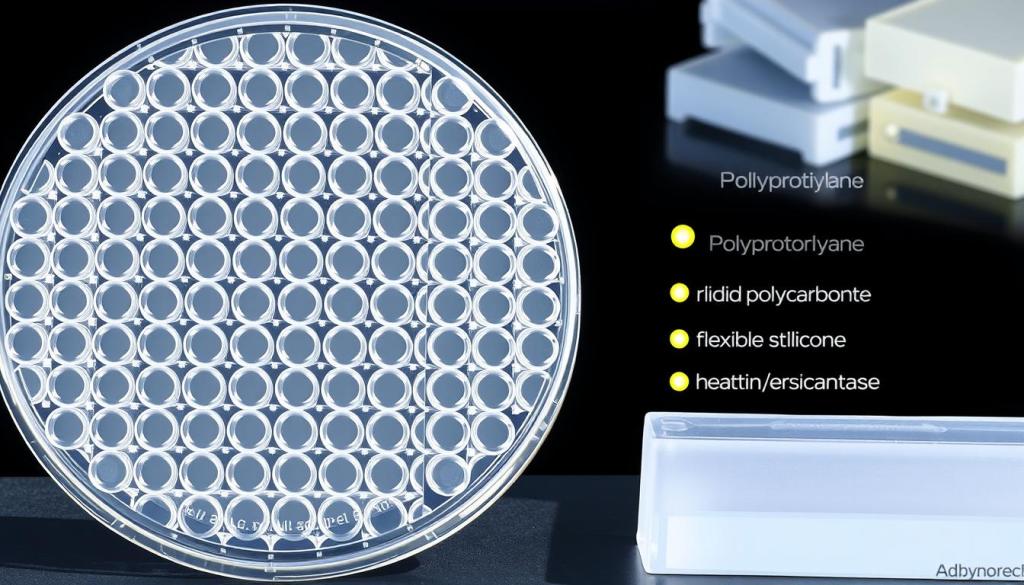
Three main materials are used in making microplates: polystyrene, polypropylene, and cycloolefin. Polystyrene is the top choice for 96 microwell plates. It has special features that make it ideal:
- High optical transmission grade
- Standard 12 x 8 configuration
- Alpha-numeric position markings
Coating Options for Optimal Performance
Coatings on microplates can boost their performance in certain tests. The surface treatment affects how well the plate works in experiments.
| Plate Material | Key Properties | Recommended Applications |
|---|---|---|
| Polystyrene | High optical clarity | ELISA, protein binding assays |
| Polypropylene | Chemical resistance | PCR, sample storage |
| Cycloolefin | Optical window to 230 nm | Nucleic acid detection |
Considerations for Biocompatibility
Biocompatibility is vital when picking 96 microwell plates. Scientists need to think about:
- How the material interacts with biological samples
- Any non-specific binding
- How it handles temperature and chemicals
The right microplate material can dramatically improve experimental precision and reliability.
Knowing about these material details helps scientists choose the best plate for their research.
Essential Features of 96 Microwell Plates
The world of lab research depends on precise tools. 96 microwell plates are key, offering a platform for many experiments.
Well Dimensions and Volume Capacities
Microwell arrays have special designs for research. Typical 96-well plates have:
- Standardized footprint of 127.76 mm × 85.48 mm
- Well spacing of 9 mm between centers
- Volume capacities ranging from 0.1 to 0.3 milliliters per well
Compatibility with Various Assays
Different well plates meet various research needs. You can choose from:
- Round bottom wells
- Flat (F-bottom) wells
- V-bottom wells
- U-bottom wells
Sterility and Packaging Considerations
Choosing the right assay plate is crucial. It involves material and sterility. Manufacturers provide:
| Material | Temperature Range | Key Characteristics |
|---|---|---|
| Polystyrene | Up to 80°C | High optical clarity |
| Polypropylene | -80°C to 121°C | Autoclavable, temperature resistant |
| Cyclo-olefin | Variable | Ultraviolet light transmission |
*”Selecting the right microwell plate is not just about capacity, but understanding its specific performance characteristics.”* – Laboratory Research Innovations
When picking a well plate, think about surface treatments and binding properties. The right microwell array boosts experiment precision and reliability.
How to Choose the Right 96 Microwell Plate
Choosing the right 96 microwell plate is key for lab success. It’s important to look at several factors for the best results.
Assessing Application Requirements
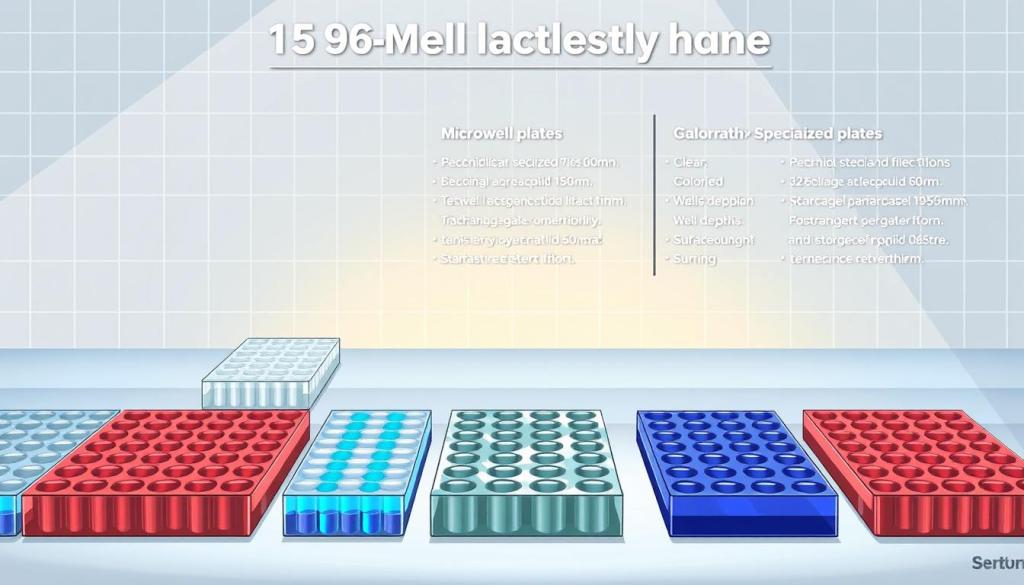
Think about these important points when picking a microwell plate:
- What type of assay do you need (colorimetric, fluorescence, luminescence)?
- What kind of microplate reader do you use?
- What are the well bottom needs?
- How much sample do you need and what’s the working range?
Understanding Plate Specifications
Material and design of the plate matter a lot. For high-throughput screening, consider:
- Wall color (black helps reduce light scattering)
- How transparent the bottom is for certain detection methods
- Is the surface treatment right for your needs?
- Does it handle temperature and solvents well?
Comparing Brands and Product Varieties
Look at what different makers offer. Important things to think about include:
- How well it works for fluorescence and luminescence
- The material it’s made of (polystyrene, polypropylene)
- Is it sterilized and safe for tissue culture?
- Is it affordable for your research?
“The right microwell plate can make your experiments more precise and reliable.”
Choosing the right 96 microwell plates is crucial for lab success. It helps with advanced research and high-throughput screening.
Best Practices for Using 96 Microwell Plates
Researchers using 96 microwell plates must handle them carefully. Specialized microwell plates need precise handling to keep experiments reliable and consistent.
Proper Handling and Storage Techniques
Managing 96 microwell plates well involves several steps:
- Store plates in sealed packaging to prevent moisture contamination
- Maintain consistent temperature control
- Protect from direct sunlight and extreme environmental conditions
- Use clean, lint-free gloves during plate manipulation
Validating Assay Conditions
Researchers must validate assay conditions when using automated systems. Key factors include:
- Precise pipetting accuracy
- Volume consistency across wells
- Temperature stability
- Minimizing cross-contamination risks
Quality Control Best Practices
Quality control is crucial for reliable experiments. Researchers should:
- Conduct regular plate performance assessments
- Check for manufacturing consistency
- Verify well-to-well uniformity
- Document all experimental parameters
Precision in microwell plate management determines the success of scientific investigations.
| Quality Control Parameter | Recommended Action |
|---|---|
| Dimensional Stability | Regular measurement verification |
| Chemical Compatibility | Pre-testing with specific reagents |
| Optical Performance | Consistent signal-to-noise ratio checks |
By following these guidelines, researchers can improve their multiplex assays. They can also ensure reliable results with automated liquid handling techniques.
Troubleshooting Common Issues
Laboratory researchers often face problems with 96 microwell plates. Knowing how to solve these issues can greatly improve results and cut down on mistakes.
Addressing Contamination Concerns
Contamination is a big problem in microplate experiments. It’s important to follow strict protocols to keep microbes out:
- Use sterile technique during plate handling
- Implement proper storage conditions
- Select high-quality microplates with protective packaging
Handling Well Leakage or Breakage
The 96 microwell plate must be strong for reliable results. Here are ways to stop leaks:
- Inspect plates for manufacturing defects before use
- Use appropriate centrifugation techniques
- Avoid excessive mechanical stress
“Precision in microplate handling can prevent up to 80% of potential experimental errors.” – Laboratory Research Experts
Optimizing Reagent Compatibility
Choosing the right reagents is key for successful microplate experiments. Consider:
- Chemical interactions between reagents and plate material
- Potential background noise from media supplements
- Optimal gain settings for fluorescence-based readouts
Using electronic pipetting, like the Picus® from Sartorius, can lower pipetting mistakes. By following these tips, lab experts can make their experiments more reliable and avoid problems.
Innovations in Microwell Plate Technology
The world of lab research is changing fast with new microwell plate tech. Scientists are exploring new ways to design assay plates and improve microwell arrays.
Today’s well plate tech is changing science with big steps in material science and microfabrication.
Developments in Material Science
New ideas are changing the old well plate design. Big advances include:
- Advanced surface treatments for better cell adhesion
- Materials that are safer for cells
- Nano-engineered surfaces for exact control
Advances in Microfabrication Techniques
New microfabrication is making microwell arrays better. Scientists are making plates that are more precise and useful.
| Innovation | Key Benefit | Application |
|---|---|---|
| Gri3D® Plates | 3D Cell Culture Optimization | Organoid Research |
| Incucyte® Nanowell Plates | High-Throughput Screening | Live-Cell Analysis |
Future Trends in Laboratory Assays
The future of microwell plates is all about precision, efficiency, and adaptability. New trends include:
- Automated media exchange systems
- Improved work with imaging tools
- Custom solutions for unique research needs
“The next generation of well plates will transform how we conduct scientific research” – Dr. Özlem Vural
These new ideas will help speed up discoveries in biomedical research. They give scientists better tools for complex experiments.
Regulatory Standards and Compliance
Laboratory testing follows strict rules to ensure accuracy and trustworthiness. Microplate readers and high-throughput screening need to meet international standards. These standards protect the integrity of science and the results of research.
Laboratories face a complex world of rules to keep quality high. Following standardized guidelines helps researchers avoid mistakes. It also makes sure experiments can be repeated with the same results.
Overview of ISO Standards for Lab Equipment
The International Organization for Standardization (ISO) sets important guidelines for lab equipment, like microplate readers. Key standards include:
- ISO 9001: Quality management systems
- ISO 17025: Testing and calibration laboratory competence
- ISO 15189: Medical laboratory quality and competence
Guidelines from FDA and Regulatory Bodies
The Food and Drug Administration (FDA) has rules for lab equipment in high-throughput screening. These rules make sure:
- Equipment performs consistently
- Data is reported accurately
- Equipment is validated properly
Importance of Quality Assurance in Lab Testing
Quality assurance is key to reliable scientific research. Microplate readers must pass tough tests to meet high standards.
“Precision in measurement is the hallmark of scientific excellence.” – Laboratory Standards Institute
| Regulatory Aspect | Key Requirements | Compliance Impact |
|---|---|---|
| Equipment Calibration | Annual verification | Ensures accurate results |
| Data Traceability | Comprehensive documentation | Supports scientific reproducibility |
| Performance Validation | Systematic testing protocols | Maintains research integrity |
Researchers using microplate readers in high-throughput screening must stay on top of compliance. Following these standards ensures the trustworthiness and reliability of scientific studies.
Conclusion: The Future of 96 Microwell Applications
Scientific research is changing fast with new 96 microwell plate technologies. Researchers use multiplex assays and automated systems to make experiments easier. These tools help get more precise data in many fields.
Now, labs focus more on being green. The 96 microwell plate helps use less reagent and cut down on waste. It lets scientists work better and still keep high-quality results. The small size of these wells makes it easy to create uniform 3D cell groups.
Potential Impact on Biomedical Research
New tech is changing how we do biomedical research. Advanced microwell plates help with cancer, stem cell, and drug studies. With more cancer cases expected, these tools are key for finding new treatments.
Emphasis on Sustainability in Lab Practices
Companies making lab gear are making it greener. The 96 microwell plate is a big step toward eco-friendly science. It uses less reagent and is more precise. New microfabrication methods make experiments cheaper and more sustainable.
Final Thoughts on Choosing the Right Microwell Plate
Choosing the right microwell plate is important. Scientists need to think about what they want to study, what works best, and how well it performs. The future of science depends on keeping improving microwell plate tech.
FAQ
What are 96 microwell plates used for in scientific research?
96 microwell plates are key tools in labs. They’re used for ELISA testing, cell culture, and drug screening. They help researchers work on many samples at once, saving time and resources.
What materials are typically used to manufacture microwell plates?
Polystyrene and polycarbonate are common materials. Polystyrene is cheap and works well with many tests. Polycarbonate is stronger and better for extreme temperatures.
How do I choose the right 96 microwell plate for my experiment?
Choose based on your assay needs, sample size, and well depth. Consider the plate’s material, coating, and sterility. Think about how it fits with your detection methods.
What are the standard volume capacities for 96 microwell plates?
They hold 50 to 400 microliters per well. Shallow-well plates are for 100-200 microliters. Deep-well plates can handle up to 2 milliliters.
How should 96 microwell plates be stored to maintain their quality?
Store them in a clean, dry place away from sunlight and extreme temperatures. Keep them in their packaging until use. Handle them carefully to avoid damage.
What regulatory standards apply to 96 microwell plates?
They follow ISO 9001, ISO 13485, and FDA guidelines. These ensure quality, sterility, and reliability.
What are the key considerations for preventing contamination in microwell plates?
Use sterile techniques and wear protective gear. Work in a clean area and use certified plates. Follow quality control during handling and processing.
What innovations are emerging in microwell plate technology?
New developments include better surface coatings and microfluidic integration. There are also specialized plates and improved materials for better detection and analysis.






Pingback: 96 Microwell Plates: Essential Lab Testing Solutions
Pingback: 96 Microwell Plate: Laboratory Research Essentials