



Ever thought about how precise measurements change science? The 96-well plate well diameter is key but often missed. It greatly affects the results of experiments.
A 96-well plate is a key tool in science, with exact dimensions for precise research. Researchers count on these precise 96-well plates for reliable results in many fields.
Well sizes usually go from 5 mm at the top to 4.38 mm at the bottom. There are also U-bottom, V-bottom, and F-bottom designs. These options help scientists pick the best plate for their research.
Key Takeaways
- 96-well plates have standardized dimensions of 127.76 x 85.48 mm
- Well diameters vary between 4.38-5 mm depending on plate type
- Different bottom designs impact sample handling and experimental precision
- Well diameter directly influences sample volume and experimental outcomes
- Proper plate selection is crucial for research reproducibility
Introduction to 96-Well Plates
The 96-well plate is key in today’s lab work. It has changed how scientists do experiments. These plates help researchers work more efficiently and accurately.
These tools are crucial in many lab settings. They make it easier for scientists to design and run experiments. This leads to more precise and reliable results.
Importance in Laboratory Research
96-well plates are great for many research areas:
- Cell culture experiments
- High-throughput screening
- Molecular biology studies
- Pharmaceutical research
- Genomic analysis
“The 96-well plate is not just a tool, but a gateway to scientific discovery.” – Research Innovation Journal
Overview of Applications
These microplates are vital in many fields. They let scientists work on many samples at once. This saves a lot of time and resources.
Design Variations
There are many types of plates for different needs:
- Bottom types: Flat, round, or conical
- Material composition: Polystyrene, polypropylene
- Color options: Clear, black, white
- Surface treatments: Tissue culture-treated, non-treated
Knowing about these options helps scientists get better results. It lets them tailor their experiments for success.
Standard Well Diameter Measurements
Researchers working with 96-well plates need to know about well diameter measurements. These exact sizes are key for high-throughput screening and well volume in labs.
Common Dimensions in 96-Well Plates
Standard 96-well plates have specific sizes for consistent experiments. Important measurements include:
- Top well diameter: 5 mm
- Bottom well diameter: 4.38 mm
- Total well depth: 9.00 mm
- Well spacing (center to center): 9.02 mm
Manufacturer Variability
Even though there are standard sizes, different makers might vary a bit. These small changes can affect how much liquid a well holds. It’s important for researchers to check the plate details to get the best results.
Well Shape Influence
The shape of wells also matters a lot. Different shapes can change how samples interact and affect screening:
- U-bottom plates: Working volume range 40-280 μl
- V-bottom plates: Working volume range 25-340 μl
- F-bottom plates: Good for many uses
“Precision in well diameter is not just a measurement—it’s a critical factor in scientific accuracy.” – Laboratory Research Journal
Knowing these details helps researchers pick the right 96-well plate for their experiments. This ensures reliable and consistent data.
Factors Affecting Well Diameter
It’s key to know what affects 96-well plate performance. This knowledge helps in getting the best results in sample handling and accuracy. Scientists need to look at several factors that change well size and how well the plate works.
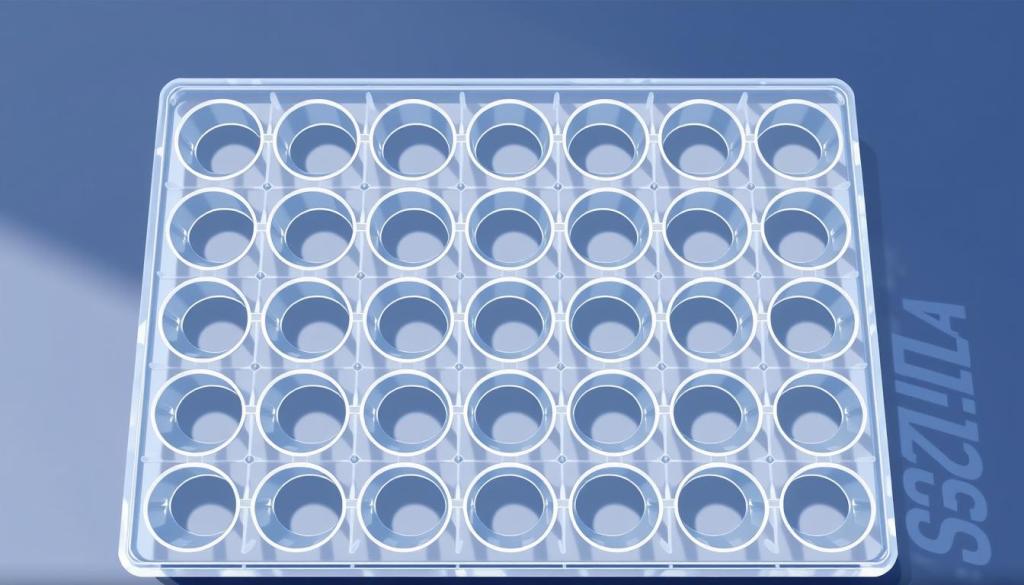
Material Composition Dynamics
The type of material in 96-well plates is very important. Materials like polystyrene, polypropylene, and others have special traits. These traits greatly influence well size and the results of experiments.
- Polystyrene: Great for optical tests
- Polypropylene: Best for handling chemicals
- Cycloolefin: Keeps temperature steady
Manufacturing Process Precision
How well plates are made affects their size. The method used, like injection molding, and quality checks are key. They help ensure the wells are the right size for precise liquid handling.
“The smallest changes in making can lead to big differences in results.”
Purpose-Driven Design Considerations
The purpose of a 96-well plate shapes its design. For example, plates for cell culture, molecular tests, or storing samples need specific sizes. These sizes are crucial for the best sample handling and reliable results.
| Research Application | Recommended Well Diameter |
|---|---|
| Cell Culture | 6.4-7.0 mm |
| Molecular Assays | 6.2-6.8 mm |
| Sample Storage | 6.3-6.9 mm |
Significance of Well Diameter in Experiments
Researchers know that the size of microplates is key in experiments. The size of the wells in 96-well plates affects how much sample you can use. It also changes how well the assay works and the results you get.
It’s important to understand how well size and what you need in an experiment are connected. This helps make sure your science is accurate.
Impact on Sample Volume
The size of the wells in a plate reader matters a lot. It affects how much liquid you can use in your experiments. Here are some common sizes for 96-well plates:
- 25-340 μl for standard F-bottom plates
- 15-175 μl for half-area plates
Consequences on Assay Performance
The exact size of the wells can change important things in your experiment:
- How well you can detect signals
- How well things mix
- How consistent your measurements are
| Well Characteristic | Performance Impact |
|---|---|
| Diameter Uniformity | Reduces measurement variability |
| Volume Consistency | Enhances reproducibility |
Considerations for Sample Interaction
Microplate dimensions greatly affect how samples interact with the plate. Different well sizes can change things like:
- How cells stick to the plate
- How proteins bind
- How reagents spread out
Picking the right well size can make your experiments much more reliable and your data better.
Compatibility with Laboratory Equipment
Precision in lab work needs top-notch equipment. 96-well plates are key, linking various scientific tools. They ensure smooth high-throughput screening and precise liquid handling across many research areas.
Pipetting Techniques
Good pipetting needs careful attention to well size and shape. Researchers can improve liquid handling by choosing the right pipettes:
- Single-channel pipettes for precise manual transfers
- Multi-channel pipettes for quick, simultaneous sampling
- Automated systems for handling large volumes
Microplate Reader Compatibility
Today’s microplate readers need exact plate sizes. Standard 96-well plates fit perfectly, allowing for consistent optical readings. This helps researchers get reliable results with different tools.
| Parameter | Specification |
|---|---|
| Well Diameter (Top) | 8.53 mm |
| Well Diameter (Bottom) | 7.60 mm |
| Maximum Volume | 1.3 mL |
| Temperature Range | -80°C to 120°C |
Storage Considerations
Keeping samples safe is key. ANSI/SLAS standards outline how to store plates right. This includes controlling temperature and using protective packaging.
“Precision in equipment compatibility transforms scientific research from good to exceptional.” – Laboratory Innovation Quarterly
Choosing the Right 96-Well Plate
Choosing the right 96-well plate is key for lab success. It’s important to look at the plate’s specs to get the best results. This helps in optimizing sample throughput and improving experimental outcomes.
Different research needs call for different plates. It’s all about understanding what each plate can do for your research.
Applications and Experiment Needs
Research needs vary, so the plate must match. When picking a 96-well plate, think about these:
- What your experiment needs
- How much sample you’ll use
- The detection method you’ll use
- The optical properties needed
Understanding Plate Formats
There are many 96-well plate formats for different research needs:
| Plate Type | Recommended Application | Key Features |
|---|---|---|
| Standard Bottom | General cell culture | Versatile, broad usage |
| Black Plates | Fluorescence assays | Minimizes background signal |
| White Plates | Luminescence experiments | Maximizes signal reflection |
| UV-Transparent | Spectroscopic measurements | Low absorbance below 320 nm |
Evaluating Vendor Options
When picking a plate vendor, consider these:
- How consistent their quality is
- If results are reproducible
- What specialized coatings they offer
- The quality of their technical support
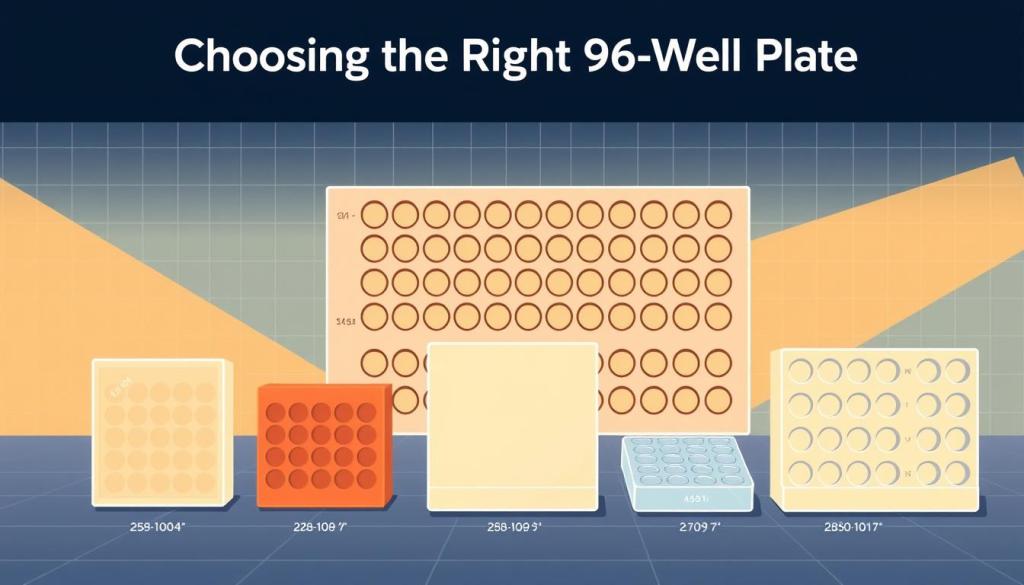
“The right plate can make or break your experimental results.” – Laboratory Research Experts
Choosing the right plate is crucial for reliable scientific results.
Maintenance and Care of 96-Well Plates
Keeping 96-well plates in good shape is key for reliable results. Lab experts need to know about microwell size and well volume. This helps keep the plates working well and avoids problems in research.
Researchers must be careful and detailed when handling 96-well plates. The standard well size of 6.4 mm (± 0.2 mm) needs to be handled with care. This prevents damage or contamination.
Proper Handling Techniques
- Always use clean, sterile gloves when manipulating plates
- Avoid touching the bottom or inner surfaces of wells
- Handle plates on flat, stable surfaces to prevent warping
- Minimize unnecessary plate movement during experiments
Cleaning and Sterilization Methods
Different materials need special cleaning to keep their shape and function.
| Plate Material | Cleaning Method | Sterilization Technique |
|---|---|---|
| Polystyrene | Gentle washing with mild detergent | Autoclave at 121°C |
| Polymer | 70% ethanol rinse | UV radiation |
| Glass | Acid wash | High-temperature dry heat |
Tips for Long-Term Storage
Keeping the well volume capacity safe during storage is crucial for consistent results.
- Store plates in sealed containers
- Maintain consistent temperature (typically 4°C)
- Protect from direct light exposure
- Use desiccant packets to control moisture
*”Precision in plate maintenance directly correlates with research reliability”* – Laboratory Best Practices Manual
By following these careful steps, researchers can make sure their 96-well plates work well. This helps get reliable scientific results.
Innovations in 96-Well Plate Design
The world of lab research is changing fast. New 96-well plate designs are making a big impact. These designs are more advanced than ever before.
Recent Technological Advances
New 96-well plate technologies are solving tough research problems. They come with special surface treatments that change how we do experiments:
- Ultra-low attachment surfaces for unique cell culture needs
- 3D-printed plates with precise well shapes
- Integrated sensors for instant data
Future Trends in Laboratory Plates
The next wave of lab plates will change science forever. New designs are making high-throughput screening better. This is thanks to innovative ideas.
| Innovation Type | Key Characteristics | Research Impact |
|---|---|---|
| Smart Surface Coatings | Special layers for protein and cell interactions | More precise experiments |
| Modular Plate Designs | Wells that can change shape | More flexible experiments |
Eco-Friendly Materials and Sustainability
Science is now meeting green goals. Makers are creating sustainable microplate solutions. These options are good for the planet and still work great.
“The future of lab research is not just about tech, but also about being green.” – Dr. Elena Rodriguez, Biotechnology Research Institute
Green plate materials are becoming popular. They include biodegradable plastics and recycled stuff. These keep the exact sizes needed for precise science.
Analyzing Experimental Results
Researchers using 96-well plates must focus on data analysis and interpretation. The precision of plate reader compatibility and liquid handling accuracy is crucial for reliable scientific results.

Examining data from 96-well plates requires careful attention. Scientists need to use strict strategies for understanding complex data from high-throughput screening.
Importance of Consistent Measurements
Consistent measurements are key to reliable experiments. Researchers should consider a few important points:
- Standardizing plate reader compatibility settings
- Maintaining liquid handling accuracy across experiments
- Documenting precise measurement protocols
- Tracking potential variations in well diameter
Data Interpretation Strategies
Effective data interpretation needs a systematic approach. Researchers can improve their analysis by:
- Implementing robust statistical techniques
- Utilizing computational tools for data normalization
- Identifying and managing experimental variations
- Cross-referencing multiple data points
Statistical Considerations
Statistical analysis is vital for validating findings. It involves understanding sample distribution, calculating standard deviations, and applying the right statistical tests to ensure data integrity.
“Precision in measurement leads to confidence in scientific discovery.” – Research Methodology Principle
By using advanced plate reader compatibility and maintaining liquid handling accuracy, researchers can greatly enhance the reliability and reproducibility of their results.
Troubleshooting Common Issues
Researchers often face challenges with 96-well plates. It’s key to solve problems related to diameter to keep assays running smoothly. This ensures the best results for sample throughput.
Identifying Diameter-Related Problems
Well diameter issues can affect experiments. The standard 6.4 mm diameter can cause problems. These include:
- Inconsistent liquid volume distribution
- Uneven cell growth patterns
- Measurement discrepancies
- Reduced experimental reproducibility
Solutions for Well Variability
Fixing well variability needs careful planning. Precision is key for microplate performance.
| Problem | Solution |
|---|---|
| Dimensional Inconsistencies | Use ANSI/SLAS standard-compliant plates |
| Liquid Handling Errors | Calibrate pipettes regularly |
| Surface Interactions | Select appropriate plate coating |
Best Practices for Experiment Replication
Good research relies on consistent methods. Researchers should:
- Standardize plate selection criteria
- Document precise handling techniques
- Validate equipment compatibility
- Implement rigorous quality control
“Precision in microplate techniques determines the reliability of scientific investigations.” – Laboratory Research Standards Institute
Knowing these troubleshooting tips helps researchers reduce variability. This improves results in high-throughput screening.
Regulatory Compliance and Standards
Understanding microplate dimensions is key in the lab world. It’s all about following strict rules to make sure everything works right. This is crucial for reliable results in research.
The size of 96-well plates is very important in science. Rules are in place to keep quality high and equipment working well together.
Understanding Industry Standards
Big names like the American National Standards Institute (ANSI) and the Society for Laboratory Automation and Screening (SLAS) set the rules. They make sure 96-well plates are made the same way everywhere.
- ANSI/SLAS 1-2004 Footprint Dimension standards
- Comprehensive specifications for plate consistency
- Ensuring equipment compatibility across laboratories
Certifications to Consider
When picking 96-well plates, look for important certifications. These show the plates are up to par:
| Certification | Focus Area | Importance |
|---|---|---|
| ISO 9001 | Quality Management | Ensures consistent manufacturing processes |
| ANSI Standards | Dimensional Accuracy | Validates microplate dimensions and well diameter |
| GMP Certification | Manufacturing Practices | Guarantees high-quality production standards |
Best Practices in Compliance
To stay compliant, you need to be very careful. Labs should check their plates closely and keep good records. This makes sure they meet the standards.
Precision in microplate dimensions is not just a technical requirement, but a fundamental aspect of scientific integrity.
Keeping an eye on the well diameter, what the plates are made of, and how they’re made is vital. This helps labs stay at the top of their game.
Conclusion: The Future of 96-Well Plates
The world of scientific research is changing fast, thanks to new microwell technologies. High-throughput screening is now key in labs, leading to better 96-well plate designs. The size of microwells is also crucial for precise and efficient experiments.
New trends show great promise in custom plate designs. We’re seeing plates with built-in sensors and surfaces tailored for cell cultures. The standard 6.4 mm well size is just the start, with new designs aiming for better signal detection and less error.
Advances in biomedicine and biotechnology rely on advanced microplate tech. These plates can handle volumes from 50 μL to 200 μL, giving researchers more flexibility. This means they can do more with less, speeding up discoveries and saving resources.
Choosing the right 96-well plate is still vital for research. It’s important to think about the surface, well shape, and how it fits with lab gear. The future of science depends on mastering these tech details to explore new biological areas.
FAQ
What is the standard well diameter for a 96-well plate?
A standard 96-well plate has wells about 6.4 mm to 7.1 mm wide. This size fits most lab tools. It helps keep experiments consistent.
How does well shape affect the diameter and volume capacity?
Well shapes like U-bottom, V-bottom, and F-bottom can change the well size slightly. U-bottom wells are usually the same size. But V-bottom and F-bottom wells might vary, affecting how much sample you can use.
What materials are commonly used in 96-well plate manufacturing?
Most plates are made from polystyrene or polypropylene. Each material has its own benefits. They can change how the plate works for different research needs.
How do well diameter variations impact experimental results?
Changes in well size can mess up your results. They can change how much liquid you use, how well it mixes, and how you detect signals. It’s important to have the same size wells for reliable results.
What factors should researchers consider when selecting a 96-well plate?
Think about what you need for your experiment. Consider the volume, bottom type, material, surface treatment, and if it works with your lab tools.
Are there specialized 96-well plate formats available?
Yes, there are many types like standard, half-area, deep-well, and low-volume plates. Each is made for different needs, like growing cells or saving space.
How can researchers ensure consistent well diameter across different plates?
Choose high-quality plates from trusted makers. Use strict quality checks and plates from the same batch. Calibrate often and handle plates carefully to avoid mistakes.
What are the most common applications for 96-well plates?
96-well plates are used a lot. They’re good for growing cells, testing many things at once, doing ELISA tests, PCR, growing bacteria, and storing compounds in research.
How do environmental factors impact 96-well plate performance?
Things like temperature and humidity can harm the plate. Store them right and follow the maker’s advice to keep them good.
What emerging trends are influencing 96-well plate design?
New trends include plates that don’t let things stick, plates with sensors, 3D-printed ones, green materials, and designs for new tech like organ-on-a-chip and 3D cell culture.






Leave a Comment
Your email address will not be published. Required fields are marked *