


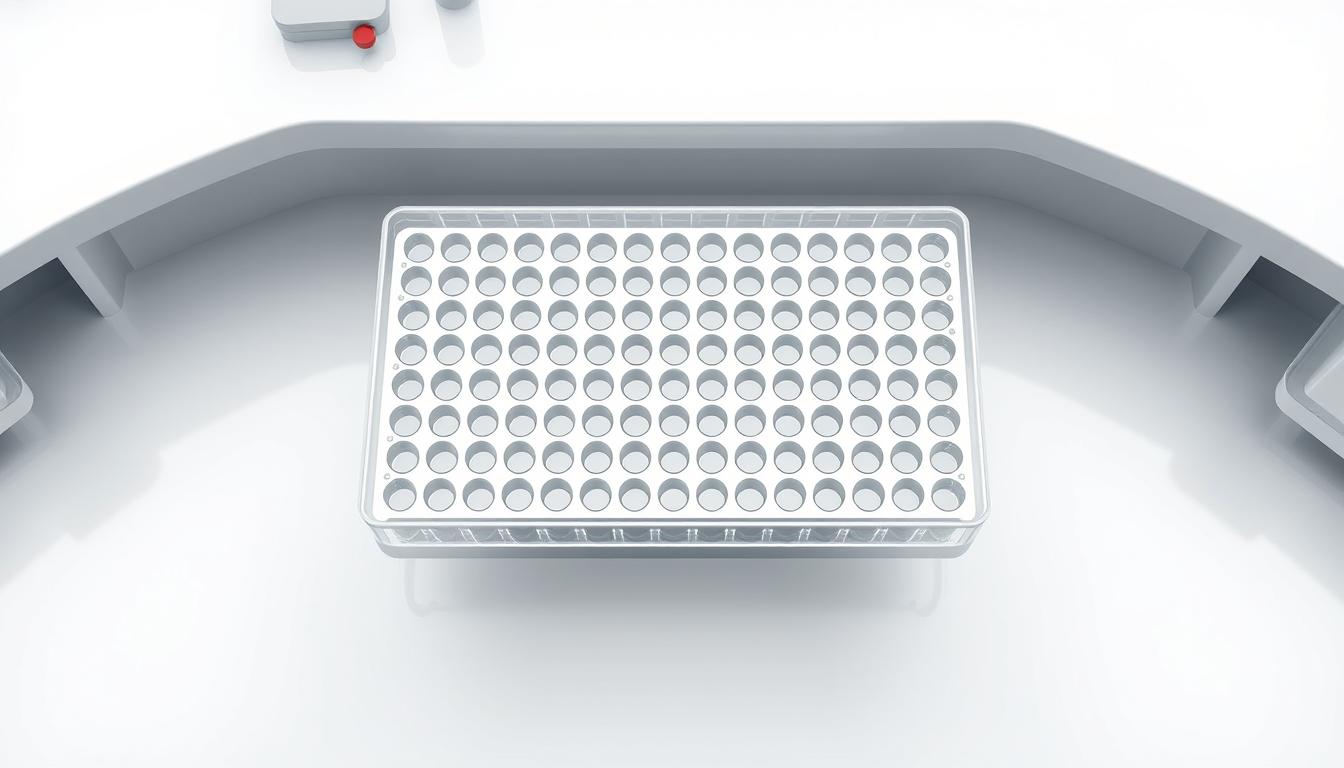
Have you ever thought about how researchers measure the tiny surface of a microplate? It’s not just a simple task. It’s key to making new scientific discoveries.
For scientists, knowing the size of a microplate is very important. Each 96 well plate has 0.32 cm² per well. This helps them plan their experiments very carefully.
The story of 96 well plates started in 1955 with Dr. Gyula Takatsy’s design. It changed how scientists work by making it easier to process samples. Today, these plates are used in many complex experiments.
Getting the area right is very important for scientists. It helps them decide how much reagent to use and affects their results. Being able to calculate the area accurately helps them make their experiments better and more consistent.
Key Takeaways
- A standard 96 well plate contains 0.32 cm² surface area per well
- Precise microplate measurements are essential for scientific research
- Historical innovations have shaped modern microplate design
- Accurate area calculations optimize experimental protocols
- Microplate dimensions directly influence research outcomes
Understanding the Structure of a 96 Well Plate
Laboratory researchers use precise tools for their work. The 96 well plate is a key tool for testing many samples at once. Knowing how it’s structured is key to designing good experiments.
The 96 well plate has a special design to make research more efficient. It has a layout that works well for many scientific tasks. This design is made with great care to support different uses.
Plate Dimensions and Configuration
A standard 96 well plate has certain features:
- Total wells: 96
- Row configuration: 8 rows (A-H)
- Column configuration: 12 columns (1-12)
- Standardized well volume: Typically ranges between 200-350 µL
Well Arrangement and Characteristics
The design of the wells and the plate is made for different needs. Each well is placed carefully for:
- Consistent sample handling
- Uniform reagent distribution
- Accurate measurement capabilities
Well Depth Considerations
The depth of each well is important for accurate results. Different studies need different well depths. This helps manage samples better and reduces errors.
Precision in plate design enables researchers to conduct complex experiments with enhanced reliability and reproducibility.
Researchers need to pick the right 96 well plates for their work. They should think about well volume, plate material, and surface treatments.
Importance of Calculating Well Plate Area
Precision is key in lab work, especially with assay plates. The area of a 96-well plate is crucial for good results, especially in high-throughput screening.
- Optimized cell seeding density
- Accurate reagent volume management
- Enhanced experimental reproducibility
- Improved data reliability
Applications in Laboratory Research
In cell culture studies, the surface area matters a lot. A standard 96-well plate has 0.32 cm² of total surface area. This affects cell growth and interaction. Researchers can seed about 10,000 cells per well, making experiments consistent.
Impact on Experimental Design
High-throughput screening needs precise area measurements. The plate’s size affects reagent volumes, cell distribution, and experiment efficiency. Microplates with smaller wells help process samples better and save materials.
Benefits of Accurate Measurements
“Precision in measurement is the cornerstone of scientific discovery” – Research Methodology Institute
Accurate area calculations give researchers important insights:
- Better control of cell density
- Reduced experimental variability
- Enhanced signal intensity in assays
- Improved resource allocation
By getting good at calculating well plate areas, scientists can improve their research in cell culture and high-throughput screening.
Standard Area Calculation Method
Getting the area of wells right is key in microplate research. Scientists need precise measurements for dependable sample analysis in various experiments.
Formula for Area Calculation
To find the area of a well, use the formula A = πr². Here, r is the radius of the circular well. This simple formula helps scientists figure out the exact area in each well of a 96-well plate.
Step-by-Step Calculation Process
- Measure the exact radius of the well with a microscope or digital tool.
- Square the radius measurement.
- Multiply the squared radius by π (3.14159).
- Write down the area for future reference.
Common Mistakes to Avoid
When calculating areas for a microplate reader, watch out for these errors:
- Incorrect radius measurements.
- Math errors from rounding.
- Ignoring differences in well depth.
- Using old or inaccurate tools.
“Precision in measurement is the foundation of reliable scientific research.” – Laboratory Research Guidelines
The standard area calculation method helps researchers improve sample analysis. It offers a consistent way to measure well plates. Using these methods leads to better experimental results.
Variations in Well Plate Designs
Laboratory researchers use special bioassay platforms for precise work. It’s key to know the different well plate designs for the best results.

Each well plate design has its own purpose. They offer benefits for various research needs.
Types of Well Plates
- Flat-bottom plates for standard cell culture
- Round-bottom plates for suspension cultures
- V-bottom plates for improved liquid handling
- Deep well plates for high-volume storage
Factors Influencing Well Plate Area
Many things affect a bioassay platform’s performance. Material and surface treatments are big factors.
| Material | Characteristics | Best Used For |
|---|---|---|
| Polystyrene | Standard cell culture | Routine laboratory work |
| Polypropylene | Chemical resistance | Mass spectrometry |
| Tissue Culture Treated | Enhanced cell adhesion | Specialized cell research |
Choosing the Right Plate for Experiments
Choosing the right bioassay platform is important. Researchers need to think about the experiment’s needs.
The right well plate can greatly improve experimental accuracy and reliability.
When picking a plate, consider material, shape, and surface treatments. These affect how cells interact and how experiments work.
Considerations for Multi-Use Plates
Laboratory researchers face big challenges with multi-use microplates. The ability to reuse 96 well plates brings up complex issues. These issues affect how accurate and efficient experiments can be.
Reusability and Sterilization Challenges
Repeated sterilization can change the microplate’s dimensions and surface. Researchers need to think about how this might affect their results when using multi-use plates.
- Surface treatments may degrade after multiple sterilization cycles
- Dimensional changes can affect area of 96 well plate measurements
- Sterilization methods vary in their potential to impact plate integrity
Impact on Area Calculations
The area of a 96 well plate can change slightly with each use. Even small changes in the plate’s dimensions can cause big differences in research results.
“Precision in measurement is the cornerstone of reliable scientific research.”
Environmental Sustainability Considerations
Using multi-use plates can help reduce waste in labs. It’s a way to be eco-friendly while keeping research accurate. By following strict validation steps, researchers can meet both goals.
- Reduce plastic waste through strategic plate reuse
- Implement rigorous dimensional validation techniques
- Monitor surface integrity during repeated use cycles
Careful documentation and periodic assessment are key when using multi-use microplates in labs.
Instruments Used for Measuring Plate Area
Researchers use special tools to measure the size of laboratory equipment. These tools help get accurate results, which is very important. Choosing the right tools is key.
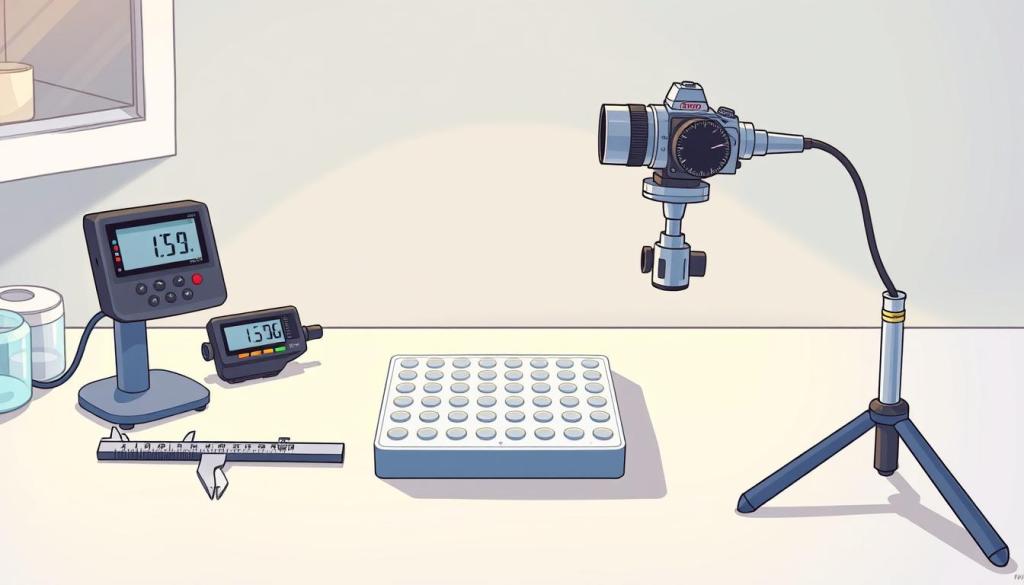
- Digital calipers
- Microplate readers
- Advanced imaging systems
- Optical measurement devices
Precision Measurement Tools
Digital calipers are a basic tool for measuring. They give accurate readings with little room for error. This helps scientists keep their experiments consistent.
Advanced Measurement Technologies
Microplate readers are a high-tech way to measure plates. The Gemini EM plate reader has great features:
- Wavelength range: 250 nm to 850 nm
- Top read sensitivity: 3 femtomoles of FITC
- Bottom read sensitivity: 8 femtomoles of FITC
- Support for multiple well configurations (96, 384, 24, 12, 6)
Instrument Selection Considerations
“The right measurement tool can make the difference between reliable data and experimental uncertainty.”
When picking tools, researchers should think about:
- How accurate the measurements are
- If the tool works with the type of plate they use
- How easy it is to calibrate
- The cost
The right tool is crucial for reliable results in lab work. It’s important to choose wisely.
Software Calculations and Simulations
Modern lab work uses advanced digital tools to make complex experiments easier. Special software has changed how researchers do assay plate calculations and high-throughput screening.
Today, lab researchers use top-notch computer solutions to improve old ways of measuring. These software tools give unmatched accuracy in checking 96 well plate setups.
Comprehensive Calculation Software Features
- Automated area measurement for assay plates
- Real-time data visualization
- Integrated statistical analysis tools
- Compatibility with multiple research platforms
Benefits of Digital Research Tools
High-throughput screening software brings big benefits for science:
- Reduces human error in calculations
- Speeds up data processing
- Allows for complex simulations
- Supports reproducible research
Digital tools have transformed laboratory research, making precise measurements more accessible than ever before.
Researchers can now create instantaneous visual representations of well plate layouts. This greatly boosts experimental efficiency and accuracy in science.
Practical Applications of Area Measurements
Getting precise measurements from microplate readers is key in science. It’s especially important when analyzing samples in different experiments. Knowing how well plate area affects experiments can really help improve results.

Scientists use area measurements to fine-tune important parts of their experiments. They focus on two main areas:
Reagent Volume Optimization
Knowing the exact area helps figure out how much reagent to use. This lets scientists use resources wisely:
- Save expensive reagents
- Keep experiments consistent
- Make research more affordable
Cell Density Considerations
The area of the well plate is crucial for seeding cells. Researchers must think about several things when deciding on cell density:
| Parameter | Typical Range | Significance |
|---|---|---|
| Platelet Concentration | >3 × 10^8/ml | Minimum threshold for effective assays |
| Assay Volume | 100-135 μl | Optimal for comprehensive analysis |
“Precision in area measurements transforms experimental design from guesswork to scientific methodology.” – Research Insights
By carefully calculating area, researchers can make their experiments more reliable. This leads to better data in many biomedical studies.
Future Trends in Well Plate Design
The world of bioassay platforms is changing fast, thanks to new tech. Things like 3D-printed microplates and organ-on-a-chip systems are changing how we do lab work. Scientists are looking into new materials and designs to change how we use well plates.
Innovations in Laboratory Technology
New tech in bioassay platforms is all about making things smaller and more custom. Companies are making deep well plates with cool features like RFID tracking and biodegradable materials. They’re also using materials like cyclic olefin copolymer (COC) and cyclic olefin polymer (COP) for better chemical resistance and clarity.
Anticipated Changes in Standard Practices
The future of well plate design is all about being more specialized and green. We’ll see more solutions made just for certain experiments, focusing on being kind to the planet. Expect to see more recyclable materials, smaller plates, and systems that work with automation to make research better.
As the global deep well plate market grows, especially in North America, these new tech will be key. They’ll help advance research in pharmaceuticals, biotechnology, and life sciences.
FAQ
What is the standard size of a 96 well plate?
A standard 96 well plate is about 127.76 mm × 85.48 mm. This is roughly 5.03 inches × 3.36 inches. Each well is in an 8 × 12 grid. The well diameter is about 6.4 mm, but this can vary.
How do I calculate the area of a single well in a 96 well plate?
To find the area of a well, use the formula πr². If the radius is 3.2 mm, the area is about 32.17 mm². Always check the exact dimensions with the plate maker, as sizes can differ.
Why are precise well plate area measurements important in laboratory research?
Accurate measurements are key for high-throughput screening. They help keep reagent volumes consistent and cell densities right. This improves data reliability and reduces experiment variability.
What factors can affect the area of a 96 well plate?
Many things can change a well plate’s area. These include manufacturing differences, surface treatments, and material types. Sterilization and temperature changes can also warp plates. Always check and use calibrated tools for accurate measurements.
How do different well plate designs impact area calculations?
Different designs, like flat-bottom or V-bottom, change area calculations. Each design affects volume and surface area differently. Choose the right design for your bioassay needs.
What tools are used to measure 96 well plate dimensions?
Tools range from vernier calipers to digital imaging systems. Microplate readers can also measure dimensions accurately. These tools help in precise area analysis.
Can well plate area calculations be automated?
Yes, modern software automates area calculations. These tools quickly measure dimensions and work with screening systems. They offer detailed analysis with little manual effort.
How do environmental factors impact well plate area measurements?
Temperature, humidity, and sterilization can alter plate dimensions. Use climate-controlled areas and calibrate tools regularly. This ensures accurate sample analysis.





Leave a Comment
Your email address will not be published. Required fields are marked *