


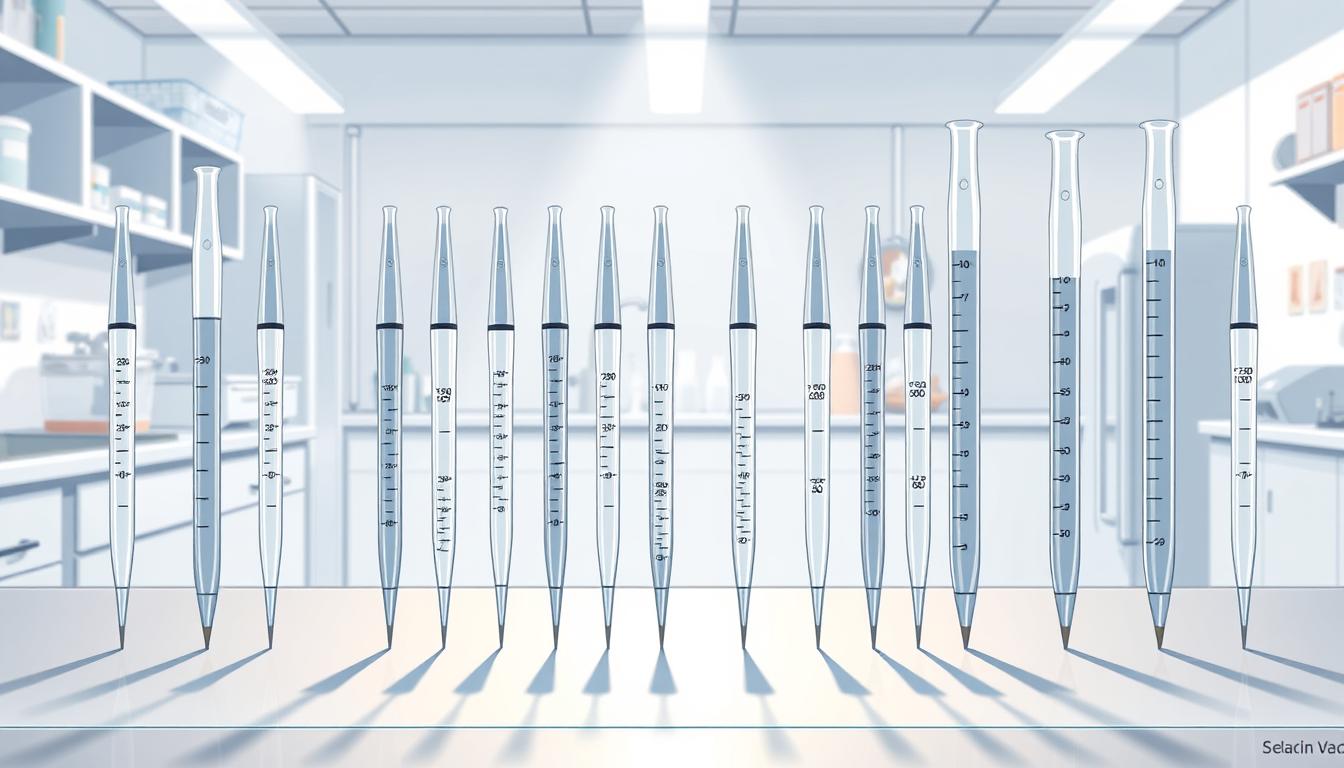
Ever thought about how precise liquid handling leads to big scientific breakthroughs? Serological pipettes are key, allowing researchers to move tiny amounts of liquid with great care.
In labs, serological pipettes are vital. They handle liquids from 0.1 milliliters to 25 milliliters. This precision is crucial for complex studies.
Keeping pipettes calibrated is an art. Scientists count on them for precise work. This is true for cell studies and medical tests, making pipettes essential in labs today.
Key Takeaways
- Serological pipettes transfer liquid volumes between 0.1 and 25 milliliters
- Accurate pipette calibration is crucial for reliable scientific research
- Different volume ranges suit various laboratory applications
- Precision is essential in liquid handling techniques
- Serological pipettes are fundamental to multiple scientific disciplines
Introduction to Serological Pipettes
Laboratories need precise tools for handling liquids. Serological pipettes are key for accurate liquid transfer. They help researchers with their work.
Using serological pipettes is a vital method in science. These tools are made for different lab tasks. They are known for their consistency and reliability.
Defining Serological Pipettes
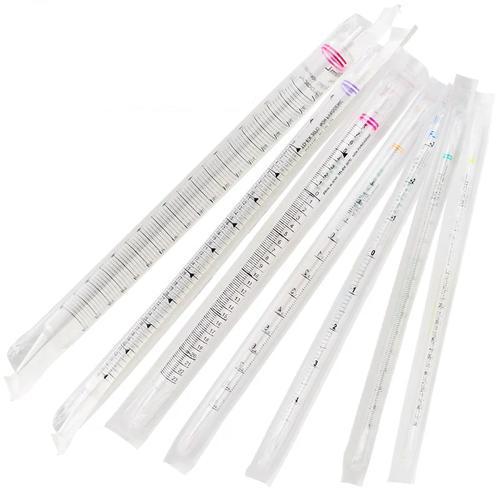
Serological pipettes are made for moving liquids in labs. They have:
- Volume range from 0.5 to 50 milliliters
- Graduated measurement scales for pipette accuracy
- Ability to transfer consistent liquid volumes
- Sterilization capabilities for controlled environments
Critical Role in Laboratory Settings
Scientists use serological pipettes in many fields, like:
- Cell culture research
- Microbiology experiments
- Biochemical analysis
- Clinical testing procedures
The precision of serological pipettes is crucial. It lets researchers do experiments with care. This is especially important when working with delicate samples.
Accurate liquid transfer is the cornerstone of reliable scientific research.
Serological pipettes are very versatile. They meet many lab needs because of their design. Their graduation marks and ability to be sterilized make them essential in science today.
Typical Serological Pipette Volumes
Serological pipettes are key in precise liquid handling in science. They help researchers move liquids with great accuracy. This is vital for lab work.
Lab experts need specific volumes for the best results. Serological pipettes offer various sizes for different needs.
Standard Volumes in Laboratory Use
Serological pipettes meet many liquid transfer needs. Common sizes include:
- 1 mL pipettes for small volume transfers
- 5 mL pipettes for medium-scale applications
- 10 mL pipettes for intermediate volume requirements
- 25 mL pipettes for larger liquid handling tasks
Volume Variations Based on Scientific Applications
Each science field needs specific pipette sizes for good experiments. Choosing the right size depends on several factors.
| Application Area | Preferred Pipette Volume | Precision Requirements |
|---|---|---|
| Blood Banking | 1-5 mL | High |
| Immunology | 0.1-10 mL | Very High |
| Microbiology | 1-2 mL | Moderate |
| Cell Culture | 5-25 mL | High |
“Selecting the right pipette volume is crucial for maintaining experimental accuracy and reproducibility.” – Laboratory Research Standards
Choosing the right pipette size is vital for reliable results. Pipette precision is key for good science.
Volume Selection Considerations
Choosing the right pipette volume is key in lab work. It affects the results of research. Pipette accuracy and precision are crucial for reliable results.
Scientists need to think about many factors when picking pipette volumes. They must understand how measurement needs match with what the pipette can do.
Factors Influencing Volume Choice
Several important things help decide the best pipette volume:
- Experimental protocol specifications
- Liquid sample characteristics
- Required measurement resolution
- Potential impact on data reproducibility
Precision and Accuracy Requirements
Pipette precision is very important in scientific work. Researchers should know that serological pipettes are only as precise as their smallest mark. This is usually:
- 0.1 mL for 5 mL pipettes
- 0.1 mL for 10 mL pipettes
- 0.2 mL for 25 mL pipettes
The right volume choice affects how accurate the pipette is. Smaller increments mean more precise measurements. This helps reduce errors in experiments.
Accurate volume selection is not just a technical detail—it’s a fundamental aspect of scientific reliability.
Lab experts must pick the right pipette volume for their experiments. Using a pipette that’s too big can lead to big measurement mistakes.
Commonly Used Pipette Volumes
Serological pipettes are key in labs, with volumes from 1 mL to 25 mL. They help transfer liquids accurately in many fields.

Scientists pick different pipettes based on their needs. The right volume is crucial for precise lab work.
1 mL Pipettes
1 mL pipettes are great for small tasks. They’re perfect for:
- Molecular biology
- Cell culture
- Chemical dilutions
5 mL Pipettes
5 mL pipettes are versatile. They’re often used for medium volume transfers that need to be accurate.
10 mL Pipettes
10 mL pipettes handle bigger tasks. They’re essential for:
- Biological sample prep
- Chemical management
- Creating standard solutions
25 mL Pipettes
25 mL pipettes are for big transfers. They’re great for large volume work in labs and industry.
| Pipette Volume | Primary Applications | Material Recommendation |
|---|---|---|
| 1 mL | Precise molecular techniques | Plastic/Sterile |
| 5 mL | Cell culture preparation | Disposable plastic |
| 10 mL | Reagent management | Plastic or glass |
| 25 mL | Large volume transfers | Glass for specialized solvents |
Knowing the needs of each pipette volume helps researchers choose the right tool for their work.
Application Areas for Serological Pipettes
Serological pipettes are key tools in many scientific and industrial fields. They help with precise liquid transfer and measurement. Knowing where they are used helps scientists pick the right ones for their work.
Laboratory experts use different serological pipettes for various tasks. They need to learn how to use these tools well to get the best results.
Clinical Laboratories
In clinics, serological pipettes are vital for testing and preparing samples. They are used for:
- Blood sample analysis
- Preparing diagnostic reagents
- Transferring cell suspensions
- Creating precise density gradients
Research and Development
Research teams use serological pipettes a lot in their work. They help with:
- Cell culture manipulation
- Molecular biology techniques
- Experimental sample preparation
- Microbial study preparations
Quality Control in Manufacturing
In manufacturing, serological pipettes are important for quality checks. They are used for:
- Pharmaceutical product testing
- Chemical composition verification
- Consistency checks in production
- Precise reagent measurements
Understanding these uses helps lab workers improve their work. They can choose the right pipettes and get better training.
Techniques for Using Serological Pipettes
Mastering serological pipetting is key for precise lab work. Scientists need accurate liquid handling for reliable results. The right method can cut down errors and boost research quality.
Proper pipette accuracy depends on several key factors. Lab professionals must understand and follow these consistently.
Essential Handling Practices
- Hold the pipette vertically for accurate volume measurement
- Check the pipette tip for damage before use
- Keep a steady pipetting speed when transferring liquids
- Pre-wet pipette tips for viscous or protein-based solutions
Tips for Maximizing Precision
For the best serological pipetting, focus on detail and practice. Lab pros should aim for consistent movements and grasp liquid dynamics.
| Technique | Impact on Accuracy |
|---|---|
| Proper Angle | Reduces volume measurement errors by 1.5% |
| Consistent Speed | Minimizes liquid adherence variations |
| Tip Conditioning | Improves volume transfer consistency |
Training and Skill Development
Laboratory technicians should spend time on serological pipetting technique. Regular training and practice can greatly improve pipette accuracy.
Precision in pipetting is not just a skill, but a critical scientific discipline.
By learning these techniques, researchers can reduce experimental variability. This makes their scientific investigations more reliable.
Calibration and Maintenance
Accurate lab work relies on precise pipette performance. Calibration and maintenance are key to reliable measurements and results.
Lab pros know regular maintenance stops errors and extends life. The ISO 8655 guidelines now offer detailed standards for pipette accuracy.
Importance of Calibration
Pipette calibration checks if the tool is accurate and precise. The ISO 8655-2 standards now list maximum errors for different volumes:
- 10% of nominal volume
- 50% of nominal volume
- 100% of nominal volume
Regular Maintenance Practices
Good pipette care includes several steps:
- Annual calibration to keep accuracy within ± 5% of specs
- Regular visual checks
- Proper cleaning and storage
- Keeping calibration records
“Precision in pipetting is not an option, it’s a necessity for scientific integrity.” – Laboratory Standards Institute
Different pipette sizes need different calibration methods. For example:
| Pipette Volume Range | Balance Precision Required |
|---|---|
| Less than 20 μL | Six-place balance |
| 20-199 μL | Five-place balance |
Effective pipette calibration and maintenance are key to reliable scientific data and lab quality.
Alternative Pipetting Solutions
Laboratory experts are always looking for new serological pipette types. They want ones that are more precise and easier on the user. Thanks to pipette ergonomics, many new solutions have come up. These meet different needs in research and clinical settings.
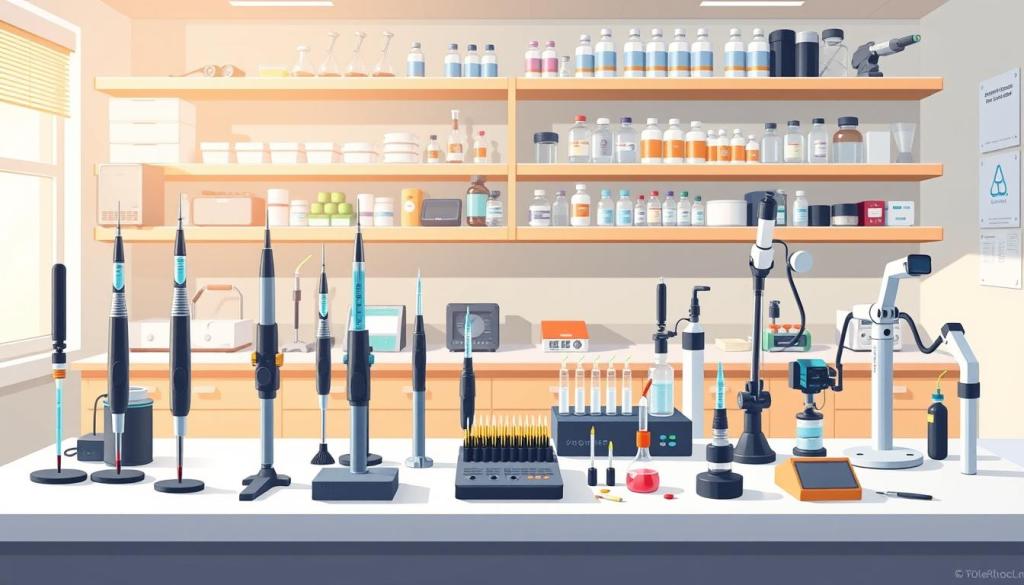
Now, there are many choices beyond the old serological pipettes. These options help with moving liquids around effectively.
Electropneumatic Pipettes
Electropneumatic pipettes are a big step up in handling liquids. They are great for labs that need to do a lot of work:
- They make it easier to avoid getting tired from pipetting a lot
- They are very precise when it comes to how much liquid you dispense
- They have digital controls for setting the volume
- They help you stay focused for longer periods without getting tired
Manual Pipette Alternatives
There are also manual options that go well with the old serological pipettes. They add flexibility to how labs work:
| Pipette Type | Volume Range | Primary Application |
|---|---|---|
| Bottle-top Dispensers | 1-50 mL | Rapid liquid transfer |
| Repeater Pipettes | 0.5-10 mL | Multiple dispensing |
| Multichannel Pipettes | 1-300 μL | 96-well plate processing |
These new pipetting options make labs work better. They solve problems with pipette ergonomics and keep accuracy high.
Troubleshooting Common Issues
Laboratory professionals often face problems with pipette accuracy and performance. Knowing common issues and how to fix them can greatly improve results. This ensures the integrity of samples and experiments.
Pipette accuracy is affected by many things. This includes how it’s handled, maintained, and the environment it’s in. Labs can reduce errors by following a systematic approach to solve common problems.
Identifying Volume Discrepancies
Volume discrepancies come from several key areas:
- Changes in environmental temperature
- Not calibrating the pipette correctly
- Dirty or damaged pipette tips
- Users not following the right technique
Solutions for Common Problems
To fix pipette issues, labs need to take specific steps:
- Regular Calibration: Check every 6-12 months to keep it precise
- Change pipette tips between samples to avoid contamination
- Train staff on the right way to use pipettes
- Keep pipettes upright to avoid damage
By training staff well and following best practices, labs can cut user errors by 50%.
Critical Maintenance Practices
Regular maintenance can spot problems in 40% of pipettes before they affect results. Important steps include:
- Clean pipettes after each use
- Look for mechanical wear
- Use top-quality, certified pipette tips
- Watch the environment
By focusing on pipette accuracy and troubleshooting, researchers can get reliable and consistent results.
Safety Considerations
Laboratory safety is key in scientific research and testing. Learning how to use pipettes correctly is crucial. It helps keep everyone safe at work.
Personal Protective Equipment (PPE) Requirements
Wearing the right gear is essential for safety in labs. Here’s what you need to do:
- Always wear a protective lab coat
- Use gloves that can resist chemicals
- Wear safety glasses or face shields
- Choose closed-toe shoes
Best Practices for Sample Handling
Safe pipetting involves several important steps. Lab workers should:
- Never use their mouths to pipette
- Use filtered tips to cut down on aerosols
- Practice good posture and ergonomics
- Tell someone if equipment is broken
Training everyone on pipettes is vital. It shows that 75% of mistakes come from bad technique. This highlights the need for thorough training and better technique.
Risk Mitigation Strategies
Lab managers must enforce strict safety rules. Here are some important steps:
- Check pipettes every month
- Clean up right after handling risky materials
- Dispose of waste safely
- Keep up with safety guidelines
Safety is not an option—it’s a requirement in laboratory settings.
By focusing on good pipette training and safe techniques, labs can lower risks. This makes the workplace safer for all scientists.
Innovations in Serological Pipette Design
Laboratory technology is always getting better. This brings new serological pipette types and better ergonomics. These changes are making research and lab work more efficient and easier to use.
Technological Impact on Pipette Efficiency
Modern serological pipettes are seeing big changes. Some key improvements include:
- Electronic pipetting systems with better accuracy
- Multi-channel pipettes for more work done
- Advanced ergonomic designs to reduce hand fatigue
Future Trends in Laboratory Pipetting
The future of pipetting in labs is exciting. Trends are focusing on making things easier for users and adding new tech. Researchers are working on pipettes with:
- Tools to manage data
- Better sensors
- Systems for automatic calibration
New pipette designs are all about comfort and accuracy. They use lighter materials, adjustable grips, and designs that reduce strain. These are now common in modern serological pipettes.
| Innovation Category | Key Developments |
|---|---|
| Electronic Pipettes | Digital volume control, precise dispensing |
| Ergonomic Design | Reduced hand strain, improved user comfort |
| Automation Integration | Smart connectivity, real-time data tracking |
These new technologies are changing how labs work. They offer scientists more reliable, efficient, and easy-to-use pipettes.
Conclusion and Key Takeaways
Knowing the typical volumes of serological pipettes is key for accurate science work. It’s important to pick the right pipette sizes and learn how to handle liquids well. Training in pipetting is crucial for reliable results in labs.
Working with serological pipettes needs careful attention. It’s about knowing the right volumes and how to handle them. You also need to know about immersion depths, tip choices, and how the environment affects your work.
Lab workers should keep learning and improving their pipetting skills. Keeping pipettes calibrated and using them in a way that’s easy on your body is important. This helps get the best results from your experiments.
At the end of the day, serological pipettes are more than tools. They help us explore and discover new things. With the right training and high standards, scientists can make the most of these important tools.
FAQ
What are serological pipettes and how do they differ from other types of pipettes?
Serological pipettes are special tools for moving liquids in labs. They can hold more liquid than regular micropipettes. They also have longer stems and clear markings for better control.
What are the most common volume ranges for serological pipettes?
Serological pipettes usually range from 1 mL to 50 mL. Common sizes are 1 mL, 5 mL, 10 mL, 25 mL, and 50 mL. These sizes depend on the experiment and the liquid being used.
How important is pipette calibration in laboratory settings?
Calibrating pipettes is very important for accurate measurements. It keeps the measurements precise and prevents mistakes. Labs should calibrate their pipettes at least once a year.
What factors should be considered when selecting a serological pipette?
When choosing a pipette, think about the experiment, the liquid’s volume, and how precise you need to be. Also, consider the liquid’s properties and any contamination risks.
What are the best practices for using serological pipettes?
Use the right pipette for the job and hold it straight. Avoid air bubbles and use clean tips. Practice steady movements and pre-wet the tip for better results.
How do I prevent contamination when using serological pipettes?
Use sterile methods, wear protective gear, and change tips often. Work in a clean area and disinfect tools regularly. Always follow lab safety rules.
What are the primary application areas for serological pipettes?
Serological pipettes are used in many fields. This includes clinical labs, research, microbiology, and quality control. They’re also used in pharmaceuticals, environmental testing, and more.
How often should serological pipettes be maintained?
Clean them after each use and calibrate them yearly. Check them visually often and store them upright. Replace them if damaged or not working right.
What safety precautions should be taken when using serological pipettes?
Wear protective gear, work in a well-ventilated area, and use gloves. Know the risks of your samples and follow safety rules.
What are some common troubleshooting issues with serological pipettes?
Issues like uneven volume, leaking tips, and contamination are common. Check the calibration, inspect the equipment, and use the right techniques. Replace worn parts as needed.




Leave a Comment
Your email address will not be published. Required fields are marked *