


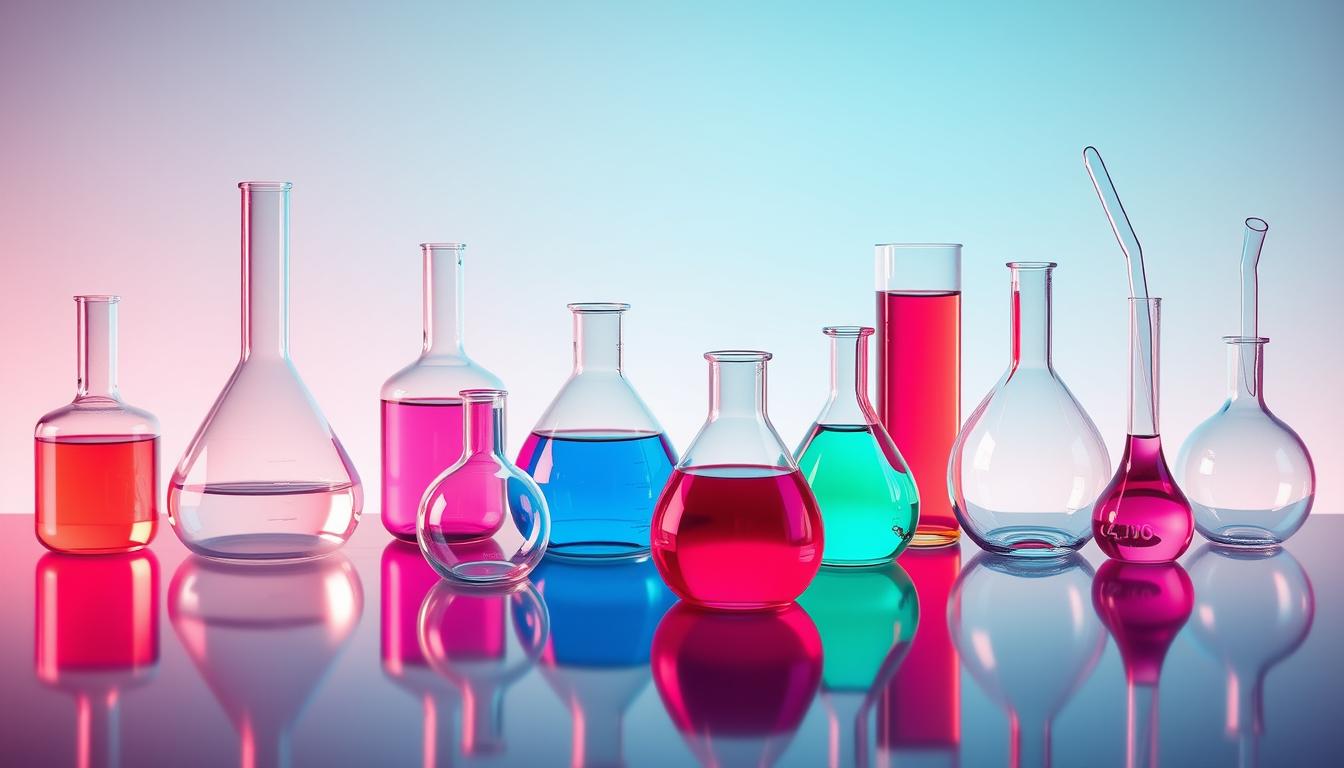
Ever thought about the role of laboratory flasks in science? These tools are key to turning curiosity into real discoveries.
The American Society for Testing and Materials (ASTM) sets global standards for lab equipment. This includes various flasks used in chemistry and biology. Erlenmeyer flasks, with their unique shape, are just one of many tools helping scientists do their work.
Flasks help measure solutions and conduct complex reactions. They are flexible and meet many scientific needs. Each flask design is made for a specific purpose, showing the complexity of scientific research.
Key Takeaways
- Laboratory flasks are fundamental tools in scientific research
- ASTM standards ensure quality and precision of flask manufacturing
- Different flask types serve unique experimental purposes
- Erlenmeyer flasks are versatile and widely used in laboratories
- Material composition impacts flask performance and durability
Overview of Laboratory Flasks
Laboratory flasks are key tools in science, used for precise experiments. They are special containers for chemical and biological studies. These tools help scientists do their work accurately and reliably.
There are many kinds of flasks, each for different scientific needs. These tools are made to fit various research areas. They help support many kinds of experiments.
Defining Laboratory Flasks
Volumetric flasks and other glassware are made for specific tasks in labs. They have key features:
- Precise volume measurements
- Resistance to chemical interactions
- Ability to withstand temperature variations
- Specialized shapes for unique experimental needs
Significance in Scientific Research
Laboratory flasks are crucial for keeping experiments reliable. They help scientists:
- Maintain controlled reaction environments
- Accurately measure and transfer liquids
- Prevent contamination
- Support complex scientific investigations
“In scientific research, the right flask can be the difference between success and failure.” – Laboratory Equipment Experts
From making chemicals to studying biology, flasks are essential. They give scientists the precision and reliability they need to advance science.
Common Types of Flasks
Laboratory researchers use different flasks for precise scientific experiments. Each flask design is made for specific needs in biological and chemical research. They are crafted to meet the needs of various experiments.
Scientific labs use many flask types, each with unique features for different research needs. Knowing these differences helps researchers pick the right glassware for their experiments.
Erlenmeyer Flasks: Versatile Laboratory Workhorses
Erlenmeyer flasks are common in labs. Their conical shape makes them stable and prevents spills during mixing or swirling.
- Flat base ensures stable positioning
- Cone-shaped body allows efficient mixing
- Ideal for heating and chemical reactions
Volumetric Flasks: Precision Measurement Tools
Volumetric flasks are key for measuring liquid volumes precisely. They come in Class A and Class B types, with Class A being more accurate.
| Flask Type | Precision Level | Material |
|---|---|---|
| Class A Volumetric Flask | High Precision | Borosilicate Glass |
| Class B Volumetric Flask | Standard Precision | Standard Laboratory Glass |
Florence Flasks: Thermal Processing Specialists
Florence flasks are great for heating and boiling. Made from borosilicate glass, they can handle high temperatures during experiments.
- Spherical body promotes uniform heating
- Borosilicate glass ensures thermal shock resistance
- Suitable for distillation and boiling processes
Choosing the right flask depends on the experiment’s needs. This ensures the best results and accurate measurements.
Material Composition of Flasks
Laboratory flasks are key tools in science, with their material being very important. The right material makes experiments work well. Different materials are best for different kinds of science.
Scientists often pick between glass and plastic for their flasks. Each has special qualities for different research needs.
Glass Flasks: Precision and Durability
Glass flasks are top choices in labs because of their great features:
- High chemical resistance
- Temperature stability
- Transparency for visual observation
- Non-reactive surface
Plastic Flasks: Lightweight Alternative
Plastic flasks are good for certain lab tasks, with benefits like:
- Lightweight design
- Cost-effectiveness
- Shatter resistance
- Disposable options
Chemical Resistance Considerations
Choosing the right flask material is key. It depends on how well the material works with the substances in the experiment. This ensures the results are accurate.
| Material | Chemical Resistance | Temperature Range |
|---|---|---|
| Borosilicate Glass | Excellent | -50°C to 500°C |
| Polypropylene | Good | -20°C to 135°C |
| Polyethylene | Limited | -50°C to 80°C |
Researchers must carefully evaluate material properties to select the most appropriate flask for their specific experimental protocols.
Erlenmeyer Flasks: Features and Uses
In 1860, German chemist Emil Erlenmeyer invented these flasks. They are key in labs around the world. Their unique shape makes them vital for scientists.
- They reduce splashing when mixing liquids.
- They are stable on lab surfaces.
- They make swirling and handling contents easy.
- They support many lab techniques.
Unique Shape and Design Characteristics
The flasks have a wide base and a narrow neck. This shape makes them stable and less likely to spill. Glass Erlenmeyer flasks are used in 70% of labs because they resist chemicals and are clear.
Critical Laboratory Applications
Scientists use these flasks for many important tasks:
- Preparing cell cultures.
- Cultivating media.
- Doing small-scale fermentations.
- Mixing chemicals and reactions.
The unique shape of Erlenmeyer flasks helps with mixing and oxygen transfer in labs.
Borosilicate glass flasks can handle extreme temperature changes. Plastic ones are light and won’t break easily. About 60% of labs prefer disposable flasks, showing their adaptability.
Volumetric Flasks: Precision and Functionality
Volumetric flasks are key in scientific research, known for their precision in making standard solutions. They are made with careful engineering to ensure accurate measurements in many scientific fields.
Laboratory experts count on volumetric flasks for their top-notch measurement skills. These tools have special designs that help in precise volume calculations with little error.
Calibration and Measurement Techniques
Calibrating volumetric flasks is a detailed process to ensure high accuracy. Key features include:
- Precise calibration at specific reference temperatures (20°C or 27°C)
- Graduation marks that meet international precision standards
- Traceability to national measurement standards
Ideal Use Cases
Scientists use volumetric flasks in many research areas, including:
- Pharmaceutical solution preparation
- Chemical synthesis experiments
- Environmental contaminant analysis
- Educational laboratory training
| Flask Class | Precision Level | Typical Applications |
|---|---|---|
| Class A | High Precision | Analytical Research |
| Class B | Standard Precision | Educational Experiments |
The precision of volumetric flasks is vital in scientific research. It helps researchers make solutions with high accuracy and dependability.
Florence Flasks: Characteristics and Benefits
Florence flasks are key in scientific research. They are also known as boiling flasks. They are vital in labs, especially for distillation.
The unique shape of Florence flasks makes them stand out. They have a 400 mL volume and are 16.5 cm tall. These features make them great for scientific tests.
Unique Design Characteristics
- Spherical bottom for even heat distribution
- Perfect for heating and distillation
- Allows for full liquid vaporization and condensation
Applications in Chemical Research
Scientists use Florence flasks a lot in chemistry. They are great for:
- Getting natural products from plants
- Cleaning biological compounds
- Doing precise heat experiments
| Flask Characteristic | Specification |
|---|---|
| Volume | 400 mL |
| Height | 16.5 cm |
| Primary Use | Distillation and Heating |
| Historical Origin | Developed by Jena Glasswork, Schott & Associates (founded 1884) |
The round bottom of Florence flasks makes them excellent in labs. They can handle chemical processes well. This makes them essential for scientists in many experiments.
Specialty Flasks in Biological Research
Biological research needs precise tools and equipment. Flasks are key in this field, with designs for specific experiments.
Scientists use different flasks for complex biological studies. These containers are made for specific needs in research.
Tissue Culture Flasks: Precision in Cell Growth
Tissue culture flasks are a big step in biological research. They have:
- Flat surface design for optimal cell adhesion
- Special surface treatments promoting cell growth
- Sterile manufacturing to prevent contamination
- Vented closures for enhanced gas exchange
Teams use these flasks to grow delicate cellular environments. The special surface helps cells attach and grow well.
BOD Flasks: Measuring Dissolved Oxygen
BOD flasks are vital in environmental and microbiological studies. They are made to:
- Measure dissolved oxygen levels accurately
- Support water quality research
- Enable precise environmental monitoring
Researchers count on BOD flasks to check water ecosystem health. They track oxygen levels in different samples.
Specialized flasks transform complex biological research by providing targeted solutions for intricate scientific investigations.
Choosing the Right Flask for Experiments
Scientific research needs precise equipment. Researchers must pick the right flasks for success. They consider many factors that affect their results.
Choosing the right vacuum flasks and glassware is key. Scientists must think carefully about several important points.
Critical Selection Factors
- Experimental requirements and specific protocol needs
- Material compatibility with chemical substances
- Temperature resistance and thermal shock potential
- Volume capacity requirements
- Potential contamination risks
Best Practices for Flask Selection
Material quality is crucial when picking flasks. Borosilicate glass is better than others because it resists heat and chemicals well.
The right flask can make the difference between successful and compromised experimental results.
When choosing flasks, consider these:
- Evaluate the specific experimental protocol
- Check material chemical resistance
- Confirm appropriate volume specifications
- Assess manufacturing quality standards
- Consider potential sterilization requirements
Each experiment needs a specific flask. Narrow-neck flasks help avoid contamination. Wide-neck ones make adding substances easier. Graduated markings help with precise volume measurements.
Material Performance Insights
The material of the flask is very important. Borosilicate glass is great because it withstands heat and chemicals well. It’s perfect for tough scientific research.
Maintenance and Care of Laboratory Flasks
Keeping laboratory flasks in good shape is key for accurate research. Researchers must clean and store them carefully. This keeps the equipment working well for a long time.
Cleaning flasks needs special steps to get rid of all dirt and chemicals. Start with warm water and a soft brush with mild soap. Then, use deionized water to make the surface smooth. For very clean experiments, you might need to sterilize the flasks in an autoclave.
How you store your flasks is also important. Keep them in closed shelves, away from busy areas and extreme temperatures. Organize them by type and size to avoid accidents. Use low cabinets with enough space to protect them and make them easy to get to.
Cleaning Best Practices
Before using or storing flasks, clean them well. Use organic solvents like acetone or ethanol to remove tough stains. Let them air dry to avoid getting fibers in them. Check them often for any damage that could affect your results.
FAQ
What are the main types of laboratory flasks used in biological research?
Laboratory flasks come in many types. You have Erlenmeyer flasks, volumetric flasks, and Florence flasks. There are also tissue culture flasks and specialized ones like Biochemical Oxygen Demand (BOD) flasks. Each is made for different tasks, like mixing or precise measurements.
How do I choose the right flask for my biological experiment?
Choosing the right flask depends on your experiment’s needs. Think about the volume, chemical use, and temperature. Your research might need precise measurements, mixing, or heat resistance.
What are the key differences between glass and plastic laboratory flasks?
Glass flasks are great for high-temperature work and harsh chemicals. They’re more durable but heavier. Plastic flasks are lighter, cheaper, and safer for cell culture or when you need to save weight.
How should I clean and maintain laboratory flasks?
Clean flasks with the right lab detergents, rinse well, and dry completely. Sterilize them for sensitive experiments. Always check for damage and replace broken flasks to keep your work safe.
What makes Erlenmeyer flasks unique in biological research?
Erlenmeyer flasks have a conical shape for easy mixing. This shape reduces splashing and helps mix contents well. They’re great for cell culture and making media.
What is the purpose of a volumetric flask?
Volumetric flasks help measure exact volumes. They have a narrow neck with marks for making standard solutions. This is key for making buffers, diluting samples, and stock solutions.
Can laboratory flasks be used for different types of experiments?
Many flasks can be used for various experiments. But, think about chemical use, temperature, and contamination risks. Always check if a flask is right for your experiment.
What are specialized flasks used in biological research?
Specialized flasks include tissue culture flasks and BOD flasks. There are also filtering flasks and others for specific needs. They’re designed for unique research tasks.






Leave a Comment
Your email address will not be published. Required fields are marked *