



Ever wondered how scientists measure and handle chemicals so accurately? It’s all thanks to the wide range of flasks used every day.
Chemistry labs are complex places where special tools are key. The Erlenmeyer flask is a must-have for precise experiments. It’s made to meet specific needs, helping turn simple chemicals into major breakthroughs.
Each flask type has its own role. Scientists pick them based on what they need for their experiments. The right flask can make all the difference in success.
Key Takeaways
- Chemistry flasks are specialized containers with specific design purposes
- Erlenmeyer flasks provide versatility in laboratory experiments
- Accurate measurement is critical in scientific research
- Flask selection depends on experimental requirements
- Different flask shapes support various chemical processes
Understanding the Importance of Flasks in Chemistry
Chemistry labs use special glassware for precise and safe tests. Flasks are key for holding, heating, and measuring chemicals. Their design lets scientists do complex tests with great accuracy.
Scientists count on flasks for many tasks in labs. These tools help with many experiments by creating safe spaces for reactions and measurements.
Role of Flasks in Laboratory Experiments
Flasks have many roles in science:
- Keeping chemicals safe
- Helping with heating and cooling
- Supporting controlled reactions
- Allowing for precise volume measurements
Contribution to Accurate Measurements
Flask designs help with accuracy in experiments. Round bottom flasks spread heat well, while flat bottom flasks sit steady on surfaces. The American Society for Testing and Materials (ASTM) makes sure these tools meet high standards.
The accuracy of flasks depends on their design and use. For example, volumetric flasks can measure with an error of less than 0.2%. This makes them crucial for detailed chemistry research.
Common Types of Flasks Used in Chemistry
Chemistry labs use many types of glassware for precise experiments. Each flask type has its own purpose. Knowing about these flasks helps in doing chemical work well.
Erlenmeyer Flask: Versatile Laboratory Essential
The Erlenmeyer flask was created in 1861 by Emil Erlenmeyer. It has a narrow neck and a conical base. This design helps prevent spills and keeps liquids from evaporating.
These flasks are great for mixing, heating, and storing chemicals.
Florence Flask: Ideal for Heating
Florence flasks are perfect for heating liquids. They have a round bottom and a long neck. Made from borosilicate glass, they can handle high temperatures evenly.
They are great for distillation and reflux reactions.
Volumetric Flask: Precision Measurement
Volumetric flasks are made for precise solution preparation. They have a pear-shaped body and a long neck with a fill line. This ensures accurate volume measurements.
They come in two types: Class A for analytical labs and Class B for general use.
Beaker: Multipurpose Laboratory Container
Beakers are used for mixing, stirring, and measuring liquids. They are not as precise as volumetric flasks but are still very important in labs.
| Flask Type | Primary Use | Key Characteristics |
|---|---|---|
| Erlenmeyer Flask | Mixing and Storing | Conical shape, narrow neck |
| Florence Flask | Heating Liquids | Round bottom, long neck |
| Volumetric Flask | Precise Solution Preparation | Pear-shaped, fill line |
| Beaker | General Mixing | Graduated markings |
Features of Erlenmeyer Flasks
Erlenmeyer flasks are key in chemistry labs, made with care and purpose. They were created in 1860 by Emil Erlenmeyer, a German chemist. These flasks have changed how scientists do their work.

The design of Erlenmeyer flasks makes them stand out. Their shape, with a flat bottom and narrow neck, makes them stable and useful for researchers.
Design and Structure
Here are the main parts of Erlenmeyer flasks:
- Cone-shaped body tapering towards the neck
- Flat bottom for stable placement
- Narrow neck to prevent liquid spillage
- Graduated markings for approximate volume measurements
Applications in Titration
Erlenmeyer flasks are great for titration experiments. Their design helps mix liquids well and prevents spills. Scientists like them for:
- Efficient chemical mixing
- Safe heating of substances
- Controlled pouring during experiments
- Secure sample storage
Erlenmeyer flasks are accurate to about 5%. They are a must-have in labs for many scientific fields.
Exploring Florence Flasks
Florence flasks are key in chemistry labs. They help in research and experiments. These flasks are made to work well with heat and chemicals.
Florence flasks stand out because of their design. They have a round body and a long neck. This design helps in heating chemicals evenly.
Characteristics of Florence Flasks
Florence flasks, also known as round bottom flasks, show great engineering. They have:
- A round body for even heat
- A long neck for controlled heating
- They are made of borosilicate glass
- They can handle high temperatures
Uses in Heating Solutions
Scientists use Florence flasks for important tasks. An iodine flask is great for certain chemical tasks. It helps with precise heating and reactions.
| Flask Characteristic | Specification |
|---|---|
| Typical Capacity | 400 mL |
| Overall Height | 16.5 cm (approx. 6.5 inches) |
| Material | Borosilicate Glass |
| Primary Use | Uniform Heating and Boiling |
The round bottom flask’s shape spreads heat evenly. This makes it essential in chemistry labs for tasks like distillation and refluxing.
The Versatility of Volumetric Flasks
Volumetric flasks are key in scientific labs for precise measurements. They help make solutions with great accuracy. This makes them vital for researchers and chemists in many fields.
Volumetric flasks have a special design. They have a flat bottom and a long, narrow neck with a precise mark. This design lets scientists make solutions that are very consistent.
Precision in Measurement
Precision is what makes volumetric flasks stand out. They are made to keep accuracy at certain temperatures:
- Calibrated at 20°C or 27°C depending on the environment
- Made from 3.3 borosilicate glass for stability
- Can measure volumes from 10 mL to 2 L
“In scientific research, precision is not a luxury—it’s a necessity.” – Laboratory Standards Institute
Applications in Analytical Chemistry
Volumetric flasks are used in many scientific areas, including:
- Pharmaceutical quality control
- Environmental sample preparation
- Chemical research and education
- Industrial product consistency testing
They are essential for making solutions with exact concentrations. This is key for reliable results in experiments. Whether it’s making standard solutions or complex analyses, these flasks offer the precision needed.
Beakers vs. Flasks: Key Differences
Chemistry labs use special glassware for different tasks. It’s important to know the differences between beakers and flasks. This helps with accurate scientific work.
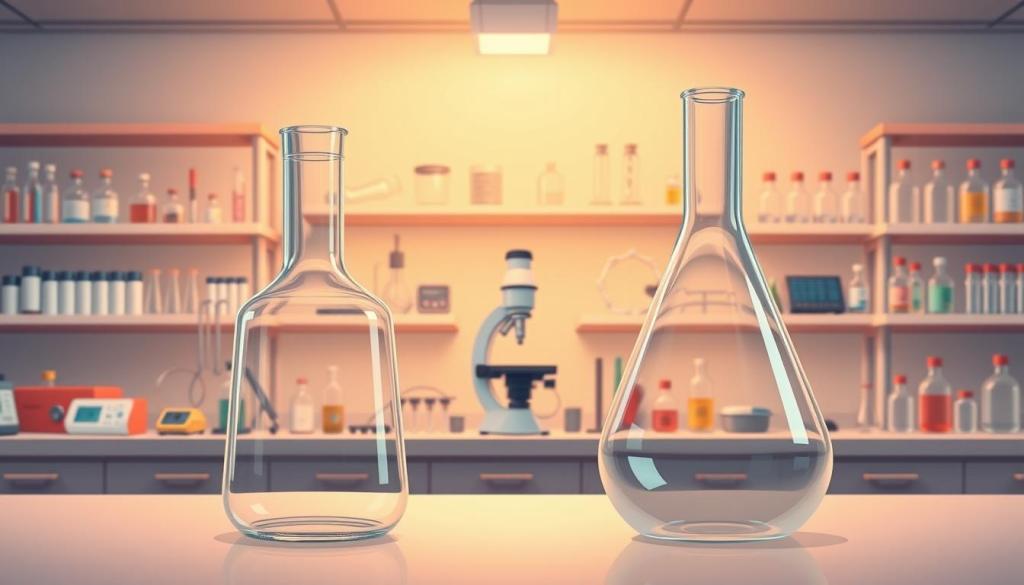
The design of glassware affects its use. Beakers and flasks look similar but serve different roles in labs.
Structural Disparities
Beakers and flasks differ in their shape:
- Beakers are tall and wide with flat bottoms
- Erlenmeyer flasks have a conical shape and narrow neck
- Round-bottomed flasks spread heat evenly
- Volumetric flasks help measure liquids precisely
Suitability for Different Tasks
Choosing the right glassware depends on the task:
| Glassware Type | Primary Uses | Key Advantages |
|---|---|---|
| Beakers | Mixing, heating, transferring chemicals | Wide opening, easy liquid disposal |
| Erlenmeyer Flask | Titrations, chemical reactions, storage | Reduced spillage, better mixing |
| Volumetric Flask | Precise solution preparation | Accurate concentration measurements |
*Precision in laboratory work begins with selecting the most appropriate glassware for each specific task.*
Chemists need to pick the right glassware for each task. The Erlenmeyer flask is better for controlling reactions than beakers.
Specialty Flasks in Chemistry
Chemistry labs use special glassware for precise work. Each flask design meets specific needs, helping scientists get accurate results. This is key for their research.
Special flasks are vital in advanced chemical research. They offer solutions for complex lab tasks. These tools are made to meet exact scientific needs.
Büchner Flask for Filtration
The buchner flask is a key tool for fast and precise filtration. It has a side arm for vacuum connection. This makes quick and clean filtering of liquids possible.
- It has thick walls to handle high pressure.
- Its wide, flat bottom ensures stable use.
- It helps quickly separate solids from liquids.
Separatory Funnel for Liquid Separation
Separatory funnels are crucial for liquid-liquid extraction. They help separate liquids based on density. The funnel’s design allows for controlled drainage and precise separation.
- It has a stopcock for controlled liquid release.
- It supports complex extraction procedures.
- It enables clean separation of liquids.
These flasks show the detailed engineering in modern lab tools. They highlight the need for precision in scientific research.
Choosing the Right Flask for Experiments
Choosing the right flask is key for successful chemical experiments. The right flask can greatly affect the outcome, precision, and safety of research. Knowing the differences in flask materials and designs helps researchers make better choices.
When picking flasks for lab work, several important factors need to be considered:
- Chemical compatibility
- Temperature resistance
- Experimental requirements
- Precision needs
Material Considerations for Flask Selection
Researchers must look at material properties when picking the best flask. Different materials have their own benefits:
| Material | Strengths | Limitations |
|---|---|---|
| Borosilicate Glass | High thermal shock resistance | More expensive |
| Polypropylene | Chemical resistant | Lower temperature tolerance |
| Soda-lime Glass | Cost-effective | Limited chemical resistance |
Practical Flask Selection Strategy
Understanding specific experimental needs is crucial for success. Precise material selection prevents potential experimental failures. Follow these tips when choosing flasks:
- Assess chemical interactions
- Evaluate temperature requirements
- Determine required precision level
- Check mechanical stress tolerance
By matching flask characteristics to experimental demands, researchers can improve their lab work. This ensures reliable and reproducible results.
Maintenance and Care for Chemistry Flasks
Keeping laboratory glassware in good shape is key for getting accurate results. It also helps your equipment last longer. Whether you’re using a flat bottom flask or a vacuum flask, you need to clean and store them carefully.
Cleaning your chemistry flasks right is important. It depends on the solution and what’s left behind. Scientists must clean fast to avoid contamination and keep their tools working well.
Essential Cleaning Techniques
Each solution needs a special cleaning method:
- Water-soluble solutions need 3-4 rinses with deionized water
- Water-insoluble solutions get 2-3 rinses with ethanol or acetone
- Strong acids need thorough rinsing under a fume hood
- Bases must be neutralized before cleaning
Storage Best Practices
Storing your flasks right is just as crucial. It keeps them precise and safe from damage.
| Storage Recommendation | Details |
|---|---|
| Drying Method | Air dry to avoid contamination from towels |
| Inspection | Check cleanliness by observing water sheet formation |
| Final Rinse | Use acetone for quick water removal if immediate use is required |
By following these strict cleaning and storage steps, lab workers can keep their glassware reliable and long-lasting.
Safety Considerations When Using Flasks
Working with different types of flasks in chemistry needs careful safety steps. Lab workers must know how to keep themselves and their area safe when using chemical tools.
Keeping safe from chemicals is key. It helps avoid accidents and keeps researchers safe. Using distillation flasks and other glassware correctly can lower risks a lot.
Understanding Chemical Compatibility
Choosing the right flask is very important. Different materials react in different ways to chemicals and heat:
- Soda Lime Glass: Good for up to 110°C
- Borosilicate Glass: Can handle up to 230°C
- Pure Fused Quartz Glass: Can go up to 1000°C
Importance of Protective Equipment
Wearing the right gear is vital for safety. Researchers should use:
- Safety goggles to protect eyes from splashes
- Heavy-duty gloves to avoid chemical contact
- Closed-toe, non-slip shoes for foot protection
- Lab coats to cover skin and clothes
Working with vacuum flasks needs extra care. Check for damage, use barriers, and keep vacuum pressure low to avoid explosions.
Safety is not an option in the laboratory—it is a necessity.
By sticking to these rules, researchers can make a safe place for their experiments. This is true for all kinds of flasks used in chemistry.
Innovations in Flask Design and Technology
Modern science is leading to big changes in flask technology. New materials and designs are making lab equipment better. These advancements improve precision, durability, and function in many fields.
The world of lab glassware is changing fast. Now, we have flasks like the iodine flask made from special glass. This glass is strong against heat and chemicals. Flasks are also getting better with new designs and treatments to reduce contamination.
New tech is adding smart features to flasks. For example, automated shake flasks with advanced motors make mixing samples easier. Now, scientists can choose from a wider range of materials, including plastics and special glass, to meet their needs.
Flask technology is getting better and more useful. These improvements help scientists do their work more accurately. They also let scientists explore new areas in their research.
FAQ
What are the most common types of flasks used in a chemistry laboratory?
In a chemistry lab, you’ll find many types of flasks. There are Erlenmeyer, round bottom, flat bottom, and volumetric flasks. You’ll also see Florence flasks and special ones like Büchner and separatory funnels. Each is made for different tasks like mixing, heating, and measuring.
What makes Erlenmeyer flasks different from other flask types?
Erlenmeyer flasks stand out because of their shape. They have a conical body, a flat bottom, and a narrow neck. This design is great for mixing and swirling liquids. It also helps keep liquids stable when heated.
How do volumetric flasks ensure precise measurements?
Volumetric flasks are made for exact measurements. They have a special mark and a long neck. This design lets scientists make solutions with the right concentration. It’s key for research and experiments.
What safety considerations are important when using chemistry flasks?
Safety is crucial when using flasks. Know what chemicals are safe together. Always wear protective gear like goggles and gloves. Check the flask’s condition before use. Choose the right material for your reactions. Follow all safety rules in the lab.
What are the primary uses of round bottom flasks?
Round bottom flasks are used for heating and distillation. Their shape helps distribute heat evenly. This is important for boiling liquids and keeping temperatures steady during reactions.
How do I choose the right flask for a specific chemical experiment?
Choosing the right flask depends on several things. Consider the chemicals, temperature needs, and the experiment’s goals. Look at the flask’s material, shape, and size. Also, think about any special features it might have.
What are some specialized flask types used in chemistry?
Chemistry uses many specialized flasks. There are Büchner flasks for filtering, separatory funnels for extracting liquids, and iodine flasks for certain reactions. Distillation flasks are used for complex separations. Each is designed for a specific task.
How should chemistry flasks be maintained and cleaned?
Keeping flasks clean is important. Clean them well after each use with the right detergent. Rinse them with distilled water and dry them completely. Store them in a clean place and check them often for damage or contamination.
What recent innovations exist in flask design and technology?
New flask designs include better glass and plastic materials. They have improved thermal properties and are easier to use. These changes aim to make labs more efficient and safe.
What is the difference between glass and plastic flasks?
Glass flasks are better for most lab work because they’re strong and resistant to chemicals. Plastic flasks are lighter and less likely to break. The choice depends on what you need for your experiment.




Leave a Comment
Your email address will not be published. Required fields are marked *