



Ever thought about how scientists measure light and matter interactions? Knowing how absorbance and transmittance are linked is key in spectrophotometry. It shows us how molecules behave.
When light hits a substance, some wavelengths get absorbed, while others pass through. This shows us a lot about what a substance is made of and how much of it there is.
In spectrophotometry, scientists use light to find out about solutions. If a sample lets 50% of the light through, that means half is absorbed by the material.
This connection between absorbance and transmittance lets scientists dive deep into molecular interactions. It turns simple light measurements into valuable scientific data.
Key Takeaways
- Transmittance ranges from 0% to 100% light passage
- Absorbance represents the logarithmic measurement of light absorption
- Spectrophotometry principles enable precise scientific measurements
- Light interactions reveal fundamental molecular characteristics
- Mathematical relationships help interpret complex scientific data
Understanding Absorbance and Transmittance
Light and matter interact in ways scientists study. They use absorbance and transmittance to see how substances react with light.
For scientists, precise light measurements are key. The Beer-Lambert law helps them understand these interactions.
Definition of Absorbance
Absorbance shows how much light a substance takes in. It’s calculated as A = log(I₀/Iᴛ). Here, I₀ is the light coming in, and Iᴛ is the light that gets through.
- Ranges from 0 to infinite values
- Logarithmic representation of light absorption
- Directly related to optical density
Definition of Transmittance
Transmittance tells us how much light goes through a sample. It’s between 0 (absorbs all light) and 1 (lets all light through).
- Can be expressed as a percentage
- Calculated by T = I/I₀
- Inversely related to absorbance
Significance in Scientific Research
The Beer-Lambert law shows a direct link between absorbance and concentration. This is true when path length and wavelength don’t change. It helps scientists figure out how much of a substance is there.
“Spectroscopic measurements provide a window into the molecular world, revealing intricate details about material composition and interactions.”
Scientists use these light properties in many fields. This includes chemistry, biology, environmental science, and medical diagnostics.
The Mathematical Relationship Between Absorbance and Transmittance
Understanding how light interacts with substances is key in spectroscopy. Scientists use special formulas to measure this interaction. These formulas help us know how substances absorb and transmit light.
Beer-Lambert Law: The Fundamental Principle
The Beer-Lambert Law is a basic rule for light absorption. It links several important factors:
- Concentration of the absorbing substance
- Path length of light through the sample
- Molar absorption coefficient
“The Beer-Lambert Law bridges theoretical understanding with practical measurement techniques in spectroscopy.”
Absorbance Calculation Formula
Scientists use a formula to find absorbance. It’s based on the relationship with transmittance. The formula is:
A = log10(1/T)
Where:
- A = Absorbance
- T = Transmittance (range 0-1)
Transmittance Calculation Formula
Transmittance shows how much light goes through a sample. The main equation is:
T = I/I0
Where:
- T = Transmittance
- I = Transmitted light intensity
- I0 = Incident light intensity
These formulas help us measure light absorption and transmission accurately. They are used in many fields, from environmental science to medicine.
Practical Applications of Absorbance and Transmittance
Measuring absorbance and transmittance is key in many fields. It helps us understand complex systems. These methods let scientists see the details of chemical and biological samples with great accuracy.
Role in Spectroscopy
Spectroscopy uses these measurements to study materials. Scientists look at how light interacts with molecules. This helps them identify and measure substances.
- Identifying chemical compositions
- Analyzing molecular structures
- Determining substance concentrations
Importance in Environmental Monitoring
Environmental scientists use these methods to check water and air quality. They look for pollutants. This helps them understand the health of our ecosystems and potential dangers.
| Application | Measurement Technique | Key Benefit |
|---|---|---|
| Water Quality | Spectrophotometric Analysis | Detect Chemical Contaminants |
| Air Pollution | Transmittance Measurement | Quantify Particulate Concentrations |
Uses in Medical Diagnostics
Doctors use absorbance to diagnose and track health issues. They analyze blood and urine samples. This helps spot medical problems early.
Accurate spectroscopic measurements can reveal critical health insights before traditional diagnostic methods.
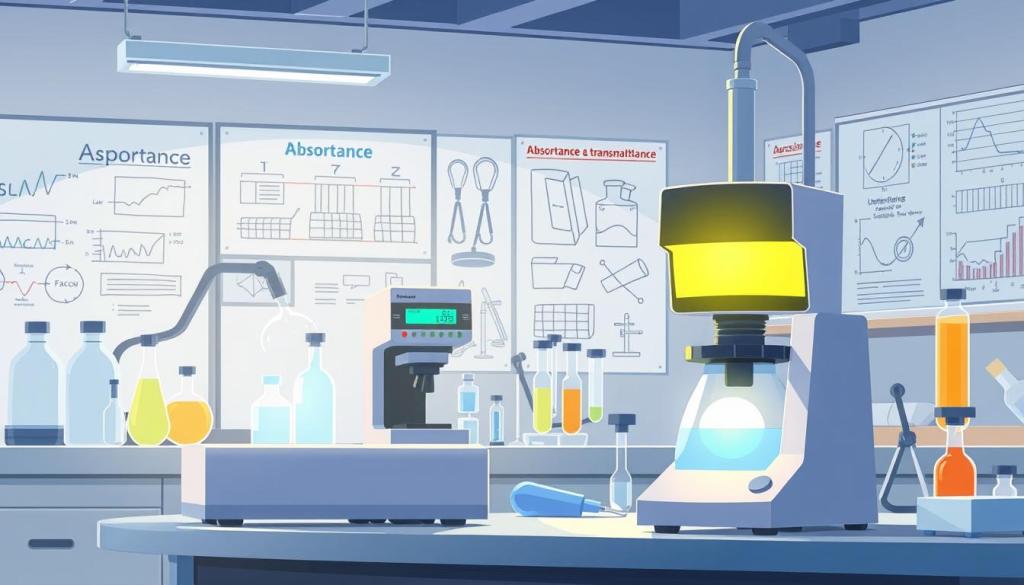
The connection between absorbance, transmittance, and concentration is very useful. It helps scientists understand complex things in many areas of study.
Factors Affecting Absorbance and Transmittance
Scientists studying solutions need to know what affects absorbance and transmittance. These key factors are vital in spectroscopic research and analytical techniques.
Concentration of Solutions
The amount of a solution affects its absorbance. More absorbing molecules mean more light is absorbed. The Beer-Lambert Law shows that absorbance goes up with concentration.
- Higher concentrations result in greater light absorption
- Linear relationship between concentration and absorbance
- Critical for quantitative chemical analysis
Path Length Impact on Measurements
Path length is how far light goes through a sample. Longer paths mean more light is absorbed. This lets researchers make their measurements more sensitive.
| Path Length (cm) | Relative Absorbance |
|---|---|
| 1.0 | Standard reference |
| 2.0 | Doubled absorption |
| 5.0 | Increased sensitivity |
Wavelength Considerations
Wavelengths interact differently with molecules, leading to varied readings. Each chemical has its own spectral characteristics based on its molecular makeup.
The wavelength of light is a fundamental parameter in determining how molecules interact with electromagnetic radiation.
Knowing these factors helps scientists get precise and accurate results. This supports advanced research in many fields.
Measurement Techniques for Absorbance and Transmittance
Scientific research depends on precise spectrophotometry principles. These principles help us understand how light interacts with substances. Transmission measurements are key in many fields, from chemistry to medical diagnostics.
Spectrophotometry Overview
Spectrophotometry is a powerful tool that measures light absorption or transmission. Scientists use special instruments to measure these optical properties with great accuracy.
- Measures light intensity before and after passing through a sample
- Operates across different wavelength ranges
- Provides quantitative data about chemical compositions
Types of Spectrophotometers
Different spectrophotometers meet various research needs. The most common types include:
- UV-Visible Spectrophotometers: Function between 185-700 nm wavelengths
- Infrared Spectrophotometers: Operate in 700-15,000 nm range
- Microplate Spectrophotometers: Used for high-throughput screening
Calibration of Instruments
Accurate transmission measurements require proper instrument calibration. Researchers must ensure:
- Regular instrument maintenance
- Use of standard reference materials
- Verification of path length accuracy
Precision in spectrophotometry is not just a goal—it’s a scientific necessity.
Modern spectrophotometers can detect absorbance values between 0.1 and 1.0. This range means they can measure 90% to 10% light transmission. This ensures reliable and reproducible scientific measurements.
Interpretation of Absorbance and Transmittance Data
Understanding spectral data is key in scientific research. It helps scientists get important insights from complex data. They need to pay close attention to detail and know the right analytical techniques.
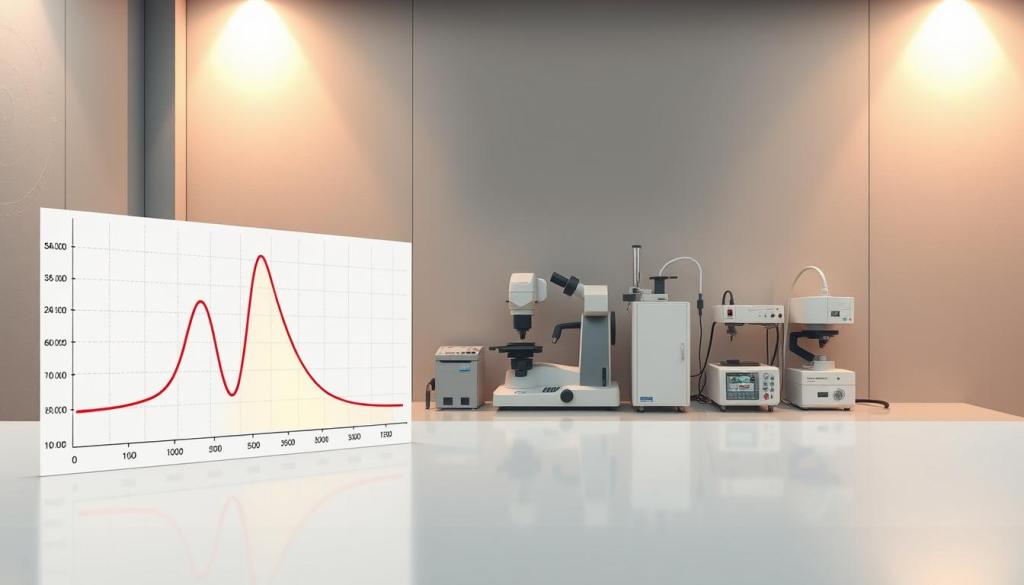
Analyzing Spectral Data
Scientists follow several steps when analyzing concentration:
- Identify characteristic peaks in the spectrum
- Evaluate baseline shifts
- Quantify signal intensity
- Compare results with reference standards
Understanding Baseline Shifts
Baseline shifts are important in solution analysis. They can show instrumental drift, chemical interactions, or sample contamination. It’s crucial to normalize baseline measurements for accurate data interpretation.
“Precision in baseline analysis determines the quality of scientific conclusions” – Spectroscopy Principles
Identifying Peaks and Valleys
Peak identification involves looking at transmittance and absorbance values across wavelengths. Key points include:
- Peak height and width
- Relative position in the spectrum
- Correlation with known molecular structures
- Consistency across multiple measurements
By carefully examining these spectral characteristics, researchers can accurately determine concentrations and analyze solutions.
Common Misconceptions About Absorbance and Transmittance
Scientists often get confused about absorbance and transmittance. This confusion can lead to big mistakes in their work. It’s important to know these mistakes to do spectroscopic analysis right.
The Linear Relationship Myth
Many think the Beer-Lambert law shows a simple, straight line between absorbance and concentration. But, this isn’t true at high concentrations.
- The Beer-Lambert law works best at low concentrations
- Optical density deviates from linearity at higher solute levels
- Molecular interactions can significantly impact measurement accuracy
Misinterpreting Transmittance Values
Transmittance isn’t always easy to understand. About 80% of spectroscopic mistakes come from not getting the basics right.
| Misconception | Actual Explanation |
|---|---|
| Transmittance is always directly proportional to concentration | Transmittance can be influenced by multiple factors beyond concentration |
| All wavelengths provide equal measurement accuracy | Wavelength selection critically impacts measurement precision |
“Understanding the nuances of optical density is key to accurate scientific measurement.” – Spectroscopy Research Institute
Scientists need to think about many things when using spectroscopy. The Beer-Lambert law is helpful, but it’s not a hard and fast rule.
Practical Considerations
To get accurate results, scientists should:
- Use very low concentrations (ideally less than 0.1 M)
- Select appropriate wavelengths
- Account for potential molecular interactions
- Verify instrument calibration regularly
Accurate spectroscopic analysis demands a critical approach and understanding of the underlying scientific principles.
The Importance of Wavelength in Absorbance and Transmittance
Wavelength is key in spectroscopic measurements. It affects how accurate and sensitive light absorption analyses are. Scientists must pick specific wavelengths for precise results in their experiments.
Wavelength Selection in Experiments
Choosing the right wavelength is vital for light absorption measurements. Different compounds absorb light at unique wavelengths. Researchers must think about several things when picking wavelengths:
- Molecular structure of the compound
- Molar absorptivity of the sample
- Spectral interference from other substances
- Instrument capabilities
Impact on Measurement Accuracy
The wavelength greatly impacts the accuracy of light absorption measurements. Instruments need precise wavelength calibration for reliable data. Molar absorptivity changes a lot with different wavelengths, so picking the right one is crucial.
| Wavelength (nm) | Absorption Characteristics | Typical Applications |
|---|---|---|
| 400-450 | High absorption for chlorophyll | Plant physiology studies |
| 650-700 | Strong chlorophyll absorption | Photosynthesis research |
| 500-550 | Lower absorption ranges | General spectroscopic analysis |
Comparison of Different Wavelengths
Scientists need to know how different wavelengths affect light absorption. Spectrophotometers give useful absorbance values between 0.05 and 1.0. Each wavelength gives unique insights into molecular interactions.
The precise selection of wavelength can make the difference between accurate scientific measurement and potentially misleading results.
Researchers should think about their compound’s spectral characteristics. They should use techniques that increase sensitivity and reduce interference.
Absorbance and Transmittance in Colorimetry
Colorimetry is where science meets color. It uses spectrophotometry to measure color with great detail. Scientists turn color feelings into numbers we can understand.

Color analysis is about how light and matter work together. Experts use special methods to figure out how colors are made.
Basics of Colorimetry
Colorimetry looks at how substances react with light. It covers:
- Measuring light absorption
- Quantifying color intensity
- Analyzing spectral reflectance
- Interpreting transmission properties
Practical Examples of Color Measurement
Many industries use colorimetry for important tasks:
- Food Quality Control: Keeping products looking the same
- Textile Manufacturing: Checking dye consistency
- Pharmaceutical Research: Watching how medication colors change
- Environmental Monitoring: Studying water and chemical colors
Color Perception and Its Relationship to Measurements
Seeing color is more than just numbers. Spectrophotometry principles connect our eyes to science. Transmission measurements turn color feelings into numbers we can use.
Color is not just what we see, but a complex interaction of light, material, and perception.
Scientists use tools that look at light between 380-750 nm. They capture the whole color range with amazing accuracy. These methods help us understand color at a deep level.
Advances in Technology for Measuring Absorbance and Transmittance
Modern spectrophotometry has seen big changes, making solution analysis better in many fields. New methods have made it easier for scientists to get accurate results quickly.
New spectrophotometry ideas focus on better, automated systems. These advances let scientists study complex samples with great accuracy and speed.
Innovations in Spectrophotometric Design
Microvolume spectrophotometers are a big step up in analysis. Key improvements include:
- Miniaturized sample handling systems
- Enhanced optical resolution
- Reduced sample volume requirements
- Improved detection sensitivity
Automated Measurement Techniques
Automation has changed solution analysis a lot. It brought high-throughput systems that can handle many samples at once. These advanced spectrophotometers use smart software and robots to make research easier.
| Technology Feature | Performance Improvement |
|---|---|
| Semiconductor Detectors | Increased light sensitivity |
| Photomultiplier Tubes | Enhanced electron multiplication |
| CCD Imaging Systems | Improved spectral resolution |
Future Trends and Developments
New spectrophotometry technologies are coming. Portable spectrophotometers and better algorithms will make analysis more flexible and precise in many places.
“The future of spectrophotometry lies in miniaturization, automation, and enhanced computational integration.” – Scientific Research Perspectives
Scientists can look forward to even better spectrophotometry. Expect more accurate wavelengths, better detection, and precise measurements as technology keeps improving.
Case Studies: Absorbance and Transmittance in Action
Measuring light absorption and concentration is key in many fields. These methods help scientists understand complex systems and get important data from samples.
Spectrophotometry gives deep insights through light absorption. It’s used in many real-world situations:
Environmental Analysis
Environmental monitoring uses these techniques a lot. Scientists use spectrophotometry to find pollutants in water, air, and soil. They focus on:
- Measuring heavy metal concentrations
- Analyzing water quality indicators
- Tracking atmospheric chemical compositions
Clinical Testing
Medical tests use light absorption to find biological markers. Spectrophotometry helps doctors:
- Diagnose metabolic disorders
- Monitor enzyme activity
- Assess protein concentration levels
Food Quality Control
The food industry uses these methods to check safety and quality. Spectrophotometry helps in:
- Verifying nutritional content
- Detecting potential contaminants
- Assessing color and quality parameters
Precision in light absorption measurements transforms scientific observations into actionable insights across diverse fields.
These examples show how important absorbance and transmittance are. They help solve real-world problems.
Conclusion: The Interconnection of Absorbance and Transmittance
Understanding absorbance and transmittance is key to spectrophotometry. These properties help us see how light interacts with matter. They give scientists tools to study many fields.
These properties are linked mathematically. This link lets scientists learn about materials and their properties.
Spectroscopic techniques are very precise. They measure light transmission and absorption well. Studies show UV-Vis spectroscopy can be accurate, even for complex samples.
This accuracy shows spectrophotometry’s value in science and real-world use.
Summary of Key Points
Choosing the right wavelength and measurement methods is important. The range of 380-700 nm works well for many samples. Advanced stats like linear regression help make data more reliable.
Implications for Future Research
Future spectrophotometry will aim for better precision and cheaper, smaller tools. New systems and algorithms will help us understand light and materials better. This will lead to new discoveries in many areas.
Final Thoughts on Measurement Techniques
The connection between absorbance and transmittance drives science forward. Improving measurement methods and using new tech will help us learn more. This will deepen our understanding of the world around us.
FAQ
What is the fundamental difference between absorbance and transmittance?
Absorbance shows how much light a sample absorbs. Transmittance shows how much light passes through a sample. Absorbance is calculated as the logarithm of the ratio of incident to transmitted light. This makes it more linear with concentration than transmittance.
How does the Beer-Lambert Law relate absorbance to concentration?
The Beer-Lambert Law links absorbance, concentration, path length, and molar absorptivity. It says absorbance is directly proportional to concentration and path length. This lets scientists find unknown concentrations with spectrophotometry.
What factors can affect absorbance and transmittance measurements?
Several factors impact absorbance and transmittance. These include:
– Solution concentration
– Path length of the sample
– Wavelength of incident light
– Temperature
– Presence of interfering substances
– Instrument calibration and sensitivity
Why are spectrophotometric measurements important in scientific research?
Spectrophotometric measurements are key in many fields. They help with:
– Concentration determination
– Chemical analysis
– Environmental monitoring
– Medical diagnostics
– Pharmaceutical research
– Quality control in food and industrial processes
How do scientists choose the appropriate wavelength for spectrophotometric analysis?
Scientists pick wavelengths based on:
– Maximum absorption peak of the specific compound
– Specificity of the measurement
– Avoiding interference from other substances
– Instrument capabilities
– Sensitivity requirements of the analysis
What is the relationship between optical density and absorbance?
Optical density is another term for absorbance. It shows the logarithmic measure of light absorbed by a sample. It’s directly related to the substance’s concentration. The terms are often used the same way in spectrophotometry.
Can absorbance be used to determine unknown concentrations?
Yes, absorbance is great for finding unknown concentrations. By using the Beer-Lambert Law and a standard calibration curve, researchers can calculate a substance’s concentration based on its absorbance.
What are the limitations of spectrophotometric measurements?
Key limitations include:
– Deviation from Beer-Lambert Law at high concentrations
– Potential interference from other substances
– Limited accuracy with very dilute or highly concentrated solutions
– Instrumental constraints
– Potential errors in sample preparation and measurement
How do transmission measurements differ from absorbance measurements?
Transmission measurements show the percentage of light passing through a sample. Absorbance is a logarithmic calculation of light absorption. Transmittance is a percentage (0-100%), while absorbance is a dimensionless value that shows a more linear relationship with concentration.
What recent technological advancements have improved spectrophotometric techniques?
Recent advancements include:
– Microvolume analysis systems
– High-throughput spectrophotometers
– Automated measurement techniques
– Improved wavelength precision
– Enhanced computer algorithms for data interpretation
– More sensitive detection methods




Leave a Comment
Your email address will not be published. Required fields are marked *