



Ever thought about how a small piece of DNA can reveal someone’s identity? Short tandem repeats (STRs) are changing forensic science and DNA fingerprinting. They give us deep insights into who we are genetically.
DNA profiling with STRs has changed how crimes are solved and genetic differences are understood. These tiny genetic markers make up about 3% of our DNA. Yet, they are incredibly powerful in forensic work.
STRs are short DNA sequences, usually 2-6 base pairs long. They create a unique genetic fingerprint for each person. Their high mutation rate makes them perfect for precise identification in forensic science.
Scientists use STR profiling by looking at 4-6 specific genetic spots. This greatly lowers the chance of matching two unrelated people. This method is now the top choice for solving crimes, helping scientists solve complex genetic puzzles with great accuracy.
Key Takeaways
- STRs account for 3% of human genetics
- DNA profiling can analyze 4-6 genetic loci simultaneously
- STR mutation rates are significantly higher than other genetic regions
- Forensic science relies on STR analysis for human identification
- STR techniques can solve previously unsolvable criminal cases
Introduction to DNA Profiling and Its Importance
DNA profiling is a cutting-edge science that lets us identify people by their unique DNA. It has changed many fields, like forensic science and medical research. It does this by finding special genetic markers that make each person different.
The way we analyze STRs gives us powerful tools to solve big biological puzzles. Scientists can get deep insights from tiny biological samples. This changes how we see human genetic information.
Definition of DNA Profiling
DNA profiling is about studying specific genetic sequences to make a unique “fingerprint” for each person. It includes:
- Mapping special genetic markers
- Finding unique chromosomal patterns
- Creating exact genetic identification profiles
Applications of DNA Profiling
DNA profiling is used in many important areas:
- Criminal Investigations: Matching DNA from crime scenes with suspects
- Disaster Victim Identification (DVI)
- Paternity and Kinship Testing
- Medical Genetic Research
“DNA profiling has transformed forensic science, providing unprecedented accuracy in human identification.” – Genetic Research Institute
This method has become key in forensic science, with an 80% chance of matching DNA. It shows how far science has come in understanding genetics.
What Are Short Tandem Repeats?
Genetic research has uncovered fascinating insights into the complex world of DNA. Short tandem repeats (STRs) are a unique and powerful class of genetic markers. They play a crucial role in understanding human genetic variation.
Definition of Short Tandem Repeats
Short tandem repeats are specific DNA sequences. They consist of 2 to 6 base pairs that repeat multiple times in a genome. These repeat sequences are like genetic fingerprints, offering remarkable insights into individual genetic profiles.
Characteristics of STRs
- Highly polymorphic genetic markers
- Vary significantly among individuals
- Located throughout human chromosomes
- Typically found in non-coding DNA regions
Importance in Genetic Studies
STRs have become critical tools in various scientific domains. They are especially important in criminal investigations. Polymorphic loci help create unique genetic profiles. Their exceptional variability makes them invaluable for:
- Forensic DNA analysis
- Paternity testing
- Population genetics research
- Evolutionary biology studies
“Short tandem repeats are like genetic signatures that tell a unique story about an individual’s genetic makeup.” – Genetic Research Journal
Recent scientific understanding suggests that while STRs were previously considered non-functional, emerging research indicates they might influence gene expression in subtle yet significant ways. This evolving perspective highlights the complexity of genetic mechanisms beyond traditional understanding.
The Role of STRs in DNA Profiling
Short Tandem Repeats (STRs) have changed how we identify DNA in forensic science. These genetic markers give us detailed insights into DNA profiles. They help us identify individuals accurately in many fields.
STRs as Genetic Markers
STRs are key in genetic identification because of their unique traits. They are specific and useful in forensic science and paternity testing. The benefits of STRs include:
- High polymorphism rate
- Small genetic segment size
- Easy amplification through PCR
- Consistent inheritance patterns
Stability in Human Populations
STRs are stable in human populations, making them reliable for long-term studies. Their consistent patterns help forensic scientists build accurate DNA databases.
Comparative Genetic Marker Analysis
STRs are the top choice for comparing genetic markers in forensic genetics. They outperform other markers like Single Nucleotide Polymorphisms (SNPs) in several ways.
| Marker Type | Identification Precision | Forensic Utility |
|---|---|---|
| STRs | High | Excellent |
| SNPs | Moderate | Good |
| VNTRs | Low | Limited |
“STRs represent the cornerstone of modern genetic identification techniques.” – Forensic Genetics Research Institute
The field of genetic identification is always growing. STRs are at the heart of forensic science, paternity testing, and advanced genetic studies.
The Process of DNA Profiling Using STRs
DNA fingerprinting is a complex science that turns biological samples into unique genetic codes. The steps in STRs analysis are key. They help forensic scientists make exact genetic profiles.

Sample Collection and Preparation
Forensic science needs careful sample collection. Investigators collect genetic material from different places:
- Blood
- Saliva
- Hair follicles
- Skin cells
- Bodily fluids
Polymerase Chain Reaction Technique
The PCR method makes more of specific DNA parts, focusing on short tandem repeats. Researchers can quickly multiply genetic material, making millions of copies of targeted DNA regions.
“PCR allows scientists to generate substantial genetic information from minimal sample quantities” – Forensic Genetics Expert
Gel Electrophoresis Analysis
Gel electrophoresis sorts DNA fragments by size, making a unique genetic fingerprint. This method lets scientists measure STR lengths accurately, which is key for correct identification.
DNA profiling through STRs analysis offers incredible genetic detail. With a 1 in 10 trillion chance of matching profiles, it’s a key part of today’s forensic science.
Analyzing STR Data
DNA profiling uses advanced methods to understand genetic markers. Forensic scientists apply complex statistics to STR profiles in criminal cases.
Interpreting STR Profiles
Interpreting STR data is a detailed process. It turns raw genetic info into useful forensic evidence. Scientists look at specific genetic markers to create unique DNA prints.
- Identify specific genetic markers at each locus
- Compare allele frequencies across population groups
- Calculate statistical probability of genetic matches
Statistical Methods in DNA Analysis
Modern labs use advanced stats to check STR profiles. They do complex math to see if samples match.
“Precision in genetic marker analysis is crucial for reliable forensic investigation.” – Forensic Genetics Research Group
Since 2011, there are strict guidelines for STR profile checks. The ANSI/ATCC ASN-0002 guidelines suggest using 13 autosomal STR loci for detailed genetic ID.
| STR Analysis Parameter | Recommended Standard |
|---|---|
| Number of Loci | 13 autosomal STR markers |
| Recommended Profiling Frequency | Every three years |
| Analysis Method | Next Generation Sequencing (NGS) |
New tech like Next Generation Sequencing gives deeper insights into STR diversity. This makes genetic ID in crimes more accurate.
Applications of STR Analysis
Short tandem repeat (STR) analysis has changed how we identify DNA in many fields. Its unique features make DNA fingerprinting precise in areas like forensic science and genetics. This gives us deep insights into human genetics and forensic science.
Forensic Science Breakthroughs
DNA fingerprinting through STR analysis has changed criminal investigations. Forensic experts use these genetic markers to:
- Link suspects to crime scenes
- Exonerate wrongly accused individuals
- Identify human remains in complex cases

Precision in Paternity Testing
Genetic identification is at its best in paternity testing. STR analysis offers high accuracy in finding biological relationships. It can:
- Confirm biological parentage
- Resolve legal inheritance disputes
- Establish familial connections with over 99.9% reliability
Exploring Ancestry and Genealogy
STR analysis goes beyond immediate forensic uses. Researchers and genealogists use these genetic markers to:
- Trace ancestral lineages
- Solve historical genetic mysteries
- Uncover complex family histories
STR analysis represents a powerful tool in understanding human genetic diversity and connections.
| Application | Key Benefits |
|---|---|
| Forensic Science | Crime scene investigation, human identification |
| Paternity Testing | 99.9% accuracy in biological relationship determination |
| Genealogy | Tracing ancestral roots, understanding genetic heritage |
As genetic technologies improve, STR analysis keeps opening up new ways to understand human genetic complexity.
Limitations of STR Analysis in DNA Profiling
Forensic science uses DNA fingerprinting a lot for identifying people. But, short tandem repeat (STR) analysis has big challenges. These challenges are important for researchers and forensic experts to know about.
Challenges with STR Variability
STR analysis has complex genetic markers. These markers can be hard to understand because of their variability. This can lead to unexpected problems:
- Rare allele occurrences can complicate profile matching
- Mutations between related individuals may produce discrepant results
- Limited detection of extremely large genetic expansions
Potential for Contamination
DNA fingerprinting can be affected by outside factors. There are big risks of contamination:
- Mixed biological samples
- Degraded DNA material
- Cross-contamination during sample processing
The precision of genetic analysis depends on maintaining rigorous scientific protocols.
Studies show that using 13-15 core genetic loci helps with some challenges. Multiplex PCR amplification lets us analyze many markers at once. This makes the results more reliable.
| Limitation | Impact on Analysis |
|---|---|
| Sample Degradation | Reduced Profile Clarity |
| Rare Mutations | Potential Misinterpretation |
| Contamination | Compromised Result Accuracy |
It’s key for forensic experts to know these limits. This helps make sure genetic investigations are accurate and reliable.
Future Developments in STR Research
The field of genetic markers is changing fast, with big steps forward for STRs analysis. Scientists are exploring new ways to understand repeat sequences. They are using new technologies that could change DNA profiling forever.
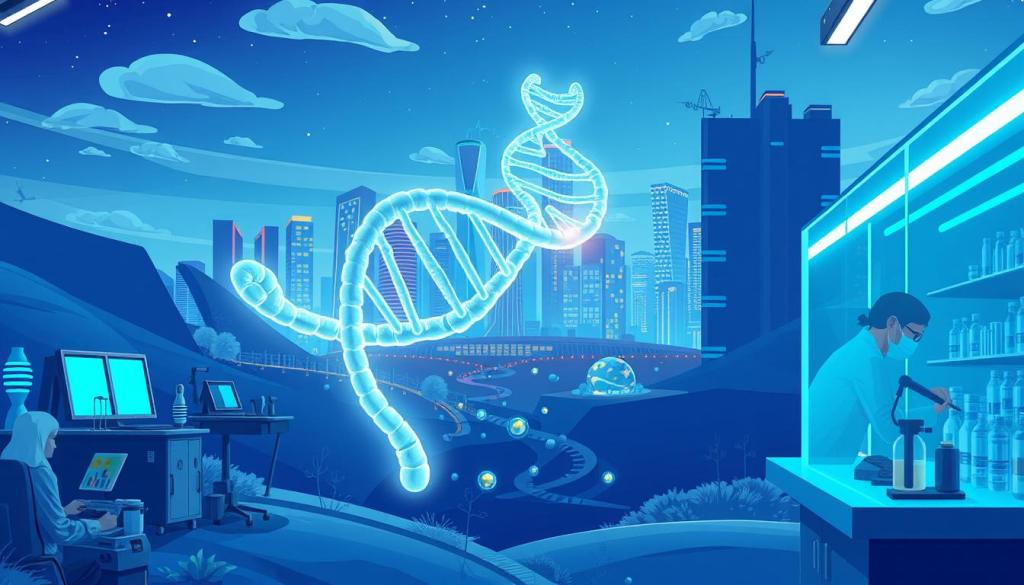
New technologies are changing how we study genes. Some big changes are coming to STR research:
- Advanced whole genome sequencing techniques
- Long-read sequencing technologies
- Enhanced precision in genetic marker identification
Technological Innovations in STR Analysis
New sequencing methods are making genetic analysis better. Researchers can now get more detailed info from STR regions. They can find genetic variations that were hard to spot before.
“The future of genetic research lies in our ability to understand the complex landscape of repeat sequences” – Genetic Research Institute
Precision Medicine Potential
STRs are key in precision medicine. They help us understand genetic variations better. This can lead to:
- Personalized treatment plans
- Disease risk checks
- Genetic advice tailored to you
Research on STR genetic markers is growing our knowledge of human genetics. As tech gets better, we’ll see more advanced DNA profiling. This will give us deeper insights into our genes.
Conclusion
Short tandem repeats (STRs) have changed DNA profiling in many fields. The FBI uses 13 core STR loci for genetic identification in the U.S. This shows how reliable and precise this method is. These genetic markers are key in forensic science, giving deep insights into genetic profiles.
STR analysis is not just for forensic use. It can work with even small DNA samples, making genetic identification very accurate. It’s so precise that two unrelated Caucasians have only a 1 in 575 trillion chance of having the same 13-STR profile.
The Future of Genetic Research
As technology gets better, STR research keeps exploring new genetic areas. Next-generation sequencing makes whole genome profiling easier, opening new paths in medical research and personal genetic analysis. Tools like STRScan can find 20% more STRs than old methods, promising even better genetic identification in the future.
Significance of Continuous Exploration
Understanding STRs is a key part of genetic science. They help diagnose genetic disorders and solve complex forensic cases. As researchers learn more about STRs, we look forward to even more precise genetic identification and medical breakthroughs.
FAQ
What are Short Tandem Repeats (STRs)?
Short Tandem Repeats (STRs) are short DNA sequences that repeat in a specific spot on a chromosome. They vary greatly between people. This makes them perfect for identifying individuals in forensic science, paternity tests, and genetic studies.
How are STRs used in DNA profiling?
STRs help create a unique genetic fingerprint by looking at specific DNA spots. Forensic experts use PCR to amplify these sequences. Then, they compare the repeats to match DNA samples with high accuracy.
Why are STRs considered ideal for forensic identification?
STRs are great for forensic identification because they vary a lot between people. They’re small and easy to amplify. Plus, they can create detailed DNA profiles from even tiny or damaged samples.
What types of samples can be used for STR analysis?
STR analysis works on many biological samples. This includes blood, saliva, hair, skin cells, semen, and more. Even tiny amounts of DNA can be used to create a profile with advanced techniques.
How accurate is STR DNA profiling?
STR DNA profiling is very accurate. The chance of two unrelated people having the same DNA profile is very low. Modern methods check 13-20 genetic markers, making matches almost impossible.
What are the main applications of STR analysis?
STR analysis is used in many areas. It helps solve crimes, identify human remains, and test paternity. It’s also used in genetic genealogy and monitoring bone marrow transplants. It’s a key tool in forensic science, medicine, and law.
Are there any limitations to STR analysis?
While STR analysis is reliable, it has some limits. These include contamination, issues with mixed or damaged samples, and mutations. Experts use various methods to overcome these challenges.
How has STR technology evolved over time?
STR technology has come a long way. Early methods used fewer markers and simpler detection. Now, we use advanced technologies like fluorescent labeling and capillary electrophoresis. This has improved accuracy and opened up new uses for STR profiling.





Leave a Comment
Your email address will not be published. Required fields are marked *