



Ever wondered about the tiny world inside you? Human cell size is more complex and fascinating than you might think.
Human cells come in all sizes, from tiny red blood cells to large egg cells. This range challenges our usual view of biological structures.
Scientists found that human cell size changes a lot depending on the cell type. Red blood cells are about 7-8 micrometers wide. But human egg cells can be up to 120 micrometers, showing how different cells can be.
Looking into human cell sizes gives us a deep look into life’s complexity. These tiny units are the building blocks of life. Each one has its own size and role, based on its size.
Key Takeaways
- Human cells range from 0.1 to 100 micrometers in diameter
- Red blood cells are the smallest human cells at 7-8 micrometers
- Human egg cells represent the largest cellular structures
- Cell size directly influences cellular functionality
- Microscopic techniques enable detailed cell size measurements
Overview of Human Cell Size
The world of human cells is full of tiny wonders. Learning about their size helps us understand life’s basics. The size of human cells is key to how our bodies work.
Importance of Cell Size
Cell size matters a lot for our bodies to work right. The size of human cells affects how well they do their jobs. This includes things like getting nutrients and getting rid of waste.
- Nutrient absorption
- Waste elimination
- Genetic information transmission
- Metabolic activities
Comparison to Other Organisms
Looking at human cells, we see they’re bigger than some but smaller than others. This is interesting when we compare them to cells in other living things.
| Organism | Cell Size Range |
|---|---|
| Prokaryotic Cells | 0.1 – 5.0 μm |
| Human Cells | 10 – 100 μm |
| Large Plant Cells | 100 – 500 μm |
Factors Influencing Cell Size
Many things affect how big human cells are. Things like genetics, the environment, and what the cell does all matter.
“The size of a cell is not just a random characteristic, but a carefully balanced mechanism crucial for cellular survival and functionality.” – Cellular Biology Research Team
Studies show most human cells are between 10-100 micrometers wide. This size is perfect for them to work well.
Interesting fact: About 635 average human cells can fit across the diameter of a penny!
Types of Human Cells
The human body is made up of over 200 different cell types. Each cell has its own special features and jobs. By studying human cells, we learn about the tiny world inside us.

Looking into how small human cells are shows us how diverse and specialized they are. Let’s look at three amazing cell types:
Red Blood Cells: Tiny Oxygen Carriers
Red blood cells are among the smallest in our bodies. They have:
- Diameter of 7-8 µm
- Biconcave disc shape
- Specialized for oxygen transportation
- Approximately 100 µm³ in volume
Neurons: Long-Distance Communicators
Neurons vary greatly in size:
- Can reach lengths over 1 meter
- Width of approximately 10 µm
- Facilitate electrical and chemical communication
- Critical for nervous system functioning
Muscle Cells: Powerful Movers
Muscle cells are quite large:
- Diameters up to 100 µm
- Some muscle cells can have multiple nuclei
- Designed for contraction and movement
- Crucial for physical performance
“The diversity of human cells is a testament to the complexity of biological systems.” – Cellular Biology Research Team
Every cell type solves a unique biological problem. This shows how adaptable human cells are.
Measuring Cell Size
Understanding human cellular size needs precise measurement techniques. These tools reveal the tiny world of cells. Scientists use them to explore the detailed dimensions of human cells, finding interesting facts about their structure.
Precision Units of Measurement
Researchers use micrometers (μm) and nanometers (nm) to measure human cell size. These small units help scientists understand the tiny details of cells with great accuracy.
- Micrometers (μm): Represent one-millionth of a meter
- Nanometers (nm): Even smaller, representing one-billionth of a meter
Advanced Measurement Tools
Many advanced instruments help researchers study human cellular size in detail. Each tool has special abilities for looking at different parts of cell size.
- Light Microscopes: Resolve objects down to 200 nm
- Electron Microscopes: Achieve resolutions less than 1 nm
- Flow Cytometry: Measures over 100,000 cells per experiment
- Atomic Force Microscopy: Provides ultra-precise cell surface mapping
Innovative Measurement Techniques
Scientists use various new methods to study human cell size. These include optical imaging and advanced electronic sensing technologies.
*”Cell measurement is an art of precision, revealing the hidden world within our biological systems.”*
The accuracy of these methods varies. Some can measure cell size within 10-20% of its total volume. This detailed approach helps scientists understand the complex sizes of human cells across different types.
Average Size of Human Cells
Human cells are incredibly small, making up a complex world we can’t see. They come in all sizes, showing how diverse our bodies are.
Looking into human cell sizes gives us a peek into the amazing world of biology. Cells can be tiny or quite large, showing us how small life can be.
Typical Cell Size Range
Most human cells are between 10 to 100 micrometers in diameter. This range shows how varied cell sizes can be:
- Red blood cells: About 8 micrometers in diameter
- Fat cells: Around 100 micrometers in size
- Nerve cells: Can grow up to 1 meter long
Variations Among Cell Types
Cell sizes change based on their function and where they are in the body. Each cell size is unique, fitting its specific role.
| Cell Type | Average Size | Unique Characteristics |
|---|---|---|
| Red Blood Cells | 8 micrometers | Smallest major cell type |
| Nerve Cells | Up to 1 meter | Longest cells in human body |
| Fat Cells | 100 micrometers | Largest storage cells |
“Cells are the building blocks of life, each with its unique size and purpose.” – Scientific Research Quarterly
How small are human cells? Imagine a cell that’s 300 feet tall if it were 3 million times bigger. This shows just how tiny and amazing cells are.
Why Cell Size Matters
Understanding human cell measurements is key to knowing how our cells work and stay healthy. The size of human cells is crucial for how well our bodies function.
Cell size affects many biological processes. It influences the surface area to volume ratio. This ratio is key to how well cells can do their jobs.
Impact on Cellular Functionality
The size of human cells impacts important functions like:
- Nutrient absorption
- Waste elimination
- Signal transmission
- Metabolic activities
“Cell size is not just a physical characteristic, but a fundamental determinant of cellular performance.” – Cellular Biology Research Institute
Role in Health and Disease
Abnormal cell sizes can hint at health issues. Changes in cell size might show underlying medical problems or genetic disorders.
| Cell Type | Normal Size Range | Potential Health Implications |
|---|---|---|
| Red Blood Cells | 6-8 micrometers | Size variations can indicate anemia |
| Neurons | 10-100 micrometers | Irregular sizes might suggest neurological disorders |
| Muscle Cells | 10-100 micrometers | Size changes can reflect muscular health |
Research shows human cell sizes can differ greatly. They range from tiny red blood cells to large neurons. These differences greatly affect how cells work and our overall health.
Factors Affecting Cell Size
Understanding human cell size involves looking at genetics, environment, and nutrition. Cells change based on what’s happening inside and outside them. Their size is key to staying healthy and working right.

Genetic Influences on Cell Dimensions
Genetics are a big deal when it comes to cell size. Scientists have found that certain genes and pathways control how cells grow and split. They’ve learned a lot:
- Cell size checkpoints exist during critical cell cycle transitions
- Genetic networks can regulate target cell dimensions
- Mutations can disrupt size homeostasis mechanisms
Environmental Factors Impacting Cell Size
Environment also plays a big role in cell size. Different conditions create unique settings for cells to grow and change:
| Environmental Parameter | Impact on Cell Size |
|---|---|
| Mechanical Properties | Can be controlled between 1.8 and 36.5 kPa |
| Microniche Geometry | Lateral dimensions range from 5-40 microns |
| Cell Density | Affects cell spreading and occupation of spaces |
Nutritional Aspects of Cell Growth
Nutrition is also important for cell size. Cell growth and upkeep need the right nutrients and energy. Here’s what’s been found:
- Nutrient-rich environments support optimal cell growth
- Energy sources directly influence cellular expansion
- Metabolic pathways regulate size compensation mechanisms
Cell size is not static but a dynamic process influenced by multiple interconnected factors.
Cell Size and Development
The journey of human cell development is truly fascinating. It shows how complex life can be. From the start of life to the growth of tissues, cell size is key.
Human cells go through amazing changes in size and shape. These changes happen at different stages of growth. They show how cells grow and change.
Growth Stages in Human Cells
Cell development has clear stages with specific sizes:
- Embryonic stage: Cells divide fast with little size change
- Fetal development: Cells become more complex and different
- Childhood: Cells keep growing and becoming more specialized
- Adulthood: Cell sizes stabilize with specific roles
Influence of Stem Cells
Stem cells are very important in cell growth. They can change into many different cell types. Each type has its own size.
Stem cells are the architects of cellular diversity, capable of transforming into specialized cells with distinct dimensional properties.
| Developmental Stage | Average Cell Size | Primary Characteristics |
|---|---|---|
| Embryonic | 10-20 micrometers | Rapid proliferation |
| Childhood | 20-50 micrometers | Increasing specialization |
| Adulthood | 30-100 micrometers | Stabilized functional sizes |
Understanding cell size shows a mix of genetics and environment. Each stage brings new challenges and chances for growth and specialization.
Observing Cell Size Under Microscopy
Human cell microscopy is a cool way to see the tiny world of cells. It helps us understand how small human cells are. We need special tools and careful steps to see these tiny structures.
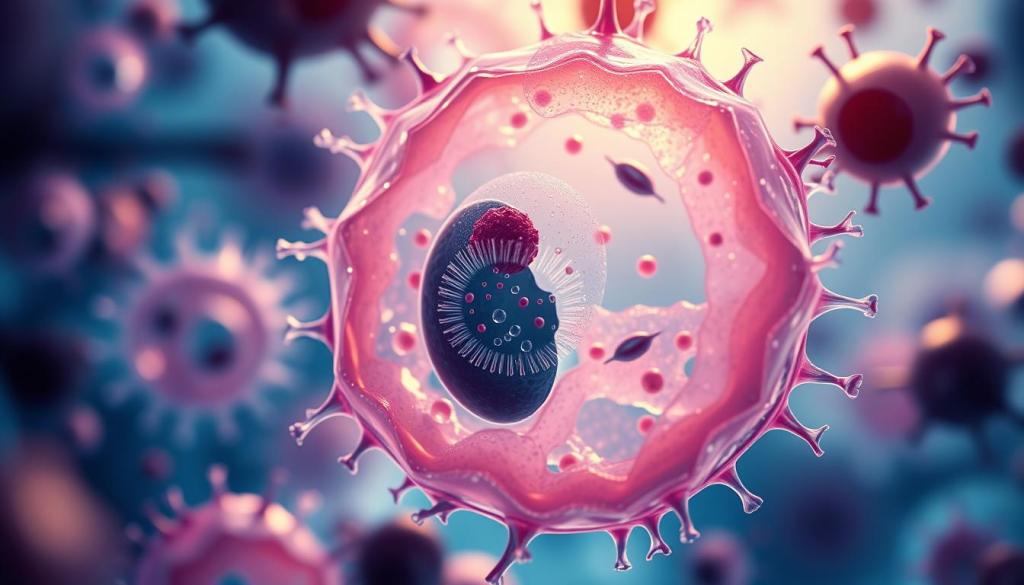
First, we pick the right microscope. Each one shows different details of cell sizes.
Microscope Types for Cellular Observation
- Light Microscopes: Magnify objects up to 1000 times
- Electron Microscopes: Provide ultra-high resolution imaging
- Fluorescence Microscopes: Highlight specific cellular components
Microscopic Sample Preparation Techniques
Getting cells ready for the microscope is a big job. It needs skill and care. Here’s what we do:
- Cell fixation to keep the cells intact
- Special staining to make them stand out
- Careful cutting of the specimens
- Mounting them on slides correctly
Scientists face challenges in seeing cells clearly. Wet mount preparations and oil lenses help a lot. They let us see cells in amazing detail.
The key to successful human cell microscopy lies in understanding the intricate relationship between preparation techniques and imaging technologies.
Measuring Cellular Dimensions
Measuring cell size is a precise task. Most human cells are between 1 and 100 micrometers wide. This makes them both small and interesting to study. Light microscopes can show cells down to 200 nanometers. Electron microscopes can go even smaller, under 1 nanometer.
Real-World Applications of Cell Size Knowledge
Knowing how big human cells are is key in medical research and tech. Scientists use this info to create new ways to solve problems in science.
Transformative Medical Innovations
Understanding human cell size leads to big medical wins. Researchers use this knowledge to:
- Spot when cells grow too much
- Make treatments just for cancer
- Customize medical plans
Biotechnology Research Frontiers
Studying cell size helps in biotech advancements. Scientists learn how cell size affects:
- How drugs are made
- Creating new tissues
- Fixing damaged tissues
| Research Domain | Cell Size Application |
|---|---|
| Cancer Research | Identifying abnormal cell growth |
| Drug Development | Designing targeted molecular therapies |
| Regenerative Medicine | Understanding cellular transformation mechanisms |
“Cellular dimensions are the microscopic blueprints of biological innovation” – Dr. Elena Rodriguez, Cell Biology Research Institute
New tech keeps helping us learn about human cell size. This pushes science forward and finds new ways to tackle tough medical issues.
Conclusion on Human Cell Size
The study of human cell sizes opens a world of wonder inside us. It shows how cells work and how they are structured. Cells range from tiny red blood cells to large neurons, each about 7 to 120 μm in size.
Scientists keep finding out how cells control their size. They pause at certain points in their life cycle to keep the right size. With 30 trillion cells in our bodies, each one is vital for our health.
Key Research Findings
New tools like electron microscopy are changing how we see cells. They help us understand how cell size affects growth and health. This research could lead to new ways to treat diseases.
Future Research Directions
Future studies will look at how genes and the environment affect cell size. By studying cells more, scientists hope to find new ways to help people. This could change how we treat diseases and understand our bodies.
FAQ
How big are human cells on average?
Human cells vary in size. Most are between 10 to 100 micrometers in diameter. Red blood cells are the smallest, about 7-8 micrometers. Nerve cells can reach up to 100 micrometers long. The size depends on the cell type and its function.
What is the smallest human cell?
Red blood cells are the smallest, measuring 7-8 micrometers in diameter. They are small and flexible to carry oxygen efficiently.
What is the largest human cell?
The female egg cell is the largest, about 100 micrometers in diameter. It’s as wide as a human hair and can be seen with the naked eye.
How do scientists measure cell sizes?
Scientists use advanced microscopes to measure cell sizes. They use light, electron microscopes, and tools like flow cytometry. These methods help measure cells in micrometers and nanometers.
Why does cell size matter in human biology?
Cell size is key because it affects how cells work. It impacts nutrient absorption, waste removal, and signal transmission. The size of a cell can show if there are health problems.
Do cell sizes change as humans develop?
Yes, cell sizes change a lot as we grow. In the early stages, cells are small and divide fast. As we mature, cells get specialized and can grow or shrink based on their role.
What factors influence human cell size?
Many things affect cell size, like genetics, environment, and nutrition. Hormones and specific cell functions also play a role. These factors can change cell size.
Can cell size indicate health conditions?
Yes, it can. Abnormal cell sizes can point to health issues. For example, big cells might show inflammation or cancer. Small cells could mean nutritional problems or genetic issues. Doctors use cell size to help diagnose.





Leave a Comment
Your email address will not be published. Required fields are marked *