



Ever wondered how tiny bacteria really are? Learning about their size opens up a world that’s both fascinating and tiny. It changes how we see the smallest life forms.
Bacteria are incredibly small, usually between 0.5 to 5 micrometers. They’re too small to see with our eyes, but special microscopes can show their detailed shapes. Scientists use high-tech tools to study their tiny sizes.
The size of bacteria varies a lot among different types. Some, like Mycoplasma, are just 0.3 µm, while others, like Thiomargarita namibiensis, can be up to 0.5 mm. This size range helps them survive and interact with their surroundings in unique ways.
Key Takeaways
- Bacteria are microscopic organisms typically ranging from 0.5 to 5 µm
- Most bacteria cannot be seen without advanced microscopy
- Size influences bacterial survival and adaptability
- Different bacterial shapes impact their functional capabilities
- Advanced imaging techniques are essential for studying bacterial cell size
Understanding Bacteria Cell Size
Microscopic bacteria are a fascinating world hidden from our eyes. Since the 17th century, scientists have been amazed by their tiny size and complex life forms. They challenge our understanding of life itself.
Bacteria come in all sizes, from 0.1 to 10 µm in diameter. Their small size lets them live in almost every environment on Earth. This shows their incredible ability to adapt.
What Are Bacteria?
Bacteria are single-celled organisms with a simple yet complex structure. They don’t have the complex parts found in more advanced life forms. This makes their size very interesting to scientists.
- Prokaryotic cellular organization
- Rapid reproduction capabilities
- Diverse metabolic functions
Importance of Size in Microscopy
The size of bacteria is key to understanding them. Scientists use different ways to see bacteria at different sizes. This helps them learn about the details of their cells.
“In the world of microbiology, size is not just a measurement, but a window into cellular complexity.” – Microbiology Research Institute
| Bacterial Type | Size Range | Typical Example |
|---|---|---|
| Mycoplasmas | 0.1 – 0.2 µm | Smallest known bacteria |
| Bacillus anthracis | 1.0 – 1.3 µm diameter | Rod-shaped bacteria |
| Pasteurella tularensis | 0.2 – 0.7 µm | Small pathogenic bacteria |
Knowing the size of bacteria helps us understand their behavior and role in nature. Their small size doesn’t mean they’re not important. They play a big part in our world.
Typical Size Range of Bacteria
Bacteria are tiny wonders with sizes that vary a lot. Their sizes and shapes are very different. Scientists are still learning about this tiny world.
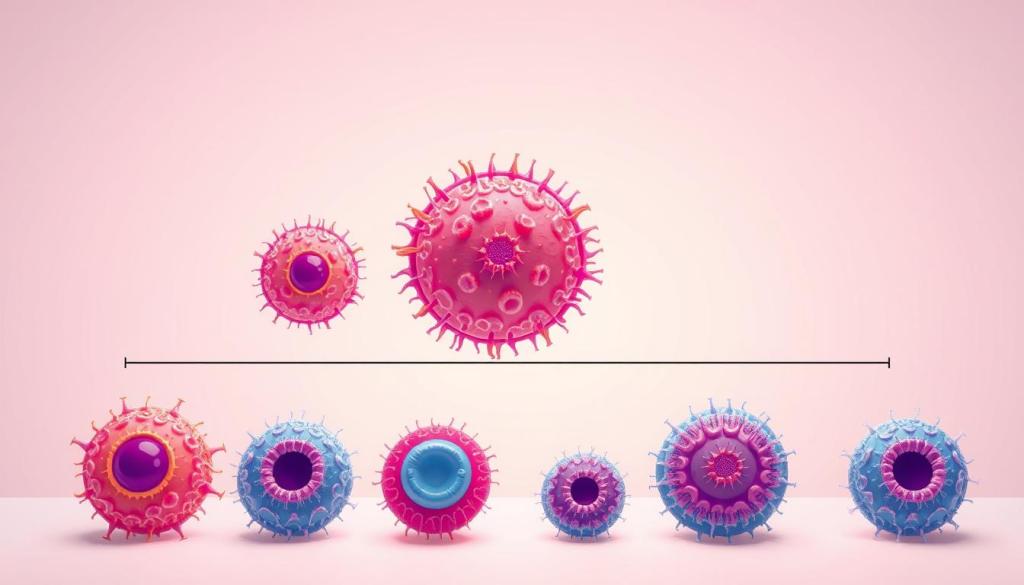
The size of bacteria can be from 0.5 to 5.0 micrometers. This shows how different they can be. Knowing their sizes helps us understand how they live and interact.
Average Size of Bacteria Cells
Most bacteria are between 0.4-3 µm³ in size. This makes them a diverse group. Here are some examples:
- Smallest bacteria: Mycoplasma at 0.3 micrometers
- Typical bacterial length: 0.5-5.0 micrometers
- Largest known bacteria: Thiomargarita magnifica up to 2 cm long
Factors Affecting Bacteria Size
Many things can change how big bacteria are:
- Nutrient availability
- Environmental conditions
- Genetic makeup
- Habitat complexity
The microscopic world of bacteria reveals extraordinary adaptability in size and structure.
| Bacterial Type | Size Range | Notable Characteristics |
|---|---|---|
| Marine Ultramicrobacteria | 0.013 µm³ | Extremely small cellular volume |
| Thiomargarita namibiensis | 0.22 µL | Large bacterial species |
| Epulopiscium | Up to 600 µm × 80 µm | Remarkably large bacterium |
The world of bacterial sizes is amazing. It shows how these tiny creatures can adapt and survive in many places.
Comparison with Other Microorganisms
To understand bacteria, we must see their size compared to other tiny life forms. Scientists have studied bacteria’s size in detail. This helps us learn about their special sizes.
Bacteria stand out in the world of tiny life. They show amazing size differences compared to viruses and fungi. Their sizes show how diverse life can be in tiny spaces.
Size Comparisons with Viruses
Viruses are much smaller than bacteria. They range from 0.02 to 0.5 microns. Bacteria, on the other hand, are 1 to 10 microns long and 0.2 to 1 micron wide. This size gap helps us understand how they interact and work together.
- Viruses: 0.02 – 0.5 microns
- Bacteria: 1 – 10 microns in length
- Bacteria width: 0.2 – 1 micron
Size Comparisons with Fungi
Fungi are much larger than bacteria. For example, yeasts like Saccharomyces cerevisiae are 3-5 µm in diameter. This size difference is key to understanding how they live together.
“The microscopic world is a realm of incredible diversity, where size determines functionality and survival.” – Microbiology Research Insights
The sizes of bacteria, viruses, and fungi show how complex tiny life is. Each size helps them fit into their own special place in the world.
Types of Bacteria and Their Sizes
Bacteria come in many shapes and sizes, each with its own unique features. This variety helps scientists understand how bacteria behave and what they can do.
There are three main shapes bacteria can take. These shapes affect how bacteria work and how they interact with their surroundings.
Cocci: Spherical Bacterial Cells
Cocci are round bacteria with certain sizes:
- Typical diameter: 0.5-2.0 µm
- They can be paired, form chains, or cluster together.
Bacilli: Rod-Shaped Bacterial Configurations
Bacilli are rod-shaped bacteria with specific sizes:
- Width range: 0.25-1.0 µm
- Length spectrum: 1-10 µm
- Escherichia coli is a well-known example, measuring 1.1-1.5 µm wide and 2.0-6.0 µm long.
Spirilla: Spiral-Shaped Bacterial Structures
Spirilla are curved or helical bacteria with unique sizes:
| Characteristic | Dimension Range |
|---|---|
| Length | 5-40 µm |
| Maximum Length | Up to 500 µm |
“The diversity of bacterial shapes reflects their remarkable adaptability to different environmental conditions.” – Microbiology Research Institute
Measuring Bacteria Cell Size
Figuring out how big a bacteria cell is requires precise tools. Scientists use advanced methods to study these tiny creatures. They uncover interesting facts about these small beings.
Measuring bacteria size is a complex task. It involves using high-tech microscopes. This process is both challenging and intriguing.
Microscopy Techniques for Measurement
Researchers use several methods to measure bacteria size accurately:
- Light microscopy for initial size observations
- Electron microscopy for high-resolution imaging
- Ocular micrometer for precise measurements
- Digital imaging software for accurate size analysis
Nanometers: The Standard of Microscopic Measurement
Scientists use nanometers to measure bacteria size. One nanometer equals 10^-9 meters. This helps them get detailed info about bacteria size.
Most bacteria are between 1 to 10 micrometers long. This shows how small they are.
Bacteria size varies by species:
- Cocci (spherical bacteria): 0.5 to 1.0 micrometers in diameter
- Bacilli (rod-shaped bacteria): 0.5 to 1.0 µm wide, 1 to 4 µm long
- Spiral bacteria: 5 to 40 µm in length
These advanced methods help us learn more about bacteria size. They give us important insights into microbial life and its diversity.
Limitations in Bacteria Size Visualization
Studying bacteria sizes is hard for scientists. Bacteria are too small to see easily. This makes it tough to study them.

Scientists face many challenges when trying to see and measure bacteria:
- Resolution limits of different microscopy tools
- Physical limits of optical equipment
- Complexities in preparing samples
- Possible errors in measurements
Challenges in Microscopic Observation
Light microscopes have big limits. They can only see up to 500 nanometers. Electron microscopes can see even smaller, down to atomic levels.
“Seeing the unseen requires constant technological innovation in microscopy.” – Microbiology Research Institute
The Impact of Staining Techniques
Staining affects how we see bacteria. Different stains can change what bacteria look like. This can lead to different measurements. Scientists must pick the right stain to get accurate sizes.
Things to consider include:
- How stains react with bacterial cell walls
- Distortion of cell structures
- Improving color contrast
- Keeping cell sizes true to life
Knowing these challenges is key for accurate research on bacteria sizes.
Variability in Bacteria Size
Bacteria show amazing flexibility in their size, revealing a world of tiny changes. Their size can change a lot due to many factors like environment and genes. This makes bacteria very adaptable.
Bacteria come in all sizes, challenging what we thought about cell growth. They can change size quickly in response to their surroundings. This is a clever way for them to survive.
Generational Differences in Bacteria
Bacteria sizes change a lot from one generation to the next. Key points include:
- Daughter cells can vary in size right after they split
- Smaller sister cells grow faster at first
- Genes also play a part in keeping sizes consistent
Environmental Influences on Size
Things around bacteria affect how big they get. Important factors include:
- How much food is available
- Extreme temperatures
- Stress
- The stage of their growth
The size of bacteria is not fixed but changes with environmental challenges.
| Bacterial Species | Minimum Size | Maximum Size | Average Diameter |
|---|---|---|---|
| Mycoplasma | 0.3 μm | 0.8 μm | 0.5 μm |
| Escherichia coli | 1.0 μm | 2.5 μm | 2.0 μm |
| Epulopiscium | 200 μm | 600 μm | 400 μm |
Studies show bacteria can change their size in complex ways. Min proteins are key in controlling when cells divide. This affects their size over time.
Notable Larger Bacteria Species
While most bacteria are tiny, some are truly huge. These giant microbes are changing how we see bacteria. They show us amazing ways life can adapt to size.

Thiomargarita: A Revolutionary Discovery
Scientists found Candidatus Thiomargarita magnifica, a huge bacterium. It’s about 2 centimeters long. That’s 5,000 times bigger than usual bacteria.
- Discovered in mangrove sediments
- Over 50 times larger than other Thiomargarita species
- Contains unique membrane-bound organelles called “pepins”
Cellular Characteristics of Giant Bacteria
T. magnifica is really big and has a huge genome. It has about 12 million base pairs. Each cell has 500,000 copies of its genome. This lets it do complex things that other bacteria can’t.
| Characteristic | T. magnifica | Average Bacteria |
|---|---|---|
| Length | Up to 2 cm | 0.002 mm |
| Genome Copies | 500,000+ | 1-2 |
| Gene Diversity | 3x standard | Standard bacterial range |
“This bacterium represents a paradigm shift in our understanding of microbial life.” – Research Team
Discovering such large bacteria is changing microbiology. It’s making us rethink what we know about size and complexity in microbes.
Role of Bacteria Size in Antibiotic Effectiveness
Bacteria size is key to understanding how antibiotics work. The size of bacteria affects how well they can fight off treatments. This creates a complex battle between bacteria and antibiotics.
Studies show that bacterial size affects how antibiotics get in and work. The size of bacteria determines how well antibiotics can get past their defenses.
Factors Influencing Antibiotic Susceptibility
- Cell wall thickness affects antibiotic penetration
- Membrane permeability determines drug absorption
- Surface area-to-volume ratio impacts cellular response
Targeting Bacterial Dimensions in Treatment
New ways to fight bacteria are based on their size. Scientists are working on treatments that match the size of different bacteria.
“Understanding bacterial cell size is key to developing more effective antimicrobial treatments” – Microbiology Research Institute
| Bacterial Size | Antibiotic Effectiveness | Penetration Rate |
|---|---|---|
| Small cells (0.5-1.0 µm) | High susceptibility | Rapid |
| Large cells (2-10 µm) | Lower susceptibility | Slower |
The study of bacteria and antibiotics is very interesting. It shows us new ways to fight infections in the future.
Advances in Bacterial Size Research
The study of bacterial cell size has seen big changes lately. Scientists are learning more about what makes bacteria grow big. They’re finding new ways to understand how microbes work.
New tools are changing how we see bacterial cell size. Researchers use advanced methods to study cells closely. This gives us detailed views of how cells grow and behave.
New Techniques in Microbial Measurement
Modern science has brought new ways to measure bacterial size:
- Advanced microfluidics technology
- High-resolution single-cell analysis
- Precision imaging techniques
Researchers have found interesting patterns in how bacteria control their size. For example, Escherichia coli and Bacillus subtilis cells grow in a consistent way before they split. This shows us that bacterial growth isn’t always as we thought.
Implications for Science and Medicine
“Understanding bacterial cell size is key to unlocking fundamental biological mechanisms” – Microbiology Research Institute
The findings from this research are very important. Scientists can now:
- Watch how cells grow with great detail
- Make better medical treatments
- Learn about the complex world of microbes
Genetic studies have shown that proteins like MinE and FtsZ are key in controlling bacterial size. These proteins help decide when cells divide and how big they get. This gives us important clues about how bacteria grow.
Conclusion: The Importance of Understanding Bacteria Size
Exploring bacteria size opens a world of amazing complexity and variety. The size of bacteria is key to understanding their behavior and impact. Even a small change in size can greatly affect their actions.
Scientists are finding out more about bacteria size and its effects. They see how one bacterium can grow to billions in a day. This shows how adaptable and powerful these tiny beings are.
Future studies will bring new discoveries about bacteria. With most bacteria still unknown, there’s much to learn. These studies could change medicine and environmental science.
Summary of Key Points
Bacteria size is more than just small. It’s crucial for their survival and how they interact with their world. As we learn more, we uncover the amazing complexity of these tiny life forms.
Future Directions in Bacterial Research
New research is set to uncover more about bacteria size and behavior. With better tools, scientists will gain deeper insights. This could help us understand how bacteria affect our world and health.
FAQ
How big are typical bacterial cells?
Most bacteria are between 0.2 to 2.0 micrometers in diameter. Their lengths usually range from 0.5 to 5 micrometers. Some bacteria can be bigger, but most are too small to see without special tools.
What factors influence bacterial cell size?
Several things affect how big bacteria get. These include their genes, the environment they live in, and what nutrients are available. The growth phase and special adaptations also play a role. This means different bacteria can be very different in size.
How do bacterial sizes compare to other microorganisms?
Bacteria are bigger than viruses but smaller than most fungi. Viruses are tiny, ranging from 20-400 nanometers. Fungi can be several micrometers to millimeters. Bacteria usually fall in between, measuring between 0.5-5 micrometers.
Can bacterial cell size change?
Yes, bacteria can change size. This happens in response to stress, changes in nutrients, and different growth phases. They adjust their size to be more efficient, survive tough conditions, and reproduce better.
What are the most common bacterial shapes?
Common shapes include cocci (spherical), bacilli (rod-shaped), and spirilla (spiral-shaped). Each shape affects how bacteria interact with their environment and their metabolic abilities.
How do scientists measure bacterial cell size?
Scientists use advanced tools like light, electron, and super-resolution microscopy. These methods help measure sizes in nanometers. This precision is key for understanding bacterial dimensions.
Are there exceptionally large bacteria?
Yes, there are large bacteria like Epulopiscium and Thiomargarita. They can grow up to 600 micrometers, big enough to see without a microscope. These bacteria challenge what we thought about the size of bacteria.
How does bacterial size affect antibiotic effectiveness?
Bacterial size matters when it comes to antibiotics. It affects how well antibiotics can get inside the cell and how effective they are. Scientists are looking into how size can be used to make antibiotics work better.





Leave a Comment
Your email address will not be published. Required fields are marked *