


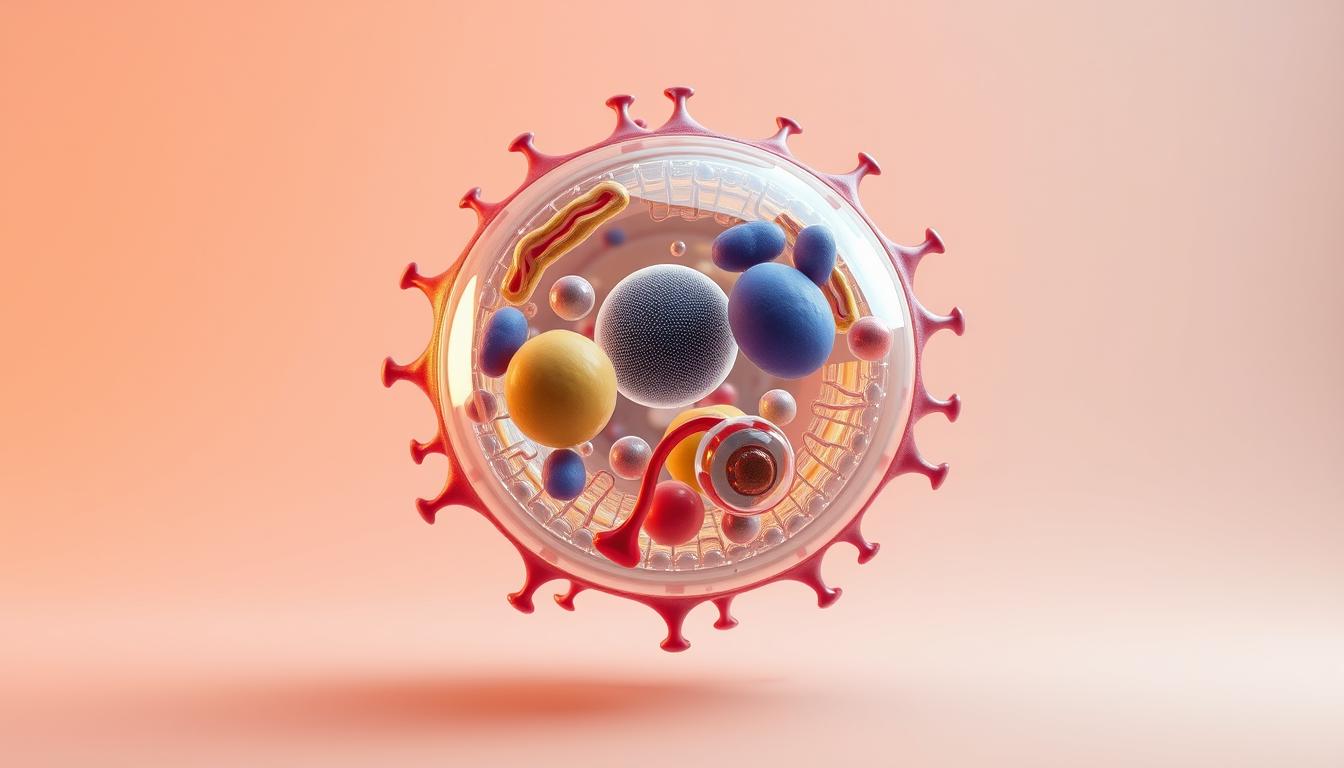
Ever thought about the tiny world inside you? Millions of human cells could fit on a pinhead. It’s mind-boggling.
Knowing how big human cells are helps us understand life’s complexity. These tiny units, the building blocks of life, are 10 to 30 micrometers wide. Their small size makes them a key area of scientific study.
Human cells come in different sizes based on their job. Most are between 10 and 30 micrometers. But some cells are much bigger or smaller. Their size affects how they work in the body.
Key Takeaways
- Human cells typically range from 10 to 30 micrometers in diameter
- Cell size directly influences biological function and performance
- Different cell types have unique size characteristics
- Microscopic technologies enable detailed cell size research
- Cell size impacts metabolic efficiency and cellular processes
Overview of Human Cell Size
Cell biology shows us a world of tiny complexity inside us. Human cells come in all sizes, each playing a key role in our bodies.
Looking into cell size, we find a detailed world of dimensions. Our bodies have about 50 to 100 trillion cells. Each cell is different, with its own size and function.
Importance of Cell Size
Cell size is not just random. It’s carefully designed for each cell to work best. Different cells have unique sizes to fit their jobs:
- Metabolic efficiency depends on cellular dimensions
- Surface area-to-volume ratio impacts cellular communication
- Size influences nutrient absorption and waste removal
Variability in Cell Size
The sizes of cells in our bodies are truly amazing. Here’s what we find:
- Red blood cells measure about 7.5 µm in diameter
- Egg cells (ova) can be up to 150 µm
- Neutrophils are 12 to 14 µm in diameter
- Monocytes can grow up to 20 µm
*”Each cell is a miniature universe, with its size precisely calibrated to perform specific biological functions.”*
Research in cell biology keeps showing us how cell size affects how our bodies work. It shows the amazing complexity of our cells.
The Average Size of Human Cells
Exploring the human body’s cellular structure opens a world of wonder. Human cytology delves into the detailed anatomy of cells. These cells vary greatly in size and shape. On average, a human cell is between 10 to 100 micrometers in diameter.
Comparative Cell Size Perspectives
Let’s look at some interesting comparisons to understand cell sizes better:
- Approximately 635 average human cells can span the diameter of a penny
- Red blood cells measure about 7-8 micrometers in diameter
- The human egg cell (ovum) is the largest, reaching around 120 micrometers

Measurement Units in Cell Biology
Scientists use specific units to measure cell sizes accurately. They use micrometers (µm) and nanometers (nm) in human cytology. These tiny scales help researchers see the detailed anatomy of cells.
“A single human body contains approximately 37.2 trillion cells, each with its unique structural complexity.”
Cell sizes vary, showing the different roles they play in our bodies. From small red blood cells to large muscle cells, each has a special function.
Types of Human Cells and Their Sizes
Cell biology shows us how diverse human cells are. Each cell is different in size, shape, and function. This diversity is key to understanding how our bodies work.
Our bodies have about 200 different cell types. Each one has its own job. They vary a lot in size and what they do, showing how complex our bodies are.
Red Blood Cells: Oxygen Transporters
Red blood cells are the most common in our bodies. They are about 7-8 μm in diameter and shaped like discs. They carry oxygen and make up 84% of all cells in our bodies.
- Size: 7-8 μm in diameter
- Primary function: Oxygen transport
- Unique characteristic: Lacks a nucleus
Neurons: Communication Specialists
Neurons are amazing cells that help us communicate. They can grow up to a meter long. This lets them connect and send signals all over our nervous system.
- Length: Can reach over 1 meter
- Primary function: Neural communication
- Complexity: Includes cell body, axons, and dendrites
Epithelial Cells: Protective Barriers
Epithelial cells protect our bodies. They come in different sizes and shapes. They cover our skin, organs, and inside cavities.
Muscle Cells: Movement Enablers
Muscle cells help us move and stay strong. There are three main types: skeletal, cardiac, and smooth muscle cells. They are long and important for our body’s function.
“Cells are the basic structural and functional units of living organisms, each with a unique purpose and design.” – Cell Biology Research
Human cells are incredibly diverse. Each type plays a vital role in keeping us healthy and functioning well.
Factors That Influence Cell Size
Cell size isn’t random. It comes from complex interactions between genes and the environment. To understand cell size, we must look at the detailed mechanisms that shape it.
Cells change in size and shape based on many factors. The mix of internal genetic plans and outside conditions creates unique cell environments.
Genetic Determinants of Cell Size
Genes are key in controlling cell size. Important genetic processes include:
- The Target of Rapamycin (TOR) signaling pathway
- Specific gene expressions controlling cell growth
- Chromosomal regulation of cell division timing
“Cell size is fundamentally a genetic blueprint with environmental modifications” – Cell Biology Research Institute
Environmental Influences on Cellular Measurements
Outside factors greatly affect cell biology in many ways:
- Nutrient availability
- Mechanical stress
- Osmotic balance
Research shows that the quality of nutrients directly affects how fast cells grow. For example, certain compounds in culture media can make cells grow bigger by activating specific signals.
Quantitative Insights into Cell Size Variation
| Factor | Impact on Cell Size |
|---|---|
| Nutrient Concentration | Directly proportional to growth rate |
| Genetic Regulation | Determines maximum size potential |
| Osmotic Conditions | Influences cell volume maintenance |
Cellular measurements show that size is not fixed but changes over time. It’s influenced by many factors working together.
Microscopy: Viewing Cell Size
Cell microscopy is key to understanding cells and human biology. Scientists use special imaging to see details that are too small for our eyes.
Light Microscopy: Exploring Cellular Landscapes
Light microscopes help us see cell structures. They can make things look up to 1,000 times bigger. Student microscopes usually go up to 400x.
- Can see objects bigger than 0.2 μm
- Visible light’s wavelength limits how clear it can be
“The light microscope opens a window into the cellular world, revealing intricate details previously hidden from human perception.” – Scientific Research Journal
Electron Microscopy: Diving into Molecular Details
Electron microscopes are the top tech for cell study. They can make things look up to 100,000 times bigger, showing us cell details like never before.
- Can see things down to about 50 picometers
- Some types can magnify up to 5 million times
- Let’s us see individual atoms
By using both light and electron microscopes, scientists keep learning about cells. This helps us understand how cells work and their role in our bodies.
Scale of Microorganisms vs. Human Cells
Understanding cell scale is key in cell biology. The microscopic world shows big size differences between human cells and tiny microorganisms like bacteria and viruses.

Prokaryotic cells, like bacteria, are much smaller than human cells. They range from 0.1 to 5.0 micrometers in diameter. Human cells are larger and more complex.
Bacterial Size Comparison
Bacteria come in all sizes. An average bacterial cell is:
- Approximately 1-2 micrometers long
- Roughly 10-100 times smaller than a typical human cell
- Can live in huge numbers in the human body
“The microscopic world is a testament to the incredible diversity of life at the cellular level.” – Cell Biology Research Institute
Viral Size Dimensions
Viruses are even smaller than bacteria. They are tiny compared to human and bacterial cells:
- Typically 20-30 nanometers in size
- Smaller than the wavelength of visible light (500 nm)
- Need electron microscopes to see them
Interestingly, research shows bacteria in the human body might outnumber human cells. There are about 38 trillion bacterial cells compared to 30 trillion human cells.
Implications of Size Differences
Size differences are not just interesting facts. They are crucial in how microorganisms interact with human cells and our body’s ecosystem. These differences affect disease transmission and how our immune system responds.
The Role of Cell Size in Function
Cell size and function are closely linked, showing us how cells work and interact. Cell biology shows that size is key in cell operation and interaction in living systems.
Cells vary in size, affecting important biological processes. There are two main ways size impacts cells:
- Surface area to volume ratio
- Metabolic efficiency
- Diffusion capabilities
Metabolic Activity and Cell Dimensions
Cell size greatly affects metabolic activity. Smaller cells usually have higher metabolic rates. They can exchange nutrients and waste more quickly because of their size.
“Cell size is nature’s elegant solution to metabolic optimization” – Cellular Biology Research Institute
Impact on Diffusion Processes
Diffusion in cells depends on their size. Smaller cells allow for quicker molecular transport. This ensures fast exchange of vital substances. Larger cells might find it hard to diffuse substances efficiently, which can slow down their metabolism.
- Small cells: Rapid molecular transport
- Large cells: Potential diffusion limitations
- Optimal size: Balanced metabolic efficiency
The balance between cell size, metabolic activity, and diffusion shows the complex nature of cellular biology. Each cell’s size is perfectly suited for its specific functions.
Technological Advances in Measuring Cell Size
Modern cell microscopy has changed how we see cells. It uses new tech to learn more about cell size and shape. This has opened up new ways to study cells.
Cell research has seen a big change with new imaging and computer methods. Scientists can now see cells in great detail.
Advanced Imaging Technologies
New microscopy tools have made seeing cells better:
- Light sheet fluorescence microscopy cuts down on blurry images
- Holo-tomographic microscopy lets us see below what light can show
- CRISPRainbow technique lets us see many parts of cells at once
Computational Analysis Methods
Computers are now big helpers in cell research. They offer advanced ways to analyze cells:
| Technology | Capability | Research Impact |
|---|---|---|
| Single-cell RNA Sequencing | Can handle thousands of cells at once | Gives detailed info on cell molecules |
| High Content Analysis | Can watch cells over time | Helps study how treatments work |
| Adaptive Optics | Improves color and detail in images | Makes seeing cells clearer |
Modern cell microscopy techniques reveal the intricate complexity of cellular structures with unprecedented clarity.
These new tools keep improving our understanding of cells. They help scientists learn more about how cells work and how they might help us.
Implications of Cell Size in Medicine
Cell biology shows us how cell size affects medical research and treatment. It’s key to understand how cell size relates to disease. This is a major area of study in human cytology.
Medical researchers have found interesting links between cell size and health issues. The size of cells is important for diagnosing and understanding complex diseases.
Cancer Cell Size Variability
Cancer cells are different in size and shape from normal cells. Key findings include:
- Cancer cells are often larger than healthy cells
- Size changes show how aggressive a tumor is
- Unusual cell size can mean cancer is present
“Cell size is not just a measurement, but a potential diagnostic marker for disease progression.” – Dr. Cellular Research Institute
Stem Cell Research Breakthroughs
Stem cell research has led to big steps in regenerative medicine. Recent trials show great promise:
- 27% of patients in a dry Age-related Macular Degeneration trial saw better vision
- Stem cell organoids, two millimeters big, can mimic complex brain areas
- Therapies show hope for treating neurodevelopmental disorders
The USC Stem Cell initiative is pushing our knowledge of cells and their medical importance. It connects over 100 research and clinical faculty in important studies.
Ongoing research suggests that cell size could be a critical indicator of cellular health and potential disease progression.
Future Research Directions on Cell Size
The field of cell biology is growing fast. Researchers are diving deep into cell dimensions and their connections. New tech like computationally enhanced quantitative phase microscopy (ceQPM) is changing how we measure cell size. It lets scientists study tiny cell parts with great detail.
Cell biology is now looking at how cell size affects diseases. Scientists are studying how cell size changes with cancer, aging, and genetic issues. The ratio of the nucleus to the rest of the cell is key. It helps show if a cell is healthy or if it might turn sick.
Potential Discoveries in Cell Biology
New studies are revealing cool things about how cells grow. Researchers are looking into how cells control their size at different times. They’re especially interested in when cells stop growing or change size.
They’re also studying how cell size, dry mass, and nuclear size relate. This could help us understand how cells grow and work better.
Understanding Size and Disease Relationships
Future studies will try to link cell size to disease causes. Scientists will use advanced computer methods and high-tech imaging. They hope to create better models of how cell size affects diseases.
This could lead to new ways to diagnose and treat diseases. It could make medicine more tailored to each person’s needs.
FAQ
What is the average size of a human cell?
Human cells usually range from 10 to 100 micrometers in size. This is as thick as a sheet of paper. But, sizes can vary a lot, from 1 micrometer to hundreds of micrometers, depending on the cell type.
How do cell sizes differ across various human cell types?
Cell sizes change a lot between different types. Red blood cells are about 7-8 micrometers. Neurons can grow up to 1 meter. Muscle cells are 10-100 micrometers, and epithelial cells are 10-20 micrometers. Each size fits the cell’s special job.
What factors influence human cell size?
Many things affect cell size. Genes control how cells grow and divide. Nutrition and stress also play a role. These factors help shape the size of cells.
How do scientists measure cell sizes?
Scientists use special microscopes to measure cells. They use light and electron microscopy. New tools like super-resolution microscopy give even more precise measurements.
How do human cell sizes compare to microorganisms?
Human cells are much bigger than most microbes. A human cell is 10-100 times larger than a bacterial cell. Viruses are the smallest, at 20-400 nanometers.
Why is cell size important in biological research?
Cell size matters a lot. It affects how cells work, how they get nutrients, and how they get rid of waste. The size of a cell’s surface area compared to its volume is key for its function.
Can cell size indicate potential health conditions?
Yes, changes in cell size can show health issues. For example, cells that are too big or too small might have cancer. Looking at cell sizes can help find new treatments.
How do technological advances help in understanding cell size?
New tech like super-resolution microscopy and advanced imaging has changed how we study cells. These tools let us see cells in great detail. This opens up new areas for research in cell biology and medicine.






Leave a Comment
Your email address will not be published. Required fields are marked *