



Ever wondered about the tiny world inside you? Your body is made up of 3.7 trillion tiny cells. Each one is unique and plays a special role.
Human cells are a world of complexity. Our bodies have more than 200 cell types. They range from tiny red blood cells to big muscle cells. Knowing about cell sizes helps us understand our health and biology.
Red blood cells are tiny, about 7-8 µm in size. Female egg cells are much bigger, around 120 µm. Every cell is important for our body’s functions. This shows how diverse our tiny world is.
Key Takeaways
- Human bodies contain approximately 3.7 trillion cells
- Over 200 distinct cell types exist in the human body
- Cell sizes vary dramatically across different cell types
- Cellular dimensions range from 7 to 120 micrometers
- Understanding cell size is crucial for biological research
Overview of Human Cell Size
Cells are tiny but crucial to our bodies. They make up the foundation of human biology. Our bodies have about 50 to 100 trillion cells, each vital for life.
Cells are the basic units of life. They vary greatly in size, from 7.5 µm red blood cells to 150 µm ova. Scientists believe there are nearly 200 different cell types in an adult human.
Definition of a Cell
A cell is the smallest unit of life that can survive and reproduce on its own. It has key parts:
- Nucleus (genetic control center)
- Cytoplasm (cellular fluid)
- Membrane (protective boundary)
- Mitochondria (energy production)
Importance of Cell Size in Biology
“In the world of biology, size matters – especially at the cellular level.” – Scientific Research Quarterly
Cell size affects how cells work. Bigger cells need more energy, while smaller ones can move nutrients and waste better. An average human cell is about 10 microns wide, which is one-tenth the width of a human hair.
| Cell Type | Diameter (µm) | Function |
|---|---|---|
| Red Blood Cell | 7.5 | Oxygen Transportation |
| Nerve Cell | 100 | Neural Communication |
| Egg Cell (Ovum) | 150 | Reproduction |
How cell size affects function is a big topic for scientists. They keep studying cells to learn more about them.
Typical Dimensions of Human Cells
The world of cell biology is full of fascinating facts. It shows us a tiny universe inside our bodies. Cells come in all shapes and sizes, making our biology complex.
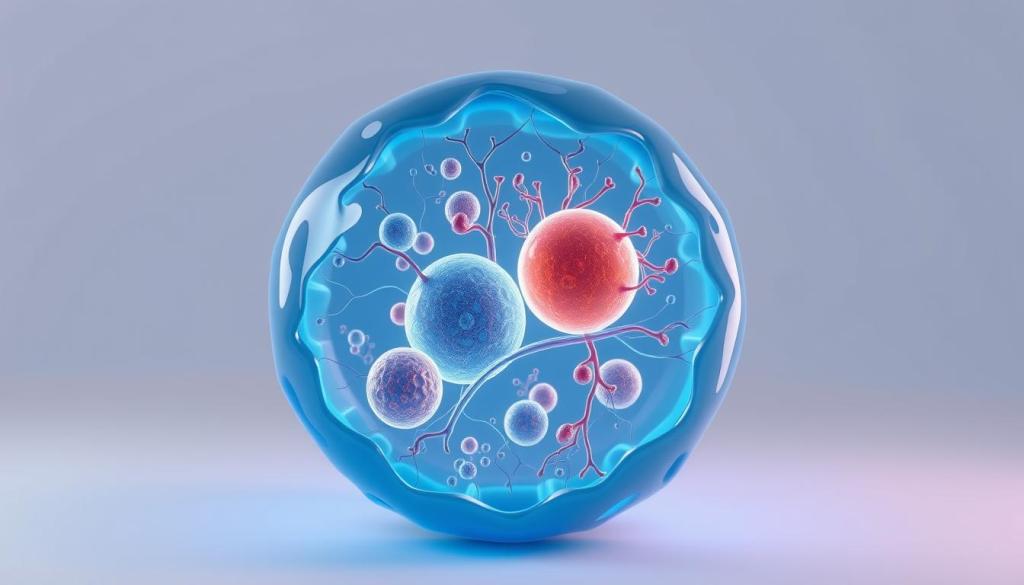
Human cells vary greatly in size and shape. This shows how different their functions are. Most cells are between 10-100 micrometers in diameter.
Average Cell Dimensions
Some cells are really big, while others are tiny. Here are a few examples:
- Egg cells (ova): Largest human cells, measuring about 0.1 millimeters
- Red blood cells: Approximately 7-8 micrometers in diameter
- Sperm cells: Tiny cells with volumes of 20-40 cubic micrometers
- Motor neurons: Can extend up to one meter long
Variations Among Cell Types
| Cell Type | Typical Size | Unique Characteristic |
|---|---|---|
| Ovum | 100 micrometers | Largest human cell |
| Nerve Cells | Up to 1 meter long | Longest cells in body |
| Red Blood Cells | 7-8 micrometers | Smallest circulating cells |
Scientists have found over 400 different cell types. Each has its own size and job. The human body contains approximately 37.2 trillion cells, showing how complex we are.
“Cells are the basic building blocks of life, each with its own remarkable characteristics and size.” – Cell Biology Research Institute
Key Factors Influencing Cell Size
Exploring cellular dimensions reveals the complex mix of genetic and environmental factors. These factors shape how human cells grow and adapt. Cell biology facts show us how cells change and respond.
Cells can change size and shape in amazing ways. They react to both inside and outside signals. The processes that control cell size are complex and connected.
Genetic Determinants of Cell Size
Genetics are key in setting cell size. Studies have found that certain genetic changes can make cells bigger:
- Some mutations can increase cell size by 13-32%
- Genetic variations directly correlate with cell cycle time
- Specific gene deletions can alter cell replication rates
Environmental Influences on Cell Morphology
Environment also plays a big role in cell growth and size. Important factors include:
- Nutrient availability
- Temperature variations
- Mechanical stress
- Cellular hydration levels
“Cells are dynamic entities that continuously respond to their surrounding environment.” – Cell Biology Research Institute
Cell size can change a lot depending on the situation. For example, older cells are usually bigger than younger ones. This shows how cells grow and change over time.
The link between cell size and lifespan is interesting. Bigger cells often live shorter lives. Some genetic changes can make cells live much shorter.
Comparison with Other Organisms
Exploring cell sizes shows us how different life forms are. The size of cells varies greatly, showing nature’s vast diversity.
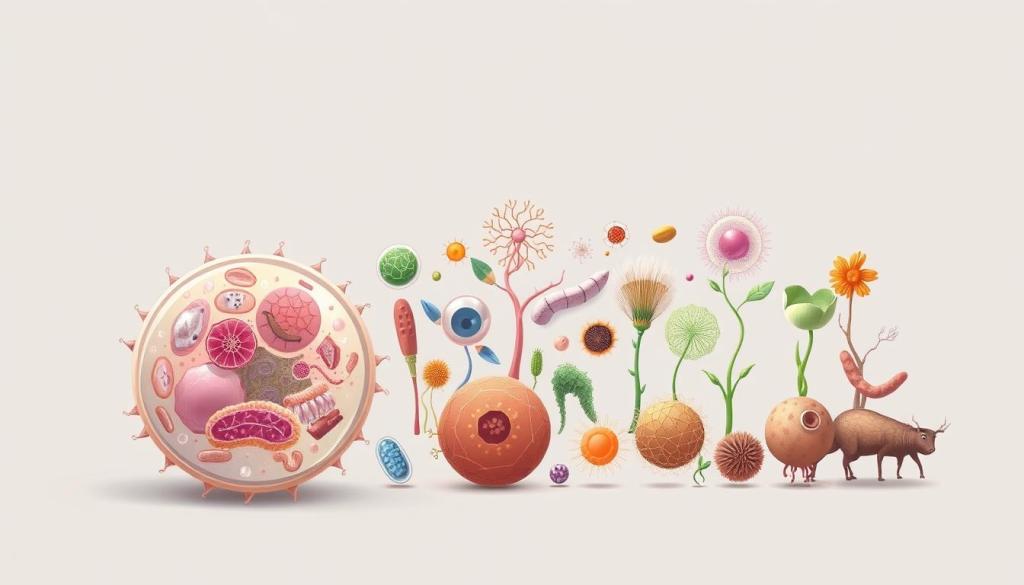
Human cells stand out when compared to others. They are usually 10-30 micrometers in diameter. This makes them unique in the world of cells.
Human Cells vs. Animal Cells
Looking at cell sizes, we find interesting differences between humans and animals:
- Human cells are 2 to 60 times bigger than bacterial cells
- Eukaryotic animal cells are 10 to 100 micrometers in diameter
- Some animal cells are much larger and have different shapes
Human Cells vs. Plant Cells
Plant cells are quite different from human cells. Human cells don’t have rigid structures, but plant cells do:
- Plant cells have thick walls that affect their size
- They can be bigger than human cells because of extra structures
- Plant cell sizes depend on their specific functions
“If we imagine E. coli as a human-sized organism, a HeLa cell would be comparable to a blue whale in scale” – Cellular Biology Perspective
These comparisons show us the complex world of life. They highlight how cell sizes help us understand life’s complexity.
Technologies Used to Measure Cell Size
Understanding microscopic cell structure needs advanced technologies. These tools help scientists see the tiny world of cells. They use new methods to study cells closely.
Today, scientists use many ways to measure and see cells. New imaging technologies have changed how we see cells. They help us understand their sizes better.
Microscopy Techniques
Light microscopy is key in studying cells. These microscopes can:
- Magnify up to 1,000 times the actual size
- See details down to about 0.2 μm
- Work with light between 0.4 to 0.7 μm
“The microscope is a window into the intricate world of cellular structures.” – Scientific Research Quarterly
Advanced Imaging Methods
New technologies give us deeper views of cells:
- Electron Microscopy: Shows details smaller than 500 nm
- Video-enhanced differential interference-contrast microscopy
- Automated cell counting systems
Now, scientists use tools like the Moxi Z mini automated cell counter. It can measure particles from 3-25 microns very accurately. These tools help us learn more about cells.
Significance of Cell Size in Health
Understanding human cell size is key to knowing about biological health and growth. Cell biology facts show that the size of cells is vital for keeping our bodies in balance. It also helps us spot health problems early.
The world of cell sizes is complex and very important for medical studies and tests. Scientists have found that changes in cell size can tell us about health issues.
Implications for Disease Detection
Abnormal cell sizes can warn us of health problems:
- Big cells might mean cancer is starting
- Small cells could show metabolic problems
- Cells that are not the right size might have genetic issues
Role in Growth and Development
Cell size greatly affects how we grow and develop. Scientists have made some amazing discoveries:
- Cells can be 100-fold different in size
- Red blood cells are the smallest
- Neurons are the largest
“Cell size is not just a measurement, but a dynamic indicator of biological health and potential.” – Cellular Biology Research Institute
Studies show that cell sizes change as we age. Keeping the right balance between cell size and count is essential for good health.
Future Research Directions
The world of cell anatomy research is changing fast. New technologies are helping us explore microscopic cell structures in new ways. Scientists are finding creative ways to understand the complex world of cells.
Emerging Technologies in Cell Measurement
New research is changing how we see cells. It’s thanks to advanced measurement tools. These tools include:
- Super-resolution microscopy
- Quantum sensing techniques
- Advanced computational modeling
- Artificial intelligence-driven cell analysis
Potential Discoveries on the Horizon
The future of cell research is full of promise. It could lead to big changes in medicine. Scientists are looking forward to making new discoveries in areas like:
- Regenerative medicine applications
- Precision cancer treatment strategies
- Synthetic biology innovations
“The most powerful electron microscopes can now resolve molecules and even individual atoms, opening unprecedented windows into cellular structures.” – Scientific Research Consortium
| Research Focus | Potential Impact |
|---|---|
| Cellular Dimensional Analysis | Enhanced disease understanding |
| Molecular Interaction Mapping | Targeted therapeutic development |
| Computational Cell Modeling | Predictive biological systems |
New technologies are coming together to give us deep insights into cell anatomy. This could change how we understand basic biology. It could also lead to new discoveries in medicine.
Conclusion: The Importance of Understanding Cell Size
Learning about human cell size opens a world that’s fascinating and crucial to our biology. Human cells vary greatly in size, from tiny red blood cells to large muscle fibers. Our journey has shown us key facts about cell biology that explain how cells work.
Studies show that adult males have about 36 trillion cells, while females have around 28 trillion. This variety in cell sizes across different tissues shows how complex our bodies are. Each cell type plays a unique role, with size being key to how well our bodies work.
Recap of Key Points
Studying cell size shows how cells grow and affect our bodies. Researchers found that cells can grow a lot during certain times, like when chondrocytes grow up to 20 times bigger. This shows how cells can change and adapt.
Final Thoughts on Human Cell Size
As technology gets better, we learn more about human cells. Ongoing research could lead to new medical treatments and a deeper understanding of biology. By studying these tiny worlds, scientists are getting closer to understanding life itself.
FAQ
What is the average size of a human cell?
Human cells usually range from 10 to 100 micrometers in size. But, sizes can vary a lot. Some cells are tiny, while others are quite large.
How many cells are in the human body?
Our bodies have about 30-37 trillion cells. This huge number shows how complex and detailed our bodies are. Each cell is important for our health and how our body works.
Do all human cells have the same size?
No, human cells come in all shapes and sizes. For example, sperm cells are very small, about 3-5 micrometers. Egg cells are much bigger, around 100 micrometers. Nerve cells can even be up to a meter long.
What factors influence human cell size?
Many things affect cell size. Genes control how cells grow. Environmental factors, like what nutrients are available, also play a role. So do mechanical stresses and the cell’s function.
How do scientists measure cell size?
Scientists use different methods to measure cell size. Light microscopy helps them see cells first. Electron microscopy gives more detailed views. New imaging and computer tools help them measure cells very precisely.
Can cell size indicate health conditions?
Yes, unusual cell sizes can mean health problems. They might show signs of cancer, developmental issues, or metabolic problems. Researchers use cell size to help diagnose and study diseases.
How does cell size compare across different species?
Cell sizes vary a lot among different living things. Human cells are similar in size to those of other mammals. But, they are much smaller than bacteria and can be different from plant cells because of their cell walls.
Are cell sizes constant throughout a person’s lifetime?
No, cell sizes change as we grow, develop, and age. Hormonal changes, what we eat, and our overall health affect cell size and shape over time.






Leave a Comment
Your email address will not be published. Required fields are marked *