



Ever thought about what makes a tiny bacterial cell different from a complex human cell? The world of cellular biology is full of fascinating differences. These differences shape life as we know it.
Bacterial cells are part of a world where prokaryotic vs eukaryotic cell structure matters a lot. These tiny organisms are much smaller than human cells. To understand the difference, we need to look at their unique structures and functions.
Prokaryotic cells are simple but efficient. They can live in many different places. This makes them one of the most common life forms on Earth. Their design shows how life can adapt and survive in many ways.
Key Takeaways
- Bacterial cells are significantly smaller than human cells
- Prokaryotic cells lack a membrane-bound nucleus
- Bacterial cells have circular DNA dispersed in the cytoplasm
- Human cells contain complex organelles absent in bacterial cells
- Bacteria have existed for approximately 3.5 billion years
Cellular Structure: Prokaryotes vs. Eukaryotes
The world of cells is full of tiny wonders. There are two main types: prokaryotic and eukaryotic cells. Each type has its own way of organizing life, showing how different they are.
Overview of Cell Types
Prokaryotic and eukaryotic cells are very different. Bacterial cells, or prokaryotes, are small and simple. They don’t have membrane-bound organelles, making their inside environment simple.
- Prokaryotic cells range from 0.1 to 5.0 µm in diameter
- Eukaryotic cells measure 10 to 100 µm across
- Prokaryotes are mostly single-celled organisms
- Eukaryotes can form complex multicellular structures
Differences in Size and Shape
Size is key for how cells work. Bacterial cells are tiny but efficient. Most bacteria are less than 1 µm in diameter, making them fast at moving molecules and doing work. Human cells, on the other hand, have more complex parts.
Organelles: Presence and Absence
The biggest difference is in organelles. Eukaryotic cells have special parts like mitochondria and a nucleus. Bacterial cells don’t have these, so they do things differently.
Cellular diversity shows nature’s amazing ways to adapt to life.
Genetic Material: DNA Organization
The world of cellular genetics shows us how different bacterial and human cells are, especially in DNA organization. Genetic material is like a blueprint for life. It has special traits that make prokaryotic and eukaryotic organisms different.
Chromosomal Structure in Bacteria
Bacterial cells have a unique DNA organization. Their genetic material is usually one or more circular DNA molecules. For example, Escherichia coli has a single chromosome that’s about 3 × 10^9 daltons in size. This makes up about 2-3% of the cell’s dry weight.
- Bacterial genome sizes range from 580,000 to 13 million base pairs
- Circular chromosomes are typically compact and densely packed
- Genome size varies significantly between different bacterial species
Human DNA: Linear Chromosomal Configuration
Human cells have linear DNA molecules in the nucleus. A typical human genome has about 3 billion base pairs. These are spread across 46 chromosomes in somatic cells. The DNA is structured differently from bacterial chromosomes, with a more complex packaging mechanism.
Plasmids and Genetic Mobility
Bacterial cells have special genetic elements called plasmids. These are small, circular DNA molecules separate from the main chromosome. Plasmids are important for bacterial adaptation and survival. They can be small or up to 2 megabase pairs in size.
- Plasmids can carry additional genetic information
- Some plasmids enable antibiotic resistance
- Plasmid size influences their copy number in bacterial cells
The DNA organization in bacterial and human cells shows the amazing complexity of genetic systems. It shows how different organisms have evolved unique ways to store and express genetic information.
Cell Membrane Composition
The cell membrane is a key part of a cell, acting as a barrier between inside and outside. Bacterial and human cell membranes have different structures. These differences are important for how cells work and stay alive.
Bacterial cell membranes are special because they have a cell wall. This wall gives extra protection and strength, unlike human cells.
Structure of Bacterial Cell Membrane
Bacterial cell membranes are complex:
- They are made mostly of protein and phospholipid, in a 3:1 ratio
- About half of their weight is lipid and half is protein
- They have a strong cell wall made of peptidoglycan
- They have porins that let molecules pass through, up to 600 molecular weight
Comparison with Human Cell Membrane
Human cell membranes are different from bacterial ones:
- They don’t have a rigid cell wall
- They have four main phospholipids: phosphatidylcholine, phosphatidylethanolamine, phosphatidylserine, and sphingomyelin
- They have cholesterol in amounts similar to phospholipids
- They have special proteins like glycophorin and band 3
These differences help cells interact, protect themselves, and adapt in different ways.
Energy Production: Metabolic Processes
Cellular respiration shows interesting differences between bacteria and humans. Both use unique ways to make and use energy. Bacteria and human cells have special ways to handle energy.
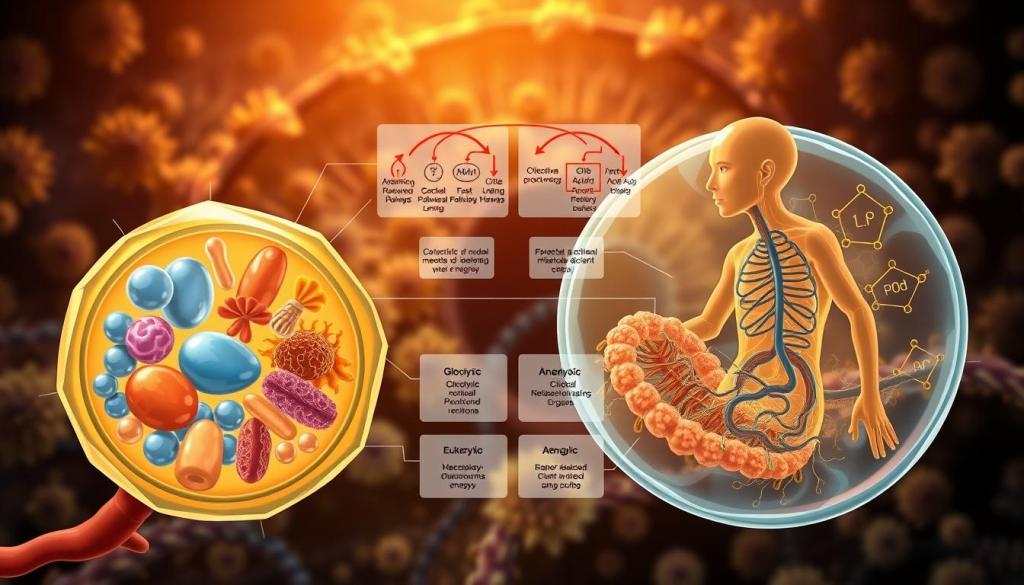
Cellular respiration is key for survival in all cells. Bacteria and human cells make energy in different ways:
- Bacteria can make their own food in many ways
- Human cells need to eat other organic molecules for energy
- How well they use energy is very different
Bacterial Respiration and Fermentation
Bacterial metabolism is very flexible. Heterotrophic bacteria can make up to 38 moles of ATP from glucose. This means they can produce about 380,000 calories. Their energy-making paths include:
- Glycolytic pathway
- Entner-Doudoroff pathway
- Anaerobic respiration using different electron acceptors
Bacteria can change how they make energy based on their surroundings. This shows their amazing ability to adapt.
Human Cellular Respiration
Human cells have a more specific way of making energy. They usually make about 38 ATP molecules from each glucose molecule. This process loses a lot of energy as heat. The total energy from glucose is about 688,000 calories, with an efficiency of about 55%.
Unlike bacteria, human cells need mitochondria to make energy. They use the Krebs cycle and electron transport chain for this.
Reproduction Methods: Asexual vs. Sexual
Bacterial and human cells have different ways of making more cells. This shows how life can spread and survive in different ways. Looking at how they reproduce helps us see these differences.
Bacteria can make more cells quickly through binary fission. This method lets them grow fast, with some types doubling every 10-15 minutes. Their fast growth is amazing:
- Bacteria can double their population in short time intervals
- 100 bacteria can potentially multiply to millions within hours
- All offspring are genetically identical to the parent cell
Binary Fission in Bacteria
Binary fission splits one bacterial cell into two identical cells. This quick growth helps bacteria survive and spread. Their simple way of making more cells lets them adapt fast.
Mitosis and Meiosis in Humans
Human cells make more cells through mitosis and meiosis. These are more complex than bacterial reproduction. They involve sexual reproduction, which brings genetic variety. Human cell reproduction needs:
- Two parents contributing genetic material
- Production of haploid gametes through meiosis
- Fertilization to create a genetically unique offspring
The main difference between bacterial and human cells is in their reproduction. Bacteria focus on quick growth, while humans aim for genetic diversity. This shows how different their ways of making more cells are.
Response to Antibiotics and Treatment
The fight between prokaryotic and eukaryotic cells in medicine is quite interesting. Antibiotics are key in fighting bacterial infections. They work by targeting bacterial cells without harming human cells.
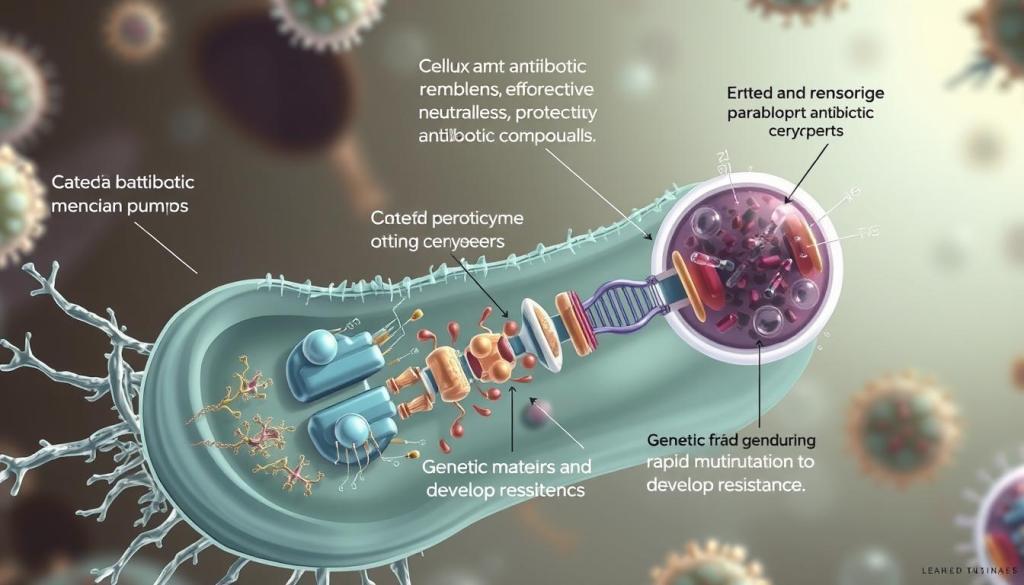
Antibiotics use the differences between prokaryotic and eukaryotic cells to kill bacteria. They do this in a way that doesn’t hurt human cells too much.
Mechanisms of Antibiotic Resistance
Bacteria are very good at becoming resistant to antibiotics. They use several ways to do this, including:
- Reducing drug entry through limited porin channels
- Activating efflux pumps to remove antibiotics
- Modifying ribosomal structures
- Altering penicillin-binding proteins
“Bacteria evolve faster than our ability to create new antibiotics” – Infectious Disease Expert
Human Cell Reactions to Pharmaceutical Drugs
Eukaryotic cells react differently to drugs than bacteria do. Human cells change in a more controlled way to drugs.
Drugs like penicillin stop bacteria from making their cell walls. This doesn’t hurt human cells. It’s a way to treat bacteria without harming us.
Research shows that almost all bacteria could become resistant to most antibiotics in 25 years. This highlights the urgent need for new ways to fight bacterial infections.
Immune System Interaction
The battle between bacteria and human cells is complex. Each side uses smart strategies to survive and protect themselves.
The human immune system is a strong defense against bacteria. It has many parts that work together to fight off threats.
Bacterial Evasion Strategies
Bacteria have clever ways to avoid the immune system. They use:
- Antigenic variation to hide their structure
- Biofilm formation for protection
- Rapid genetic mutations
- Camouflage mechanisms
Human Immune System Components
The human immune response has many specialized cells working together:
- Phagocytes: White blood cells that engulf and destroy germs
- T cells: Produced in bone marrow, detect and destroy infected cells
- B cells: Generate antibodies specific to invading pathogens
The innate immune system can quickly respond to bacteria. It uses nine different enzymes for a fast response. Newborns get important protection from their mother’s antibodies in breastmilk, showing how complex immune defense is.
Adaptability and Evolution
Cellular adaptation is a journey of survival and change. Prokaryotes and eukaryotes face environmental challenges in different ways. Bacteria show incredible ability to evolve.
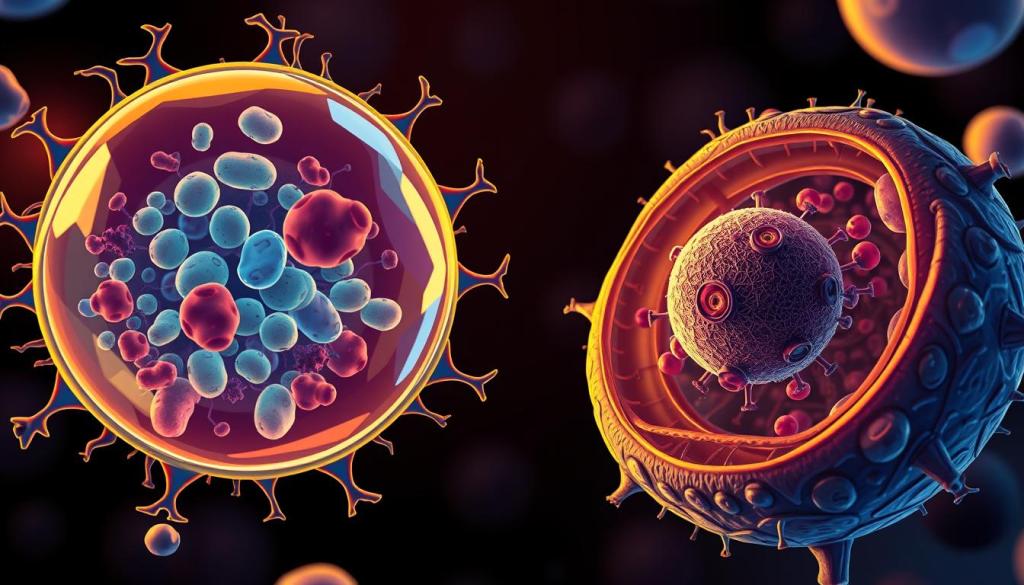
Bacterial cells are incredibly adaptable. They use several key ways to adapt:
- Rapid mutation rates
- Horizontal gene transfer
- Quick genetic recombination
- Minimal organelles allowing swift structural changes
Bacterial Adaptation Mechanisms
Bacteria have been around for about 3.5 billion years. They make up about 75% of Earth’s biological history. Their ability to adapt comes from unique genetic strategies.
Organelles play a minimal role in bacterial adaptation. This lets bacteria change their genetic structure quickly.
| Adaptation Mechanism | Bacterial Capability |
|---|---|
| Mutation Rate | Extremely High |
| Gene Transfer | 5-10% Genome Exchanged |
| Generational Adaptation | Significant Changes in 200 Generations |
Human Evolutionary Changes
Human evolution is different from bacterial adaptation. Eukaryotic cells, with many organelles, change more slowly but in complex ways. Sexual reproduction adds genetic diversity, leading to gradual changes over time.
The dance of cellular evolution shows the amazing resilience and creativity of both bacterial and human cells. They keep finding new ways to survive.
Cell Communication: Signaling Pathways
Cellular communication is a complex network that lets organisms react to their environment. It also helps them work together on complex tasks. Both bacteria and human cells have their own ways of talking to each other, using special signals in their cytoplasm.
Each type of cell has its own way of communicating, based on how it evolved. These methods can be grouped into five main types:
- Autocrine signaling
- Intracrine signaling
- Juxtacrine signaling
- Paracrine signaling
- Endocrine signaling
Quorum Sensing in Bacterial Populations
Bacteria have a unique way to talk to each other called quorum sensing. It lets them act together based on how many there are. They release signals that build up as more bacteria join in, leading to a unified response.
Human Cellular Communication Mechanisms
Human cells use more complex ways to talk to each other. They involve hormones and the nervous system. These systems use special receptors and messengers to send information between tissues and organs.
Bacteria and human cells communicate in different ways. Bacteria use simple signals, while humans have more complex systems. These include:
- Electrical signaling
- Chemical messenger transmission
- Receptor-mediated interactions
Learning about these complex signals helps us understand how cells work and adapt. It also shows us new ways to help in biology and medicine.
Applications in Biotechnology and Medicine
The study of bacteria and human cells has changed biotechnology and medicine a lot. Microbial products help make medicines like antibiotics, cancer drugs, and vaccines. Bacteria’s unique DNA is key for genetic engineering and drug research.
Bacterial ribosomes help us understand how proteins are made and how to target medical treatments. Only about 1% of microbes can be grown in labs, but scientists are still learning a lot. The discovery of antibiotics in the 1940s was a big step forward in fighting infections.
Role of Bacteria in Genetic Engineering
Genetic engineering uses bacteria’s simple structure to create new medical technologies. The Human Genome Project, finished in 2003, showed the power of understanding genetics. Now, researchers use bacteria to find new ways to help people, using their unique traits.
Human Health and Bacterial Microbiomes
The link between human health and bacterial microbiomes is very interesting to scientists. Studies show bacteria are important for our digestion and immune system. As we learn more, scientists are finding new ways to use bacteria to improve health and create new medicines.
FAQ
What are the fundamental differences between bacterial and human cells?
Bacterial cells are simpler and smaller, lacking membrane-bound organelles. Human cells are larger and more complex, with specialized organelles like mitochondria and a nucleus.
How do bacterial and human cells differ in size?
Bacterial cells are tiny, from 0.5 to 5 micrometers. Human cells are much bigger, with sizes from 10 to 100 micrometers. This size difference shows their structural and functional differences.
Do bacterial and human cells have different DNA organizations?
Yes, they do. Bacterial cells have circular DNA in the nucleoid region. Human cells have linear DNA in a membrane-bound nucleus. Bacteria also have plasmids, which human cells don’t.
How do cell membranes differ between bacterial and human cells?
Bacterial membranes have a rigid peptidoglycan wall for support. Human membranes are flexible, made of phospholipids and proteins, without a cell wall.
What are the key differences in energy production between bacterial and human cells?
Bacteria use photosynthesis, chemosynthesis, and fermentation for energy. Human cells mainly use cellular respiration in mitochondria to produce ATP.
How do bacterial and human cells reproduce differently?
Bacteria divide quickly by binary fission. Human cells reproduce through mitosis and meiosis, involving nuclear division and genetic recombination.
How do bacterial and human cells respond to antibiotics?
Bacteria can quickly become resistant to antibiotics through mutations and gene transfer. Human cells respond to drugs in a more controlled way, protecting themselves from damage.
What are the communication differences between bacterial and human cells?
Bacteria use quorum sensing for communication. Human cells communicate through hormonal and nervous system signals, thanks to their complex structures.
How do bacterial and human cells adapt to environmental changes?
Bacteria adapt fast through mutations and gene transfer. Human cells evolve slowly, relying on sexual reproduction for genetic diversity.
What practical applications exist from understanding bacterial and human cell differences?
These differences are key in biotechnology and medicine. They help in genetic engineering, antibiotic development, and creating targeted treatments.





Leave a Comment
Your email address will not be published. Required fields are marked *