



Ever thought about how many cells make up our amazing bodies? The number of cells in a human is a fascinating mystery. It makes us question how complex life can be.
Scientists have always been curious about the tiny world inside us. They think there are about 30 trillion cells in an average human body. This number is so big, it’s hard to wrap our heads around it. It shows just how complex our bodies are.
Our bodies are like a huge ecosystem, full of tiny interactions. From tiny red blood cells to brain neurons, each cell is vital. They all work together to keep us healthy and alive.
Key Takeaways
- The human body contains approximately 30 trillion cells
- Cell count varies significantly across different body tissues
- Cellular composition changes throughout an individual’s lifetime
- Each cell type has a unique function and lifespan
- Modern research continues to refine our understanding of cellular populations
Understanding Cell Structure and Function
Cells are the basic units of life, the smallest parts that work together in our bodies. There are about 37.2 trillion cells in each of us. These tiny structures are key to all life processes.
Human cells are very small, measuring 10-30 micrometers in size. Yet, they do so much to keep our bodies healthy and functioning.
What Are Cells?
A cell is a complex living unit with important parts:
- Nucleus: Holds the genetic material (DNA)
- Cytoplasm: Fills the cell’s interior
- Cell membrane: Controls what goes in and out
- Mitochondria: Makes energy for the cell
- Ribosomes: Creates proteins
Types of Cells in the Human Body
Our bodies have many different cell types, around 200. Each type has a special job in our biological systems.
- Muscle Cells: Help us move and support our bodies
- Nerve Cells (Neurons): Carry electrical signals
- Red Blood Cells: Carry oxygen
- Fat Cells (Adipocytes): Store energy
- Skin Cells: Protect and act as a barrier
Learning about the different cells and their roles shows us how amazing our biology is.
The Estimated Number of Cells
The human body’s cells are a scientific wonder that fascinates experts all over the world. They have made big steps in figuring out how many cells we have. This shows the complex and changing nature of our cells.
Recent studies have given us amazing insights into our cells. On average, our bodies have about 37.2 trillion cells. This number shows just how complex we are.
Cell Count Estimation Methods
Scientists have found different ways to guess how many cells we have:
- Weight-based estimation method
- Volume-based calculation technique
- Comprehensive cellular mapping
Factors Influencing Cell Count
Many things affect how many cells we have:
- Age
- Body weight
- Overall health status
- Genetic variations
| Cell Type | Approximate Number |
|---|---|
| Red Blood Cells | 20-30 Trillion |
| Fat Cells | 50 Billion |
| Heart Muscle Cells | 2 Billion |
Interestingly, previous scientific estimates ranged dramatically from 1 trillion to 100 quintillion cells, highlighting the complexity of precise cellular counting.
The Human Cell Atlas project is a big step forward. It aims to fully map out our cells in different parts of our body. This research is helping us understand our cells better.
Cells and Body Weight
Exploring how body weight relates to cells offers interesting insights. Scientists have created advanced ways to figure out how many cells are in our bodies. These methods go beyond simple math.
The study of human cells and their numbers is complex. It shows how body weight and cell counts are connected. On average, an adult male has about 30 to 40 trillion cells. This number can vary based on individual factors.
Correlation Between Weight and Cell Count
Estimating cell counts requires advanced science. Some key findings are:
- The mean weight of a single cell is about 1 nanogram
- A 70-kilogram adult male has roughly 70 trillion cells
- Cell numbers vary greatly across different body parts
Impact of Obesity on Cell Numbers
Body weight has a big impact on cell composition. Fat cells, though large, make up a small part of total cell count. Important points include:
- Fat cells make up almost 19 percent of body weight
- They are less than 0.2 percent of total cell numbers
- Obesity can change how cells are distributed and work
Research keeps improving our knowledge of human cells and their numbers. It helps us understand the complex link between body weight and cell composition.
Organs and Their Cell Contributions
The human body is made up of many cells, each with its own role. Knowing how many cells are in each organ helps us understand our body’s design.

Each organ has a different number of cells. Some organs have a lot of cells and make a lot of new ones.
Major Organs and Their Cellular Landscape
Our organs have many different types of cells. Here’s a look at how many cells are in some important organs:
- Liver: Contains approximately 240 billion cells
- Brain: Houses around 86 billion neurons
- Heart: Composed of specialized cardiac muscle cells
- Skin: Largest organ with multiple cell layers
Bone Marrow: The Cellular Production Powerhouse
Bone marrow is key for making new cells. It produces blood and immune system cells, including:
- Red blood cells
- White blood cells
- Platelets
“Bone marrow is the body’s primary cellular factory, continuously producing millions of new cells every second.”
| Organ | Cell Count Estimate | Primary Cell Types |
|---|---|---|
| Liver | 240 billion | Hepatocytes |
| Bone Marrow | 2.5% of total body cells | Hematopoietic stem cells |
| Brain | 86 billion neurons | Neurons, glial cells |
The way our organs work shows how complex our bodies are.
The Lifespan of Different Cell Types
The human body is made up of many changing cells. To understand how many cells we have, we must look at their different lifespans. Each cell type has its own life cycle.
Looking at the human cell count, we see interesting patterns. Some cells live for just a short time, while others can last decades. Let’s dive into the world of cell lifespans:
- Blood cells have short lives, with white blood cells surviving about 13 days
- Red blood cells typically last around 120 days
- Liver cells can survive up to 18 months
- Skeletal cells have an average age of slightly over 10 years
Short-Lived vs. Long-Lived Cells
Not all cells age the same way in our bodies. Gastrointestinal epithelial cells are among the shortest-lived, lasting only about 5 days. On the other hand, brain cells from the visual cortex stay the same from birth to death.
The Renewal Process of Cells
The body replaces about 330 billion cells every day. This means over 3.8 million new cells are made every second. This constant renewal keeps our body working well and healthy.
- 86% of cell turnover involves blood cells
- Skin cells comprise 1.1% of total cell turnover
- Fat cells replace at a rate of 8% per year
By understanding the human cell count and how cells renew, we learn about the amazing complexity of our bodies.
The Role of Stem Cells
Stem cells are a key area of study in the world of cells. They are important for keeping our cells healthy and replacing old ones. They help our bodies fix and grow new cells.
Our bodies have many stem cells in different tissues. They can change into different cell types. This makes them essential for our health and healing.
- Can differentiate into multiple cell types
- Capable of self-renewal
- Critical for tissue maintenance and healing
- Found in almost all body tissues
Stem Cell Types and Their Significance
There are two main types of stem cells in our bodies:
- Embryonic stem cells: Very versatile, can become any cell type
- Adult stem cells: More focused on repairing specific tissues
“Stem cells are the body’s raw materials — cells from which all other cells with specialized functions are generated.” – National Institutes of Health
Stem Cell Research and Potential
Scientists are working hard to understand stem cells better. They hope to use them to treat many diseases. This could include:
- Parkinson’s disease
- Heart disease
- Diabetes
- Neurological disorders
| Stem Cell Type | Origin | Differentiation Potential |
|---|---|---|
| Embryonic Stem Cells | 3-5 day old embryos | All cell types |
| Adult Stem Cells | Bone marrow, fat tissue | Limited specialized cells |
| Induced Pluripotent Stem Cells | Reprogrammed adult cells | Multiple cell types |
Learning about stem cells could change how we heal and treat diseases. It’s a very exciting area of research.
Cell Density in Different Tissues
The human body is made up of many different types of tissues. Each tissue has its own unique cell density. This shows how our body works at a very small scale.
Researchers have found big differences in how cells are arranged in our bodies. Not all cells are packed the same way. This creates special environments in different organs and tissues.
Tissue Type Variations
Different tissues have different cell densities. For example:
- Skin has at least 36 different cell types in its structures
- Immune tissues have complex cell arrangements
- Vascular areas have specific cell patterns
High-Density Cellular Regions
Some areas of the body have very interesting cell concentrations:
- Blood and immune cells form dense clusters
- Testis has complex cells with 4,786 genes expressed
- Brain tissue has unique cell distributions
Studies using advanced imaging have shown how cells interact. For example, in skin, immune cells are about 56 µm from blood cells. This shows how cells are organized in our bodies.
The Immune System and Cell Count
The human immune system is a complex network of cells. These cells work hard to protect us from harmful invaders. Understanding how many cells are in our body helps us see how our immune system works.
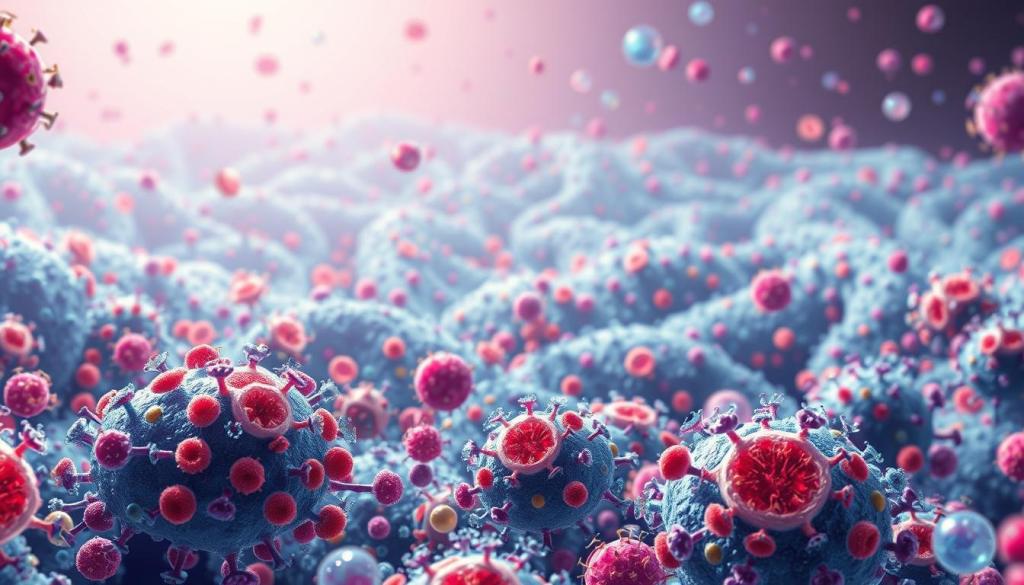
Our immune system’s success depends on knowing how many cells are in our body. White blood cells are key in fighting infections and keeping us healthy.
Types of Immune Cells
The immune system has several important cell types. Each type has its own job:
- Neutrophils: Most abundant white blood cells (55-70% of leukocytes)
- Lymphocytes: Represent 20-40% of white blood cells
- B lymphocytes: 10-15% of lymphocyte population
- T lymphocytes: 70-80% of lymphocyte population
- Natural Killer (NK) cells: 5-10% of lymphocyte count
- Eosinophils: 1-4% of white blood cells
- Basophils: Less than 1% of white blood cell population
How Cell Counts Define Immune Response
Each immune cell type plays a role in our defense. Neutrophils, for example, can quickly increase in number during an infection. They can double or triple to fight off pathogens.
The total white blood cell count is about 372 billion cells. This is a key part of our immune defense. These cells work together to find, target, and get rid of threats.
The human immune system shows amazing complexity. Cells are always talking and responding to health challenges.
Memory B and T cells help us fight off infections again. They stay in our body forever after an infection. This means we can fight off infections faster and better the next time.
Impact of Aging on Cell Numbers
As we age, our cells change a lot. Knowing about these changes helps us understand aging better. It also shows how aging affects our health.
- Cellular senescence happens after about 50 cell divisions
- Telomere length gets shorter over time
- Protein quality control gets worse
- Mitochondrial function declines
Cell Regeneration Over Time
Our body’s cell-making ability gets weaker with age. Mammalian cell cultures usually stop growing after 40-60 divisions, known as the Hayflick limit. This affects how well we can replace old or damaged cells.
The Aging Process and Its Effects
Cellular aging brings about many biological changes:
- Less effective protein quality control
- More cellular damage
- Worse mitochondrial function
- Higher risk of age-related diseases
Studies link aging to a decline in cell function. Conditions like diabetes become more common in people in their 50s, 60s, and 70s. This is due to changes in our cells.
The complexity of cellular aging shows the delicate balance between biological processes and the environment.
Learning about these cell changes could lead to ways to slow aging. This could improve our health and how long we live.
Cellular Communication
The human body is made up of trillions of cells that work together. They communicate in a complex way, making our body work as one. This system is key to how our cells function together.
Cells talk to each other in many ways. They do this to work together and respond quickly to changes. These talks are vital for our body to stay healthy.
Cellular Signaling Mechanisms
There are many ways cells communicate:
- Endocrine signaling through hormones
- Paracrine signaling between nearby cells
- Autocrine signaling within the same cell type
- Juxtacrine signaling through direct cell contact
Receptor Types and Interactions
Cells use special receptors to send and receive messages. The main types of receptors are:
| Receptor Type | Primary Function | Key Characteristics |
|---|---|---|
| G-Protein-Coupled Receptors | Signal transduction | Seven transmembrane segments |
| Enzyme-Linked Receptors | Direct enzymatic activity | Transmit signals through protein modification |
| Ligand-Gated Ion Channels | Ion movement regulation | Open/close in response to molecular binding |
Signaling Speed and Efficiency
Our cells can communicate very fast. Neurons can send information up to 100 meters per second. This shows how efficient our cells are at talking to each other.
Cellular communication is the silent language that keeps our bodies functioning, connecting trillions of cells in a seamless, coordinated network.
The Future of Cell Research
Cell research is on the verge of major breakthroughs. These will change how we see human biology. Scientists are making detailed maps of cells in the human body with new tools.
Cellular biology is moving fast thanks to new technologies. Researchers are finding new ways to understand cells and how they work.
Emerging Advances in Cellular Biology
New tech is changing how we see cells:
- Single-cell RNA sequencing lets us look at genes closely
- High-resolution images help us see cells better
- Advanced models help us understand cells
- Genomic analysis gives us new insights
Potential Discoveries on Human Health
Research is showing big promises for health:
| Research Technology | Potential Health Impact |
|---|---|
| Single-cell genomic analysis | Personalized disease treatment |
| Mass cytometry | Detailed cellular state mapping |
| Neural cell sequencing | Neurological disorder insights |
“The future of medical research lies in understanding the complex world of cells at an unprecedented level of detail.” – Dr. Elizabeth Roberts, Cellular Biology Research Institute
As researchers dive deeper into the world of cells, we’re on the edge of huge discoveries. These could change medical science and human health forever.
Conclusion: The Importance of Cell Count
Learning about the total cells in a human is a big scientific win. It shows how our bodies have about 30 to 37 trillion cells working together. Studies have found that cell counts change with age, gender, and weight.
Our bodies have many different cell types, over 210. These range from tiny sperm cells to long nerve cells. Muscle and fat cells are key, even though they’re not the most common.
Science has made big strides in understanding our cells. We used to guess how many cells we had, but now we know more accurately. This knowledge helps us see how complex life is at the cellular level.
Summary of Human Cell Estimates
Recent studies say an adult male has about 36 trillion cells, and a female has around 28 trillion. These numbers show how far science has come in understanding our bodies.
The Broader Implications of Understanding Cell Count
Studying human cell counts is more than just interesting. It helps us understand how our bodies work, how diseases start, and how to treat them. As science keeps improving, we’ll learn even more about keeping people healthy.
FAQ
How many cells are actually in the human body?
Scientists think there are about 30-40 trillion cells in us. This number can change based on things like how big we are, how old we are, and how healthy we are. They keep working to get a more exact count using new ways to count and computer models.
Do different body types have different total cell counts?
Yes, the number of cells in our bodies can vary a lot. Things like how much we weigh, how tall we are, how much muscle we have, and what our body is made of can affect it. People who are bigger usually have more cells than people who are smaller, and there can be differences in cell count based on body type and health.
Which organs contain the most cells in the human body?
The skin has the most cells, followed by the liver and other big organs like the brain and muscles. Each organ has its own special mix of cells that help it do its job in our body’s complex system.
How do stem cells contribute to our total cell population?
Stem cells are very important for keeping our cells fresh. They can turn into different types of cells and make more of themselves. This helps replace old or damaged cells, which is key for staying healthy and fixing tissues.
Do cell counts change as we age?
Yes, as we get older, our bodies make new cells at a slower rate. Some cells don’t work as well as they used to. This is part of why we age and why our bodies change in different ways.
How accurate are current cell count estimates?
Scientists are pretty close, but it’s still hard to count every cell. They use advanced methods, math, and sampling to get the best numbers they can. But, as they get better at their work, these numbers keep getting more accurate.
What impacts the total number of cells in our body?
Many things can change how many cells we have. This includes our genes, how old we are, what we eat, how healthy we are, how active we are, our hormones, and our environment. Changes in these areas can affect how many cells we make, how fast they renew, and what kinds of cells we have.
Are there differences in cell count between males and females?
Yes, there are small differences in cell count between men and women. These come from differences in body type, hormones, and genes. But, the basic ways cells work are pretty similar for both men and women.
How do immune cells contribute to our total cell population?
Immune cells are a small but very important part of our cells. They help protect us from sickness and disease. The bone marrow always makes new immune cells, keeping our immune system ready to go.
Can lifestyle choices affect our cellular composition?
Definitely. What we eat, how we exercise, how we handle stress, how well we sleep, and our overall lifestyle can all affect our cells. Making healthy choices can help our cells work better, which might change how many cells we have and how well they work.






Leave a Comment
Your email address will not be published. Required fields are marked *