


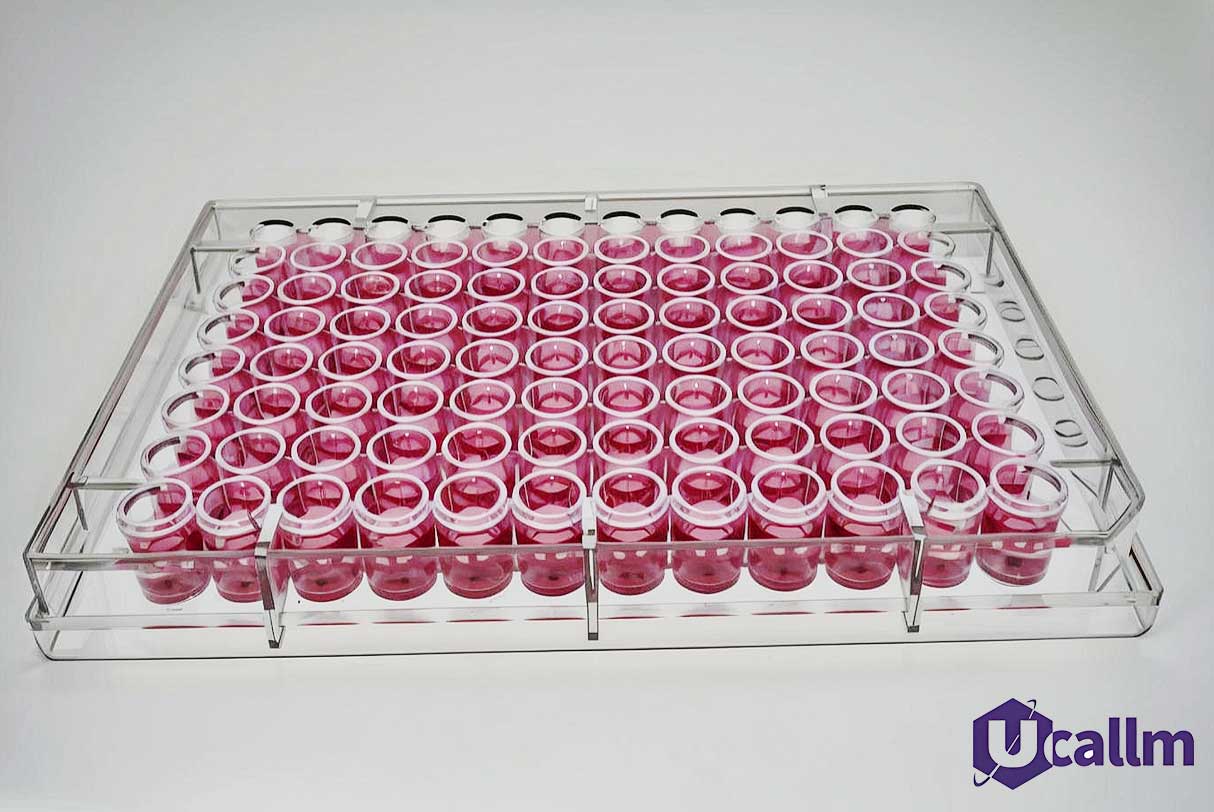
Since the 1950s, Dr. Gyula Takatsy’s microtiter plate for influenza virus testing changed molecular biology. These 96 well plates are now key for precise research.
Choosing the right 96 well plate is crucial. Researchers need to think about the plate’s material, surface treatment, and assay needs for the best results.
Today’s molecular biology needs high precision. The 96 well plate format is perfect for many tasks. It’s used in detailed enzyme-linked immunosorbent assays and quick screening tests.
Key Takeaways
- Microplate selection is key to success in experiments
- Knowing about plate types boosts research accuracy
- Different surface treatments work for different tests
- Being compatible with automation makes labs more efficient
- The type of material affects how sensitive and reliable the results are
Understanding the 96 Well Plate Format
The 96 well plate is key in modern molecular biology. It lets scientists do complex experiments easily. These plates have changed labs by making it easier to handle many samples at once.
Scientists use these special plates to make their work more efficient. A standard 96 well plate is about 127.8 mm x 85.5 mm x 14.4 mm. It’s small but powerful for many research tasks.
Defining the Plate Structure
A typical 96 well plate has a specific layout:
- 8 rows (A-H)
- 12 columns (1-12)
- Total of 96 individual wells
- Standardized well volume capacity
Common Applications in Molecular Biology
These plates are vital in science, used for:
- PCR amplification
- Enzyme-linked immunosorbent assays (ELISA)
- Cell culture experiments
- Drug screening processes
“The 96 well plate format has transformed experimental design, enabling researchers to maximize efficiency and precision.” – Dr. Elizabeth Chen, Molecular Biology Research Institute
Experimental Design Significance
The 96 well plate helps with high-throughput screening. It lets scientists test many samples at once. Its design helps by:
- Reducing experimental variability
- Increasing experimental throughput
- Minimizing sample volume requirements
- Facilitating automated processing
Choosing the right 96 well plate is key for reliable and consistent results.
Different Types of 96 Well Plates
Researchers in molecular biology use 96 well plates as key tools for complex experiments. These versatile tools come in various forms, materials, and treatments. They meet different scientific needs.
Standard Polystyrene Plates
Polystyrene is the main material for 96 well plates. It’s known for its clearness and flexibility. Scientists have many plate options:
- Clear plates for standard optical measurements
- Black plates for fluorescence-based assays
- White plates for luminescence experiments
Treated vs. Non-Treated Plates
Surface treatments greatly affect how cells interact and the results of experiments. Non-treated plates have a standard surface. Treated plates have special features:
| Plate Type | Surface Characteristics | Recommended Application |
|---|---|---|
| Non-Treated | Standard hydrophobic surface | General purpose screening |
| Cell Culture Treated | Hydrophilic, enhanced cell attachment | Mammalian cell culture |
| Poly-D-Lysine Coated | Positively charged surface | Neuronal cell growth |
Special Coatings for Specific Applications
Advanced surface treatments help improve bioassay results. Coatings like collagen, fibronectin, and extracellular matrix proteins are used. They help with specific cell interactions and precise experiments.
Material Considerations
Choosing the right material for biotechnology research is key for good results. When picking a microtiter plate, it’s important to look at the material’s properties. These properties can greatly affect the outcome of your experiments.
Researchers need to know the main differences between primary plate materials. This knowledge helps them design their experiments better.
Polystyrene vs. Polypropylene: A Comparative Analysis
There are two main materials used to make microtiter plates:
- Polystyrene: It has great optical clarity
- Polypropylene: It’s very good at chemical resistance
Chemical Resistance Characteristics
The chemical resistance of plate materials is very important in biotechnology. Polypropylene stands out because it can handle many solvents and reagents well. This makes it perfect for tough experiments.
Impact of Material on Experimental Outcomes
The material you choose can affect how accurate and reliable your results are. Important things to consider include:
- How well it holds up to temperature changes
- How it interacts with biological samples
- Any chance of non-specific binding
Biotechnology experts must think carefully about material properties. This ensures their research is done well and their data is reliable.
Surface Treatment Options
Surface treatments are key to how well cell culture and assay plates work. They affect how cells stick, proteins bind, and the results of experiments.
There are many surface treatments for different research needs. Scientists pick the best one for their experiments:
- Non-treated surfaces for general use
- Cell culture treated surfaces for better cell growth
- Low-attachment surfaces to stop cells from sticking
- Custom protein-binding surfaces
Cell Culture Treated Plates
Cell culture treated plates help cells stick and grow. They have special polystyrene surfaces that:
- Help cells stick better
- Improve how cells spread out
- Make cells look better
Low-Attachment Plates
Low-attachment plates stop cells from sticking. They’re great for studies where cells don’t need to stick, like in 3D cell cultures. These plates have special coatings to keep cells from sticking.
Custom Surface Treatments
Researchers can get special surface treatments for their experiments. They can choose coatings that change how proteins and cells work together.
| Surface Type | Primary Application | Key Characteristics |
|---|---|---|
| Non-Treated | General screening | Standard polystyrene surface |
| Cell Culture | Adherent cell studies | Enhanced cell attachment |
| Low-Attachment | Suspension cultures | Prevents cell adhesion |
| Protein-Binding | Immunoassays | Optimized protein interaction |
Choosing the right surface treatment is very important for good results in molecular biology.
Compatibility with Automation
Modern molecular biology labs use automated systems to boost efficiency. These systems have changed how experiments are done, making precision and speed key.
Choosing the right 96 well plate for automated systems is important. You need to think about several things:
- Plate mechanical strength
- Standardized dimensional specifications
- Compatibility with robotic handling systems
- Surface treatment requirements
Plate Design for Automated Workflows
Fully skirted plates are great for robotic handling because they are strong. They have the same size for easy use with automated systems. Precise plate specifications are crucial for maintaining consistent performance across different experimental protocols.
Evaluating Robot Compatibility
To check if a 96 well plate works with robots, look at these technical details:
- Plate height and rigidity
- Material composition
- Surface treatment characteristics
- Optical transparency requirements
Automation Performance Metrics
Advanced automated systems do well in high-throughput screening. They handle plates fast, transfer liquids accurately, and process samples quickly. It’s important to pick plates that work well with these systems.
Assay Formats and Applications
Choosing 96 well plates is key in biotechnology research, especially for bioassays. Each experiment needs a specific plate type for the best results.
In molecular biology, picking the right plate format is a big challenge. It’s important to know what each assay needs to get accurate results.
Enzyme-Linked Assays
For enzyme-linked assays like ELISA, the right plate is crucial. It needs to be clear for precise readings, have surfaces that help proteins stick, and have uniform wells for consistent results.
Cell-Based Assays
Cell-based assays require special plates for cell growth and interaction. Important features include tissue culture-treated surfaces, materials that work well with cells, and good gas exchange.
High-Throughput Screening
High-throughput screening uses 96 well plates for quick testing of many samples. The plates must work well with automation, have standard sizes, and reduce errors.
Choosing the right 96 well plate format is all about matching your research goals, sample needs, and testing methods. This ensures your research is successful.
Sample Volume and Well Depth
Choosing the right 96 well plate is key for good results in molecular biology. The microplate selection affects how well your experiment works. Sample volume and well depth are very important for precise research.
Knowing how sample volume and well features work together is important. The 96 well plate format is very flexible. It can handle volumes from 0.1 mL to 0.4 mL.
Critical Volume Considerations
When picking microplates, researchers need to think about a few things:
- How to keep samples safe
- Preventing evaporation
- How well liquids mix and react
- Seeing the signals clearly
Well Depth Impact on Experimental Outcomes
Well depth is very important for your results. It affects:
- Meniscus formation
- How liquids interact with surfaces
- Heat transfer
- How well reagents mix
| Well Volume | Recommended Applications |
|---|---|
| 0.1 mL | Molecular screening |
| 0.2 mL | PCR and enzyme assays |
| 0.3 mL | Cell culture preliminary studies |
| 0.4 mL | Complex biochemical reactions |
Strategic Plate Selection
When picking a 96 well plate, focus on what you need for your experiment. The right plate helps manage your samples well. It also lowers the chance of contamination and makes your results more reliable.
Well Arrangement and Layout
The design of microtiter plates is key in molecular biology. Researchers need precise well setups for better results. Knowing the standard plate layout is crucial for success.
Standard 8×12 Configuration
The 96-well plate has an 8×12 grid. This layout helps organize samples and makes replication easy. It’s a standard for scientific research.
- Total wells: 96 (8 rows × 12 columns)
- First column center distance from plate edge: 14.38 mm
- Column spacing: 9 mm between well centers
- First row center distance from plate edge: 11.24 mm
- Row spacing: 9 mm between well centers
Alternative Configurations
While the 8×12 format is common, researchers can try other layouts. Some plates have special arrangements for specific research needs.
| Plate Type | Rows | Columns | Total Wells |
|---|---|---|---|
| Standard 96-well | 8 | 12 | 96 |
| 384-well | 16 | 24 | 384 |
| 1536-well | 32 | 48 | 1536 |
Considerations for Optical Measurement
The way wells are arranged affects optical measurements. The tolerance for well centers is 0.70 mm diameter. This ensures accurate data across the plate.
Researchers must think about well placement to avoid errors. Proper sample placement can reduce variability and enhance results.
Key Factors in Experiment Design
Creating successful molecular biology experiments needs careful thought. The 96 well plate format is a powerful tool for detailed bioassays and high-throughput screening. It helps researchers work with precision and efficiency.
When planning experiments, researchers must consider several key points:
- Specificity of research objectives
- Sample replication requirements
- Customization needs for unique experimental protocols
- Compatibility with automated screening systems
Experiment Specificity Considerations
Every bioassay has its own special needs. The 96 well plate’s design lets scientists tailor their experiments to fit their goals. For example, high-throughput screening needs careful planning to collect data efficiently and reduce errors.
Sample Replication Strategies
Good experimental design means careful sample replication. Here’s what’s often needed:
- 3 biological replicates per target gene
- Multiple technical replicates for reliable data
- Negative and positive control wells for comparison
Customization and Flexibility
Today’s research needs flexible approaches. The 96 well plate format supports complex designs. Strategic well arrangement boosts data quality and understanding.
Great experiment design mixes scientific accuracy with thoughtful plate setup. This lets researchers gain deeper insights into molecular biology.
Quality and Performance Metrics
Researchers in biotechnology need precise laboratory equipment for accurate experiments. It’s key to know how to measure the quality of 96 well plates. This is important for reliable results in molecular biology.
Scientists check several important signs to see if their experiments are good. They look at how well the equipment works. This includes things like 96 well plates, which must be top-notch for advanced research.
Assessing Plate Uniformity
Getting consistent data is vital. Researchers use different metrics to check if the data is reliable:
- Z-factor: Shows how good the assay quality is
- Coefficient of Variation (CV): Tells if the data is the same
- Signal-to-noise ratio: Checks how sensitive the experiment is
Evaluating Consistency of Results
Getting the same results every time is important in biotechnology. Scientists look at a few things:
- How consistent the wells are
- If the results are the same in different plates
- If the material is the same everywhere
Key Performance Indicators
Advanced researchers use special metrics to make their experiments better. Critical performance indicators help keep the data true and the experiments successful in molecular biology.
Precision in measurement is the cornerstone of scientific discovery.
Today’s biotechnology needs top-notch quality control. Researchers must always improve their methods. This way, they get the most reliable and consistent results.
Regulatory and Best Practice Considerations
Researchers in molecular biology face a complex world of rules and best practices with cell culture plates. They must follow these to get reliable results.
Following strict guidelines is key to reduce errors and keep science honest. Important points include:
- Following ANSI/SLAS microplate standards
- Keeping detailed records of experiments
- Checking quality regularly
- Tracking cell culture plate lots
Guidelines for Biological Experiments
Designing bioassays needs focus on precision. The FDA suggests a fit-for-purpose (FFP) validation method. This method fits the study’s needs.
Quality Control Standards in Lab Settings
Quality control in labs is crucial. It involves several steps:
- Set up clear validation plans
- Check the purity of standards
- Record any changes in methods
- Do partial validation for changes
Importance of Proper Documentation
Keeping detailed records is essential in molecular biology. Researchers should document everything from sample collection to analysis. This ensures results can be repeated and research is open.
90% of experts recommend implementing blinding and rigorous documentation to enhance the validity of scientific studies.
Conclusion
The world of 96 well plate formats is complex and crucial in molecular biology. Choosing the right plate is more than a technical choice. It’s a strategic move that affects the results and discoveries in science.
Biotechnology advancements are leading to new 96 well plate designs. Now, scientists have access to plates with better surface treatments and materials. These improvements help labs in pharmaceutical, clinical, and academic fields do more research.
Key Insights for Experimental Success
Knowing what 96 well plate formats need helps researchers make better choices. Every detail, from surface chemistry to volume, matters. Modern experiments need careful attention to these details for accurate and reliable results.
Future Research Perspectives
The future of 96 well plate technology looks bright for high-throughput screening and drug discovery. Staying up-to-date with new technologies will help scientists use the latest methods in their work.
FAQ
What is a 96 well plate and why is it important in molecular biology?
A 96 well plate is a standard tool in molecular biology. It lets researchers do many experiments at once. This makes it easier to work with samples, grow cells, and run tests like PCR and ELISA.
What materials are typically used to manufacture 96 well plates?
Most 96 well plates are made of polystyrene or polypropylene. Polystyrene is good for general lab use and is clear. Polypropylene is better for sensitive tests like PCR because it’s more resistant to chemicals.
How do surface treatments impact 96 well plate performance?
Surface treatments can really help a plate work better. Some treatments help cells stick, while others prevent them from sticking. Special coatings like poly-D-lysine or collagen can also improve cell growth and test results.
What factors should I consider when selecting a 96 well plate?
When picking a plate, think about what you’re doing in the lab. Consider the volume of your samples, the material, and how it will work with your equipment. Also, think about the surface treatment and how clear the plate is. This helps make sure your experiments go well.
Are all 96 well plates compatible with automated laboratory systems?
No, not all plates work with automated systems. Look for plates that fit your system well. Check the skirt type, how rigid the plate is, and if it’s the right size. It’s also good to check with the system’s maker to make sure it works.
How do I choose the right plate for different types of assays?
Each assay needs a special plate. For ELISA tests, you want a plate that’s good for seeing things clearly. For tests with cells, the right surface treatment is key. And for screening lots of things, you need plates that are the same and don’t have edge effects.
What quality metrics should I use to evaluate 96 well plate performance?
Look at the Z-factor, signal-to-noise ratio, and how consistent the wells are. These numbers tell you if the plate is even, if your results are reliable, and if you can trust the data from different wells.
How important are regulatory considerations when using 96 well plates?
Following the rules is very important in lab work. You need to follow safety rules, keep good records, and make sure your plates are up to standard. This keeps your work safe and meets the standards of science and ethics.






Leave a Comment
Your email address will not be published. Required fields are marked *