



Could a single piece of equipment change your laboratory research? Magnetic stirrers are at the forefront of science. They offer a powerful tool for precise mixing in many scientific fields.
Magnetic stirrers are key in today’s labs. They help scientists mix with high accuracy. This is crucial in biology, chemistry, and pharmacy.
Magnetic stirrers are more than just tools. They make experiments smoother. Scientists use them for even mixing, temperature control, and reliable results in various fields.
Key Takeaways
- Magnetic stirrers are essential for precise mixing in scientific research
- They provide consistent performance across multiple laboratory disciplines
- These devices significantly reduce manual mixing time
- Magnetic stirrers support diverse research applications
- They enhance experimental reproducibility and accuracy
Understanding Magnetic Stirrers
Magnetic stirrers are key tools in labs around the world. They mix liquids precisely and consistently, without touching them. This makes them essential for many lab tasks.
Scientists need accurate mixing methods, and magnetic stirrers are perfect for this. They show how far lab tools have come.
What is a Magnetic Stirrer?
A magnetic stirrer mixes liquids by using a magnetic field. It has important features:
- Allows contactless mixing of liquids
- Provides consistent and controlled rotation
- Minimizes contamination risks
- Supports various container types
How Does a Magnetic Stirrer Work?
A magnetic stirrer works by using a magnetic bar in a liquid. A magnetic field below the container makes the bar spin. This spinning mixes the liquid well.
“Magnetic stirrers represent precision engineering in laboratory mixing technology” – Dr. Emily Richardson, Laboratory Sciences
Key Components of Magnetic Stirrers
Magnetic stirrers have important parts for good performance:
| Component | Function | Material |
|---|---|---|
| Magnetic Stir Bar | Creates mixing motion | PTFE-coated |
| Control Panel | Regulates speed and temperature | Digital interface |
| Magnetic Drive | Generates rotating magnetic field | Neodymium magnets |
Modern magnetic stirrers are a big step in science. They give researchers great control and consistency in mixing.
Applications of Magnetic Stirrers in Biology
Magnetic stirrers are key in biology, mixing and controlling temperature for complex research. They have changed how scientists work in many areas of biology.
Mixing Biological Samples
Stir plates mix delicate biological samples with great care. Scientists use magnetic stirrers for many important tasks:
- Preparing culture media for bacterial growth
- Blending enzymatic solutions
- Homogenizing cell cultures
- Making consistent reagent mixtures
Preparing Solutions and Reagents
In biology labs, magnetic stirrers are a big help for making solutions. They can mix liquids up to 100 mPa and stir at speeds of 400-800 rpm.
| Solution Type | Recommended Stirring Speed | Volume Range |
|---|---|---|
| Micro Samples | 800-1,200 rpm | Up to 50 ml |
| Standard Samples | 400-800 rpm | 50-1,000 ml |
| Large Volume Samples | 200-400 rpm | 1,000+ ml |
Maintaining Temperature Control
Keeping the right temperature is vital in biology. Modern magnetic stirrers can heat up to 500°C. This lets researchers do temperature-sensitive reactions with great accuracy.
Magnetic stirrers are especially useful in microbiology, biochemistry, and pharmaceuticals. They work quietly, need little upkeep, and mix very well.
Advantages of Using Magnetic Stirrers
Laboratory experts use stirrer hotplates and agitation devices to improve their work. Magnetic stirrers have changed mixing methods. They bring unique benefits that make scientific research and experiments better.
Enhanced Precision in Mixing
Magnetic stirrers make sample preparation more accurate. Consistent and uniform mixing is key for good scientific results. These devices help by:
- Making sure particles are evenly spread
- Keeping samples clean
- Allowing for precise control over mixing speed
Time Efficiency and Consistency
Scientific work needs fast and reliable mixing. Magnetic stirrers are top-notch because they:
- Need less human help
- Keep the same speed all the time
- Can mix many samples at once
Safety Benefits in Laboratory Settings
Magnetic stirrers make labs safer in many ways:
- They keep hands away from dangerous stuff
- They lower the chance of contamination
- They cut down on mistakes made by people
| Feature | Magnetic Stirrer Advantage |
|---|---|
| Mixing Precision | High uniformity and consistency |
| Temperature Control | Integrated heating capabilities |
| Safety | Minimal direct substance handling |
Scientists can trust magnetic stirrers for safe, reliable, and efficient mixing. They work well in many scientific fields.
Choosing the Right Magnetic Stirrer
Choosing the right magnetic stirrer is key for lab success. Researchers must look at many factors to get the best results. This ensures the stirrer works well with their experiments.
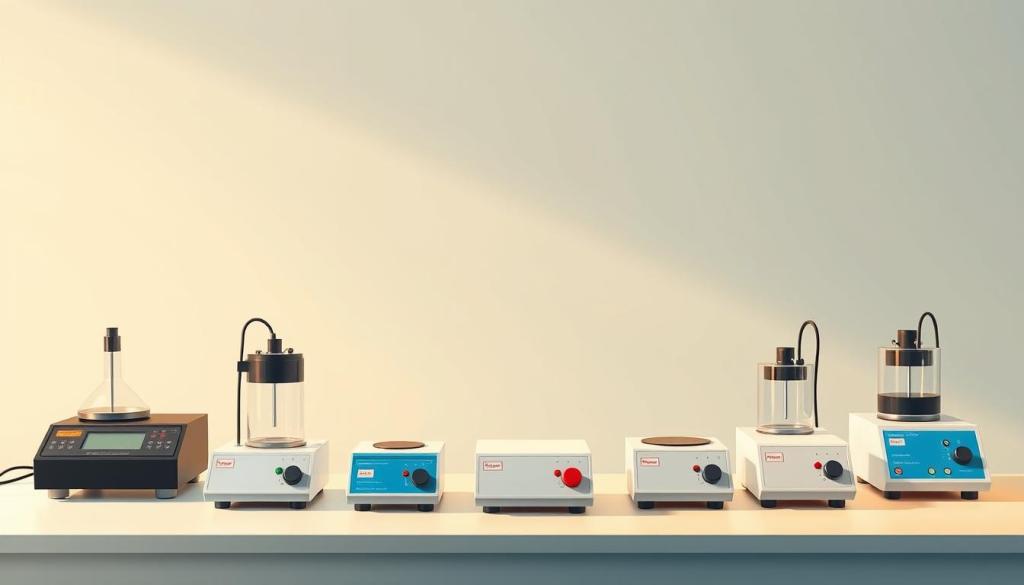
Lab experts must think about important things when picking stirrers and stir bars. These choices affect their research a lot.
Key Considerations for Selection
- Stirring capacity and speed range
- Temperature control capabilities
- Material compatibility
- Safety features
- Size and workspace requirements
Essential Features to Evaluate
Researchers should look at certain features in magnetic stirrers. These features make labs more efficient:
- Digital speed control mechanisms
- Precise temperature regulation
- Robust construction materials
- Integrated safety protection systems
Types of Magnetic Stirrers
| Stirrer Type | Primary Applications | Key Characteristics |
|---|---|---|
| Standard Magnetic Stirrer | Low viscosity liquids | Basic mixing, room temperature |
| Hot Plate Magnetic Stirrer | Temperature-sensitive experiments | Integrated heating element |
| Multi-Position Stirrer | Simultaneous sample processing | Multiple stir bars, parallel mixing |
| Cell Culture Stirrer | Delicate biological samples | Gentle agitation, low heat |
Researchers need to pick the right stirrer type for their needs. Stir bars are key for good mixing in labs.
Knowing what to look for helps scientists make better choices. This improves their experiments and research results.
Maintenance Tips for Magnetic Stirrers
Keeping laboratory agitators in good shape is key for their best performance and long life. Regular care stops equipment breakdowns and keeps the accuracy needed for science.
Professional labs count on well-kept magnetic stirrers for steady and dependable results. Knowing the main maintenance steps can greatly extend these tools’ life.
Regular Cleaning Practices
Cleaning magnetic stirrers needs a careful plan to avoid contamination and keep them working well:
- Take out stir bars and clean them well after each use
- Use FDA-approved cleaning solutions
- Use ultrasonic cleaners for deep cleaning
- Check surfaces for debris and residue
The cavitation action in ultrasonic cleaners creates billions of microscopic vacuum bubbles, effectively removing even the most persistent contaminants.
Ensuring Calibration for Accuracy
Calibration is key to keeping laboratory agitators precise. Labs should do regular calibration checks to make sure mixing is accurate.
| Maintenance Task | Frequency | Purpose |
|---|---|---|
| Visual Inspection | Before/After Each Use | Check for physical damage |
| Speed Calibration | Quarterly | Verify consistent rotation speed |
| Temperature Verification | Bi-Annually | Ensure heating accuracy |
Troubleshooting Common Issues
Magnetic stirrers can face several common problems that need careful handling:
- Spinout during high-speed mixing
- Uneven mixing in different vessel shapes
- Stir bar coupling difficulties
- Potential motor wear
Pro tip: Choose stir bars about the same length as the drive magnet to cut down spinout and boost mixing efficiency.
By sticking to these maintenance tips, labs can get the most out of their magnetic stirrers. This ensures precise and consistent scientific results.
Innovations in Magnetic Stirrer Technology
The world of stirring equipment is changing fast, with magnetic mixers leading the way. New technologies are making lab work better and more efficient.
Today’s magnetic stirrers are changing science with their smart features. They offer better precision and control for researchers.
Advancements in Magnetic Stirring Devices
Recent updates in magnetic mixers have brought big changes:
- IoT-enabled remote monitoring capabilities
- Advanced digital control systems
- Miniaturized and portable design options
- Enhanced safety features with automatic shutoff mechanisms
Integration of Digital Controls
Digital tech has made stirring equipment smarter. Precise speed adjustments and real-time data are now common in top magnetic stirrers.
Eco-Friendly Features and Sustainability
Now, making lab equipment green is key. Modern magnetic mixers have:
- Low-power consumption technologies
- Ceramic coatings for improved durability
- High-performance materials resistant to chemical wear
- Energy-efficient operational modes
These updates show the bright future of magnetic stirrers. They blend technology, precision, and care for the environment.
Comparing Magnetic Stirrers to Other Mixing Methods
Laboratory professionals have to make important choices when picking mixing technologies. They must decide between magnetic stirrers, mechanical stirrers, and manual mixing. This depends on the research needs and the type of samples.
Different mixing methods have their own benefits in labs. Lab stirrers are key for precise scientific work because of their unique advantages.
Magnetic Stirrers vs. Mechanical Stirrers
Researchers see big differences between magnetic and mechanical stir plates:
- Volume Capacity: Magnetic stirrers handle volumes from 250 mL to 20 L
- Shear Stress: Mechanical stirrers create more shear forces
- Contamination Risk: Magnetic stirrers reduce cross-contamination
Advantages Over Manual Mixing
Magnetic stirrers beat manual mixing in many ways:
- They mix at a steady speed
- They cut down on human mistakes
- They make experiments more repeatable
Preferred Scenarios for Each Mixing Method
| Mixing Method | Ideal Applications | Limitations |
|---|---|---|
| Magnetic Stirrers | Low-viscosity liquids, cell cultures | Limited to smaller volumes |
| Mechanical Stirrers | High-viscosity materials, large volumes | Higher contamination risk |
| Manual Mixing | Quick, small-scale preparations | Inconsistent results |
Choosing the right mixing method is crucial. It depends on the experiment’s needs, the sample’s type, and the desired results in research.
Safety Precautions with Magnetic Stirrers
Laboratory safety is very important in scientific research, especially with stirrer hotplates and agitation devices. Knowing and following safety rules can greatly lower accident risks. It helps keep the research area safe.

Proper Usage Guidelines
Researchers need to follow detailed safety guidelines when using magnetic stirrers. Important steps include:
- Wear the right personal protective equipment (PPE)
- Check the equipment before each use
- Know what your agitation devices can do
- Keep your workspace clean and organized
Minimizing Risks in the Laboratory
Lab settings face big safety challenges. More than 60% of hotplate accidents come from wrong setup or ignoring safety rules. To lower risks, focus on:
- Regular equipment checks
- Good safety training
- Right temperature control
| Safety Metric | Percentage |
|---|---|
| Laboratory accidents related to hotplates | 60% |
| Chemical spills during stirrer operations | 40% |
| Personnel familiar with emergency procedures | 30% |
| Accidents prevented by proper lab attire | 80% |
Emergency Procedures and Response
Having a strong emergency plan is key for lab safety. It should cover quick actions, how to communicate, and detailed reports for stirrer hotplates and other gear.
Safety is not an accident, but a deliberate and continuous commitment to protecting human life and scientific research.
The Future of Magnetic Stirrers in Research
The world of lab equipment is changing fast, with magnetic stirrers leading the way. These tools are getting better to keep up with the complex needs of today’s science.
The magnetic stirrer market is growing fast. It’s expected to go from US$ 1.9 billion in 2022 to US$ 2.2 billion by 2028. This shows how important hotplate stirrers and stir bars are for science.
Emerging Trends in Laboratory Equipment
New tech in magnetic stirrers is changing how labs work:
- Enhanced digital control interfaces
- Improved energy efficiency
- Advanced material technologies for stir bars
- Integration with automated laboratory systems
Accelerating Scientific Discoveries
Magnetic stirrers are getting smarter, helping with important research in many fields. The biotechnology and pharmaceutical industries especially benefit. They get:
- Consistent mixing of complex biological samples
- Precise temperature control
- Reduced experimental variations
Potential for Enhanced User Experience
The future of magnetic stirrers is in being adaptable and user-friendly. Researchers will see:
- Remote operation capabilities
- Seamless integration with digital laboratory environments
- More intuitive control mechanisms
| Market Segment | 2022 Value | 2028 Projection | CAGR |
|---|---|---|---|
| Global Magnetic Stirrer Market | $1.9 Billion | $2.2 Billion | 3% |
As science keeps exploring new frontiers, magnetic stirrers will be key. They will help researchers make new discoveries.
Case Studies of Magnetic Stirrers in Practice
Magnetic stirrers have changed the game in scientific research. They offer precise and consistent mixing solutions in many fields. This means researchers can control experiments better, leading to more accurate results.
Successful Applications in Microbiology
In microbiology, magnetic stirrers have made a big difference. Scientists use them for important tasks like:
- Cell culture preparation
- Bacterial growth media mixing
- Enzymatic reaction monitoring
Enhancements in Chemical Preparations
The Smart Stirrer is a big step forward in magnetic stirrer technology. This device checks five key solution parameters:
- Color
- Transparency
- Conductivity
- Viscosity
- Temperature
Real-World Examples of Improved Outcomes
Researchers have seen big improvements in their work with magnetic stirrers. The device lets them monitor solutions wirelessly and works in sealed vessels. This cuts down on contamination risks, making research more reliable.
The integration of magnetic stirrers represents a quantum leap in laboratory automation and reproducibility.
Magnetic stirrers are changing the way scientists work. They reduce the need for many wired sensors and offer advanced monitoring. This helps scientists in many fields do better research.
Frequently Asked Questions About Magnetic Stirrers
Exploring stirring equipment can be tough for researchers and lab experts. Magnetic mixers are key in science, and knowing how they work is crucial for good lab results.
Common Queries from Laboratory Professionals
Scientists and researchers often ask about magnetic stirrers. Here are the most common questions:
- What volume can magnetic stirrers handle?
- How do speed settings impact mixing performance?
- What are compatibility considerations for different vessels?
Best Practices for New Users
Using magnetic mixers well means knowing a few important things:
- Select the appropriate spinner bar for your specific solution
- Match the spinner bar length to your vessel size
- Consider solution viscosity when choosing stirring parameters
Critical User Training Elements
Good training boosts lab work. Key areas to focus on include:
- Understanding equipment specifications
- Recognizing potential mixing limitations
- Implementing safety protocols
Effective magnetic stirrer usage requires precision, knowledge, and careful attention to detail.
Laboratory experts should know magnetic stirrers can handle up to 20 liters. Most models work between 100 to 1,600 RPM. Proper training leads to better results and avoids problems.
Conclusion: The Vital Role of Magnetic Stirrers in the Laboratory
Magnetic stirrers have changed how we do science in labs over the last 100 years. They are now key for precise research. These lab stirrers have made mixing better, giving scientists more control and speed in their work.
Their role is big in many fields, especially in biology. They mix liquids well, which is very important in labs today. Features like temperature control and digital interfaces help scientists set up experiments easily.
Investing in good magnetic stirrers can really help labs do better research. They cut down on contamination and mix well in many situations. As technology grows, magnetic stirrers will get even better, helping scientists do more.
Key Takeaways
Scientists should see how magnetic stirrers can change research. By choosing the right stirrers, they can do their work more accurately and efficiently.
Future Perspectives
As tech gets better, magnetic stirrers will too. They will offer even more control and work better with other lab tools. Labs that keep up with these changes will stay ahead in research.
FAQ
What is a magnetic stirrer and how does it work?
A magnetic stirrer is a tool used in labs. It mixes liquids by spinning a stir bar with a magnetic field. The device has a magnetic drive and a small bar in the liquid. This setup mixes liquids well without touching them.
What are the primary applications of magnetic stirrers in biological research?
In biological research, magnetic stirrers are key. They help mix cell culture media and reagents. They also keep solutions even and control temperature. This is important for keeping samples safe.
How do I choose the right magnetic stirrer for my laboratory?
Choosing the right stirrer involves several factors. Look at stirring capacity, temperature range, and speed control. Also, consider the type of vessels you use and your research needs. For precise temperature control, a hot plate stirrer is best.
What safety precautions should be taken when using magnetic stirrers?
Using magnetic stirrers safely is important. Follow the instructions and wear protective gear. Avoid overheating and ensure good ventilation. Use the right containers and check the equipment regularly. Always be careful and keep your workspace clean.
How often should magnetic stirrers be maintained?
Magnetic stirrers need regular care. Clean them after each use and calibrate them yearly. Check for damage monthly and follow the manufacturer’s maintenance advice. This keeps them working well and accurate.
Can magnetic stirrers be used with all types of laboratory containers?
Not all containers work with magnetic stirrers. Glass, plastic, and certain chemicals are best. The size, shape, and material of the container affect mixing. Always check if your stirrer is compatible with your container.
What are the advantages of magnetic stirrers over mechanical stirrers?
Magnetic stirrers are better for several reasons. They are cleaner, quieter, and don’t wear out. They mix more evenly and are safer for sensitive biological research.
How do digital features enhance modern magnetic stirrers?
Modern digital stirrers have many benefits. They control temperature precisely, can be programmed, and log data. These features make experiments more accurate and efficient.
What are common troubleshooting techniques for magnetic stirrers?
For common issues, check the power and stir bar. Make sure the magnetic field is right and clean the contacts. If needed, recalibrate the temperature sensors. Always refer to the manufacturer’s guide for specific problems.
Are there eco-friendly magnetic stirrer options?
Yes, there are eco-friendly stirrers. They use less energy, are made from sustainable materials, and last longer. These options help reduce environmental impact without sacrificing performance.





Leave a Comment
Your email address will not be published. Required fields are marked *