


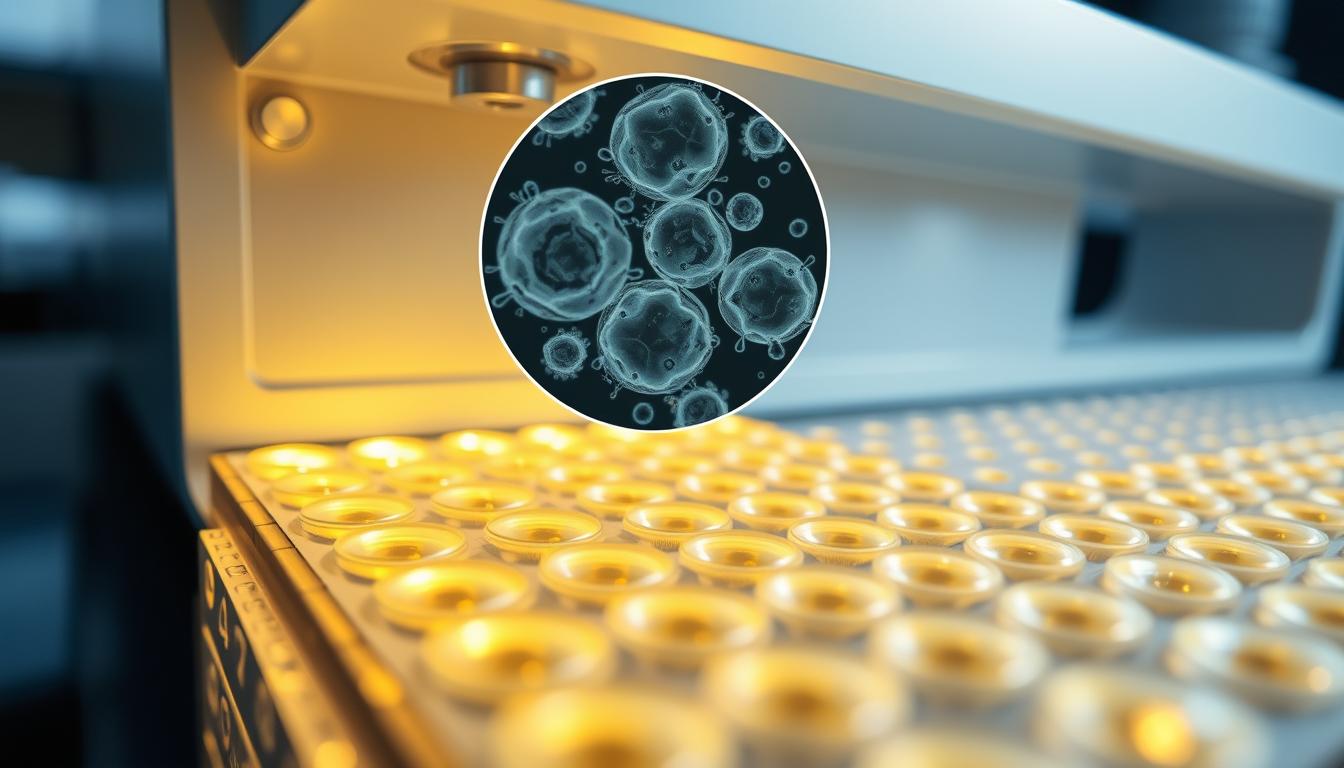
Can a tiny microwell change how scientists study cells at a huge scale? Microwell technology is a new way to look at single cells. It lets researchers study each cell very closely and quickly.
Microwells are key in biomedical research. They help scientists study cells in a new way. This lets them understand complex biological systems better.
The microwell array platform can catch over 50% of cells. It can hold between 15,000 and 150,000 microwells. Each one is 50 µm in diameter and 58 µm high. It’s like a tiny lab for studying cells in detail.
Key Takeaways
- Microwells enable high-precision single-cell analysis
- Advanced platforms can capture over 50% of cells efficiently
- Microwell technology supports extensive cellular research
- Each microwell functions as a miniature research environment
- Cutting-edge approach to understanding cellular behavior
Introduction to Microwells
Microwell arrays are a new technology in cell analysis. They let researchers study cells in new ways. These small platforms create tiny spaces for each cell.
Scientists use microwell arrays for precise high-throughput screening. The design lets them watch cells closely. This helps in more detailed research.
What Are Microwells?
Microwells are small, carefully made wells in a special substrate. They have:
- Dimensions ranging from 30 to 100 μm in diameter
- Typical well depth of approximately 20-35 μm
- Fabricated using advanced microfabrication techniques
- Capable of supporting isolated cell culture environments
Purpose of Microwells in Cell Analysis
The main goal of microwell arrays is to create controlled settings for experiments. They help researchers:
- Do high-throughput screening with little sample
- Study individual cells closely
- Make uniform cell groups
- Lower the chance of mistakes in experiments
Researchers have seen great results, like 88 ± 6% well occupancy in under 10 seconds. These advanced arrays give scientists powerful tools to study how cells work and behave.
The Structure and Design of Microwells
Microwells are a key technology for advanced 3D cell culture and lab-on-a-chip. They offer precise control over cell environments. This lets researchers study cell behavior and interactions in new ways.
The design of microwells requires careful thought about materials and shapes. These choices greatly affect the results of cell research.
Material Composition
Scientists use different materials to make microwells. Each material has special properties for cell culture:
- Polydimethylsiloxane (PDMS): Flexible and safe for cells
- Agarose: Keeps cells in a moist environment
- Hydrogels: Supports complex 3D cell interactions
Well Geometry and Sizes
The size of microwells is key for controlled cell environments. They usually have:
| Parameter | Typical Range | Significance |
|---|---|---|
| Diameter | 50-500 μm | Determines cell aggregate size |
| Depth | 100-300 μm | Influences cellular clustering |
| Tip Angle | 66°-106° | Affects cell aggregation dynamics |
Advanced microwell designs help create uniform cell clusters. This is crucial for research in regenerative medicine and drug discovery.
The ability to control cellular microenvironments represents a quantum leap in biological research capabilities.
Choosing the right materials and shapes lets scientists create tailored microenvironments. These environments closely mimic natural cell conditions. This has changed how we understand cell interactions and behavior.
Applications of Microwells in Biotechnology
Microwells are changing biotechnology by allowing for detailed cell studies. They are small platforms that help scientists study cells and complex systems in new ways.
Advanced Cell Culture Techniques
Organ-on-a-chip uses microwells to create detailed cell models. These models are like tiny versions of human bodies. Scientists can make:
- Controlled cell groups that are all the same size
- Three-dimensional cell structures
- Small tissue models for specific research
High-Throughput Drug Screening
Microwells make drug testing faster with high-throughput screening. They let scientists:
- Test many drugs at once
- Use less space and resources
Single-Cell Analysis Capabilities
Single-cell analysis is more precise with microwells. Scientists can study how cells are different in detail. They look at genes and how cells interact.
Microwell technologies are transforming our understanding of cellular behaviors and interactions.
Using materials like poly(ethylene glycol), microwells can create cell groups. They also improve cell retrieval and control temperature. These advancements are changing biological research.
Advantages of Using Microwells
Microwell technology is a big step forward in studying single cells. It gives scientists new ways to look at cells. These lab-on-a-chip systems change how we do microfluidics and cell studies.
- High throughput capability
- Enhanced precision in cell isolation
- Minimized sample volume requirements
- Reduced cross-contamination risks
High Throughput Capability
Microwells let researchers study about 3,000 cells at once. This fast pace speeds up research without losing quality.
Improved Accuracy and Precision
The microwell array platform shows top-notch results in single-cell studies:
| Metric | Performance |
|---|---|
| Cell Capture Efficiency | >50% |
| RNA-Seq Profile Purity | >98.8% |
| Genes Detected per Cell | ~4,800 |
These advanced microwell technologies work well with modern microfluidic systems. They give scientists strong tools for detailed cell studies.
The future of cellular research lies in precise, scalable technologies that can capture intricate cellular dynamics.
By cutting library prep costs to $0.10–$0.20 per cell and keeping cross-contamination very low, microwells are a game-changer.
Microwell Array Technology
Microwell arrays are changing the game in cellular research. They offer new ways to study complex biological systems. These platforms give scientists deep insights into 3D cell culture and cellular microenvironments.
The design of microwell arrays has changed how we analyze cells. Now, these systems can handle up to 150,000 cells at once. This means researchers can do high-throughput screenings like never before.
Breakthrough Array Configurations
Modern microwell arrays come with advanced features. These features boost cellular research:
- Enhanced single-cell capture mechanisms
- Improved spatial resolution
- Advanced cell tracking capabilities
- Precise microenvironment control
Key Technological Innovations
Recent updates in microwell arrays have shown impressive results:
- Capturing over 90% of rare tumor cells
- Achieving single-cell analysis throughput of 10,000 cells per experiment
- Supporting stem cell growth with 90% viability after 14 days
- Reducing protein adsorption by 70% compared to traditional surfaces
These advancements are expanding what we can learn from cells. They allow for more detailed studies of complex biological processes.
Comparative Analysis: Microwells vs. Traditional Methods
Scientific research is always changing, with microwell technology leading the way. It’s a big step forward for high-throughput screening and single-cell analysis. When we compare microwells to old methods, we see big tech wins that change how we do experiments.
Efficiency Differences in Cell Analysis
Microwells are way more efficient than old cell analysis methods. They show big wins in several areas:
- Reduced reagent consumption by up to 50%
- Enhanced single-cell analysis precision
- Increased experimental throughput
- Improved cell isolation capabilities
Cost-Effectiveness of Microwell Technology
Microwell tech helps researchers use resources better in microfluidics. It saves money not just in the lab but also in the long run.
| Parameter | Microwells | Traditional Methods |
|---|---|---|
| Cell Recovery Rate | 70-90% | 40-60% |
| Gene Detection | 2,793-4,312 genes | 627-2,324 genes |
| UMI Counts | 8,779-13,719 | 1,063-4,994 |
The numbers show microwells are a big leap in making experiments better. They’re becoming key for complex cell analysis research.
Challenges in Microwell Technology
Microwell technology is changing the game in science, but it’s not without its hurdles. Researchers struggle to create reliable and large-scale systems for microfluidics and lab-on-a-chip. They need new ways to improve 3D cell culture methods.
Manufacturing Consistency Challenges
Making microwells that are precise and uniform is a big challenge. The process is complex and requires a lot of focus. It’s especially hard to make arrays with exact dimensions.
- Maintaining dimensional accuracy within micrometers
- Ensuring reproducible surface treatments
- Controlling material properties consistently
Scalability Constraints
Scaling up microwell tech from small tests to big, fast systems is tough. Researchers face many technical issues to make it work for more uses.
| Challenge | Impact |
|---|---|
| Dimensional Variability | ±5-10% variation in well geometry |
| Production Throughput | Limited to 672 wells per chip |
| Volume Constraints | 500 nl per well |
“The future of microwell technology lies in overcoming current manufacturing and scalability limitations.” – Research Insights
To solve these problems, scientists, engineers, and manufacturing experts need to work together. They must create better microwell systems for advanced cell culture and drug testing research.
Future Trends in Microwell Development
The world of biomedical research is changing fast. Microwell technology is key in studying cells and testing drugs. Scientists are looking at new ways to understand cells better and make treatments that fit each person.
New trends in microwell tech are exciting. They focus on two main areas:
- Combining microwells with advanced microfluidic systems
- Using microwells for personalized medicine
- Creating better organ-on-a-chip models
Microfluidics and Microwell Convergence
Microwells and microfluidics together are a big step forward. They help create detailed environments for cell studies. This setup lets scientists watch how cells interact closely and accurately.
Personalized Medicine Potential
Microwell tech is set to change personalized medicine. Organ-on-a-chip models are getting better. They help scientists predict how patients might react to treatments.
The future of microwell technology lies in its ability to create increasingly complex and physiologically relevant cellular environments.
Improvements are coming in design and tracking cell behavior. This will help scientists study cells in more detail and under different conditions.
Conclusion
Microwells are changing the game in scientific research. They make high-throughput screening and single-cell analysis super accurate. They let researchers study complex biological systems in new ways.
The rise of microwell technology is a big step forward in science. It lets scientists study single cells in detail. This gives them insights into how cells work and interact in ways they couldn’t before.
Scientists are finding new uses for microwells in many fields. They’re helping in drug discovery and personalized medicine. As microwell tech gets better, scientists will have even more tools to explore biology.
Microwells are key to making new discoveries in science. They’re helping scientists tackle tough biological questions. This technology is exciting and will keep driving scientific progress.
FAQ
What exactly are microwells?
Microwells are tiny, carefully made platforms with small wells. They help researchers study individual cells in detail. This lets them understand how cells behave and interact with great precision.
How do microwells differ from traditional cell culture methods?
Microwells are different because they keep cells separate. This reduces contamination and allows for detailed single-cell studies. They also make experiments more efficient and can handle thousands of cells at once.
What materials are typically used in microwell fabrication?
Materials like PDMS, PMMA, glass, and silicon are used to make microwells. The choice depends on what’s needed for the experiment, like being clear or resistant to chemicals.
What are the primary applications of microwell technology?
Microwells are used in many ways in biotechnology. They help in drug testing, studying genes, and creating models of organs. They’re also used in personalized medicine.
How do microwells enhance single-cell analysis?
Microwells let researchers study individual cells closely. This helps understand how different cells behave and respond. It makes studying cells more accurate and detailed.
What challenges exist in microwell technology?
Making microwells consistently and scaling them up are big challenges. Integrating them with other technologies and creating standard protocols are also issues.
How are microwell arrays being innovated?
Researchers are making more advanced microwell arrays. These can handle hundreds of thousands of cells at once. They’re working on better designs and materials to improve these systems.
What future developments are anticipated in microwell technology?
The future looks bright for microwells. They’ll be used more in personalized medicine and in creating detailed models of organs. They’ll also be integrated with other technologies.
Are microwells suitable for all cell types?
Yes, microwells can be tailored for different cell types. By adjusting the design and materials, they can work with various cells. But, it’s important to make sure they’re compatible.
How do microwells contribute to drug discovery?
Microwells help in drug discovery by allowing fast testing of drugs on cells. They help find out how well drugs work and their effects on cells. This makes drug testing more precise and efficient.





Leave a Comment
Your email address will not be published. Required fields are marked *