


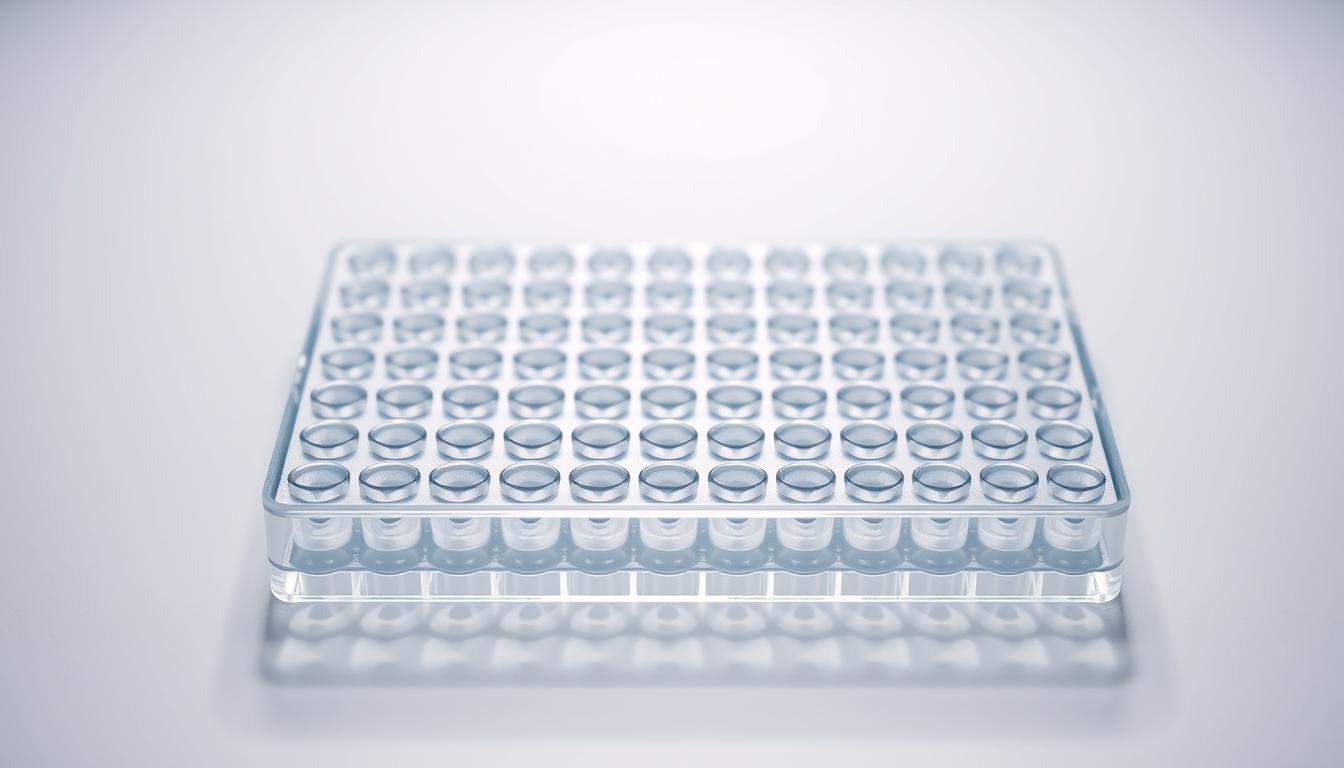
Ever thought about how a small 96 well plate can change science? These tiny plates are a big deal in labs. They help scientists do complex tests faster and better.
The size of a 96 well plate is key in today’s science. It lets scientists test many samples at once. This makes their work quicker and uses less resources.
Dr. Gyula Takatsy first came up with the 96 well plate in 1955. It has changed how scientists work in many fields. Its design helps manage samples, grow cells, and do detailed molecular studies.
Key Takeaways
- 96 well plates enable simultaneous testing of multiple samples
- Microplate dimensions are critical for experimental precision
- Standard plate design supports diverse research applications
- High-throughput screening depends on consistent well geometry
- Plate design impacts research efficiency and accuracy
Overview of 96 Well Plates
Laboratory researchers use 96 well plates as key tools for precise scientific work. These microplates are vital in modern experiments. They help manage and analyze samples in a systematic way.
The size and shape of the wells are crucial for these tools. 96 well plates are made with great precision. They are 127.76 mm long and 85.48 mm wide, with a small tolerance.
Definition and Purpose
A 96 well plate is a flat, rectangular platform with an 8×12 grid of small wells. Each well acts like a tiny test tube. These plates help researchers:
- Store many samples at once
- Run parallel experiments
- Work more efficiently
- Standardize their research
Common Applications
Scientific fields use 96 well plates in many ways:
| Research Field | Primary Applications |
|---|---|
| Molecular Biology | Gene expression analysis |
| Immunology | Antibody screening |
| Pharmaceutical Research | Drug discovery screening |
| Microbiology | Bacterial growth studies |
The standardized design of 96 well plates enables researchers to achieve unprecedented levels of experimental precision and reproducibility.
Each well can hold between 0.1 mL to 0.3 mL of sample. This allows for flexible volume management. The consistent spacing of 9 mm makes automated handling and analysis reliable across different scientific platforms.
Importance of Plate Diameter in Experiments
Precision in assay plate specifications is key in scientific research, especially in high-throughput screening. The size of each well affects the experiment’s results, how much sample is used, and how sensitive the assay is.
Researchers need to think about well sizes to make their experiments better. Different sizes can change the results by affecting:
- Sample volume capacity
- Cell seeding densities
- Experimental reproducibility
- Assay sensitivity
Impact on Sample Volume
The size of the well decides how much sample can be used. Seeding densities vary from 1,000 to 11,000 cells per well. The best results usually happen when there are 5,000 to 11,000 cells.
| Well Type | Seeding Density Range | Recommended Volume |
|---|---|---|
| U-Bottom Wells | 7,000-11,000 cells | 10 µl (inner well) |
| V-Bottom Wells | 5,000-11,000 cells | 70 µl (upper well) |
Influence on Assay Sensitivity
The exact size of the well is crucial for the sensitivity of high-throughput screening. Even a small difference, like 50 μm, can greatly affect the results. By controlling well sizes and cell distribution, researchers can get over 90% differentiation.
Precision in well diameter is not just a technical detail—it’s a fundamental factor in experimental success.
Using advanced methods like centrifugation at 290 × g for 3 minutes can help standardize cell distribution. This reduces the variability in results.
Standard Dimensions of 96 Well Plates
Microplate dimensions are key in lab work, ensuring everything fits together right. Knowing the standard sizes of 96 well plates helps scientists pick the best tools for their studies.
Precise Plate Measurements
The standard 96 well plate has exact measurements for consistent lab work. These include:
- Length: 127.8 mm
- Width: 85.5 mm
- Height: 14.4 mm
Individual Well Characteristics
Each well in a 96 well plate has unique features that affect results. Scientists must think about these details when planning their experiments.
| Well Parameter | Measurement |
|---|---|
| Growth Area per Well | 0.32 cm² |
| Well Volume | 360 µL |
| Maximum Volume | 390 µL |

Structural Configuration
The typical 96 well plate has an 8 x 12 grid layout. Important details include:
- First column center: 14.38 mm from left edge
- Subsequent columns: 9.0 mm apart
- First row center: 11.24 mm from top edge
- Row spacing: 9.0 mm between centers
Precision is crucial in lab work, where small differences can greatly affect results.
Materials Used in 96 Well Plates
Researchers in biotechnology use special materials for 96 well plates. This choice is key to their success in the lab.
Polypropylene vs. Polystyrene: A Detailed Comparison
Two main materials are used in making microplates: polypropylene and polystyrene. Each has its own benefits for science.
- Polystyrene advantages:
- Excellent optical clarity
- Superior thermal stability
- Ideal for imaging and fluorescence techniques
- Polypropylene advantages:
- High chemical resistance
- Better for temperature-sensitive experiments
- Lower protein binding properties
Material Impact on Experimental Outcomes
The plate material affects how reliable your results are. Different research applications need specific material properties for accurate results.
“The right material can make or break your scientific investigation.” – Laboratory Research Quarterly
Choosing the right 96 well plates is crucial for biotechnology. Factors like surface treatment, chemical compatibility, and what you’re testing guide your choice. These details are important for your lab’s success.
Types of 96 Well Plates
Researchers need to know the key differences in 96 well plates. The size and shape of the wells are very important. They affect how well experiments work in many fields of science.
Conical vs. Flat Bottom Wells
There are two main types of 96 well plates:
- Flat Bottom Wells
- Great for growing cells that stick to surfaces
- Cells grow evenly on the flat surface
- Perfect for taking pictures of cells
- Conical (V-Bottom) Wells
- Best for studying how liquids settle
- Liquids collect at the bottom
- Helps in getting more sample
Surface Treatments and Their Benefits
Changing the surface of plates can make experiments better. Different coatings help the plate work better with biological samples.
| Surface Treatment | Primary Application | Key Benefit |
|---|---|---|
| Tissue Culture Treated | Cell Culture | Cells stick better |
| Hydrophobic | Protein Studies | Less sticking of unwanted proteins |
| Low Evaporation | Long-term Incubation | Less sample lost |
Choosing the right well size and surface treatment can make experiments more reliable and accurate.
Knowing the details about 96 well plates helps researchers pick the best one for their needs.
Choosing the Right 96 Well Plate
Choosing the right 96 well plate is key for good lab work. Scientists need to look at many factors. This ensures their results are precise and reliable.
Considerations for Specific Experiments
When picking a 96 well plate, scientists must think about a few important things. These things affect how well experiments work and succeed:
- Assay type and detection method
- Sample properties and volume needs
- Plate shape and well details
- How well it works with lab tools

Compatibility with Assay Techniques
The shape of the plate is very important for success. Scientists need to pick a plate that fits their research needs well.
| Assay Type | Recommended Plate Characteristics |
|---|---|
| Fluorescence Imaging | Black walls, clear bottom |
| Absorbance Testing | Clear bottom, UV-transparent |
| Luminescence | White plates to reduce crosstalk |
Knowing what each experiment needs helps scientists choose the best 96 well plate. The right plate choice can make data better and experiments more reliable.
Precision in plate selection is the cornerstone of successful scientific research.
Proper Handling and Use of 96 Well Plates
Researchers must learn how to handle 96 well plates correctly. These tools are key for keeping samples safe and experiments accurate.
Managing samples well is about paying attention to many details. It’s important to know how to avoid contamination and make sure experiments work right.
Best Practices for Plating Samples
There are a few main steps for plating samples well:
- Use calibrated multichannel pipettes for consistent volume transfer
- Ensure proper pipetting technique to prevent cross-contamination
- Maintain a clean, sterile workspace
- Practice careful sample handling techniques
“Precision in sample preparation determines the quality of scientific outcomes.” – Laboratory Research Guidelines
Avoiding Contamination
Keeping samples clean is very important. Researchers need to follow strict rules to keep samples safe:
- Always wear clean, sterile gloves
- Use dedicated pipettes for specific sample types
- Regularly disinfect work surfaces
- Store plates in controlled environmental conditions
Proper sealing of 96 well plates is crucial for maintaining sample quality and preventing external contamination. Using special sealers and handling plates carefully can greatly lower the chance of mistakes in experiments.
Maintenance and Storage of 96 Well Plates
Keeping laboratory supplies in good shape is key. 96 well plates need special care to work well in science. This care helps them last longer and perform better.
It’s important for scientists to take good care of these tools. This helps keep them working right and avoids mistakes in research.
Ideal Storage Conditions
Storing 96 well plates right is crucial. Here’s what you need to know:
- Keep them at 15-25°C
- Use low humidity places
- Keep them away from direct sunlight
- Store them in sealed, clean containers
Cleaning Recommendations
Cleaning your lab tools well is important. Here’s how to keep your plates in top shape:
- Wash them right after use with the right cleaners
- Use gentle lab cleaners
- Avoid strong chemicals that can harm the plates
- Dry them well before putting them away
| Storage Condition | Recommended Practice |
|---|---|
| Temperature Range | 15-25°C (59-77°F) |
| Humidity Level | Below 60% relative humidity |
| Light Exposure | Minimal direct sunlight |
| Storage Container | Sealed, clean plastic container |
“Proper maintenance of 96 well plates is not just a best practice, it’s a critical component of reliable scientific research.”
Following these tips helps keep your 96 well plates in great shape. This ensures your research results are reliable and consistent.
The Role of 96 Well Plates in Automation
Laboratory automation has changed the game in biotechnology, thanks to 96 well plates. These plates are key in today’s research. They make complex scientific tasks easier.

Researchers use 96 well plates to make their work more efficient and accurate. The plates fit perfectly with robots, boosting research abilities.
Compatibility with Advanced Robotic Systems
Modern robots use 96 well plates to speed up screening. The benefits are clear:
- Less chance of mistakes in experiments
- Quicker results
- More reliable results
- Less need to handle samples
Enhancing Research Throughput
Automation changes labs by letting researchers work on many samples at once. 96 well plates help with detailed experiments with great accuracy.
Automation is the future of science, making experiments bigger and more precise.
Using 96 well plates with automated systems leads to new discoveries in biotechnology. It helps in genomics, drug finding, and medical testing.
Recent Advances in 96 Well Plate Technology
The world of biotechnology is changing fast, with big steps forward in 96 well plates. Scientists are seeing new things that are changing how these plates work and what they can do.
Today’s 96 well plate tech is opening up new ways to do science. It’s thanks to new designs and materials. Now, scientists can try new things in their labs.
Innovative Design Developments
There have been big changes in how 96 well plates are made:
- They’re clearer for better microscope views
- They have special coatings for certain cell types
- They can handle heat better
- They’re safer from contamination
Material Science Breakthroughs
New materials are making a big difference in biotech tools. Scientists can now use plates made from advanced polymers. These plates work better in different lab settings.
“The future of laboratory research lies in innovative microplate dimensions and intelligent material design.” – Scientific Research Quarterly
Future Technological Trends
There are exciting new things coming in 96 well plate tech:
- Nanotech coatings for better surfaces
- Plates that can track data automatically
- Plates that work better with other tools
- Custom plates for specific needs
These changes show how biotech tools are always getting better. They promise to make research more accurate, efficient, and flexible.
Troubleshooting Common Issues with 96 Well Plates
Researchers often face problems when using 96 well plates. Knowing how to solve these issues can greatly improve their work. This makes their results more reliable.
Identifying Critical Problems in Microplate Research
Microplate research has its own set of challenges. These can affect the quality of the data. It’s important for researchers to watch out for these issues.
- Evaporation disrupting sample integrity
- Edge effects causing inconsistent readings
- Uneven cell growth across plate wells
- Background noise interference
Strategic Solutions for Experimental Optimization
There are ways to solve common problems in 96 well plate experiments. Using the right techniques and preparing carefully is key. This helps keep the experiments precise.
| Issue | Potential Solution |
|---|---|
| Evaporation | Use plate sealers, minimize plate exposure |
| Edge Effects | Utilize central wells, standardize incubation conditions |
| Cell Growth Variability | Optimize seeding density, ensure uniform substrate |
Best Practices for Effective Experimentation
To make experiments more reliable, follow these tips:
- Maintain consistent environmental conditions
- Use calibrated pipettes for precise sample transfer
- Implement proper washing techniques
- Monitor plate integrity throughout experiments
“Precision in laboratory consumables management is the cornerstone of reproducible scientific research.”
By knowing the challenges and using the right solutions, researchers can greatly improve their microplate experiments. This makes their work more reliable and accurate.
Conclusion: The Significance of Well Plate Diameter
The 96 well plate diameter is a big step forward in lab research. It makes it easier to test many things at once in different fields. These tools have changed how we do experiments, letting us work on lots of samples at the same time.
Now, scientists can use 96 well plates to do their work better. They can handle small to medium amounts of liquid, from 50 μL to 200 μL. This means they can do more with less, saving time and resources.
Recap of Key Points
Knowing about 96 well plate diameter is key to better research. Every detail, from what it’s made of to its shape, helps in getting accurate results. Scientists need to pick the right plates for their needs, thinking about surface treatments and how much liquid they can hold.
The Future of Lab Research with 96 Well Plates
As science gets better, so will 96 well plates. New designs and materials will help us do even more in lab tests. This will lead to more advanced and efficient ways to conduct research in many areas of science.
FAQ
What is a 96 well plate and what is it used for?
A 96 well plate is a tool used in labs. It’s made of plastic and holds many samples at once. It’s used in biology, immunology, and drug discovery for things like cell culture and PCR.
What are the standard dimensions of a 96 well plate?
A standard 96 well plate is about 127.76 mm × 85.48 mm. Each well is 6.4 mm in diameter. They can hold 300-350 μL of liquid, depending on the maker.
What materials are commonly used to manufacture 96 well plates?
Most plates are made of polypropylene or polystyrene. Polypropylene is good for low protein binding and heat. Polystyrene is better for cell culture and seeing through.
How do I choose the right 96 well plate for my experiment?
Choosing the right plate depends on your experiment. Think about your assay type, detection method, and sample properties. Also, check if it works with your lab equipment.
What are the different types of 96 well plate bottom configurations?
There are flat bottom, U-bottom, and V-bottom plates. Flat bottom plates are versatile. U-bottom plates are great for immunology. V-bottom plates are best for precise handling and centrifugation.
How should 96 well plates be stored?
Store plates in a cool, dry place away from sunlight. Keep them at room temperature or in the fridge, as the maker suggests. Always use the original packaging to avoid contamination.
Can 96 well plates be reused?
Usually, plates are for one-time use to avoid contamination. But some can be cleaned and reused. Always check the maker’s guidelines.
What common issues can occur when using 96 well plates?
Issues include edge effects, evaporation, and uneven cell growth. These can be fixed by sealing well, keeping conditions steady, and following handling tips.
How do 96 well plates support laboratory automation?
96 well plates are key in automation labs. Their standard size fits with robots and automated systems. This makes handling samples precise and efficient.





Leave a Comment
Your email address will not be published. Required fields are marked *