



Imagine freezing time for living things, keeping them safe at very cold temperatures. Cryopreservation is a new way to protect and store living things. It’s a big deal in science and medicine.
This method cools living samples to very low temperatures. It stops cells from working but doesn’t hurt them. Scientists use special freezing methods to keep cells and tissues safe.
For over 50 years, scientists have worked on cryopreservation. They first froze mouse embryos and now use it in many areas. It’s key in reproductive and genetic research.
Key Takeaways
- Cryopreservation allows biological materials to be stored at ultra-low temperatures
- The technique preserves cellular structures without compromising their future functionality
- Applications span multiple scientific and medical disciplines
- Developed over 50 years of intensive research
- Critical for advancing reproductive and genetic technologies
What is Cryopreservation?
Cryogenic preservation is a new way to freeze biological materials at very low temperatures. It helps scientists and doctors keep delicate cells safe for a long time. This opens up new areas in science and medicine.
This method carefully controls the freezing to avoid harming cells. Experts use special techniques to stop ice crystals from damaging biological samples.
Definition and Core Principles
Cryopreservation keeps cells, tissues, and other biological materials cool to very low temperatures, usually below -130°C. The main goals are:
- Preventing cellular deterioration
- Maintaining biological integrity
- Enabling long-term storage of critical biological specimens
“Cryopreservation opens a window to suspend biological time, protecting the essence of life at its most fundamental level.” – Scientific Research Journal
Historical Context
The journey of cryogenic preservation started in 1953. Researcher James Lovelock found out how freezing can damage cells. He showed that osmotic stress is key to keeping cells safe.
Some interesting facts show how important this technology is:
- Approximately 4,500 individuals are currently signed up for cryopreservation
- Several hundred people have already paid for cryogenic preservation in existing facilities
- Research has successfully cryopreserved small animals like Caenorhabditis elegans with memories intact
The potential of cryopreservation continues to expand, promising revolutionary advancements in medical science and biological research.
The Science Behind Cryopreservation
Cryopreservation is a new way to store biological materials at very low temperatures. It helps keep cells safe and ready for use later. This method is a big step forward in science.
The science of cryopreservation focuses on cooling and keeping things safe. Scientists use special methods to protect cells from harm when they freeze.
Biological Principles of Preservation
There are important rules for keeping cells alive in cryopreservation:
- Stopping ice crystals from forming
- Keeping cell membranes safe
- Keeping molecules stable
- Reducing chemical damage
Cooling and Freezing Techniques
Scientists use careful cooling methods for success:
- Freezing slowly at -1°C per minute
- Putting samples in very cold temperatures below -135°C
- Using special agents to protect cells
Vitrification Process
Vitrification is a new method in storing things at low temperatures. This method turns biological samples into glass without ice crystals. Scientists use special agents to keep cells safe and working.
Studies show cryopreservation works well. Materials stored at -196°C can last a very long time. Some say they could last over 3000 years.
Applications of Cryopreservation
Cryopreservation is a new and exciting method used in many fields. It helps keep important biological materials safe for a long time. This is thanks to the work of scientists and medical experts.
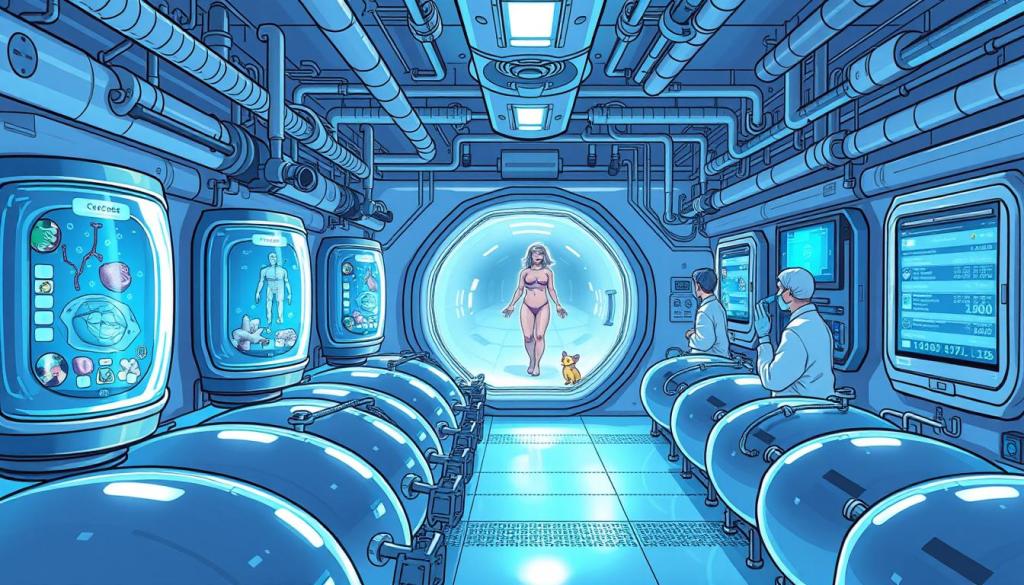
This method is used in many important areas. It changes how we do research, medical treatments, and save genetic information.
Medical Science Applications
In medicine, cryopreservation is very important. It helps in many ways:
- Keeping blood products for transfusions
- Storing bone marrow for transplants
- Keeping stem cells for a long time
- Preserving organs
Reproductive Technology Breakthroughs
Vitrification has changed reproductive medicine a lot. It’s especially useful for freezing embryos. Here are some key uses:
- Helping with artificial insemination
- Supporting in vitro fertilization
- Keeping fertility treatments alive
- Creating egg and sperm banks
Biodiversity Conservation Efforts
Cryopreservation is also key for saving genetic diversity. It helps researchers:
- Save genetic material from endangered species
- Keep seed banks
- Store germplasm for future farming research
- Protect plant and animal genetic resources
By cooling samples to around −196°C, cryopreservation keeps genetic materials safe. This is crucial for many scientific fields.
The Benefits of Cryopreservation
Cryopreservation is a new way to store stem cells, opening doors for medical research and treatments. It keeps biological materials safe for a long time with great precision.
Scientists have found many benefits in using cryopreservation for stem cell banking:
- Indefinite longevity of frozen cells
- Preservation of critical biological materials
- Enhanced research capabilities
- Improved fertility treatment options
Extended Preservation of Biological Material
Cryopreservation stores samples at very cold temperatures, around -320 degrees Fahrenheit. This keeps cells alive for a long time, helping in medical research and treatments.
Enhanced Research Opportunities
Stem cell banking through cryopreservation brings new chances for scientists. They can study cells without losing much information, helping in regenerative medicine and genetic studies.
| Preservation Parameter | Optimal Condition |
|---|---|
| Storage Temperature | -196°C (Liquid Nitrogen) |
| Freezing Rate | -1°C per minute |
| Cell Concentration | 1×10³ to 1×10⁶ cells/mL |
Increased Success Rates in Fertility Treatments
Cryopreservation has changed fertility treatments, giving people more control over their reproductive health. Now, using thawed embryos can lead to pregnancies as often as fresh ones, offering hope for those facing fertility issues.
Cryopreservation transforms biological limitations into opportunities for medical innovation.
Challenges and Limitations
Cryopreservation is a complex science with big challenges. It requires careful handling to avoid damage to biological materials. This is true during the freezing and thawing steps.
- Potential cellular damage during freezing
- Complex cryoprotectants interactions
- Maintaining biological integrity
- Ethical considerations in research
Potential Damage to Cells
Keeping cells alive during cryopreservation is a big task. It involves avoiding osmotic stress and ice crystal damage. Cryoprotectants help by protecting cells from rupture and damage.
Ethical Considerations
Cryopreservation raises big ethical questions, especially in reproductive tech. Scientists must balance progress with respect for individual rights and future impacts.
Regulatory Issues
Cryopreservation is tightly regulated to ensure safety and ethics. Labs must follow strict rules for handling biological materials.
The success of cryopreservation depends on precise science and responsible use.
New research is finding ways to reduce cell damage. It’s using advanced cryoprotectants to improve preservation in different areas of biology.
Cryopreservation in Human Medicine
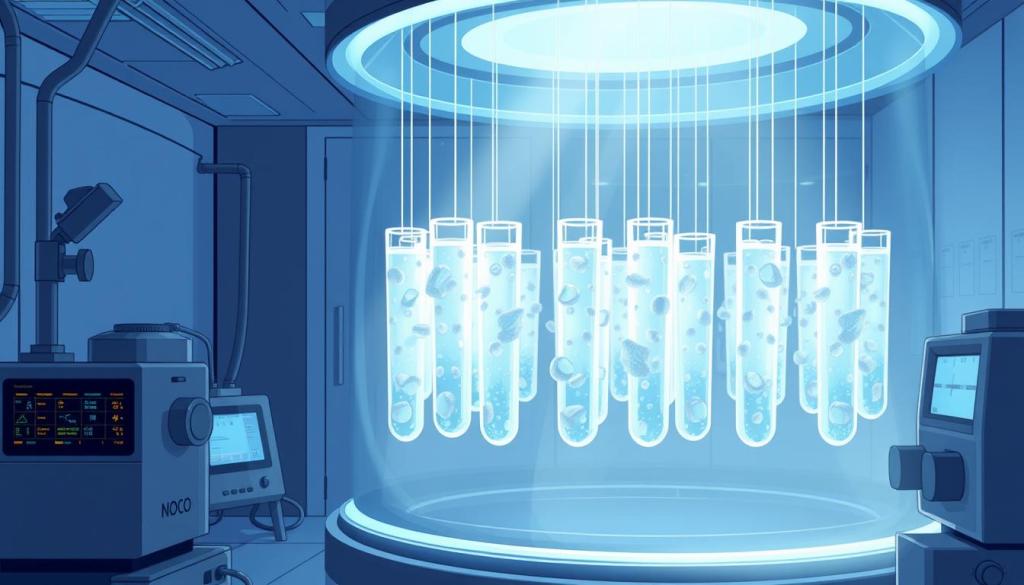
Modern medicine has found a new way to save important biological materials. This method, called cryogenic preservation, combines stem cell banking with advanced techniques. It’s changing regenerative medicine and medical research.
Stem Cell Preservation: A Critical Medical Innovation
Stem cell preservation is a big step forward in medical tech. Scientists can now store different types of stem cells with great care. These include:
- Embryonic stem cells
- Mesenchymal stromal cells
- Hematopoietic stem cells
These stored stem cells are key for future treatments. They offer new chances in regenerative medicine. Cryogenic preservation techniques keep cells safe for a long time, making them ready for use.
Organ Preservation Techniques
Cryopreservation has changed how we keep organs for transplants. It’s made keeping tissues alive longer possible. The main improvements are:
- Precise temperature control methods
- Advanced cryoprotective agent formulations
- Minimized cellular damage during freezing
Doctors can now save complex biological materials with high success rates. Stem cell banking is helping make personalized treatments a reality. It gives hope to patients with serious health issues.
Advances in Cryopreservation Technology
The field of freezing biological materials is growing fast. New technologies are being developed to store delicate samples better. This is thanks to the hard work of researchers.
- Enhanced cryoprotectant formulations that minimize cellular damage
- Precision cooling systems with ultra-controlled temperature gradients
- Advanced monitoring techniques for cellular integrity during freezing
Innovative Preservation Methods
Scientists have made big steps in understanding how to store samples at low temperatures. Controlled-rate freezing is now used to reduce stress on cells. This method keeps the cooling rate between 1 to 10°C per minute, greatly improving survival rates.
Artificial Intelligence in Cryopreservation
Artificial intelligence is changing how we freeze biological materials. It gives us new insights into how to preserve samples. Machine learning algorithms can predict the best cooling rates and cryoprotectant concentrations with high accuracy.
The future of cryopreservation lies in the intersection of biological understanding and computational precision.
AI is being used in many ways:
- Predictive modeling of cellular survival rates
- Optimization of cryopreservation protocols
- Real-time monitoring of biological sample conditions
Researchers are always looking for new ways to improve cryopreservation. They aim to make it better for medicine, science, and research.
Future of Cryopreservation
The world of cryogenics is changing fast, bringing new hopes to medical science and keeping things alive longer. Cryopreservation is now exploring new areas, pushing the limits of what we thought was possible.
New trends in cryopreservation are changing how we store and use biological materials. These changes are set to make a big impact on medicine and research. Here are some key areas to watch:
- Advanced cryoprotective agent development
- Precision organ preservation techniques
- Enhanced tissue regeneration capabilities
- Innovative warming technologies
Breakthrough Research Directions
Researchers are tackling big challenges in cryopreservation. A team at the University of Minnesota made a big leap by preserving rat kidneys. They used iron nanoparticles to keep organs alive for up to 100 days, with successful transplants.
| Research Focus | Potential Impact |
|---|---|
| Organ Preservation | Extended storage times |
| Stem Cell Research | Enhanced regenerative medicine |
| Drug Screening | Revolutionized toxicology testing |
Healthcare Transformation
The impact on healthcare could be huge. Cryopreservation technologies might solve the organ shortage problem. Experts think these advances could save thousands of lives each year by keeping organs alive longer.
João Pedro de Magalhães, a leading researcher, believes we could see the revival of small rodents in the next decade. This could start a new chapter in keeping things alive.
Summary of Key Points and Implications
Cryopreservation is a new scientific method that freezes biological materials. It keeps cells, tissues, and genetic materials frozen for years. This breakthrough has opened new doors in medicine and biotechnology.
Scientists have made big strides in cryopreservation. New methods like vitrification and special freezing agents have greatly improved survival rates. They are also using new technologies to keep cells safe during freezing and thawing.
The future of cryopreservation is bright. It could change medical treatments, reproductive technologies, and genetic research. Scientists are working hard to improve these methods, aiming to make them better for storing biological materials.
Cryopreservation is not just a scientific method. It’s a key to unlocking new medical and scientific possibilities. As research goes on, the uses of cryopreservation will grow. This could lead to better treatments, more genetic research, and new ways to preserve biological materials for the future.
FAQ
What exactly is cryopreservation?
Cryopreservation is a way to keep biological materials like cells and tissues cold. It freezes them to very low temperatures, below -130°C. This helps keep them in good shape for a long time.
How does cryopreservation prevent damage to biological materials?
Scientists use special chemicals called cryoprotectants to prevent ice from forming. This process turns the materials into a glass-like state. This helps protect the cells and makes it possible to use them again in the future.
What are the primary applications of cryopreservation?
Cryopreservation is used in many areas, like medical research and organ transplantation. It helps store stem cells, embryos, and even endangered species’ genetic materials. It also prepares organs for transplantation.
Is cryopreservation safe for biological materials?
Generally, yes, but there are risks. Freezing and thawing can damage cells. New methods like vitrification have made it safer. They help keep the materials in better condition.
What types of biological materials can be cryopreserved?
Many things can be cryopreserved, like embryos, sperm, eggs, and stem cells. Even plant seeds and small organisms can be preserved. Each one needs its own special way to be kept safe.
How long can biological materials remain cryopreserved?
With the right storage, materials can stay preserved for a very long time. Even centuries. Liquid nitrogen helps keep them in good shape for a long time.
What role does artificial intelligence play in cryopreservation?
AI is helping make cryopreservation better. It predicts the best freezing conditions and helps understand how cells react to cold. AI is making it easier to preserve materials and study their responses.
Are there ethical considerations surrounding cryopreservation?
Yes, there are many ethical questions. Especially in reproductive technologies and stem cell research. Issues include consent, the use of genetic materials, and the morality of long-term storage.
What are the current challenges in cryopreservation technology?
There are a few big challenges. One is reducing damage during freezing and thawing. Another is finding effective cryoprotectants. There are also complex tissue preservation and ethical and regulatory issues.
How is cryopreservation contributing to medical research?
Cryopreservation is changing medical research a lot. It allows for the long-term storage of rare samples. It supports stem cell research and personalized medicine. It also opens up new ways to study cells and find treatments.






Leave a Comment
Your email address will not be published. Required fields are marked *