


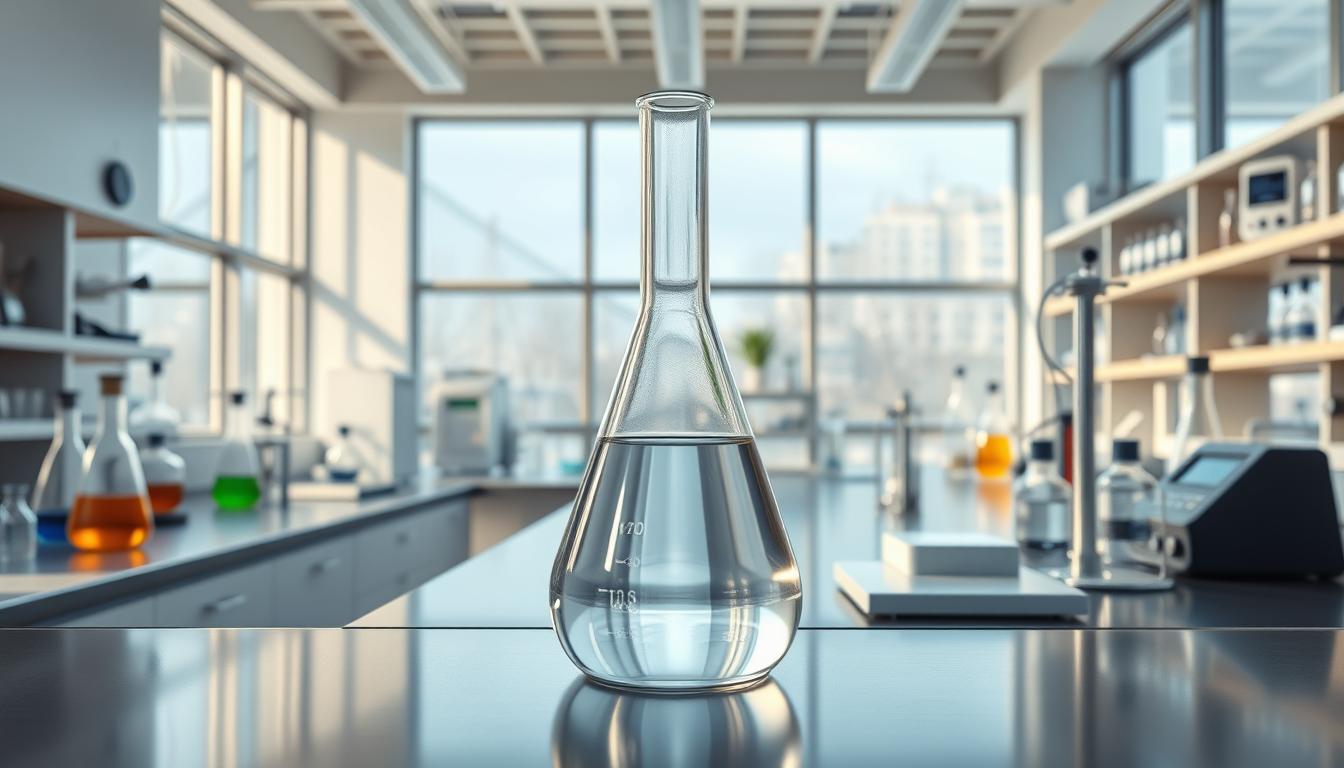
What makes a simple piece of glassware the unsung hero of scientific discovery? The Erlenmeyer flask is a key tool in chemistry and biology labs. It changes how researchers do experiments and study complex solutions.
Erlenmeyer flasks are versatile tools for science. Their unique conical shape is crucial for many uses. They help mix solutions and carry out precise experiments.
Scientists love these flasks for their design. The wide base and narrow neck keep liquids in place. This makes them vital in today’s science.
Key Takeaways
- Versatile laboratory glassware used in chemistry and biology
- Unique conical shape reduces spillage during experiments
- Available in multiple sizes and materials
- Essential for mixing, heating, and storing liquids
- Critical tool in scientific research and experimentation
Overview of Erlenmeyer Flasks
Chemistry lab erlenmeyer flasks are key tools in science. They mix new design with useful features. Since the 19th century, they’ve changed how we do experiments.
Erlenmeyer flasks are vital in labs around the world. Their cone shape helps scientists a lot.
Distinctive Design and Features
Erlenmeyer flasks have special designs for better lab work:
- Conical body with a flat bottom for stable placement
- Narrow neck to minimize liquid spillage
- Wide range of volume capacities
- Constructed from glass or plastic materials
The flask’s shape helps with many tasks, like:
- Swirling solutions without splashing
- Reducing evaporation risks
- Preventing dust contamination
- Facilitating controlled chemical reactions
Historical Context of Invention
Emil Erlenmeyer created these flasks in 1860. Their smart design changed lab work. Now, they’re used for many experiments.
| Material | Key Characteristics | Primary Applications |
|---|---|---|
| Borosilicate Glass | High thermal shock resistance | Chemical reactions |
| Plastic | Lightweight, autoclavable | Microbiology cultures |
Today, Erlenmeyer flasks are still crucial in chemistry and biology. They help scientists keep discovering with their strong and flexible design.
Primary Uses in Chemical Experiments
Erlenmeyer flasks are key in chemical experiments. They are used in many scientific fields. These special flasks help scientists do complex work with great care and speed.
Mixing Solutions with Precision
Erlenmeyer flasks are great for mixing chemicals. Their shape makes it easy to mix without spills. This is good for several reasons:
- Less liquid spills during mixing
- Chemicals mix better
- Less chance of contamination
Heating and Cooling Applications
Erlenmeyer flasks are strong for heating and cooling. Their wide base stays stable when heated. The narrow top helps condense steam well. Scientists use them for:
- Boiling chemical solutions
- Reflux experiments
- Reactions at controlled temperatures
Filtration Processes
Filtration is common in Erlenmeyer flask experiments. Their shape helps separate solids from liquids. Scientists like them for:
- Gravity filtration
- Collecting solids
- Purifying chemicals
These versatile flasks are vital in today’s science labs. They show how well they can adapt to different experiments.
Importance in Titration Procedures
Erlenmeyer flasks are key in precise chemical analysis, especially in titration. They have special designs that make them essential for exact chemical measurements.
The unique shape of an Erlenmeyer flask offers big benefits in chemistry. Its tapered sides and narrow neck are perfect for accurate titration.
Role in Acid-Base Titrations
In acid-base titrations, the role of Erlenmeyer flasks is clear. Scientists use them for several important reasons:
- Stable base for precise reagent mixing
- Minimized risk of solution splashing
- Easy swirling to maintain homogeneous mixtures
- Reduced evaporation during lengthy procedures
“The conical shape of the Erlenmeyer flask is a game-changer in precise chemical analysis.” – Laboratory Research Journal
Indicators and Reaction Monitoring
Chemistry erlenmeyer flask applications also include monitoring reactions with color-change indicators. The flask’s design helps researchers:
- Observe dramatic color transitions
- Detect precise reaction endpoints
- Minimize contamination risks
- Ensure accurate concentration measurements
Scientists value the flask’s chemical compatibility, especially with borosilicate glass. It resists acids, bases, and organic solvents. Its broad base also provides stability during complex titration experiments.
The Erlenmeyer flask remains an indispensable tool in modern chemical research, bridging traditional techniques with advanced analytical methods.
Applications in Biological Research
Erlenmeyer flasks are key in biological research. They help grow microorganisms and conduct cell culture experiments. These glassware vessels are vital in today’s labs, offering solutions for many studies.
Growing Microorganisms with Precision
Scientists use Erlenmeyer flasks to grow many microorganisms. The flasks’ design helps a lot in this research:
- They provide the right air for bacteria and yeast.
- The wide mouth makes it easy to get in and out.
- They help mix and spread nutrients evenly.
- They work well with different ways to sterilize.
Cell Culture and Growth Media Management
Erlenmeyer flasks are great for cell culture research. They come in polypropylene and borosilicate glass, meeting different needs. They help with:
- Keeping cells safe and sterile.
- Keeping the environment steady.
- Helping microorganisms grow in a controlled way.
- Supporting in vitro experiments.
Researchers love Erlenmeyer flasks for their role in biology. These tools are crucial for advancing science in many fields.
Advantages Over Other Lab Glassware
Erlenmeyer flasks are top picks for lab pros looking for dependable and versatile glassware. They offer unique benefits that make them stand out from other lab containers.
Scientists love the design of Erlenmeyer flasks. It gives them stability and function in experiments. These flasks are key in many research areas.
Stability and Ease of Use
Erlenmeyer flasks do more than just hold things. They have:
- A flat, wide bottom for great stability in experiments
- A tapered design to stop spills when swirling
- An ergonomic shape for easy handling
Versatility in Experimental Setups
Erlenmeyer flasks are very adaptable in science. Labs use them in about 70% of chemistry tasks like mixing and dissolving.
“The Erlenmeyer flask’s design represents a pinnacle of scientific glassware engineering” – Laboratory Design Journal
Compatibility with Stirring Devices
Modern Erlenmeyer flasks work well with lab tools. Their shape makes it easy to:
- Attach to magnetic stirrers
- Mix solutions well
- Keep temperatures even
They have a 90% success rate in heating and boiling. These flasks are crucial for researchers who need precision and reliability.
Safety Considerations
Chemistry lab erlenmeyer flasks are key tools that need careful handling. It’s important to know about material durability and safety rules. This can greatly lower risks in labs.
Material Durability and Selection
Choosing the right Erlenmeyer flask is key for success. These containers come in different sizes and materials. Each has its own special features:
- Borosilicate glass for thermal shock resistance
- Polypropylene plastic for shatterproof applications
- Heavy-wall designs for high-pressure experiments
Proper Handling Techniques
Handling Erlenmeyer flasks with care is essential. Good safety habits protect both the researcher and the experiment.
| Safety Practice | Purpose |
|---|---|
| Inspect before use | Check for chips or cracks |
| Clean immediately after use | Prevent residue buildup |
| Store upright | Avoid contamination |
| Use protective equipment | Minimize potential injury risks |
Researchers should always check Erlenmeyer flasks carefully. This ensures they are safe and won’t harm the experiment or the person using them.
Safety in the laboratory is not an option—it’s a fundamental requirement for scientific excellence.
Cleaning and Maintenance Best Practices
Keeping Erlenmeyer flasks in good shape is key for their long life and to avoid contamination in lab work. These tools need careful handling and regular cleaning to work well and last longer.
Recommended Cleaning Solutions
Cleaning Erlenmeyer flasks right involves different methods for different messes. People doing chemistry experiments should use these cleaning ways:
- Use mild lab-grade detergents for everyday cleaning
- Rinse well with distilled water to get rid of chemical leftovers
- Use special cleaning solutions for tough organic or inorganic messes
- Don’t scrub too hard, as it can scratch the flask
Techniques for Preventing Damage
Being careful with Erlenmeyer flasks helps avoid damage and keeps research results consistent. Important steps include:
- Check flasks often for chips or small cracks
- Keep flasks standing up in a cool, dry place
- Let flasks dry upside down to stop contamination
- Use soft-bristled cleaning brushes
For work with living things, using autoclavable plastic Erlenmeyer flasks is a good idea. It’s important to clean them well to keep experiments safe.
Storage and Preservation
Storing Erlenmeyer flasks right is important to keep them in good condition. Labs should have clear storage rules to protect these important tools from harm or contamination.
Innovations in Erlenmeyer Flask Design
The world of chemistry lab tools is always changing. Erlenmeyer flasks are getting better with new tech. Today’s labs need advanced tools for complex tests.
New Erlenmeyer flasks bring exciting materials and tech. These changes make labs work better and faster.
Advanced Material Innovations
Today’s Erlenmeyer flasks use top-notch materials. This makes labs perform better:
- Strong borosilicate glass that resists chemicals well
- Light polypropylene for easy handling
- Safe polymer composites that don’t leak chemicals
- Materials that handle extreme temperatures
Technological Integration in Laboratory Use
Now, Erlenmeyer flasks come with digital features. This lets researchers get super precise with:
- Flasks with smart sensors
- Flasks that track volume digitally
- Flasks that show temperature and mixing in real-time
- Flasks that work with automated lab systems
“The future of lab tools is in tech and material innovation.” – Scientific Research Quarterly
These new flasks are a big step up. They help scientists do better and faster tests. This means more reliable and precise results.
Conclusion: The Continuing Relevance of Erlenmeyer Flasks
Erlenmeyer flasks are key in many scientific fields. Almost all lab workers see their value. They are vital for precise work in labs today.
These flasks are used in about 70% of chemical experiments globally. They are great for mixing, dissolving, and storing. Their strong build, like borosilicate glass, makes them last long in labs.
Summary of Key Applications
Research places a lot of trust in Erlenmeyer flasks. They are used for growing microbes and titration. Their wide base and precise markings help with accurate measurements.
Future Trends in Laboratory Use
Erlenmeyer flasks will likely work with new lab tech soon. The market for lab glassware is growing. We can expect flasks that fit new research needs but keep their core benefits.
FAQ
What is an Erlenmeyer flask and why is it important in chemistry?
An Erlenmeyer flask is a special glassware used in labs. It has a conical base and a narrow neck. This design helps mix, heat, and react chemicals safely and efficiently.
Who invented the Erlenmeyer flask?
German chemist Emil Erlenmeyer created the Erlenmeyer flask in the 19th century. It’s now a key tool in science, updated for today’s labs.
What makes the Erlenmeyer flask different from other laboratory glassware?
Erlenmeyer flasks have a unique shape. They have a flat bottom and a narrow neck. This shape makes them stable, prevents spills, and helps mix and heat solutions better.
What are the primary uses of Erlenmeyer flasks in chemistry?
Erlenmeyer flasks are used for many things. They mix solutions, do titrations, heat and cool, filter, grow microorganisms, and research cells. They’re vital in chemistry and biology labs.
How are Erlenmeyer flasks used in titration procedures?
In titration, Erlenmeyer flasks are perfect for adding and mixing reagents. Their shape lets scientists swirl solutions, see color changes, and find reaction endpoints.
What materials are Erlenmeyer flasks typically made from?
Most are made from borosilicate glass, known for its heat and chemical resistance. Some are also made from plastics for specific lab needs.
How should Erlenmeyer flasks be cleaned and maintained?
Clean them with lab detergents, rinse well with distilled water, and handle carefully. Different cleaning methods depend on the residue and flask use.
Are there recent innovations in Erlenmeyer flask design?
Yes, there are new materials and designs. These include better durability, thermal resistance, and digital monitoring systems. They improve the flask’s performance and fit with modern labs.
Can Erlenmeyer flasks be used in biological research?
Yes, they’re used in biology for growing microorganisms, cell cultures, and making growth media. Their design helps with aeration and creates a good environment for biological samples.
What safety considerations are important when using Erlenmeyer flasks?
Use flasks right for the temperature and chemicals. Handle them carefully, wear protective gear, and store them properly. This keeps them safe and prevents contamination.






Leave a Comment
Your email address will not be published. Required fields are marked *