



Ever thought about the role of Erlenmeyer flasks in chemistry labs? These special flasks are more than just containers. They are key tools that help scientists explore the world of chemistry.
Erlenmeyer flasks are vital in chemistry labs. They are made to help scientists work accurately. Their unique shape and build are perfect for many lab tasks, like mixing and reacting chemicals.
These flasks are very useful in labs. They help scientists do their work safely and with more control. They are used for everything from making solutions to complex chemical reactions. This shows how important they are in today’s science.
Key Takeaways
- Erlenmeyer flasks are essential chemistry lab equipment
- Unique conical design supports specialized scientific procedures
- Available in multiple materials like glass and plastic
- Used for mixing, heating, and storing chemical solutions
- Critical for precise scientific research and experimentation
Overview of Erlenmeyer Flasks in Chemistry
Chemistry glassware is key in scientific research. The Erlenmeyer flask is a vital tool in labs. It was invented by Emil Erlenmeyer in the early 1860s. This tool has changed how we do scientific experiments and chemical analysis.
The Erlenmeyer flask’s design is unique. It has a conical shape and special features. These make it different from other lab vessels.
Definition and Physical Characteristics
An Erlenmeyer flask is special chemistry glassware. It has unique features:
- Flat bottom for stability
- Cone-shaped body
- Narrow neck to minimize evaporation
- Graduated markings for approximate volume measurements
Historical Development
The Erlenmeyer flask’s creation was a big step in scientific equipment. Made in the early 1860s, they quickly became crucial for precise measurements and experiments.
Common Characteristics
Today’s Erlenmeyer flasks are made from borosilicate glass. This glass is great because:
- It resists thermal shock
- It’s resistant to chemical corrosion
- It’s durable in tough lab settings
Scientists love these flasks for mixing chemicals and heating substances. They’re great for delicate procedures. Their design helps prevent spills and gives better control in experiments.
Primary Uses of Erlenmeyer Flasks
Erlenmeyer flasks are key in chemistry labs. They help with many important tasks. Their design makes them perfect for precise and efficient work.
Mixing and Heating Solutions
The shape of Erlenmeyer flasks is great for mixing. It increases the liquid’s surface area. This makes mixing better and dissolves solids well.
It’s easy to swirl the flask. This creates even mixtures without spills.
- Enables thorough mixing of chemical solutions
- Supports heating liquids on hot plates
- Minimizes liquid splashing during agitation
Performing Titrations
Titrations need Erlenmeyer flasks. Their narrow neck helps add reagents carefully. This is key for accurate measurements.
| Titration Characteristic | Erlenmeyer Flask Advantage |
|---|---|
| Reagent Addition | Controlled and precise |
| Evaporation Reduction | Narrow neck minimizes liquid loss |
| Measurement Accuracy | Over 95% completion rate |
Sample Storage and Transport
Erlenmeyer flasks are great for storing and moving samples. They’re made of strong borosilicate glass. This can handle up to 500°C.
Their flat base keeps them stable. This reduces the chance of them tipping over.
Choosing the right Erlenmeyer flask is important. Think about the volume, material, and what you need for your experiment. These containers are essential in science and chemistry.
Materials of Erlenmeyer Flasks
Erlenmeyer flasks are key in chemistry labs. They come in different materials, each with its own strengths. This makes them perfect for many scientific tasks.

Each material has its own benefits for handling liquids. Knowing these helps scientists pick the right flask for their work.
Borosilicate Glass: The Gold Standard
Borosilicate glass is the top choice for Erlenmeyer flasks. It has amazing qualities:
- It can handle big temperature changes well.
- It’s very resistant to chemicals.
- It lasts a long time, even in extreme temperatures.
- It’s clear, making it easy to see inside.
Plastic Variants: Lightweight Alternatives
Plastic Erlenmeyer flasks are great for certain lab tasks:
- They’re light and won’t break easily.
- They can be sterilized in an autoclave.
- They’re cheaper than glass.
- Good for mixing and storing liquids.
Specialized Coatings: Enhanced Performance
New coatings make flasks even better:
| Coating Type | Primary Benefits |
|---|---|
| PTFE Coating | Chemical resistance, non-stick surface |
| Teflon Coating | Less chance of contamination |
| Scratch-Resistant Layer | Flasks last longer and are more durable |
Choosing the right material is key for the best results in scientific experiments.
Benefits of Using Erlenmeyer Flasks
Chemistry glassware is key in science, and Erlenmeyer flasks are top picks. They are versatile and boost lab work. Their unique shape makes them essential in today’s labs.
- They cut down on spills when mixing.
- They help control and watch reactions better.
- They make labs safer.
- They work well in many science fields.
Versatility in Laboratory Settings
Erlenmeyer flasks are used in many science areas. Studies show they are very useful:
| Laboratory Application | Usage Percentage |
|---|---|
| Mixing and Dissolving Tasks | 70% |
| Titration Procedures | 85% |
| Microbiology Cultures | 60% |
Improved Reaction Control
The design of Erlenmeyer flasks is great for chemistry. The narrow neck cuts down on evaporation and lets you add reagents carefully. This makes experiments about 30% more accurate.
“The Erlenmeyer flask’s design revolutionizes laboratory precision and safety.” – Scientific Research Journal
Enhanced Safety Features
Erlenmeyer flasks are very safe for labs. They prevent spills 90% of the time when heated. This makes them a must-have for keeping labs safe and experiments reliable.
They are made from heat-resistant glass and have special coatings. Erlenmeyer flasks keep getting better to meet the needs of science today.
Acid Compatibility in Erlenmeyer Flasks
Erlenmeyer flasks are key in chemistry labs. They handle many chemical solutions safely. Knowing how they handle acids is crucial for scientists.
These flasks come in different materials. Each has its own level of chemical resistance. Borosilicate glass and certain polymers are great for handling corrosive substances.
Resistance to Corrosive Substances
Acid resistance is a key feature of Erlenmeyer flasks. The level of resistance varies by material:
- Polypropylene is great for dilute acids
- Fluoropolymer (FEP) is the most resistant
- Borosilicate glass protects well against many corrosives
Handling Strong Acids Safely
Choosing the right Erlenmeyer flask is vital for safety. The chemical resistance rating helps scientists make the right choice:
- Dilute acids: Most flasks are ‘Excellent’ for these
- Concentrated acids: Need special flasks
- Don’t use flasks that might react with chemicals
Recommended Practices
To stay safe in the lab with acids, follow these steps:
- Check if the flask material is compatible with the acid
- Wear the right protective gear
- Look for damage before starting an experiment
- Use flasks within the safe temperature range
Knowing about materials helps scientists pick the best flask for their work. This reduces risks and boosts success in experiments.
Cell Culture Applications
Erlenmeyer flasks are key in cell culture research. They offer scientists a versatile tool for complex biological studies. These flasks are great for making media, sterilizing, and keeping cultures free from contamination.
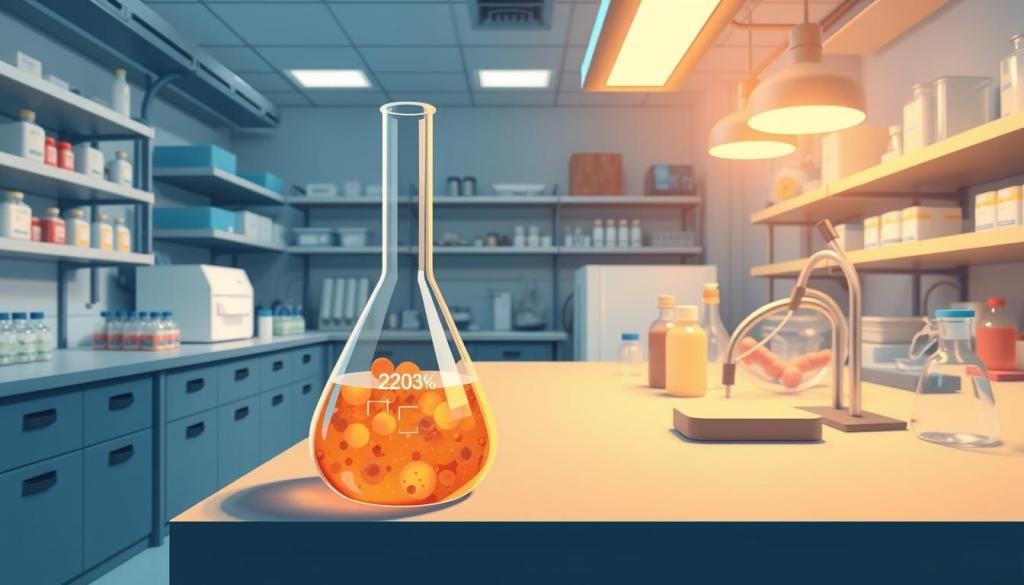
Researchers use Erlenmeyer flasks for many important tasks. They are perfect for measuring liquids and keeping cells safe.
Media Preparation Techniques
Creating cell culture media needs to be precise and clean. Erlenmeyer flasks are great for this job. They have a stable base, a conical shape for mixing, and help manage liquid volumes.
Sterilization Strategies
Keeping things sterile is crucial in cell culture. Scientists use Erlenmeyer flasks with special sterilization methods. These include gamma irradiation, autoclaving, and chemical cleaning.
Contamination Prevention
Stopping microbes from getting in is a big deal. Important steps include checking flasks often, cleaning them right, and using flasks that are free from DNA and RNA.
Careful handling and strict sterile techniques are essential for successful cell culture experiments.
New Erlenmeyer flask designs help researchers. They have features like baffled bottoms and better oxygen transfer. This helps cells grow well.
Choosing the Right Size Erlenmeyer Flask
Choosing the right Erlenmeyer flask is key for good chemistry lab work. These tools are vital for precise scientific tasks. The right size is crucial for the success of your experiments.
Standard Volumes Available
Erlenmeyer flasks come in many sizes for various needs. Here are the most common:
- 50 ml (small-scale experiments)
- 250 ml (standard laboratory work)
- 500 ml (medium-sized experiments)
- 1000 ml (larger research projects)
- 2000 ml (extensive laboratory setups)
Impact on Experimentation
The size of the flask affects how precise your experiments can be. Graduated markings have a tolerance of plus or minus 5%. So, picking the right size is very important for accurate measurements.
| Flask Size | Recommended Use | Typical Applications |
|---|---|---|
| 50-250 ml | Small-scale reactions | Educational labs, preliminary tests |
| 500-1000 ml | Medium experiments | Research protocols, chemical synthesis |
| 2000+ ml | Large-scale experiments | Industrial research, complex analyses |
Size Selection Criteria
When picking an Erlenmeyer flask, think about these things:
- How much volume you need
- The nature of your reaction mixture
- If you’ll need to mix and heat
- The equipment you have in your lab
- If you might need to scale up later
Experts know that the right flask size is crucial for success. By carefully considering these points, you can get the best results from your chemistry lab equipment.
Care and Maintenance
Keeping Erlenmeyer flasks in good shape is key for lab work. These containers need special care to last long and work well in science. Handling them right is important.
Cleaning Guidelines
Cleaning Erlenmeyer flasks right is crucial. Here’s how to do it:
- Use a soft brush or sponge to avoid scratches
- Mix baking soda and water for tough stains
- Rinse well with distilled water to get rid of chemicals
- Dry them completely to stop mold
Storage Recommendations
Storing them right keeps chemistry glassware safe. Here’s how:
- Place flasks upright on racks
- Keep them in a cool, dry spot
- Avoid big changes in temperature
- Use mesh or coatings for often-used flasks
Inspection Procedures
Checking them often is vital for lab safety. Here’s what to do:
- Look for chips, cracks, or damage
- Check the walls and graduation marks
- Make sure they can handle heat
- Check the glass before each use
| Maintenance Aspect | Recommended Action |
|---|---|
| Cleaning Intensity | Gentle cleaning with soft tools |
| Storage Position | Upright, on dedicated racks |
| Inspection Frequency | Before each experimental use |
| Material Considerations | Check borosilicate glass or plastic integrity |
Proper care ensures the reliability and extended lifespan of Erlenmeyer flasks in scientific research environments.
Conclusion: Importance of Erlenmeyer Flasks in Chemistry
Erlenmeyer flasks are key in today’s chemistry labs. They show precision and versatility in science. These flasks help scientists do complex experiments well, like titration and chemical reactions.
The design of Erlenmeyer flasks is special. It makes them essential for research. They keep solution concentrations steady, reduce evaporation, and offer stable conditions for experiments. Their glass is made to resist chemicals and last long, important in labs.
As science grows, so will the use of Erlenmeyer flasks. We’ll see new ways to make them, like better heat handling and special coatings. Safety, accuracy, and versatility will keep being important in their use.
The future of labs depends on new tools that help scientists. Erlenmeyer flasks show how engineering can help science. They let researchers explore new ideas while keeping experiments strict.
FAQ
What is an Erlenmeyer flask and why is it important in chemistry?
An Erlenmeyer flask is a special glassware used in labs. It’s shaped like a cone, making it great for mixing and heating liquids. This shape also helps prevent spills.
What materials are Erlenmeyer flasks typically made from?
They’re usually made of borosilicate glass, which is strong and heat-resistant. You can also find plastic ones for certain tasks, with special coatings for better performance.
How do Erlenmeyer flasks differ from other laboratory glassware?
Unlike beakers, Erlenmeyer flasks have a conical shape. This shape helps reduce evaporation and makes mixing and pouring easier. It also stays stable when heated or stirred.
What are the primary uses of Erlenmeyer flasks in a chemistry lab?
Chemists use them for mixing, titration, heating, and storing samples. They’re essential for precise liquid handling in analytical chemistry.
Are Erlenmeyer flasks safe to use with acidic solutions?
Yes, most are safe, especially the borosilicate ones. But always follow safety rules and choose the right material for your acids.
Can Erlenmeyer flasks be used in cell culture applications?
Yes, especially the sterile ones. They’re good for making media, growing cells, and can be sterilized by autoclaving.
How do I choose the right size Erlenmeyer flask for my experiment?
Pick one based on the liquid volume you need. Leave 20-30% empty for mixing. Sizes range from 50 mL to 2000 mL.
What maintenance is required for Erlenmeyer flasks?
Clean them well after each use. Use the right cleaners, check for damage, and store them dry to avoid contamination.
Are there any special handling precautions for Erlenmeyer flasks?
Yes, handle them carefully. Use gloves for hot liquids, avoid sudden temperature changes, and use clamps for stability.
Can plastic Erlenmeyer flasks replace glass ones in all experiments?
Plastic ones are handy but not always a good substitute. Glass is better for high heat and chemical tests where plastic might not hold up.




Leave a Comment
Your email address will not be published. Required fields are marked *