



Have you ever wondered about the tiny wonders inside your body? What are the body cells that make up every living tissue and keep you alive?
Cell biology opens a world of wonder within human anatomy. The human body has an amazing 30 to 37 trillion cells. Each cell plays a vital role in keeping us alive.
Cells are the basic building blocks of life. They give structure, process nutrients, and generate energy. They also enable specialized functions across different body systems. From muscle movements to immune responses, cells are the unsung heroes of human physiology.
Understanding body cells helps us see the intricate mechanisms that keep us healthy. Each cell is a tiny universe with specialized parts working together.
Key Takeaways
- Cells are the fundamental units of life in human anatomy
- The human body contains approximately 30-37 trillion cells
- Cells perform critical functions like energy production and nutrient processing
- There are approximately 200 distinct cell types in the human body
- Cell biology reveals complex microscopic mechanisms within living organisms
Introduction to Body Cells
Cells are the basic units of life, forming all living things. In humans, they are key to our body’s systems. Knowing about cell structure and types helps us understand how our bodies work.
Our bodies have about 30 trillion cells, all working together. These tiny units handle almost every process that keeps us alive.
Definition of Body Cells
Body cells are tiny units that make up tissues, organs, and systems. They vary in size, from 0.2 μm (mycoplasmas) to 20 μm for human cells.
- Contains genetic information (DNA)
- Performs specialized functions
- Capable of reproduction
- Maintains internal chemistry
Importance of Body Cells
Cells are vital for many functions in our bodies. They handle energy, communication, and reproduction through complex processes.
| Cellular Component | Primary Function |
|---|---|
| Nucleus | Stores genetic information |
| Mitochondria | Generates cellular energy |
| Cell Membrane | Controls substance exchange |
Each cell has over 10,000 different molecules for biosynthesis. This makes them incredibly complex systems that keep life going.
Types of Body Cells
The human body is made up of many specialized cells. These cells work together to keep us alive. Cell biology shows us how different cells play unique roles in our body.
Scientists have found many types of cells in our bodies. Knowing about these cells helps us understand how our body works.
Epithelial Cells: Protective Cellular Barriers
Epithelial cells create protective layers on our bodies and inside organs. Keratinocytes are a big part of our skin, helping protect us from harm.
- Create protective barriers
- Line organs and blood vessels
- Regulate absorption and secretion
Muscle Cells: Movement and Functionality
Muscle cells help us move. There are three main types: skeletal, cardiac, and smooth muscle cells. Each type is different in size and function.
| Muscle Cell Type | Length Range | Primary Function |
|---|---|---|
| Skeletal Muscle | 2-30 cm | Voluntary Movement |
| Cardiac Muscle | 0.1 mm | Heart Contraction |
| Smooth Muscle | 10-600 µm | Involuntary Movement |
Nerve Cells: Communication Networks
Neurons are the body’s communication system. They send signals across different parts of the body. There are different types of neurons, each with its own shape.
- Multipolar neurons (multiple dendrites)
- Bipolar neurons (two dendrites)
- Unipolar neurons (single dendrite)
Connective Tissue Cells: Structural Support
Connective tissue cells give our body structure and support. They include bone cells, cartilage cells, and fat cells. Each type has its own role in keeping our body together.
Structure of Body Cells
Cells are the basic building blocks of our bodies. They are tiny worlds with complex structures. Learning about cell structure shows us how amazing and complex cells are.
Our bodies have about 37.2 trillion cells. Each cell has special parts that help it survive and do its job. These parts work together perfectly.
Cell Membrane: The Protective Boundary
The cell membrane acts as a guard. It controls what goes in and out of the cell. It lets good stuff in and keeps bad stuff out.
- Thickness ranges from 5-10 nanometers
- Composed of phospholipid bilayer
- Contains embedded protein channels
- Regulates cellular communication
Cytoplasm: The Cellular Interior
Cytoplasm is the jelly-like stuff inside cells. It’s where many important things happen. It’s where organelles live and where cells do their work.
Nucleus: The Genetic Command Center
The nucleus holds the cell’s genetic information. It’s where the cell’s instructions are kept. Each cell has 23 pairs of chromosomes and DNA.
Essential Cellular Organelles
| Organelle | Primary Function |
|---|---|
| Mitochondria | Energy production (ATP generation) |
| Endoplasmic Reticulum | Protein and lipid synthesis |
| Golgi Apparatus | Protein modification and packaging |
| Lysosomes | Cellular waste disposal |
“Cells are the fundamental units of life, each a marvel of biological engineering.” – Scientific Research Journal
Today, scientists are still learning about cells. They find out how these tiny parts work together to keep us alive.
Functions of Body Cells
Cells are the basic units of life, crucial for our bodies to function. They carry out vital processes that keep us alive. Understanding these functions shows how our bodies work together seamlessly.
Every cell in our body has many important jobs. They work hard to keep us healthy and support our complex systems.
Metabolism: Powering Cellular Life
Metabolism is key for cells to turn nutrients into energy. They break down food through complex chemical reactions. This energy is essential for survival.
- Transform nutrients into usable energy
- Regulate chemical reactions
- Manage energy storage and distribution
Cell Communication: Networking within the Body
Cell communication is vital for our body’s coordination. It lets different parts talk and respond to each other. This ensures our body stays in balance.
- Transmit chemical signals
- Coordinate immune responses
- Regulate hormone secretion
Cell Reproduction: Ensuring Biological Continuity
Reproduction is essential for cell growth and renewal. Cells divide to create new cells or specialized ones. This process is vital for our bodies to grow and repair.
With about 30 trillion human cells in our bodies, they work non-stop. They keep life’s complex processes going smoothly.
Cell Division and Growth
Cell biology shows us how our bodies grow and change. It’s all about how cells divide and grow. This is key for our bodies to heal and grow new cells.
Our bodies have a special way of making new cells. This helps us grow and fix ourselves. Cells can multiply and change to help our bodies work right.
Mitosis: Cellular Replication
Mitosis is how most body cells divide. It makes two cells that are the same as the original. Here are some important facts about mitosis:
- Contains 46 chromosomes in human cells
- Produces two genetically matching cells
- Occurs in approximately 1-2 hours
- Critical for growth and tissue repair
Meiosis: Reproductive Cell Formation
Meiosis is special because it makes sperm and egg cells. These cells have unique genes that help in reproduction.
“Cell division is the fundamental process that enables life to continue and adapt.” – Scientific Research Journal
Cell Differentiation
Cell differentiation turns regular cells into special ones. This lets cells do specific jobs in our bodies. It’s how our bodies work so well.
| Cell Type | Specialization | Function |
|---|---|---|
| Nerve Cells | Neural Transmission | Communication |
| Muscle Cells | Movement | Contraction |
| Blood Cells | Oxygen Transport | Immune Response |
Learning about these cell processes helps us understand how we grow and heal. It also shows us how we can help our bodies even more.
Specialized Body Cells
The human body has many specialized cell types. They are key to keeping us alive and healthy. Each cell has a specific job to do, making sure our bodies work right.
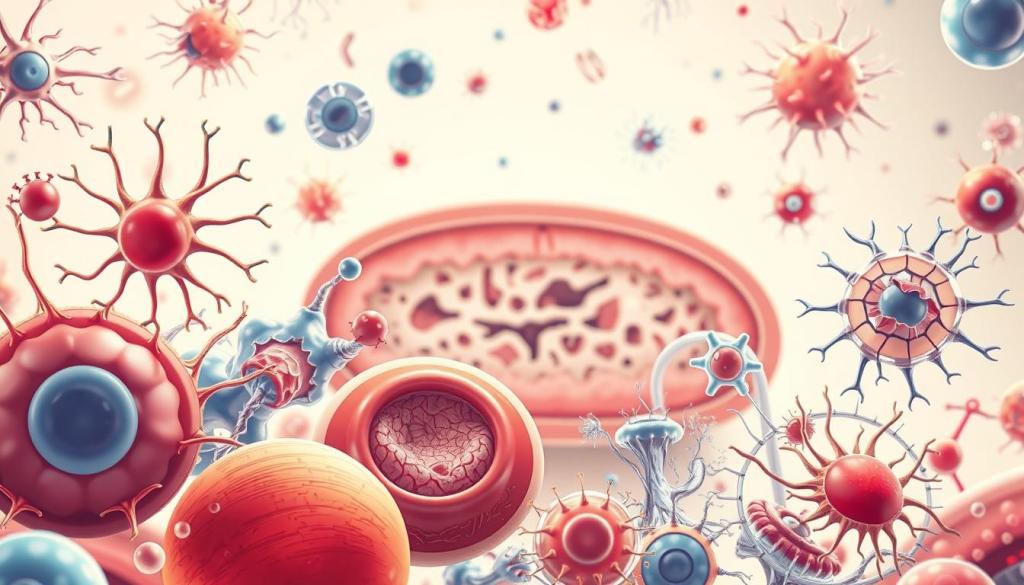
These cells show how complex and amazing our bodies are. They prove that cells can change and grow to meet our needs.
Stem Cells: The Body’s Cellular Architects
Stem cells are vital for fixing and growing tissues. They have special powers:
- Can turn into many different cell types
- Are found in different parts of the body
- Help keep our cells healthy
Hematopoietic stem cells in our bones can make all kinds of blood cells. This shows how versatile they are in keeping us healthy.
Immune Cells: Defenders of the Body
Immune cells are a smart defense system in our bodies. They fight off bad guys in a clever way:
- White blood cells kill off harmful germs
- Find and stop threats
- Keep our bodies safe
Blood Cells: Vital Circulation Components
Blood cells are essential for moving oxygen, fighting off infections, and keeping balance in the body:
- Red blood cells carry oxygen
- Platelets help blood clot
- White blood cells fight infections
Every type of specialized cell plays a unique role in our bodies. They show the incredible complexity of life at the cellular level.
Cell Communication
Cellular processes are key to understanding life. In the complex world of human physiology, cell communication is vital. It lets biological systems interact, respond, and adapt to their surroundings.
Cell biology shows how cells send and receive complex signals. Organisms have complex communication networks. These networks help cells work together with great precision.
Signaling Mechanisms
Cells use many ways to communicate:
- Chemical signaling
- Electrical signaling
- Mechanical signaling
Neurons are amazing at sending information, moving it up to 100 meters per second. Neurotransmitters work over very short distances, usually less than 100 nanometers. This ensures messages are sent quickly.
Importance of Cell Communication
Multicellular organisms need cell signaling to work right. Cells deal with hundreds of signals at once. This creates complex networks that guide how organisms respond.
| Signaling Type | Key Characteristics | Typical Response Time |
|---|---|---|
| Chemical Signaling | Uses molecular messengers | Seconds to hours |
| Electrical Signaling | Rapid ion channel activation | Milliseconds |
| Mechanical Signaling | Physical force transmission | Immediate to minutes |
Extracellular signal molecules work at very low concentrations, about 10^-8 M. Yet, they greatly affect how cells behave. This careful system helps organisms adapt, grow, and stay in balance.
The Role of Body Cells in Health
Human physiology depends on complex cells to keep us healthy and safe. These cells help keep our body in balance by fixing and defending it.
Cells are the basic building blocks of life. They work hard to keep our body stable and fight off dangers. The body’s amazing healing power comes from these tiny cell functions.
Cellular Homeostasis
Cellular homeostasis is a fine balance in our body’s systems. It includes:
- Maintaining a consistent internal environment
- Regulating nutrient absorption
- Managing energy production
- Balancing chemical reactions
Response to Injury
When we get hurt, cells start healing processes. Blood cells are key in this healing:
- White blood cells fight off infections
- Platelets help blood clot
- Stem cells help grow new tissue
The immune system’s cells are very important. Natural killer cells find and kill damaged or infected cells. Lymphocytes create specific responses to threats.
The body’s cellular defense mechanisms represent a sophisticated network of protection and healing.
Learning about these cell functions shows how amazing our body is. Each cell works hard to keep us healthy and deal with challenges.
Impact of Aging on Body Cells
As we age, our cells go through amazing changes. These changes affect how our bodies work and look. Aging is a complex process that changes our body’s structure and function.

Our bodies change in how they work as we age. Important things to know about aging include:
- Organs lose about 1% of their function each year after 30
- Cells stop dividing after about 50 divisions
- Tissues shrink over time due to atrophy
Cellular Senescence
Cellular senescence is a key part of aging. Cells slowly lose their ability to divide and work well. This leads to big changes in how our body works.
- Cells build up damage over time
- They become less efficient
- They become more stressed
“Aging is not just about time passing, but about the intricate cellular transformations happening within our body.” – Modern Cell Biology Research
Age-Related Changes
Our bodies change in different ways as we age. The heart gets weaker, losing 1% of its strength each year. The muscles, brain, and reproductive organs are especially affected.
Learning about these changes helps us manage our health better. It also shows us ways to slow down aging.
The Future of Cell Research
Cell biology is on the verge of big discoveries that could change how we treat diseases. New areas like regenerative medicine and genetic engineering are leading the way. They promise to help us understand and fix complex problems at the cellular level.
Stem cell technology is showing great promise in medicine. Scientists are finding new ways to use cells to heal and repair the body.
Regenerative Medicine: Healing from Within
Regenerative medicine is a new way to heal that uses the body’s own cells. It’s making big strides with:
- Stem cell therapies for chronic diseases
- Tissue engineering for new organs
- Custom treatments for each person
Genetic Engineering: Precision Cellular Modification
Genetic engineering is changing how we see cells. Scientists are getting better at making precise changes to genes.
| Technology | Potential Applications | Current Progress |
|---|---|---|
| CRISPR Gene Editing | Genetic disorder treatment | Advanced clinical trials |
| Induced Pluripotent Stem Cells | Personalized medicine | Promising research stage |
| Cellular Reprogramming | Disease modeling | Active research |
The future of cell research is very promising. Cutting-edge technologies are leading to better treatments. They could greatly improve human health.
Conclusion
Exploring what are the body cells is a journey into human anatomy and cell biology. Our bodies have 37 trillion cells, each vital for life. These cells have evolved from simple forms to complex ones over billions of years.
Cell biology shows us a world of diverse and specialized cells. Eukaryotic cells, larger than prokaryotic cells, have hundreds of organelles working together. In our bodies, cells have structures like mitochondria and ribosomes, each with its own role.
Summary of Key Points
Body cells are incredibly capable. They handle tasks like metabolism and communication. The complex systems within cells show how life is sustained.
As cell biology research advances, we learn more about these tiny wonders. This knowledge could lead to big breakthroughs in medicine and health.
Final Thoughts on Body Cells
The study of body cells is a testament to life’s complexity. Each cell is like a tiny universe, working together in our bodies. There’s still much to discover in this exciting field of science.
FAQ
What are body cells?
Body cells are the basic units of life in our bodies. They make up all tissues and organs. They do important jobs like metabolism and communication. This helps keep our bodies working right.
How many types of cells exist in the human body?
There are about 200 types of cells in us. They fall into four main groups: epithelial, muscle, nerve, and connective tissue cells. Each type has its own job in our bodies.
What is the basic structure of a body cell?
A cell has a few key parts. The cell membrane controls what goes in and out. The cytoplasm is where things happen. The nucleus holds our genetic info. Organelles help with specific tasks.
How do cells communicate with each other?
Cells talk to each other through signals. These can be chemical, electrical, or mechanical. This helps them work together and respond to things outside.
What is cell division?
Cell division lets cells make more of themselves. There are two kinds: mitosis for growth and repair, and meiosis for making reproductive cells.
What are stem cells?
Stem cells can become many different cell types. They’re important for fixing damaged tissues and could help treat diseases.
How do cells contribute to human health?
Cells keep us healthy by keeping things balanced and fighting off infections. They fix damaged tissues and help our bodies work right.
What happens to cells as we age?
As we get older, cells start to slow down. They get damaged and can’t divide as well. This leads to aging and health problems.
What is the future of cell research?
Cell research is getting exciting. New ways like regenerative medicine and CRISPR could fix genetic problems and change how we treat diseases.
How do different cell types work together?
Cells team up to form tissues, organs, and systems. They work together through communication and special jobs. This keeps our bodies healthy and working well.





Leave a Comment
Your email address will not be published. Required fields are marked *