


Ever thought about how your body fixes and keeps its tissues in check? Fibroblasts, often overlooked, are key players in this process. They help keep our body’s tissues in top shape.
So, what makes fibroblasts so important? They are the main builders of our connective tissues. They make the matrix that supports our organs and systems.
Fibroblasts do more than just build structures. They help heal wounds, fight off inflammation, and grow new tissues. They make proteins like collagen and elastin, keeping our tissues flexible and strong.
Key Takeaways
- Fibroblasts are essential connective tissue cells
- They produce critical structural proteins like collagen
- Fibroblasts play a key role in wound healing
- These cells contribute to tissue repair and regeneration
- Fibroblasts help maintain extracellular matrix homeostasis
Introduction to Fibroblasts
Fibroblasts are key cells that keep our body’s connective tissues healthy. They are the main builders of the extracellular matrix. This makes them vital in fibroblast biology.
Fibroblasts are special cells that build and keep tissues together. They are important in the body’s cellular world. They work hard to keep tissues strong and fix them when needed.
Understanding Fibroblast Fundamentals
Here are some important facts about fibroblasts:
- They can make a lot of extracellular matrix components.
- They play a big role in healing wounds.
- They are found in almost all connective tissues.
- They can change and adapt to tissue needs.
“Fibroblasts are the unsung heroes of tissue maintenance and repair.” – Cell Biology Research Journal
Importance in Connective Tissue
Fibroblasts are very important in connective tissue. They make proteins like collagen, which gives tissues strength. They help keep organs in shape and working right.
Studies show that fibroblasts are common in mammals, making up 10-20% of our body weight. They make a lot of collagen type I, the most common protein in humans. This shows how important they are.
Structure of Fibroblasts
Fibroblasts are key cells in our body’s connective tissue. They keep tissues strong and healthy. Their special structure and functions are vital in dermal fibroblasts biology.
Fibroblasts have a complex design. This design lets them do important jobs in keeping tissues healthy and fixing them when needed.
Cellular Composition Characteristics
Dermal fibroblasts have unique traits that set them apart in fibroblast biology:
- Elongated and spindle-shaped morphology
- Large, oval nucleus with prominent nucleolus
- Extensive endoplasmic reticulum for protein synthesis
- Abundant mitochondria supporting metabolic processes
Morphological Features
Fibroblasts are very flexible in different tissues. Their ability to change shape lets them:
- Secrete extracellular matrix components
- Migrate through connective tissues
- Respond to mechanical and chemical signals
- Transform phenotypes during injury or stress
“Fibroblasts are the architects of connective tissue, constantly rebuilding and maintaining cellular landscapes.” – Dr. Elizabeth Morgan, Cellular Biology Research
The detailed structure of fibroblasts helps them make important proteins. Proteins like collagen types I and III are key for tissue strength and flexibility.
Role in Wound Healing
Fibroblasts are key players in wound healing. They are the main builders of new tissue. These cells quickly start the healing process after an injury.
- Proliferate and move to the injury site
- Make collagenous matrix
- Help rebuild tissue
- Control inflammation
Initial Response to Injury
When an injury happens, fibroblasts spring into action. Wound healing starts with these cells responding to signals. They multiply and move to the injury site to start the repair.
Tissue Remodeling
The remodeling phase is crucial for fibroblasts. It can take over a year. During this time, the skin gets stronger, reaching 80% of its original strength.
Fibroblasts are not just passive repair cells, but active participants in reconstructing damaged tissue architecture.
Important parts of fibroblast-driven remodeling include:
- Making extracellular matrix components
- Contracting wound margins
- Regulating inflammatory responses
- Supporting new blood vessel formation
Studies show how adaptable fibroblasts are in healing wounds. They play a vital role in fixing tissue and making it work again.
Synthesis of Extracellular Matrix (ECM)
Fibroblasts are key in making the extracellular matrix. They build the structure and strength of tissues. They create a network of molecules that support and talk to other cells.
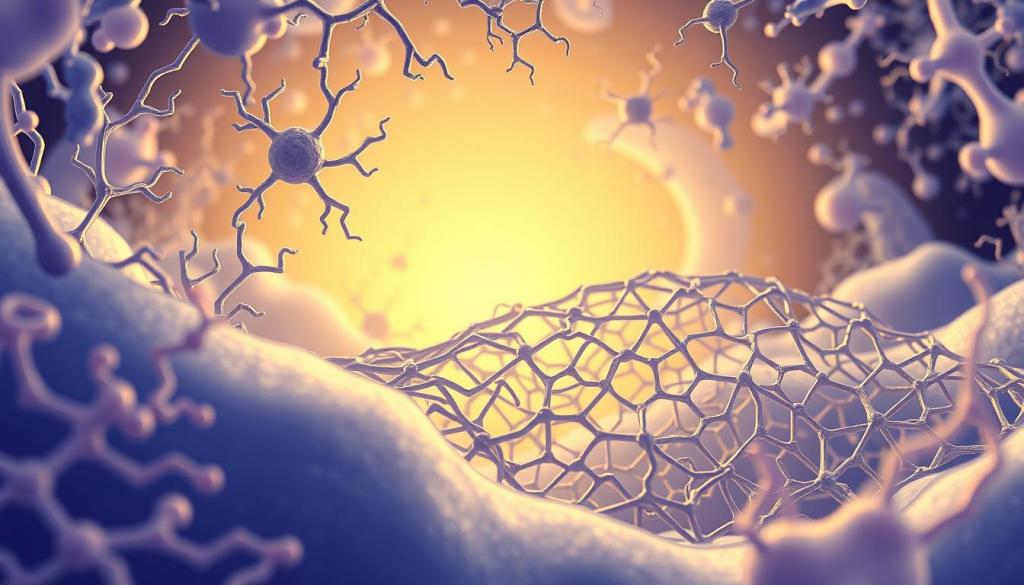
Collagen is a main part of ECM making. Fibroblasts make different types of collagen for different tissues. Studies show how collagen types vary in tissues:
- Collagen Type I: Makes up about 90% of skin collagen
- Collagen Type III: Makes up about 10% of skin collagen
- Collagen Type V: Makes up roughly 2% of collagen
Key Components of Extracellular Matrix
The ECM is more than collagen. Fibroblasts also make other proteins like:
- Proteoglycans: Help with hydration and shock absorption
- Elastin: Helps tissues stay flexible
- Fibronectin: Helps cells stick together
- Laminins: Important for making basement membranes
ECM Homeostasis Mechanisms
Fibroblasts keep an eye on the ECM and adjust it as needed. They respond to stress and signals, changing the ECM. This helps keep tissues healthy and strong.
The ECM is not just a passive scaffold, but an active, dynamic system that communicates critical information between cells.
Learning about ECM production helps us understand how tissues heal and age. Fibroblasts’ role in making and keeping the ECM shows how important they are in our bodies.
Fibroblasts in Tissue Repair
Fibroblasts are key in skin healing and tissue repair. They keep tissues healthy and help them heal after damage. Knowing how they work helps doctors find new ways to treat injuries.
- Papillary dermal fibroblasts
- Reticular dermal fibroblasts
- Hair follicle-associated fibroblasts
Fibroblast Activation Mechanisms
When tissues get damaged, fibroblasts start to work. They change how they act and grow fast. This process has several important steps:
- Initial injury detection
- Inflammatory response initiation
- Proliferation and migration
- Extracellular matrix remodeling
Proliferation Dynamics
Fibroblast growth is vital for skin repair. These cells can adjust to their environment for days. This makes them very flexible.
| Fibroblast Type | Primary Function | Regeneration Potential |
|---|---|---|
| Papillary Fibroblasts | Surface tissue repair | High |
| Reticular Fibroblasts | Deep tissue reconstruction | Moderate |
| Hair Follicle Fibroblasts | Specialized healing | Variable |
Fibroblasts and the matrix they work with are crucial for healing. They make important proteins like collagen. This helps them adapt to stress and fix tissues.
Interaction with Other Cell Types
Connective tissue cells are key in complex communication networks in our bodies. Fibroblast biology shows how different cells work together, especially in fighting off infections and healing tissues.
Fibroblasts are very good at working with other cells, like immune cells. They play a big role in keeping our tissues healthy and responding to inflammation.
Fibroblast-Macrophage Communication
The connection between fibroblasts and macrophages is complex. It involves:
- Mutual cytokine secretion
- Reciprocal activation signals
- Coordinated inflammatory responses
- Tissue repair mechanisms
Inflammatory Response Dynamics
When our body gets inflamed, fibroblasts are very important. They help by:
- Producing inflammatory mediators
- Recruiting more immune cells
- Helping with tissue repair
- Guiding immune cell actions
Recent studies show how fibroblasts create special signaling environments. They can send out many cytokines and growth factors. This helps in coordinating our immune and repair responses.
Fibroblasts are not just passive players. They actively join in on cellular communication and keeping tissues healthy.
Fibroblasts and Fibrosis
Fibroblasts are key in fixing tissues and forming scars. But, too much of their work can cause big health problems. If they don’t stop when they should, they can start harmful changes that lead to fibrosis.
Mechanisms of Fibrosis Development
Fibrosis starts with fibroblasts turning into myofibroblasts. These cells make a lot of the stuff outside cells, called the extracellular matrix (ECM). This can change how tissues work and might even hurt organs.
- Triggered by inflammatory cytokines
- Activated by growth factors like TGF-β1
- Responsible for excessive collagen deposition
Consequences of Excess Fibroblast Activity
Too many fibroblasts can lead to serious health issues. When they keep making ECM, it builds up and scars tissues. This messes up how tissues work and look.
Some big problems include:
- Organ stiffening
- Reduced tissue elasticity
- Potential progression to chronic diseases
Fibrosis represents a critical intersection between wound healing and pathological tissue transformation.
Influence of Growth Factors on Fibroblasts
Growth factors are key in fibroblast biology. They help keep tissues healthy and repair them when needed. To understand fibroblasts, we must see how growth factors work with them.

Fibroblast biology is complex. It involves many signaling molecules that control cell behavior. Scientists have found important growth factors that affect fibroblast function.
Key Growth Factors in Fibroblast Regulation
Fibroblast growth factors (FGFs) are a big family of proteins. They have a big impact on cells. Research shows their roles are crucial.
- 22 distinct FGFs have been discovered
- 18 FGFs interact with and activate FGF receptors
- Divided into seven subfamilies based on structural characteristics
Molecular Mechanisms of Growth Factor Signaling
Growth factor signaling is complex. It involves many pathways. Some important ones are:
- RAS/MAP kinase pathway
- PI3 kinase/AKT pathway
- Phospholipase C-gamma (PLCγ) pathway
| Growth Factor | Primary Function | Molecular Weight |
|---|---|---|
| FGF1 | Cellular proliferation | 17 kDa |
| FGF2 | Wound healing | 18 kDa |
| FGF7 | Epithelial cell growth | 24 kDa |
Growth factors are very versatile in fibroblast biology. They affect important cell processes like proliferation, migration, and differentiation. Their detailed interactions show how complex cell communication and tissue repair are.
Fibroblasts in Cancer Biology
Cancer research shows how important fibroblasts are in understanding tumor growth. These connective tissue cells play a big role in cancer biology. They do this especially through cancer-associated fibroblasts (CAFs).
CAFs are a special group of cells that help tumors grow. They are very flexible in cancer environments.
Cancer-Associated Fibroblasts: Tumor Architects
Research has found some key things about CAFs in cancer:
- They make important growth factors and chemokines.
- They help bring in cells needed for blood vessels.
- They change the structure of the outside of cells.
- They affect how cells use energy.
Impact on Tumor Microenvironment
CAFs and cancer cells work together to make a complex system. This system helps tumors grow. Their roles include:
- Bringing in immune cells.
- Controlling how the immune system reacts.
- Making tumors resistant to drugs.
- Helping blood vessels grow.
CAFs are very adaptable. They can survive extreme conditions that would kill other cells.
Learning about these complex interactions is key to finding new cancer treatments. These treatments aim to break the support system tumors get from fibroblasts.
Experimental and Therapeutic Applications
Fibroblast biology is leading the way in medical research. It’s giving us new insights into how to heal skin and build tissues. Scientists are finding new ways to use fibroblasts to improve medical treatments.
Fibroblasts are key in medical research. They show great promise in many areas:
- Stem cell research and development
- Advanced tissue engineering techniques
- Regenerative medicine applications
- Wound healing innovations
Stem Cell Research Breakthroughs
Scientists found that fibroblasts help stem cells grow and change. They create the best environment for these cells. This makes them crucial for new treatments.
Tissue Engineering Innovations
Fibroblast biology is exciting for tissue engineering. Clinical trials show promising results in skin regeneration. Researchers are working on new ways to fix damaged tissues.
Fibroblasts offer a transformative approach to healing complex medical conditions through innovative cellular technologies.
Recent studies show great progress in medical uses:
- 820 published papers explored fibroblast uses in clinical trials
- 35 studies met rigorous research criteria
- 19 studies focused on chronic wound treatments
- 9 studies investigated cosmetic applications
The future of fibroblast research is bright. It could lead to new ways to treat chronic wounds and degenerative diseases. It could also help with personalized medicine.
Advances in Fibroblast Research
The study of fibroblast biology is moving fast, with new discoveries every day. Scientists are using advanced technology to learn more about fibroblasts. They are finding out how these cells work in amazing ways.
Single-cell RNA sequencing has changed how we see fibroblast diversity. It lets researchers track changes in cells during growth and healing. This is done with great accuracy.
Current Research Trends
Some big trends in fibroblast research are:
- Advanced molecular profiling techniques
- Comprehensive genomic mapping
- Exploration of cellular differentiation trajectories
- Investigating tissue-specific fibroblast variations
Future Research Directions
New directions in fibroblast research are exciting. Scientists are looking into:
- Developing targeted therapeutic interventions
- Understanding complex cellular interactions
- Exploring epigenetic regulation mechanisms
- Mapping fibroblast responses in various disease states
Technologies like ATAC-seq are helping researchers. They can see how accessible chromatin is in different fibroblast types. This gives them new ideas for treatments.
Conclusion
Fibroblasts are key cells in our bodies, playing many roles in keeping us healthy. They help fix damaged tissues and make the framework of our body. This is why they are so important.
But fibroblasts do more than just hold things together. They also help fight off infections and heal wounds. Their ability to change and grow makes them vital for fixing damaged tissues.
Scientists are still learning about fibroblasts and their amazing abilities. They can make important proteins and control inflammation. This shows how adaptable and crucial they are for our health.
As research goes on, we’ll learn even more about fibroblasts. This could lead to new ways to treat diseases and improve health. Studying fibroblasts could change how we approach medical treatments.
FAQ
What are fibroblasts?
Fibroblasts are special cells in our body. They help make and keep the framework of tissues. They are key in healing wounds and keeping tissues strong.
What is the primary function of fibroblasts?
Fibroblasts mainly make collagen and other important proteins. They help fix tissues and heal wounds. They keep our body’s structure in place.
How do fibroblasts contribute to wound healing?
Fibroblasts move to wounds, grow, and make new proteins. They are vital in rebuilding tissue and making it strong again. They make collagen and other proteins to fix the wound.
What is the relationship between fibroblasts and the extracellular matrix?
Fibroblasts are the main makers of the extracellular matrix. They keep making and changing it. This matrix gives tissues their shape and support.
Can fibroblasts become problematic in certain conditions?
Yes, in some diseases like fibrosis, fibroblasts can cause trouble. They might make too much matrix, leading to scarring and organ problems.
How do fibroblasts interact with other cell types?
Fibroblasts work closely with immune cells, especially macrophages. They help in the healing process by making and responding to signals.
Are fibroblasts important in cancer research?
Yes, they are very important. Cancer-associated fibroblasts help tumors grow and spread. They change the area around the tumor to help cancer cells.
What recent advances have been made in fibroblast research?
New research uses single-cell RNA sequencing to understand fibroblasts better. It shows their diversity and function. This research could lead to new ways to heal tissues and fight diseases.





Leave a Comment
Your email address will not be published. Required fields are marked *