



Have you ever thought about how tiny creatures can live almost everywhere on Earth? The structure of bacterial cells shows a complex world in a tiny space.
Bacteria are tiny, single-celled organisms with amazing abilities. They can live in places like deep-sea vents and our guts. Despite being very small, they have complex ways of working.
To understand bacteria, we need to look at their basic parts. These tiny cells have important parts like membranes, genes, ribosomes, and special proteins. These help them survive and make more cells.
Prokaryotic cells are very flexible. They have a bigger surface area compared to human cells. This lets them quickly share nutrients and waste, helping them work efficiently.
Key Takeaways
- Bacterial cells are microscopic organisms typically 1-2 μm in diameter
- Prokaryotic cells have unique structural characteristics different from eukaryotic cells
- Bacteria can survive in extreme environmental conditions
- Bacterial cell structure supports rapid metabolic processes
- Genetic material in bacteria is contained in a single circular chromosome
Structure of Bacterial Cells
Bacterial cells are a world of tiny complexity. Their design shows how small things can be very detailed. These tiny beings can live in many different places.
Bacteria have special shapes that help them survive. Knowing about these shapes helps us understand how they live and adapt.
Overview of Bacterial Cell Shapes
Bacteria come in different shapes. These shapes help us tell them apart and group them:
- Cocci: Spherical-shaped bacteria
- Rods: Cylindrical or rod-like bacterial cells
- Spirals: Spiral or helical-shaped bacteria
These shapes are not just for looks. They are key to how bacteria interact with their world. There are about 5 nonillion bacteria on Earth, each with its own survival strategy.
Importance of Cell Structure in Function
The shape of a bacterial cell affects what it can do. The structure of a bacterial cell decides:
- Motility and movement
- Nutrient absorption
- Environmental adaptation
- Interaction with host organisms
About 90% of bacteria have a cell wall. This wall keeps them strong and safe. Their shape lets them live in places like our guts or very hot areas.
Key Components of Bacteria Cells
Bacteria cells are complex and have internal structures that help them survive and grow. They have developed ways to live in many different places for billions of years.
The bacterial cell membrane is key to keeping the cell together and working right. It’s made of a phospholipid bilayer with proteins. This creates a barrier that lets in some things and keeps others out, controlling energy and substance flow.
Cell Membrane Functions
The bacterial cell membrane does a few important things:
- It controls what comes in and goes out.
- It helps make energy through electron transport.
- It keeps the inside of the cell safe.
- It helps the cell talk to its surroundings.
Cytoplasm: The Living Matrix
The cytoplasm is like a living part of the bacterial cell. This gel-like substance holds important parts like ribosomes, enzymes, and genetic material. It’s where all the cell’s work happens.
Nucleoid Region and Genetic Material
Bacteria don’t have a membrane-bound nucleus like other cells. Instead, they have a nucleoid region. This area holds the bacterial chromosome, a single circular DNA molecule that carries their genetic information.
Bacteria can quickly change their genes by swapping genetic material. This helps them adapt to new environments fast.
Bacterial Cell Wall: Composition and Purpose
The bacterial cell wall is key to a bacterium’s survival. It acts as a shield, keeping the cell safe and sound. This shield is made of complex materials that help the cell stay strong.
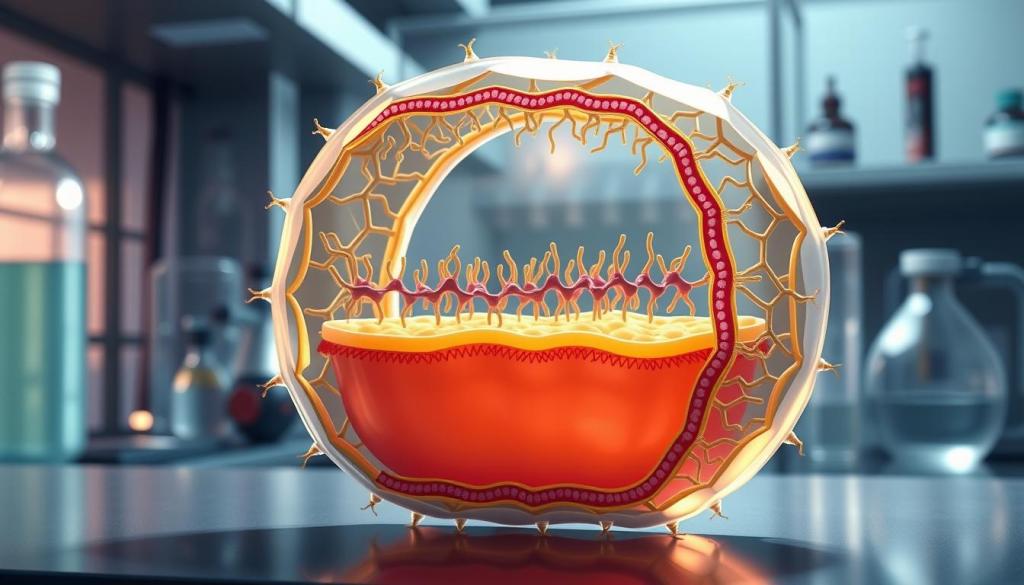
At the heart of the cell wall is peptidoglycan. It’s like a strong framework that keeps the cell together. Made from sugar and amino acids, it gives the cell both strength and protection.
Types of Bacterial Cell Walls
Bacterial cell walls come in two main types. These are:
- Gram-positive cell walls with thick peptidoglycan layers
- Gram-negative cell walls with thin peptidoglycan layers
These differences affect how bacteria interact with their surroundings. They also influence the bacteria’s characteristics.
Structural Characteristics of Cell Walls
| Cell Wall Type | Peptidoglycan Layer | Additional Features |
|---|---|---|
| Gram-Positive | Thick (multilayered) | High teichoic acid content |
| Gram-Negative | Thin (single layer) | Outer membrane present |
The cell wall’s makeup is crucial for its job. It keeps the cell safe, handles pressure, and sets boundaries. Peptidoglycan’s unique molecular architecture helps bacteria face challenges while keeping their inner workings running smoothly.
Learning about the bacterial cell wall helps us understand microbes better. It sheds light on how they interact with antibiotics and evolve over time.
Ribosomes: Protein Synthesis Machinery
Bacterial ribosomes are key parts of cells that make proteins in microbes. They are tiny factories that turn genetic info into proteins needed for survival and growth.
Bacterial ribosomes are different from others because of their size and shape. They are smaller and more compact, known as 70S structures. They have two main parts:
- 30S small subunit
- 50S large subunit
Structural Characteristics of Bacterial Ribosomes
Ribosomes in bacteria are made of RNA and proteins. These parts work together to make proteins from genetic info. This process is very precise.
Functional Mechanisms in Protein Synthesis
The design of bacterial ribosomes is special for making proteins. They have three important sites for tRNA:
- A site (Aminoacyl site)
- P site (Peptidyl site)
- E site (Exit site)
| Ribosome Characteristic | Bacterial Ribosomes | Eukaryotic Ribosomes |
|---|---|---|
| Size Classification | 70S | 80S |
| Small Subunit | 30S | 40S |
| Large Subunit | 50S | 60S |
Bacterial ribosomes are very accurate, making mistakes only once in 10,000 amino acids. This shows how important they are for cell function.
Plasmids: Extra Genetic Material
Bacterial DNA has something special called plasmids. These are small, circular pieces of genetic material. They exist outside of the main chromosome in bacteria. They help us understand what bacteria have beyond their main DNA.
Plasmids are unique genetic elements. They give bacteria the ability to adapt quickly. They can move between bacteria, sharing genetic information and helping them face challenges.
Characteristics of Plasmids
Plasmids have some key traits:
- They are small, circular DNA molecules.
- They can replicate on their own.
- They carry non-essential genetic information.
- They can move between different bacterial species.
Functions of Plasmids in Bacteria
Plasmids play important roles in bacterial survival and evolution:
- Antibiotic Resistance: Many plasmids have genes that help bacteria fight antibiotics.
- They can pass on virulence factors.
- They help with metabolic adaptations.
- They have potential for genetic engineering.
Studies show that about 35% of plasmids carry genes for antibiotic resistance. This shows how crucial they are for bacterial adaptation. The F-plasmid in E. coli is a well-studied example of genetic transfer between bacteria.
Flagella and Pili: Motility and Attachment
Bacteria have amazing external parts that help them move and connect. These tiny structures are key for their survival and how they talk to each other.

Bacterial flagella are incredible machines that help bacteria move. They are long and thin, allowing bacteria to move through different places with great skill.
Structural Characteristics of Bacterial Flagella
Bacterial flagella have impressive features:
- Length typically ranges from 5–20 μm
- Diameter measures 10–30 nm
- Powered by proton motive forces
- Rotary motor driven by hydrogen ion diffusion
Pili: Attachment and Genetic Exchange
Pili are shorter structures that help bacteria in many ways. They are important for how bacteria stick together and share genes.
| Pili Type | Length | Primary Function |
|---|---|---|
| Type I Pili | 0.3–3 μm | Surface attachment |
| Type IV Pili | 0.3–1.6 μm | Mechanical movement |
| Curli Fibers | Variable | Biofilm formation |
Learning about bacterial flagella and pili helps us understand how microbes behave. These tiny parts show how bacteria adapt to their world and survive.
Differences Between Gram-Positive and Gram-Negative Bacteria
It’s key to know how bacterial cell walls differ. The Gram staining method, created in 1884, shows big differences between bacteria. These differences affect how they act and how we treat them.
Structural Characteristics of Bacterial Cell Walls
Bacterial cell walls vary a lot. Gram-positive and Gram-negative bacteria have unique traits. These traits affect how they react to antibiotics and our immune system.
- Gram-positive bacteria are monoderms with a thick peptidoglycan layer
- Gram-negative bacteria are diderms with a thin peptidoglycan layer and outer membrane
- Teichoic acids are unique to Gram-positive bacterial cell walls
Implications for Antibiotic Treatment
The way bacterial cell walls are built affects antibiotics. Gram-negative bacteria’s outer membrane makes them harder to treat. This makes fighting infections more difficult.
| Characteristic | Gram-Positive Bacteria | Gram-Negative Bacteria |
|---|---|---|
| Cell Wall Thickness | Thick peptidoglycan layer | Thin peptidoglycan layer |
| Outer Membrane | Absent | Present with lipopolysaccharides |
| Staining Result | Purple/Blue | Pink/Red |
| Antibiotic Susceptibility | Generally more vulnerable | More resistant due to outer membrane |
The World Health Organization sees these differences as vital. They point out how important it is to study bacterial cell walls. This knowledge helps in finding new ways to fight infections.
Metabolic Pathways in Bacteria
Bacteria have many ways to survive in different places. Their metabolic pathways are complex. They help bacteria make energy and keep their cells working.
Bacteria are mainly divided into three groups based on how they breathe:
- Aerobic bacteria (oxygen-dependent)
- Anaerobic bacteria (functioning without oxygen)
- Facultative bacteria (adaptable to both conditions)
Energy Production Mechanisms
Bacteria are very flexible in how they make energy. Each type of bacteria has its own way to produce energy:
- Glycolysis: A basic way to break down glucose
- Citric acid cycle: Makes ATP through oxidation
- Electron transport chain: Gets the most energy
Metabolic Performance Insights
Bacteria are very good at making energy. For example, aerobic respiration can make up to 38 ATP molecules from one glucose molecule. But, fermentation only makes 2 ATP molecules.
Some interesting facts about bacteria’s metabolism include:
- Heterotrophic metabolism uses organic compounds
- Autotrophic bacteria use inorganic compounds
- Nitrogen cycle processes are mainly done by bacteria
These complex pathways show how well bacteria can adapt and survive in different places.
Bacterial Adaptations and Survival Strategies
Bacteria are incredibly resilient thanks to their advanced survival tactics. They can quickly adapt to survive in harsh environments. This is made possible by strategies like horizontal gene transfer and genetic mutation.
Studies show that bacterial genomes can take in up to 5-10% of genetic material from other species. This allows them to evolve quickly and adapt to new situations.
Biofilms are a key defense for bacteria. These complex communities form protective layers around individual bacteria. This shields them from harmful conditions.
Research shows that bacteria can change up to 60% of their core genes over multiple growth cycles. This highlights their incredible genetic flexibility and ability to adapt.
Biofilms: A Protective Mechanism
Biofilms help bacteria create strong protective networks. By clustering and secreting substances, they form complex structures. These structures resist threats and protect bacteria from antibiotics and stress.
Endospores: Survival in Harsh Conditions
Bacterial spores are another amazing survival technique. They can last for millions of years in extreme conditions. These dormant structures have a protective coating that keeps DNA safe.
The ability to survive in harsh conditions shows how resilient bacteria are. They are among the most adaptable life forms on Earth.
FAQ
What are the basic components found in bacterial cells?
Bacterial cells have a cell membrane, cytoplasm, and a nucleoid region. They also have ribosomes, a cell wall, and genetic material (DNA). External structures like flagella and pili are present too. These parts work together to help bacteria survive and adapt.
How do bacterial cell shapes differ, and why are they important?
Bacteria come in three main shapes: cocci (spherical), rods (cylindrical), and spirals. Their shape helps identify and classify bacteria. It also affects how they move and interact with their environment.
What is the function of the bacterial cell membrane?
The cell membrane keeps the cell intact and controls what goes in and out. It helps with energy production and communication between cells. It acts as a barrier, letting some substances pass through while keeping others out.
How do bacterial cell walls differ between Gram-positive and Gram-negative bacteria?
Gram-positive bacteria have a thick cell wall. Gram-negative bacteria have a thinner wall with an outer membrane. These differences affect how bacteria work and how they react to antibiotics.
What role do bacterial ribosomes play in cell function?
Ribosomes make proteins from genetic information. They are key for bacterial growth and function. Their unique structure also makes them targets for antibiotics.
What are plasmids, and why are they important?
Plasmids are small DNA circles that carry extra genes. They can give bacteria new abilities like antibiotic resistance. They help bacteria adapt and survive by sharing genes.
How do bacterial flagella and pili contribute to bacterial survival?
Flagella help bacteria move towards better environments. Pili help them stick to surfaces and share genetic material. These structures are vital for bacterial survival and interaction with hosts.
What metabolic strategies do bacteria use to survive?
Bacteria use different ways to make energy, like aerobic and anaerobic metabolism. They adapt to environments by changing their energy production methods. This flexibility helps them survive in tough conditions.
How do bacteria form biofilms and endospores?
Biofilms are protective bacterial communities. Endospores are dormant, highly resistant forms that survive extreme conditions. Both are advanced survival strategies for bacteria.
Why are bacterial cell structures important in medical research?
Knowing about bacterial cell structures helps in making better antibiotics and vaccines. It also helps understand how bacteria cause disease. This knowledge is key for treating bacterial infections.






Leave a Comment
Your email address will not be published. Required fields are marked *