



Ever wondered why bacteria are so tough and flexible? Looking into their structure shows us a tiny world full of complexity. It makes us rethink what we know about life.
Bacteria are special microbes with traits that set them apart from other living things. They are tiny, measuring between 0.4 µm to 2.0 µm. But don’t let their size fool you; they are packed with amazing features.
Unlike other cells, bacteria don’t have membrane-bound organelles. Instead, they have a special area called the nucleoid where their DNA is stored. Their structure includes a cell wall, plasma membrane, ribosomes, and genetic material. These parts help them survive in many different places.
Bacteria’s ability to adapt comes from their simple yet effective design. Their structure lets them live in extreme conditions. They can even survive in places like oil slicks and acid mine drainage.
Key Takeaways
- Bacterial cells are prokaryotic organisms measuring 0.4-2.0 µm
- They lack membrane-bound organelles but contain a nucleoid region
- Bacterial cell structure includes a cell wall, plasma membrane, and ribosomes
- Their unique structure enables survival in diverse environmental conditions
- Bacterial cells represent a fundamental form of microbial life
Understanding the Structure of Bacterial Cells
Bacterial cells are tiny but have a complex structure. They have designs that help them survive and work well in many places.
Each bacterial cell has key parts that keep it alive. Knowing about these parts helps us see how they can adapt to different situations.
The Cellular Envelope: A Protective Shield
The cellular envelope is a strong shield for bacterial cells. It has two main parts:
- Cell membrane: A phospholipid bilayer that controls nutrient flow
- Cell wall: A tough outer layer that keeps the cell’s shape and strength
Gram-positive and Gram-negative bacteria have different cell walls. Gram-positive bacteria have a thick peptidoglycan layer. Gram-negative bacteria have a thinner peptidoglycan layer with an extra outer membrane.
Cytoplasm and Cellular Components
The cytoplasm is the heart of the bacterial cell. It holds important things like:
- Ribosomes for making proteins
- Metabolic enzymes
- Storage granules
- Genetic material
Nucleoid Region: Genetic Command Center
Bacterial cells have a special area called the nucleoid. It’s where the genetic material is found. This area has circular DNA that guides the cell’s actions without a nuclear membrane.
“The bacterial cell is a marvel of efficiency, with each component precisely engineered for survival.” – Microbiology Research Insights
Key Components of Bacterial Cells
Bacterial cells are tiny but complex. They have parts that help them live and work well. Knowing about these parts helps us understand how they work.
Cell Wall: A Protective Structural Framework
The cell wall is a key defense for bacteria. It’s made mostly of peptidoglycan. This keeps the cell strong and safe from harm.
There are different types of cell walls. Some are thin, others are thick. This helps bacteria stay strong in different situations.
Plasma Membrane: The Cellular Gatekeeper
The cell membrane is vital for bacteria. It’s about 7 nm thick. It controls what gets in and out, helping the cell work right.
This membrane is very selective. It lets some things in but keeps others out. This is important for the cell’s health.
Ribosomes: Protein Synthesis Powerhouses
Ribosomes are tiny but mighty. They make proteins from genetic information. Bacteria have 70S ribosomes, made of 30S and 50S parts.
*”Ribosomes are the molecular workhorses that transform genetic instructions into living cellular machinery.”*
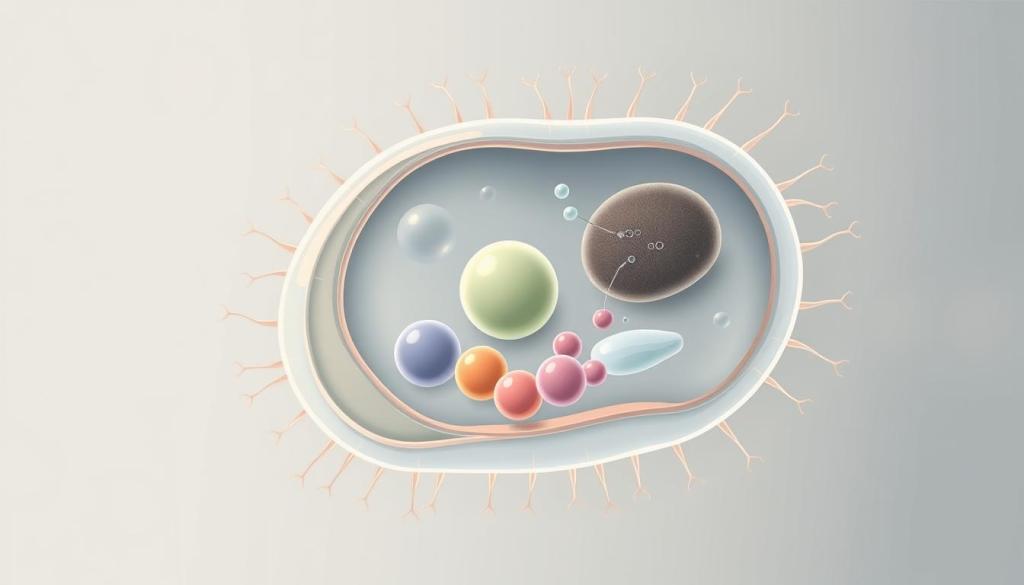
Learning about these parts shows how bacteria can survive and grow. They face many challenges but have the tools to overcome them.
Genetic Material in Bacterial Cells
Bacterial cells have a complex world of genetics inside them. DNA is the main guide for the cell’s life and survival. It controls everything the cell does.
DNA Structure and Function
Bacterial DNA is a single circle found in the nucleoid area. It’s different from eukaryotic DNA because it’s more compact. This DNA holds all the information needed for the cell to live and reproduce.
- Chromosome size ranges from 580,000 to 13,000,000 base pairs
- Most bacteria have one circular chromosome
- DNA is tightly coiled in the cell
Plasmids and Their Importance
Plasmids are small, circular DNA pieces that live on their own. They are key for bacterial adaptation and evolution. They carry genes that give bacteria big advantages, like resistance to antibiotics.
“Plasmids are nature’s genetic Swiss Army knives, offering bacteria remarkable flexibility in challenging environments.”
Plasmids have important traits:
- They can replicate on their own
- They can move between bacterial cells
- They carry genes that help bacteria
Scientists are still learning about bacterial genetics. They see its big impact on medical research and biotechnology.
The Role of Cytoplasm in Bacterial Cells
Bacterial cells have a special area called the cytoplasm. It’s like a gel-like matrix where most of the cell’s work happens. This space is full of life, managing nutrients and processes.

The cytoplasm is key for the cell’s functions. It supports important activities and stores nutrients. It’s made up of:
- Enzymes that start chemical reactions
- Dissolved nutrients and products
- Machines for making proteins
- Places to store energy
Metabolic Processes in Cytoplasm
In the cytoplasm, bacteria do vital work. Glycolysis, a key energy-making process, happens here. They turn glucose into pyruvate, making ATP to power the cell.
Nutrient Storage Mechanisms
The cytoplasm also stores nutrients. Special areas called inclusion bodies hold glycogen and lipids. These help bacteria keep energy when times are tough.
The cytoplasm is where bacteria plan and carry out survival strategies.
Bacterial cells use their cytoplasm for many things. They manage nutrients and energy very well.
Membrane Proteins and Their Functions
Bacterial cell membranes are complex structures filled with essential proteins. These proteins are key to the cell’s survival. The cell membrane does more than just protect the cell. It also acts as a dynamic interface for communication and transport.
Proteins in the cell membrane perform many important functions. They help bacterial cells interact with their environment effectively.
Transport Proteins: Cellular Gatekeepers
Transport proteins are crucial in the cell membrane. They control the movement of molecules across the bacterial cell boundary. These proteins include:
- Channel proteins that create passageways for specific molecules
- Carrier proteins that actively move substances through the membrane
- Pumps that generate concentration gradients
Signal Transduction: Environmental Sensing Mechanism
Membrane proteins are key in signal transduction. They help bacteria sense and respond to environmental changes. These proteins act as molecular sensors, turning external stimuli into cellular responses.
“Membrane proteins are the communication bridges between a bacterial cell and its external world.” – Microbiology Research Insights
| Membrane Protein Type | Primary Function | Percentage in Membrane |
|---|---|---|
| Transport Proteins | Molecule Movement | 30-40% |
| Signal Transduction Proteins | Environmental Sensing | 10-20% |
| Structural Proteins | Membrane Integrity | 20-30% |
Understanding these membrane proteins sheds light on bacterial adaptation and survival strategies. It also opens up new avenues for medical interventions.
Bacterial Appendages
Bacteria have amazing external parts that help them live and interact with their surroundings. These special parts are key for moving around, talking to each other, and adapting to new situations.
Flagella: Bacterial Motility Powerhouses
Flagella are long, spiral structures that help bacteria move fast. They can push bacteria forward at speeds up to ten times their body length per second. This is even faster than the fastest human athlete.
- Flagella enable bacterial chemotaxis
- Multiple flagella arrangements exist:
- Monotrichous (single flagellum)
- Amphitrichous (flagella at both ends)
- Lophotrichous (multiple flagella at one pole)
- Peritrichous (flagella distributed around cell surface)
Pili: Bacterial Connection Mechanisms
Pili are shorter, hair-like structures that are vital for bacterial interactions. They can be found in hundreds on a single bacterial surface. They help with sticking to surfaces and transferring genetic material.
- Types of pili include:
- Conjugation pili for genetic exchange
- Adhesion pili for surface attachment
- Crucial in bacterial pathogenicity
- Enable genetic material transmission between bacteria
“Bacterial appendages represent sophisticated biological machinery, enabling survival through mobility and communication.” – Microbiology Research Insights
The Importance of Endospores
Bacteria have developed amazing ways to survive over time. One key strategy is making endospores. These help bacteria live through very tough conditions.
Endospores are special parts of bacteria that let them handle extreme challenges. They are small but very strong. This lets bacteria keep their genes safe when things get really bad.
When and Why Bacteria Form Endospores
Bacteria make endospores when they face big survival tests. These include:
- Extreme temperature changes
- Not enough food
- Being very dry
- Being exposed to harmful chemicals
- Being hit by radiation
Structure and Resistance Mechanisms
Endospores have many layers that make them very strong. These layers are:
- A tough protein coat
- A calcium-dipicolinate core
- A thick peptidoglycan wall
- Special membrane systems
“Endospores represent nature’s most sophisticated survival mechanism in bacterial cell structure” – Microbiology Research Center
| Endospore Characteristic | Resistance Level |
|---|---|
| Heat Resistance | Up to 100°C for hours |
| Chemical Resistance | Survive strong disinfectants |
| Radiation Tolerance | Withstand significant radiation exposure |
Endospores show how amazing bacteria are at surviving. They can handle conditions that seem impossible.
Interaction with Their Environment
Bacterial cells are amazing at talking and adapting to their surroundings. They have clever ways to survive and interact with their environment.
Bacteria have developed smart ways to move through complex environments. They find nutrients and deal with challenges in their own unique ways.
Nutrient Uptake Mechanisms
Bacterial cells have different methods to get the nutrients they need:
- Passive diffusion through cell membranes
- Facilitated diffusion using specialized transport proteins
- Active transport requiring cellular energy
- Specialized protein channels for selective nutrient absorption
Response to Environmental Stressors
Bacterial cells are very good at adapting to tough situations. They change their internal makeup to handle things like:
- Temperature changes
- pH changes
- Osmotic pressure changes
- Lack of nutrients
“Bacterial survival depends on their ability to rapidly respond and adapt to environmental conditions.” – Microbiology Research Institute
Bacterial cells have special ways to sense and react to changes outside. Stress proteins and changes in genes help them stay strong when things get tough.
Thanks to their complex parts, they can always adjust to new signals. This lets them survive in many different places.
The Role of Bacterial Cell Components in Disease
Bacterial cell structure is key to understanding how pathogens cause infections. The detailed parts of bacterial cells make them powerful disease agents.
Pathogenicity Factors
Bacteria have special parts that let them invade and live in host systems. These include:
- Toxins that disrupt cellular functions
- Adhesins that help bacteria attach to host tissues
- Invasins that facilitate cellular penetration
- Enzymes that break down host defenses
About 90% of bacteria have a cell wall that makes them more harmful. Gram-positive bacteria have walls with up to 90% peptidoglycan. This is key to their survival.
Biofilm Formation
Biofilm formation is a smart defense by bacteria. It creates a protective layer that keeps bacteria safe from antibiotics and the immune system.
“Biofilms represent a sophisticated survival strategy that transforms individual bacterial cells into resilient communities.” – Dr. Elizabeth Roberts, Microbiology Research Institute
Special proteins and substances help bacteria form biofilms. These create strong, safe environments.
- Biofilms can increase antibiotic resistance by up to 1000 times
- They enable bacteria to survive in challenging environments
- Chronic infections often result from biofilm-protected bacterial populations
Knowing how bacterial cells work helps us find new ways to fight infections.
Comparisons with Eukaryotic Cells
Exploring what a bacterial cell contains takes us into the detailed world of cells. Bacterial and eukaryotic cells show big differences and some similarities.
Looking at cells under a microscope, we see big differences. Bacterial cells are much simpler than eukaryotic cells.
Key Differences in Cellular Organization
- Size: Bacterial cells range from 0.1–5.0 µm, while eukaryotic cells measure 10–100 µm
- Organelle Structure: Prokaryotes lack membrane-bound organelles
- Genetic Material Location: Bacterial DNA exists in a nucleoid region, not a membrane-bound nucleus
- Cell Wall Composition: Bacteria have peptidoglycan cell walls, unlike eukaryotic cells
Shared Cellular Characteristics
Even with their differences, bacterial and eukaryotic cells share basic life principles. This shows that life is connected.
| Shared Feature | Description |
|---|---|
| Genetic Material | Both use DNA as primary genetic information carrier |
| Protein Synthesis | Utilize ribosomes for creating proteins |
| Metabolic Processes | Engage in fundamental energy production mechanisms |
“In the grand tapestry of cellular life, bacteria and eukaryotic cells represent two distinct yet interconnected threads.” – Cellular Biology Research Collective
Bacterial cells might seem simple, but they are very adaptable. Thiomargarita namibiensis, for example, can grow up to 750 μm. This challenges what we thought about bacterial size.
Future Research Directions in Bacterial Cell Biology
The study of bacterial cell structure is changing fast. New technologies are helping us learn more about microbes. Single-molecule detection lets us see how cells work at a very small scale.
New microscopy tools are making it easier to study bacterial cells. Scientists can now watch how proteins move inside cells. This shows us things we couldn’t see before.
Advances in Microscopy Techniques
New ways to see cells are changing how we study them. Single-molecule tracking is a big help. It lets us see where proteins are with great detail.
Implications for Medicine and Biotechnology
These new tools could lead to big changes in medicine and tech. They might help us make better antibiotics and prevent diseases. They could also lead to new ways to use biology in technology.
FAQ
What are the basic components of a bacterial cell?
A bacterial cell has several key parts. These include a cell membrane, cell wall, and cytoplasm. It also has ribosomes, DNA, plasmids, and structures like flagella and pili. These work together to help the cell survive and adapt.
How do bacterial cells differ from eukaryotic cells?
Bacterial cells are prokaryotic, lacking membrane-bound organelles like a nucleus. They have a simpler structure than eukaryotic cells. Their genetic material floats freely in the cytoplasm. Bacterial cells are smaller and have different cell walls than eukaryotic cells.
What is the function of the bacterial cell wall?
The bacterial cell wall gives structural support and protection. It keeps the cell shape and helps resist osmotic pressure. The wall’s composition varies between Gram-positive and Gram-negative bacteria, aiding in identification.
How do bacteria reproduce?
Bacteria reproduce through binary fission, dividing into two identical cells. This process allows them to grow quickly under favorable conditions. Some bacteria can divide every 20-30 minutes.
What are plasmids in bacterial cells?
Plasmids are small, circular DNA molecules separate from the bacterial chromosome. They carry additional genetic information. Plasmids are key for bacterial adaptation and can transfer traits like antibiotic resistance.
How do bacterial cells move?
Many bacteria move using flagella, which are whip-like appendages. Some use pili for movement or attachment. These structures are vital for survival, helping bacteria find nutrients or escape harm.
What makes bacterial endospores so resistant?
Bacterial endospores are very resilient, surviving extreme conditions like high temperatures and radiation. They form when bacteria face severe stress. This protects the cell’s genetic material, allowing survival in harsh conditions for long periods.
How do bacterial cells respond to environmental changes?
Bacterial cells have ways to sense and respond to environmental changes. They can change gene expression, produce stress proteins, and alter metabolic processes. They may also form protective structures like endospores to survive.
What role do ribosomes play in bacterial cells?
Ribosomes are essential for protein synthesis in bacterial cells. They translate genetic information into proteins, crucial for cellular functions and survival. Bacterial ribosomes are smaller but perform the same role as eukaryotic ribosomes.
How do bacterial cells contribute to disease?
Bacterial cells can cause disease through various factors. These include toxin production, invasion of host cells, and biofilm formation. Some bacteria adapt quickly to host environments, evade immune responses, and develop antibiotic resistance, posing significant medical challenges.






Leave a Comment
Your email address will not be published. Required fields are marked *