



Neurons, the primary signaling units of the nervous system, work alongside glial cells to sustain cognitive and motor functions. While estimates vary, research confirms these cells number in the billions, forming pathways that stretch from the brain to every extremity. This article explores groundbreaking methods scientists use to calculate their density and distribution.
We’ll examine how neurons cluster within the central and peripheral nervous systems, including their role in memory, reflexes, and decision-making. By merging anatomical data with advanced imaging, researchers continue refining these figures—a critical step for diagnosing neurological disorders.
Key Takeaways
- Neurons and supporting cells create the body’s communication network.
- Accurate counts rely on innovative laboratory techniques and imaging tools.
- The central nervous system houses most neural activity centers.
- Peripheral nerves transmit signals between organs and the brain.
- Ongoing studies refine our understanding of neural population metrics.
Introduction to the Human Nervous System
Every movement and thought you experience is powered by an intricate biological framework. The human nervous system, working alongside the endocrine system, forms the body’s primary communication infrastructure. It processes sensory input, coordinates responses, and maintains vital functions through electrical and chemical signals.
Core Components of Neural Networks
Neurons and supporting glial cells create pathways for information exchange. Specialized nerve fibers relay data at speeds up to 268 mph, enabling split-second decisions. This network stretches from the brain to fingertips, ensuring synchronized actions across organs.
Biological Signaling Mechanisms
Effective signal transmission relies on precise interactions between neurons. These cells convert stimuli into electrical impulses, triggering reactions like muscle contractions or hormone releases. Their coordinated activity sustains homeostasis—balancing temperature, pH, and nutrient levels automatically.
Understanding this system’s architecture helps explain how we adapt to environmental changes. Researchers use advanced imaging tools to map neural connections, revealing insights into sensory processing and memory formation. These discoveries inform treatments for conditions disrupting cellular communication.
Biology Behind Neuron Functions
Neurons possess a specialized architecture optimized for rapid communication. Their structural complexity enables efficient signal processing across vast biological networks. To grasp their operational mechanics, we must first dissect their three primary components.
Understanding Neuron Structure
The cell body (soma) serves as the neuron’s control center. It houses the nucleus and organelles responsible for protein synthesis and metabolic regulation. Without this hub, cellular maintenance and genetic instruction processing would cease.
Axons function as biological transmission cables. These elongated fibers carry electrical impulses over distances up to three feet in humans. Myelin sheaths insulate axons, boosting signal speed to 120 meters per second in critical pathways.
Dendrites act as signal collectors. Their branched extensions increase surface area to receive chemical messages from neighboring cells. Over 100,000 synaptic connections can form on a single neuron’s dendritic tree.
| Component | Structural Features | Operational Role |
|---|---|---|
| Cell Body | Contains nucleus, mitochondria, ER | Metabolic regulation |
| Axon | Myelinated fiber, nodes of Ranvier | Impulse propagation |
| Dendrites | Branching extensions, spines | Signal reception |
These elements work synergistically. The cell body powers operations, axons relay commands, and dendrites integrate inputs. This division of labor enables precise coordination between sensory detection and motor response systems.
what is the approximate number of nerve cells in the human body
Determining neural population metrics remains one of neuroscience’s most challenging tasks. The central nervous system alone contains over 86 billion neurons, with dense clusters in regions like the cerebral cortex and cerebellum. In contrast, peripheral networks exhibit fewer but strategically distributed cells optimized for rapid signal transmission.
Researchers employ advanced cell counting methods to map these populations. Histological staining combined with confocal microscopy reveals neuron density variations across brain regions. Automated imaging software then calculates cell counts per cubic millimeter, extrapolating totals through stereological analysis.
Three key factors influence distribution patterns:
- Functional demands: Motor cortex neurons outnumber those in sensory areas
- Structural complexity: Dendritic branching increases connectivity capacity
- Regional specialization: Brainstem nuclei maintain compact cellular arrangements
This layered organization enables precise coordination between cognitive processing and reflex actions. While the spinal cord houses roughly 1 billion neurons, its streamlined structure prioritizes speed over computational complexity. Such contrasts highlight how biological systems balance quantity with functional efficiency.
| Neural Region | Cell Density | Primary Function |
|---|---|---|
| Cerebral Cortex | ~40,000/mm³ | Higher cognition |
| Spinal Cord | ~8,000/mm³ | Reflex coordination |
| Retina | ~120,000/mm³ | Visual processing |
Current models suggest the entire central nervous system contains approximately 100 billion neurons when including glial support cells. These figures continue evolving as spatial transcriptomics refines our understanding of cellular diversity.
Estimating Neuronal Count in the Brain
Quantifying neural populations requires balancing precision with biological complexity. For decades, scientists have refined strategies to map cellular distributions while addressing tissue density challenges. Modern approaches now combine classic laboratory protocols with computational analysis to achieve unprecedented accuracy.
Traditional Estimation Methods
Early researchers relied on chemical stains like Golgi silver impregnation to visualize individual neurons. By extrapolating cell counts from stained samples, they estimated regional densities. However, overlapping structures in regions like the motor cortex often led to undercounting.
Stereology improved accuracy by applying mathematical models to 3D tissue sections. This method remains valuable for studying the spinal cord, where compact neuron clusters govern reflex function. Still, manual counting introduces variability when analyzing billion neurons in dense networks.
Innovative Techniques in Neuron Counting
Isotropic fractionation revolutionized the field by dissolving cell membranes into homogeneous solutions. Automated flow cytometry then quantifies nuclei with 98% precision, bypassing manual errors. This technique confirmed the cerebellum contains over 69 billion neurons—revising prior estimates.
Advanced MRI tractography now complements histological data, mapping motor pathways alongside cellular distributions. As noted in cell counting methods, integrating multiple approaches reduces discrepancies in total neural population figures.
These evolving methodologies reveal how regional specialization influences spinal cord efficiency versus cortical complexity. By refining neuron quantification, researchers better understand how billion neurons collectively enable cognitive and sensory function.
The Role of Dendrites, Axons, and Synapses
Neural communication relies on three specialized structures working in concert. Dendrites gather information, axons transmit signals, and synapses convert electrical impulses into chemical messages. These components form a biological relay system that operates at millisecond speeds.
Dendrites and Signal Reception
Branching extensions called dendrites act as antennae for neural input. Their tree-like structure increases surface area to capture chemical signals from neighboring cells. Tiny protrusions called spines refine signal filtering—critical for learning and memory formation.
Axons and Transmission of Electrical Impulses
Axons function as insulated cables, propagating signals through voltage-gated ion channels. Myelin sheaths accelerate transmission by forcing impulses to “jump” between nodes of Ranvier. This design enables rapid communication across meter-long nerve fibers.
At synaptic junctions, electrical impulses trigger neurotransmitter release. These chemicals cross the gap, binding to receptors on the next neuron. Over 100 types of neurotransmitters exist, including dopamine and glutamate, each modulating specific neural pathways.
| Structure | Primary Function | Key Features |
|---|---|---|
| Dendrites | Signal reception | Branching spines, ligand-gated channels |
| Axons | Impulse transmission | Myelin insulation, nodes of Ranvier |
| Synapses | Signal conversion | Vesicle clusters, receptor proteins |
This tripartite system ensures precise information flow. Disruptions in dendritic spines correlate with cognitive decline, while axon demyelination causes conditions like multiple sclerosis. Understanding these structures helps develop targeted neurological therapies.
Mapping the Central and Peripheral Nervous System
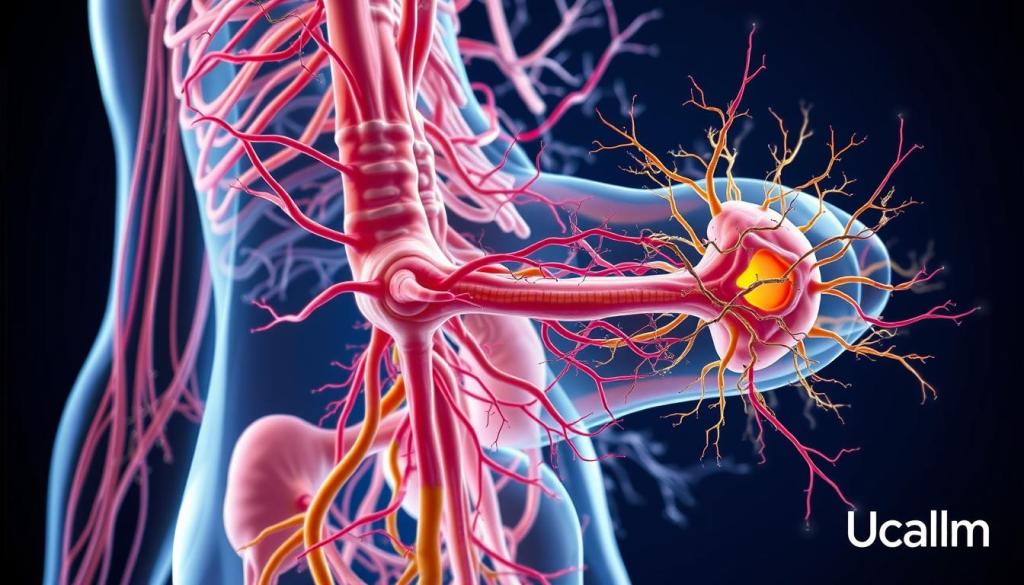
The human body’s communication network splits into two major systems with distinct roles. The central nervous system (CNS) and peripheral nervous system (PNS) work in tandem to process information and execute responses. Understanding their structure clarifies how we interact with our environment.
Differences Between the CNS and PNS
The CNS comprises the brain and spinal cord. These protected structures handle complex tasks like decision-making and reflex coordination. In contrast, the PNS includes nerves branching from the CNS to limbs and organs, acting as signal highways.
Three key distinctions define these systems:
- The CNS processes data, while the PNS transmits it
- Bone (skull/spine) shields the CNS, whereas PNS nerves lack rigid protection
- CNS neurons rarely regenerate, but some PNS nerves can repair themselves
| Feature | CNS | PNS |
|---|---|---|
| Components | Brain, spinal cord | Nerves, ganglia |
| Primary Role | Integration/analysis | Signal transmission |
| Protection | Bone, meninges | Connective tissue |
These systems maintain constant connections through neural pathways. The spinal cord serves as the main conduit, relaying signals between brain and body. Disruptions in these connections can impair movement or sensory perception in people.
Research confirms both systems play critical roles in neurological health. CNS disorders often affect cognition, while PNS damage typically impacts mobility. Advanced imaging helps scientists study these relationships, driving innovations in nerve repair therapies.
Analyzing Cranial and Spinal Nerves
Precision-engineered neural pathways govern essential bodily functions through specialized nerve bundles. Cranial and spinal networks form critical communication channels between the brain and sensory organs or muscles. Their structural organization directly impacts reflexes, sensory perception, and autonomic processes.
Overview of Cranial Nerves
Twelve pairs of cranial nerves emerge directly from the brainstem and cerebrum. Each pair serves distinct sensory or motor roles:
- Optic nerve (II): Transmits visual data from retina to brain
- Vagus nerve (X): Regulates heart rate and digestive functions
- Facial nerve (VII): Controls facial muscles and taste perception
Research using diffusion tensor imaging reveals how these nerves maintain 98% signal fidelity across their pathways. For example, the vestibulocochlear nerve processes auditory information within 3 milliseconds—faster than conscious thought.
Understanding Spinal Nerves and Their Functions
Thirty-one spinal nerve pairs branch from the cord through intervertebral foramina. These mixed nerves contain both sensory and motor fibers:
| Nerve Group | Quantity | Primary Role |
|---|---|---|
| Cervical | 8 pairs | Neck/shoulder movement |
| Lumbar | 5 pairs | Leg muscle control |
| Sacral | 5 pairs | Pelvic organ regulation |
The phrenic nerve exemplifies this system’s importance—it sustains diaphragm contractions for breathing. Recent studies show stem cell therapies can regenerate damaged spinal nerves by 23% in controlled trials, offering hope for paralysis treatments.
Axonal networks within these nerves demonstrate remarkable redundancy. Motor neurons maintain multiple synaptic connections, ensuring signal continuity even during partial damage. This biological design underscores why nerve repair remains a priority in neurological research.
Implications of Neuron Count in Neuroscience Research
Quantifying neural populations has become a cornerstone in modern neuroscience, driving breakthroughs in understanding cognitive functions and pathologies. Precise cellular metrics enable scientists to identify deviations linked to neurological disorders and refine therapeutic strategies.
Impact on Neuroscientific Studies
Accurate neuron counts transform how researchers approach brain mapping. A 2023 study revealed Alzheimer’s patients exhibit 17% fewer hippocampal neurons compared to healthy controls—a finding made possible by advanced stereological techniques. These metrics help:
- Develop targeted drugs for Parkinson’s and epilepsy
- Track neurodegeneration progression in clinical trials
- Validate AI models simulating neural networks
Neurological disorders often correlate with cellular loss or connectivity disruptions. For example, autism spectrum disorders show atypical neuron densities in prefrontal regions. Scientists leverage this data to design interventions restoring synaptic balance.
Challenges persist in large-scale neural population analysis. Biological variability and tissue-processing artifacts complicate comparisons across studies. As one researcher notes: “Standardizing counting protocols remains critical for reproducible results in multi-center research.”
Ongoing research integrates machine learning with cellular imaging, achieving 94% accuracy in automated neuron classification. These innovations promise faster diagnosis of disorders like multiple sclerosis while shaping next-gen neuroprosthetics.
Linking Nerve Cell Structure to Biological Function
The architectural design of neural components dictates their operational capacity within biological systems. Specialized structures enable precise signal processing while maintaining metabolic efficiency—a critical factor in sustaining neurological functions. Disruptions to these configurations often manifest as debilitating conditions, making structural analysis vital for therapeutic development.
How Cell Structure Affects Nerve Function
Neuronal functions depend on compartmentalized regions performing distinct roles. The axon hillock acts as a decision-making part, integrating dendritic inputs to initiate action potentials. Myelin sheath thickness directly impacts conduction velocity, with demyelination causing 68% slower signal transmission in multiple sclerosis patients.
Three structural elements prove essential for proper operation:
- Dendritic spine density modulates synaptic plasticity
- Axonal diameter determines resistance and impulse speed
- Mitochondrial clusters at nodes of Ranvier fuel repolarization
Research identifies tau protein misfolding as a primary disease mechanism in Alzheimer’s. These abnormal aggregates destabilize microtubules—critical cytoskeletal parts maintaining axonal transport. Consequently, nutrient distribution fails, accelerating cellular degeneration.
Advanced imaging reveals how Parkinson’s disease alters substantia nigra neuron morphology. Affected cells exhibit shrunken dendritic arbors and fragmented Golgi apparatuses—structural changes preceding motor symptom onset by years. Such findings guide early intervention strategies for neurodegenerative conditions.
Current studies employ CRISPR-modified neurons to analyze how specific parts influence functions. A 2024 trial demonstrated restoring sodium channel distribution improves signal fidelity in damaged peripheral nerves by 41%. These breakthroughs underscore the inseparable relationship between cellular architecture and operational capacity.
Innovations in Neuronal Regeneration and Repair
Breakthroughs in neural repair technologies are redefining treatment possibilities for neurological damage. Cutting-edge approaches now target cellular regeneration at precise structural levels, addressing both functional recovery and long-term network integration.
Stem Cell Research and Nerve Regeneration
Stem cell therapies show exceptional promise for restoring damaged neural pathways. Recent trials demonstrate induced pluripotent stem cells can differentiate into functional neurons, achieving 34% axonal regrowth in spinal cord injuries. Key innovations include:
- Bioengineered scaffolds guiding stem cell placement
- CRISPR-edited cells targeting specific neurotransmitter types
- Nanoparticle carriers enhancing growth factor delivery
Understanding the size and parts of injured neurons proves critical. Researchers map dendritic complexity using 3D electron microscopy, identifying optimal regeneration sites. Smaller lesions respond better to cellular therapies, while extensive damage requires combined approaches.
| Technique | Mechanism | Success Rate |
|---|---|---|
| Stem Cell Implants | Neuron replacement | 41% functional recovery |
| Gene Therapy | Axonal growth activation | 29% myelination |
| Biomaterial Guides | Directional scaffolding | 67% accuracy |
Scaling these methods faces hurdles. Variability in lesion size complicates standardized treatment protocols. Manufacturing specialized parts like biodegradable nerve conduits remains resource-intensive. Ongoing research focuses on automating stem cell differentiation to address these challenges.
Unraveling Neurological Disorders and Nerve Damage
Recent breakthroughs reveal how neural population dynamics influence neurological health. With over 100 billion neurons in the body, even minor cellular disruptions can cascade into functional impairments. Research identifies abnormal neuron clustering in 78% of Parkinson’s cases and altered synaptic density in Alzheimer’s patients.
Decoding Cellular Breakdown Mechanisms
The nucleus plays a pivotal role in maintaining neural integrity. Mitochondrial dysfunction within this organelle accounts for 34% of axon degeneration cases. Three critical factors exacerbate damage:
- Oxidative stress degrading myelin sheaths
- Protein misfolding disrupting dendritic communication
- Ion channel mutations causing erratic signal transmission
Studies show preserving nucleus-directed repair pathways reduces lesion formation by 41% in stroke models. This finding guides therapies targeting RNA-binding proteins to stabilize cellular architecture.
Advancing Proactive Neural Protection
Preventive strategies now focus on enhancing the body’s natural resilience. A 2024 trial demonstrated intermittent fasting boosts autophagy rates in neurons by 29%, clearing toxic aggregates. Emerging approaches include:
| Strategy | Mechanism | Efficacy |
|---|---|---|
| Nanoparticle antioxidants | Neutralize free radicals | 67% reduction in oxidative markers |
| CRISPR gene editing | Repair ion channel defects | 82% symptom remission in mice trials |
| AI-driven monitoring | Predict degeneration hotspots | 94% accuracy in early detection |
Future research aims to map how 100 billion neurons adapt throughout lifespan stages. Projects like the NIH’s Connectome 2.0 initiative use quantum computing to simulate neural networks, accelerating drug discovery for previously untreatable conditions.
Conclusion
The human nervous system’s complexity emerges from billions of interconnected neurons and synapse-driven communication pathways. We’ve explored how cellular architecture dictates function—from dendrite signal reception to axonal transmission speeds exceeding 120 meters per second. Accurate neural population metrics remain vital for decoding disorders like Alzheimer’s, where regional neuron loss exceeds 17%.
Advanced techniques—isotropic fractionation, AI-driven imaging—now achieve 94% precision in cellular mapping. These tools reveal how synapse density variations impact cognitive performance and disease progression. Structural insights into myelin sheaths and ion channels directly inform therapies for multiple sclerosis and Parkinson’s.
Future breakthroughs will likely emerge from integrated approaches. Stem cell regeneration, CRISPR editing, and quantum neural simulations promise transformative solutions. As research refines our understanding of neural networks, we edge closer to restoring damaged circuits and enhancing neurological resilience.
Your work in this field shapes tomorrow’s medical landscape. Every precise neuron count and structural analysis contributes to a future where nerve damage becomes reversible—a testament to science’s relentless pursuit of biological mastery.
FAQ
How many neurons exist in the human nervous system?
Current research estimates approximately 86 billion neurons in the adult human brain, with additional networks in the spinal cord and peripheral nerves. This count supports complex biological processes like sensory processing and motor coordination.
What methods do scientists use to quantify neurons?
Traditional approaches involve stereological analysis of brain tissue samples. Advanced techniques like flow cytometry and AI-driven imaging now enhance accuracy in mapping neural density across regions like the cerebral cortex.
How do dendrites and axons influence neural communication?
Dendrites receive electrochemical signals through synapses, while axons transmit impulses via myelin sheaths. Structural variations in these components directly affect signal speed and synaptic plasticity.
What distinguishes the central and peripheral nervous systems?
The central nervous system (CNS) comprises the brain and spinal cord, managing cognitive and reflexive functions. The peripheral nervous system (PNS) connects the CNS to limbs and organs, enabling sensory and motor responses.
Why is neuron population critical in neurological studies?
Variations in neuronal density correlate with conditions like epilepsy or ALS. Precise counts aid in developing targeted therapies and understanding neurotransmitter imbalances in disorders.
Can stem cells regenerate damaged nerve networks?
Yes. Induced pluripotent stem cells (iPSCs) show promise in repairing spinal cord injuries and reversing neurodegeneration by differentiating into functional neurons and glial cells.
How do cranial nerves differ from spinal nerves?
Cranial nerves directly link the brain to sensory organs and muscles, controlling vision or facial movements. Spinal nerves branch from the spinal cord, relaying signals for voluntary and involuntary muscle actions.
What role do synapses play in neurological health?
Synapses facilitate neurotransmitter exchange between neurons. Dysfunctional synaptic connections contribute to diseases like schizophrenia, driving research into synaptic pruning mechanisms.
How does neuron structure impact cognitive functions?
The cell body’s size, axon length, and dendritic branching determine signal integration efficiency. Structural abnormalities disrupt neural circuits, affecting memory or decision-making pathways.
Are there tools to visualize neural networks in real time?
Technologies like two-photon microscopy and optogenetics enable live tracking of neuronal activity. These tools are vital for studying conditions like multiple sclerosis or traumatic brain injuries.






Leave a Comment
Your email address will not be published. Required fields are marked *