


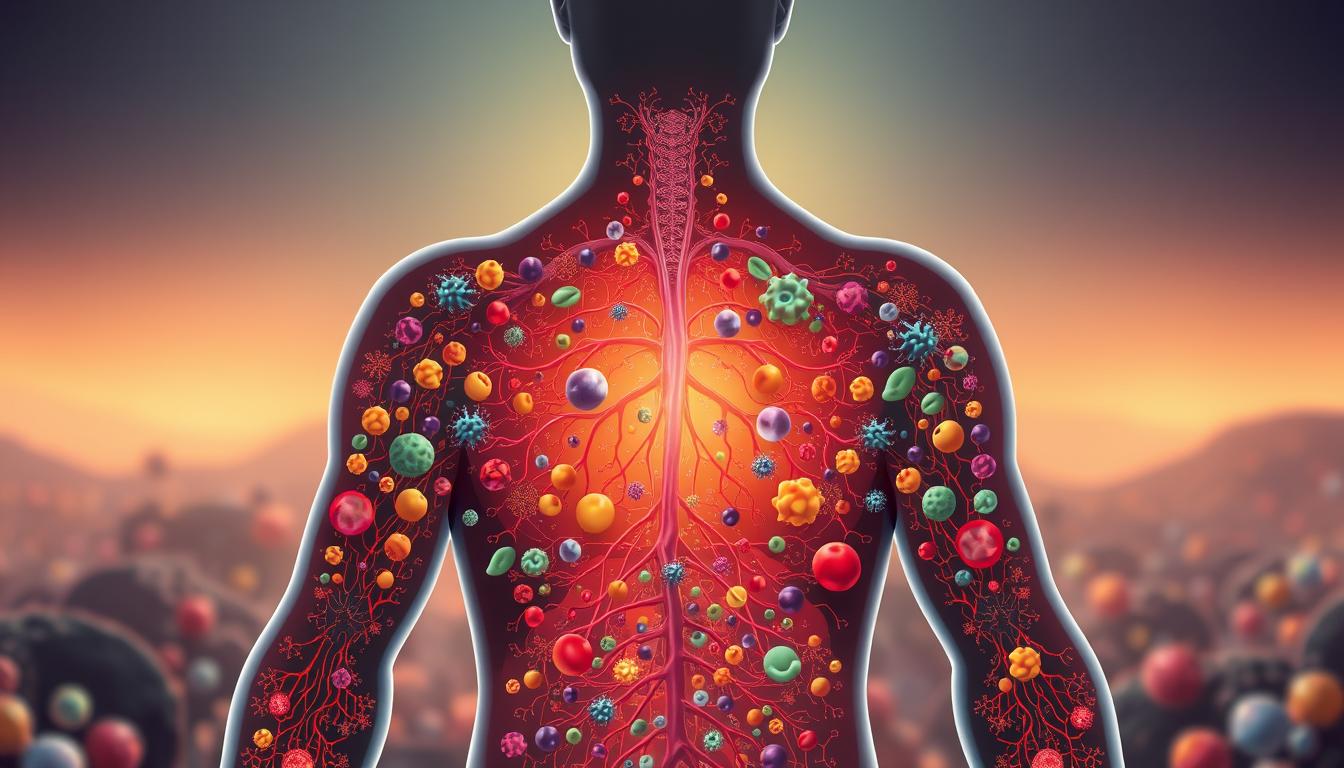
Ever thought about the tiny building blocks that make up your whole body? Can you imagine counting every cell in your body?
The world of cell biology is truly amazing. It shows that the average human body has about 30 trillion cells. This huge number shows how our bodies are made up of tiny, working parts.
Learning about the number of cells in our bodies is more than just a fun fact. Each cell is a tiny wonder that helps us stay alive. They all work together to keep us going.
Scientists have been studying our cells for years. They’ve made big discoveries about how our cells work together. These studies help us understand our bodies better.
Key Takeaways
- The human body contains approximately 30 trillion cells
- Cell biology reveals complex microscopic interactions
- Different cell types perform unique functions
- Cell count can vary based on individual factors
- Scientific research continues to uncover cellular mysteries
Understanding Cell Composition in Humans
The human body is a complex system made up of tiny cells. These cells are the basic units of life. They work together to keep our bodies running smoothly.
Each cell has its own set of parts, like genetic material and organelles. It’s all wrapped up in a protective membrane. These tiny units are key to keeping us alive, processing nutrients, and supporting our body’s functions.
Defining Cellular Structures
Scientists have found about 200 different cell types in us. Each type has its own job and special features. They can be grouped by their roles:
- Structural cells that provide physical support
- Functional cells responsible for specific physiological processes
- Reproductive cells involved in genetic transmission
Diverse Cell Types in the Human Body
Our bodies are made up of many cell types, each with its own role:
- Red Blood Cells: Carry oxygen throughout the body
- White Blood Cells: Support immune system defense
- Muscle Cells: Enable movement and internal functions
- Nerve Cells: Facilitate communication within the nervous system
- Fat Cells: Store energy and regulate metabolism
Learning about the different cells in our bodies shows how complex we are. It reveals the amazing design of our bodies at the smallest level.
Estimating the Total Number of Cells
Finding out how many cells are in the human body is a big challenge. Scientists have come up with smart ways to guess the number of cells. They’ve learned a lot about how many cells make up our bodies.
Scientists have made big strides in figuring out how many cells we have. They think there are about 37.2 trillion cells in an average person. But, this number can change for many reasons.
Scientific Methods for Counting Cells
Researchers use different ways to figure out how many cells we have:
- Mathematical modeling
- Organ-specific calculations
- Volumetric analysis
- Microscopic cell sampling
Factors Affecting Cell Count
Many things can change how many cells we have:
- Body weight and size
- Age
- Overall health status
- Individual genetic variations
Interestingly, different cell types add up in different ways. For example, red blood cells are between 20-30 trillion. Heart muscle cells are about 2 billion.
The complexity of human cellular composition continues to fascinate scientific researchers worldwide.
Scientists think the number of cells can be anywhere from 15 trillion to 70 trillion. This shows how complex our cells are.
Breakdown of Cell Types in the Human Body
The human body is made up of many different cell types. Each cell has a special role in keeping our body working right. With over 200 cell types found, our body is a complex system.
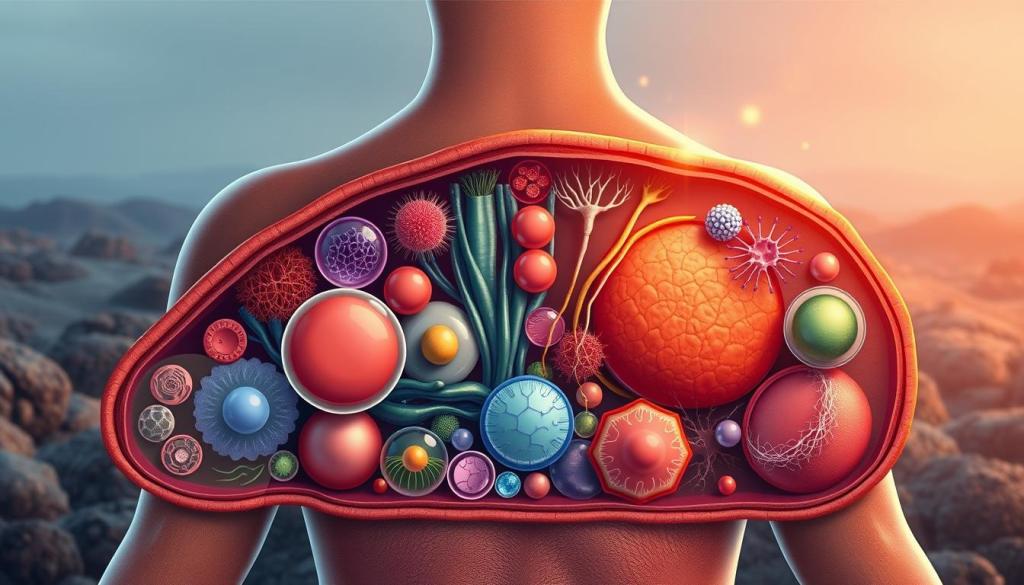
Learning about cells shows us how amazing our body is. Red blood cells make up about 84% of all cells in us.
Red Blood Cells: Oxygen Carriers
Red blood cells, or erythrocytes, are the most common in our blood. They do important jobs:
- They carry oxygen all over the body
- They take carbon dioxide to the lungs to get rid of it
- They are shaped like a disc to have more surface area
White Blood Cells: Guardians of Immunity
White blood cells are key to our body’s defense. They fight off infections and diseases in different ways:
- Neutrophils make up about 65% of white blood cells
- Lymphocytes find and destroy harmful invaders
- Monocytes can grow up to 20 µm in diameter
Specialized Cells: Beyond Blood
There are many other cell types in our body. Neurons are especially interesting. They are the nerve cells in our brain, with about 86 billion of them. These cells talk to each other through electrical and chemical signals. They help us move and think.
Variability in Cell Count Across Individuals
The human body is made up of many cells, each with its own role. This makes the body’s composition both complex and dynamic. Looking into the average cell count shows us how different people can have different cell numbers.
Cell counts vary a lot due to several important factors. Studies have found big differences in cell numbers based on age and gender.
Age-Related Cell Count Changes
As we grow, our cells change a lot. Scientists have found big changes in cell counts from when we’re kids to when we’re adults:
- Average child: Approximately 17 trillion cells
- Average adult female: Around 28 trillion cells
- Average adult male: Roughly 36 trillion cells
Gender Influences on Cell Populations
Being male or female affects how many cells we have. Biological differences lead to variations in cell counts between men and women. These differences are small but important:
- Male bodies usually have more cells because of more muscle
- Hormones affect how cells work
- Genetics also play a part in cell count differences
Researchers say these differences are small compared to the differences within the same gender group. The study of human cells is a big interest for scientists all over the world.
The Role of Cells in Body Functions
Cell biology shows us the amazing world of human anatomy. It’s all about how cells work together. This teamwork keeps life balanced.
Cells are the basic units of life. They make sure our bodies run smoothly. Their main job is to keep everything stable inside us.
Cell Communication and Homeostasis
Cells talk to each other in a complex way. This helps our bodies work well. They keep important conditions stable:
- Regulating body temperature
- Managing nutrient distribution
- Controlling metabolic processes
- Responding to environmental changes
Cellular Interaction Mechanisms
Cells use many ways to communicate:
| Communication Method | Primary Function |
|---|---|
| Chemical Signaling | Transmitting messages between different cell types |
| Electrical Impulses | Enabling rapid neural network communication |
| Hormonal Regulation | Coordinating systemic bodily responses |
Understanding these intricate cellular interactions provides profound insights into human health and biological systems.
Innovations in Cell Counting Techniques
Cell biology has seen big changes in recent years. New technologies have made counting cells more precise. These advancements have changed how we understand the number of cells in our bodies.

Microscopy’s Quantum Leap
New microscopy techniques have improved how we see cells. These include:
- High-resolution digital imaging systems
- Laser scanning microscopy
- 3D cellular mapping technologies
- Electron microscopy with nanoscale resolution
Artificial Intelligence’s Transformative Role
Artificial intelligence has changed cell biology a lot. It offers advanced analysis tools. Machine learning algorithms can:
- Automatically identify and count different cell types
- Detect subtle cellular variations
- Process massive datasets with remarkable speed
- Predict cellular behavior patterns
These new technologies are changing cell count research. They let scientists study human cells in new ways.
Health Implications of Cell Count Variations
Understanding human body composition means knowing how cells affect health. Changes in cell counts can show if you might have a health issue or if your body is changing.
The number of cells in our bodies is key to spotting and tracking health problems. If there are too many or too few cells, it can mean big changes in how our body works:
- Changes in red blood cells might mean you have anemia or problems with blood flow
- Shifts in white blood cells often point to how our immune system is reacting
- Changes in platelet counts can hint at issues with bleeding or clotting
Disease and Cell Abnormalities
Cell biology shows us how cell counts are linked to health issues. Certain cell count levels help doctors figure out if you might have a problem:
- Leukopenia (low white blood cell count): 3.4 billion to 9.6 billion cells/L
- Erythrocytosis (high red blood cell count): Outside normal ranges of 4.35-5.65 trillion cells/L for males
- Thrombocytopenia (low platelet count): Below 135 billion/L for males
Aging and Cell Regeneration
As we get older, our bodies make fewer new cells. It’s harder to keep the right number of cells, which can affect our health and make us more likely to get sick.
Scientists are still learning about how cell counts change with age. They hope to find ways to keep our bodies healthy longer and prevent or treat diseases.
The Human Microbiome and Cell Count
The human body is a complex ecosystem filled with many different cells. It’s not just human cells, but also a world of tiny creatures called the microbiome. These tiny beings are key to our health and make up a big part of who we are.
Recent studies have changed how we see the human body and its cells. We now know that human and microbiome cells live together in a more balanced way than we thought.
Understanding Microbiome Cells
Microbiome cells are tiny living things inside us. They include:
- Bacteria
- Fungi
- Viruses
- Microeukaryotes
The Human Microbiome Project has given us new insights into these tiny populations. Some key findings are:
| Microbiome Characteristic | Quantitative Data |
|---|---|
| Total Bacterial Cells | Approximately 39 trillion |
| Bacterial Gene Content | 8 million unique protein-coding genes |
| Bacterial Mass | 0.2-0.5 kg in an average adult |
The Relationship Between Host and Microbiome Cells
The connection between human and microbiome cells is symbiotic and intricate. These tiny friends help us in many ways, like:
- Digestive processes
- Immune system regulation
- Metabolic activities
- Protection against harmful pathogens
“The human body is not just a single organism, but a complex ecosystem of interacting cellular components.” – Modern Microbiome Research
Studies now say that for every human cell, there are about 1.3 bacterial cells. This changes what we thought about the makeup of our bodies.
Future Research on Human Cell Counts
Cell biology is always exploring new ways to understand the human body’s cells. Scientists are using advanced methods to study human anatomy and cells.
New techniques are changing how we count cells. Researchers are finding new ways to see the human body’s cells more clearly. This lets scientists discover new things about cells.
Potential for New Discoveries
New research in cell biology includes:
- Advanced microscopy techniques
- AI-driven cell counting
- Genetic mapping of cells
- Single-cell sequencing
The Importance of Accurate Cell Counting
Accurate cell counting is key for medical research. It helps scientists:
- Make treatments tailored to each person
- Find early signs of disease
- Target treatments more effectively
- Learn more about how cells grow back
Studies show an average adult male has about 30 trillion human cells. But, there can be big differences between people. Ongoing research is working to get more accurate counts and understand cells better.
Common Myths About Human Cell Count
Learning about the human body’s makeup means facing many wrong ideas about cell count. Science has shown us surprising facts about our cells.
Many people believe wrong things about how many cells we have. These myths can mess up our understanding of our bodies and cells.
Debunking Cellular Misconceptions
Many myths about human cells have been proven wrong by science:
- The old idea that we have 10 times more bacterial cells than human cells is not true
- Old guesses about cell numbers have been updated with new research tools
- Many think cells are constantly being made and lost, but this isn’t always right
Clarifying Popular Beliefs
New studies have cleared up common wrong ideas about cell count. Scientists now have better ways to count and understand cells.
| Myth | Scientific Reality |
|---|---|
| 10:1 Bacterial to Human Cell Ratio | Approximately 1:1 Ratio |
| Constant Neuron Loss with Aging | Only 2-4% Actual Neuron Loss |
| Fixed Number of Brain Cells | Neurogenesis Continues Throughout Life |
To know how many cells we have, we must question old beliefs and accept new science. Our body’s cells are more complex and dynamic than we thought.
Scientific progress continually reshapes our understanding of human body composition and cellular dynamics.
Scientists keep learning about cell count, debunking myths and giving us clearer views of our cells.
Conclusion: The Significance of Cell Count
Exploring human anatomy shows us the detailed world of cell biology. The average cell count gives us deep insights into our biological complexity. The human body has about 3.0 × 10^13 cells, with different types varying greatly.
Red blood cells make up almost 70% of our cells. Other cells, like glial and endothelial cells, support our bodies in important ways.
Cell composition is more than just numbers. These tiny building blocks are key to our health. They drive important functions in science and medicine.
The balance between human cells and bacteria in our bodies is fascinating. It shows the complex ecosystem inside us. This knowledge opens new doors for medical research.
Implications for Science and Medicine
Cell biology is changing how we understand human anatomy. Scientists can now map cells with great detail. They’ve found that the top six cell types make up 97% of our cells.
This knowledge helps in personalized medicine and disease prevention. It also opens up possibilities for new treatments.
Final Thoughts on Human Cell Composition
Understanding human cell count is a never-ending journey. Each new discovery changes what we know. It shows the complex and dynamic nature of our biological systems.
As technology gets better, we’ll learn even more about the cells that keep us alive.
FAQ
How Many Cells Are Actually in the Human Body?
Scientists once thought there were about 37.2 trillion cells in us. Now, they believe it’s closer to 30-40 trillion. This number changes based on age, size, and health.
What Are the Most Common Types of Cells in the Human Body?
The most common cells are red blood cells, white blood cells, skin cells, and neurons. Red blood cells make up a big part of our cells. Neurons are key for our nervous system.
Do Cell Counts Differ Between Men and Women?
Yes, men and women have different cell counts. This is because of body size, hormones, and health. Muscle, fat, and metabolism play a role too.
How Do Scientists Accurately Count Human Cells?
Scientists use tools like microscopes and computers. They also use artificial intelligence. These methods help count cells more accurately by analyzing tissues and applying algorithms.
How Do Cell Counts Change as We Age?
As we get older, our cells and ability to make new ones go down. This affects our health and contributes to aging.
What Role Do Microbiome Cells Play in Total Cell Count?
Bacteria in our microbiome might be as many as human cells. Studies say there are about 38 trillion human cells and 39 trillion bacteria in an adult.
Can Cell Count Indicate Health Conditions?
Yes, abnormal cell counts can show health issues. This includes infections, immune problems, blood diseases, and some cancers. Doctors use this to diagnose.
Are Cell Counting Techniques Improving?
Yes, new tech like AI is making cell counting better. It’s more accurate and fast, helping in research and analysis.
Do Environmental Factors Impact Cell Counts?
Yes, things like diet, stress, and toxins affect our cells. Our lifestyle can change how our cells work and our health.
How Significant Are Ongoing Research Efforts in Cell Counting?
Research on cell counts is key for medicine and science. It helps us understand cells better. This could lead to new treatments and personalized care.






Leave a Comment
Your email address will not be published. Required fields are marked *