



Have you ever thought about how tiny bacterial cells can live and grow everywhere on Earth? The world of prokaryotic cells is full of surprises. It shows us a new way of life that makes us rethink what we know about cells.
Bacterial cells are a special kind of cell called prokaryotic cells. They are much smaller than eukaryotic cells. In fact, they can be as small as 0.1 µm or as big as 5.0 µm.
Prokaryotic cells are simple but very good at adapting. They don’t have the complex parts that eukaryotic cells do. But they have four key things: a plasma membrane, cytoplasm, DNA, and ribosomes.
The DNA in bacterial cells is found in a special area called the nucleoid. It’s not in a nucleus like in eukaryotic cells. This lets bacterial cells change quickly and grow fast.
Key Takeaways
- Bacterial cells are prokaryotic, significantly smaller than eukaryotic cells
- They lack membrane-bound organelles but contain essential cellular components
- Genetic material is located in the nucleoid region
- Bacterial cells can survive in extreme environmental conditions
- Their simple structure enables rapid adaptation and reproduction
Overview of Bacterial Cells
Bacteria are fascinating single-celled organisms that are key to our planet’s ecosystem. They help us understand the world of microbial life and the structure of bacterial cells.
Definition of Bacteria
Bacteria are single-celled prokaryotes without a true nucleus or membrane-bound organelles. They are incredibly diverse, found in almost every environment on Earth. These tiny beings are smaller than human red blood cells, ranging from 1 to 10 μm in length.
Importance in Ecosystems
Bacteria play a big role in our planet’s ecological processes. They are involved in:
- Nutrient cycling in soil and water systems
- Decomposing organic matter
- Supporting symbiotic relationships with other organisms
- Producing oxygen through photosynthesis
Distinction from Eukaryotic Cells
Bacterial cells are different from eukaryotic cells in several ways:
| Bacterial Cells | Eukaryotic Cells |
|---|---|
| No membrane-bound nucleus | Membrane-enclosed nucleus |
| Simple internal structure | Complex organelles |
| Circular DNA | Linear chromosomal DNA |
| Smaller size (1-2 μm) | Larger size (10-100 μm) |
“Bacteria are the oldest known forms of life, existing for approximately 3.5 billion years and demonstrating remarkable adaptability.” – Microbiology Research
Exploring bacterial cell anatomy shows their incredible complexity and resilience. These tiny organisms continue to shape life on Earth.
Prokaryotic Nature of Bacteria
Bacteria are tiny, fascinating organisms with unique prokaryotic cells. They show a simple way of organizing cells that’s different from more complex life forms.
Prokaryotic cells are simple and efficient. They don’t have a membrane-bound nucleus like eukaryotic cells do. They have a single circular chromosome and no membrane-enclosed organelles.
Characteristics of Prokaryotic Cells
Prokaryotic cells have a streamlined design. This lets bacteria live in many different places. Their genetic material is in a region called the nucleoid, without a membrane. This helps them quickly change and adapt.
“Prokaryotic cells are the masters of minimalist cellular design” – Microbiology Research Insights
Lack of Membrane-Bound Organelles
Bacterial cells work well without special compartments. Their processes happen right in the cytoplasm. This shows a smart and simple way of working.
- Metabolism occurs in open cellular space
- Genetic material directly accessible
- Rapid environmental adaptation
- Efficient energy utilization
The prokaryotic nature of bacteria shows how simple can lead to amazing complexity. It’s a sign of evolutionary genius.
Key Components of Bacterial Cells
Bacteria are amazing microorganisms with complex cells that help them survive and adapt. Knowing what makes up bacterial cells helps us understand their incredible biology.
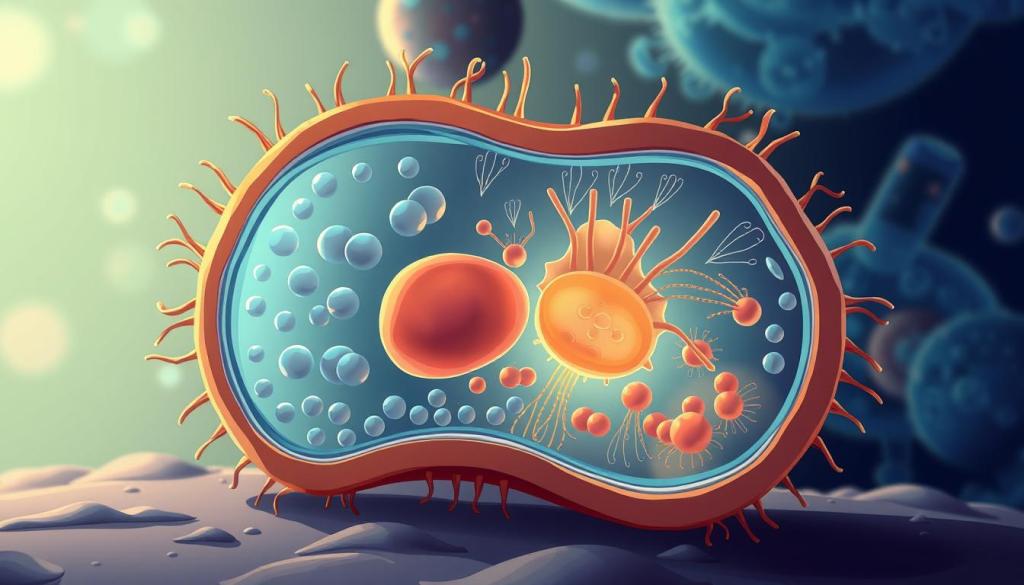
The bacterial cell membrane is key. It connects the inside of the cell to the outside world. This phospholipid layer is vital for many functions, like moving nutrients in and out, getting rid of waste, and making energy.
Cell Membrane Structure and Composition
The cell membrane has about 3 times more proteins than phospholipids. Its special mix lets it control what comes in and out. This structure is crucial for many important tasks:
- Nutrient absorption
- Waste elimination
- Energy transduction
- Signal reception and transmission
Cytoplasm: The Cellular Powerhouse
The cytoplasm is inside the cell membrane. It’s like a gel that holds all the cell’s important stuff. This includes ribosomes for making proteins and enzymes for metabolism.
Genetic Material Organization
Bacterial DNA is different from ours. They have one big circle of DNA in the nucleoid. Many also have plasmids, which add more genetic flexibility and help them survive.
Bacteria have been around for about 3.5 billion years. They show incredible genetic strength and ability to adapt.
Cell Wall Composition
Bacterial cell walls are key to a bacterium’s survival. They protect the cell and give it shape. The cell wall acts as a shield against harmful outside forces.
The structure of bacterial cells is complex, especially the peptidoglycan layer. About 90% of bacteria have a cell wall. It’s crucial for keeping the cell intact and alive.
Peptidoglycan Layer Fundamentals
Peptidoglycan is the main part of bacterial cell walls. It’s made up of:
- Glycan chains with GlcNAc and MurNAc
- Peptide bridges for strength
- Different levels of complexity in various bacteria
Variations Among Bacterial Cell Walls
Bacteria have different cell walls. There are two main types with unique features:
| Bacterial Type | Peptidoglycan Characteristics | Wall Thickness |
|---|---|---|
| Gram-Positive Bacteria | 90% peptidoglycan content | 20-80 nm thick |
| Gram-Negative Bacteria | 5-10% peptidoglycan content | 10-20 nm thick |
The unique makeup of the bacterial cell wall lets it handle high internal pressures, like a fully inflated car tire.
“The cell wall is not just a barrier, but a dynamic interface between the bacterial cell and its environment.” – Microbiology Research Journal
Types of Bacterial Cells
Bacterial cells come in many shapes, showing nature’s amazing diversity. Knowing about these shapes helps us understand how bacteria adapt and survive. Scientists have found three main types of bacterial shapes.
Cocci – Spherical Bacterial Cells
Cocci are round bacterial cells with special patterns. They can be:
- Monococcus: Single, round cells
- Diplococcus: Paired, round cells
- Streptococcus: Cells that form chains
- Staphylococcus: Cells that look like grapes
Bacilli – Rod-Shaped Bacterial Cells
Bacilli are long, rod-shaped cells with unique features. They can be:
- Individual rods
- Diplobacilli: Paired rods
- Streptobacilli: Rods in chains
- Coccobacilli: Short, oval rods
Spirilla – Spiral-Shaped Bacterial Cells
Spirilla have spiral shapes that help them fit into their environments. There are two main types:
- Spirillum: Rigid cells with flagella
- Spirochete: Thin, flexible bacteria often linked to diseases
*”Bacterial morphology reflects an extraordinary evolutionary strategy for survival and adaptation.”*
These different shapes show nature’s incredible design. They help bacteria live in many environments with their special structures.
Bacterial Cell Division
Single-celled organisms like bacteria have a unique way to reproduce. This method helps them grow their numbers quickly. It’s a biological process that lets these tiny beings multiply fast.
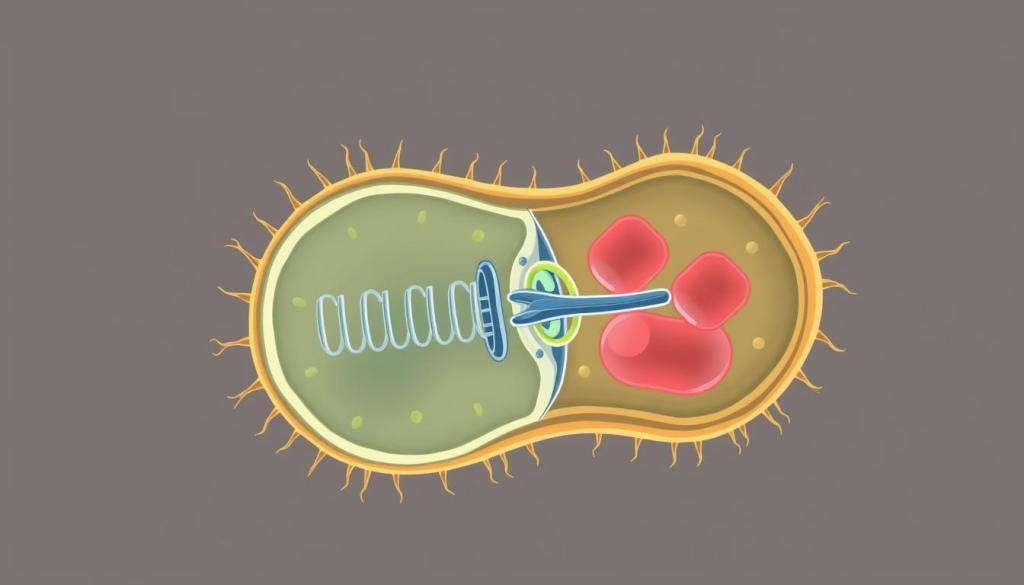
The main way bacteria reproduce is through binary fission. This is when one bacterial cell splits into two identical daughter cells. It’s a fast way for bacteria to make exact copies of themselves.
The Binary Fission Mechanism
Binary fission involves several important steps:
- DNA chromosome replication starts at the origin point
- Chromosomes move to opposite ends of the cell
- A protein ring called FtsZ forms to guide cell separation
- A septum forms to split the cell’s contents
Population Growth Dynamics
Bacteria can double their numbers in just 20 minutes when conditions are right. This fast growth lets them quickly adapt to their environment and spread out.
“Bacterial cell division is nature’s most elegant and efficient multiplication process.” – Microbiology Research Quarterly
The division process uses special proteins like FtsZ. These proteins work like tubulin in eukaryotic cells. They use GTP for energy to build and break down structures for division.
Metabolism of Bacteria
Bacterial cell function is a world full of metabolic diversity. Prokaryotic cells are very adaptable in making energy. They use different ways to survive in almost every place on Earth.
- Autotrophic bacteria make their own energy
- Heterotrophic bacteria use energy from outside
Energy Production in Autotrophic Bacteria
Autotrophic bacteria create energy in special ways. They can make nutrients using:
- Photosynthesis (energy from light)
- Chemosynthesis (energy from chemical reactions)
Heterotrophic Bacterial Energy Sources
Heterotrophic bacteria need outside organic compounds to live. They can break down complex molecules in many places, like soil and our guts.
| Bacterial Type | Energy Source | Primary Environment |
|---|---|---|
| Photosynthetic Bacteria | Sunlight | Aquatic Ecosystems |
| Chemosynthetic Bacteria | Inorganic Chemical Reactions | Deep Sea Vents |
| Heterotrophic Bacteria | Organic Compounds | Soil, Digestive Systems |
“Bacteria are nature’s ultimate survivors, transforming almost any environment into a potential habitat through metabolic innovation.”
Bacterial metabolism is key in ecological processes. It shows how these tiny organisms can adapt to many environments.
Cellular Reproduction in Bacteria
Bacterial cell division is a fascinating process. It drives population growth and survival. These tiny organisms have developed unique ways to multiply and create genetic diversity.
Bacteria mainly reproduce through asexual methods. Binary fission is the most common way. Under good conditions, bacteria can divide every 10-15 minutes. This creates two identical daughter cells from one parent cell.
Asexual Reproduction Mechanisms
The main way prokaryotic cells reproduce is through binary fission. This process includes several important steps:
- DNA replication in the bacterial chromosome
- Chromosome segregation to opposite cell poles
- Cell membrane pinching to create two separate cells
- Formation of genetically uniform daughter cells
Genetic Recombination Strategies
Bacterial cells can share genetic material in three main ways:
- Transformation: Direct DNA transfer between bacterial cells
- Transduction: Genetic exchange mediated by bacteriophage viruses
- Conjugation: Direct genetic material transfer via cellular connections
“Bacterial reproduction is a testament to the incredible adaptability of life at the microscopic scale.”
These methods ensure bacterial population growth and genetic variation. This adaptability helps prokaryotic cells thrive in various environments. They are among the most successful life forms on Earth.
Functions of Bacterial Structures
Bacterial cell anatomy is key to understanding how these tiny organisms live and grow. The detailed parts inside bacterial cells help them do important tasks. These tasks are vital for their survival.
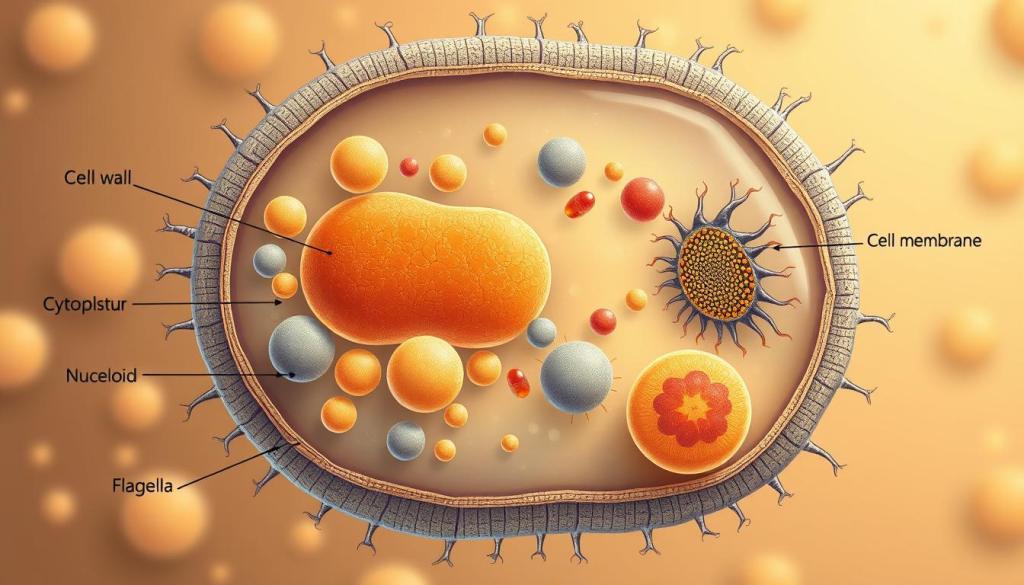
Several important parts work together in bacterial cells. These parts help support life processes. Ribosomes and flagella are two key structures. They play a big role in how bacteria survive and move around.
Ribosomes and Protein Synthesis
Ribosomes are tiny molecular machines in bacterial cells. An E. coli cell has about 20,000 ribosomes. They are smaller than those in eukaryotic cells. These structures are crucial for making proteins through several steps:
- Decode genetic information from messenger RNA
- Assemble amino acids into protein chains
- Support bacterial metabolic processes
Flagella and Bacterial Motility
Flagella are another vital part of bacterial cells. These hair-like structures help bacteria move. They also help them find their way around their environment.
| Flagella Characteristic | Description |
|---|---|
| Structure | Protein filament extending from cell body |
| Primary Function | Bacterial locomotion |
| Movement Mechanism | Rotational motion powered by molecular motor |
Flagella allow bacteria to move towards better places or away from danger. This movement is key for their survival. It helps them find food and avoid threats.
“The complexity of bacterial structures reveals nature’s remarkable engineering at the microscopic level.” – Microbiology Research Journal
Learning about these detailed structures helps us understand how bacteria adapt and thrive. They can survive in many different places.
Bacterial Adaptations
Bacterial cells have amazing ways to survive in harsh environments. These tiny cells have developed clever ways to protect themselves. They can live in places that are very hard for other living things.
Biofilm Formation
Biofilms are a key survival method for bacteria. They form when bacteria stick to surfaces and create a protective layer. This layer is made of many things that help the bacteria stay safe.
- Initial surface attachment
- Microcolony development
- Mature biofilm structure
- Potential dispersal
Resistance Mechanisms
Bacteria have many ways to fight off dangers. They can:
- Make a protective layer around themselves
- Change their DNA to adapt
- Become resistant to antibiotics
- Change how they use energy
| Adaptation Type | Mechanism | Survival Benefit |
|---|---|---|
| Capsule Production | Polysaccharide gel layer | Resistance to phagocytosis |
| Genetic Mutation | DNA sequence changes | Enhanced environmental tolerance |
| Metabolic Shift | Alternative energy pathways | Survival under nutrient scarcity |
“Bacterial adaptations represent nature’s most sophisticated survival blueprint.” – Microbiology Research Institute
Learning about these complex adaptations helps us understand how bacteria can survive in extreme conditions. It shows their incredible ability to adapt and thrive.
The Role of Bacteria in Human Health
Bacterial cells are key to our health, showing a complex mix of good and bad microbes. Knowing about their types helps us see how they work together in our bodies.
Bacteria are more than just invaders; they’re vital for our well-being. Our bodies have trillions of these cells that help us function.
Beneficial Bacteria: Microscopic Allies
Bacteria do many important jobs for us:
- They help our digestive system work right.
- They make nutrients we need.
- They boost our immune system.
- They keep bad microbes away.
Pathogenic Bacteria: Potential Health Threats
But, some bacteria can make us sick. Their structure lets them invade and harm our bodies.
“The difference between a friend and a foe lies in the subtle details of cellular organization.” – Microbiology Research Insights
Microbiome Significance
Science has shown how crucial bacteria are for our health. They affect:
- How we metabolize food.
- Our mental health.
- How our immune system grows.
- How our genes work.
Keeping a balance between good and bad bacteria is key. This balance is helped by good food, lifestyle, and knowing how microbes interact.
Conclusion on Bacterial Cell Types
Bacteria show us a world of tiny complexity. They are incredibly diverse and can live in extreme places. Their cells are designed to survive in harsh conditions.
Studies on bacterial cells reveal their wide range of sizes and shapes. From the tiny Mycoplasma pneumoniae to the huge Thiomargarita namibiensis, they vary greatly. This diversity helps them thrive in different environments.
Bacteria come in many shapes and sizes. They are mainly spherical, rod-shaped, or spiral. These shapes help them adapt to various places. Their cells also allow them to reproduce quickly and adapt to their surroundings.
Key Research Insights
Microbiology is always finding new things about bacteria. Future studies will look at bacteria in extreme places and how they form biofilms. They also want to find new uses for bacteria in synthetic biology.
Scientists are also interested in how bacteria resist antibiotics. They want to know more about their interactions with the environment. This could lead to new technologies.
Future Scientific Exploration
Studying bacteria will lead to exciting discoveries. New tools and methods will help us learn more about them. Bacteria have been around for over 3.5 billion years.
They continue to amaze us with their ability to survive and adapt. They play a key role in our ecosystems. Their study is crucial for understanding life on Earth.
FAQ
What makes bacterial cells unique compared to other cell types?
Bacterial cells are simple and efficient. They lack membrane-bound organelles and have a single chromosome. Their cell walls are made of peptidoglycan. These traits make them adaptable and efficient in many environments.
How do bacterial cells reproduce?
Bacteria reproduce by dividing into two identical cells. This process is fast, allowing them to grow quickly. They also share genetic material through conjugation, transformation, and transduction.
What are the main shapes of bacterial cells?
Bacterial cells come in three main shapes:
– Cocci: Spherical
– Bacilli: Rod-shaped
– Spirilla: Spiral
These shapes help us understand their ecological roles.
Do all bacteria have a cell wall?
Most bacteria have a cell wall, but it varies. Gram-positive and Gram-negative bacteria have different structures. The cell wall is important for shape and protection. Some bacteria, like mycoplasmas, don’t have a traditional cell wall.
How do bacterial cells generate energy?
Bacteria have different ways to make energy. Some make their own energy through photosynthesis or chemosynthesis. Others consume organic compounds. This diversity helps them thrive in many environments.
What role do bacterial cells play in human health?
Bacteria have a complex role in human health. Some are beneficial, aiding digestion and immune function. Others can cause diseases. The human body hosts trillions of bacteria, essential for health.
How do bacterial cells adapt to different environments?
Bacteria adapt in many ways. They form biofilms, produce capsules, and develop antibiotic resistance. They also adjust their metabolism to survive. These adaptations help them thrive in extreme environments.





Leave a Comment
Your email address will not be published. Required fields are marked *