



Ever thought about how scientists count tiny bacteria we can’t see? It’s a world of precision and complexity. They use special units to measure these tiny creatures.
Scientists use many ways to count bacteria, from old methods to new ones. They use different units to understand how many bacteria there are. This helps them study how bacteria grow and what they are like.
Bacteria are really small, about 1 micrometer. This makes it hard to measure them. But scientists have special ways like Colony Forming Units (CFU) and optical density to count them well.
Key Takeaways
- Bacterial measurement involves multiple precise scientific techniques
- Common units include Colony Forming Units (CFU) and optical density
- Measurement accuracy depends on specific research goals
- Techniques range from traditional plate counting to advanced molecular methods
- Microbial size (around 1 micrometer) requires specialized measurement approaches
Understanding Bacteria Measurement
Bacteria are tiny life forms found in many places. They live in soil, water, and even inside us. Despite being very small, they have big effects on our world.
Scientists have special ways to count bacteria. They use colony forming units (CFU) and most probable number (MPN). These methods help them understand how bacteria grow and affect us.
What Are Bacteria?
Bacteria are single-celled organisms that are everywhere. Here are some interesting facts:
- Estimated bacteria on Earth: approximately 5 x 10^30
- Bacteria per gram of soil: up to 40 million cells
- Average human body contains trillions of bacterial cells
“Bacteria are the oldest and most adaptable life forms on our planet.”
The Importance of Measuring Bacteria
Counting bacteria is key in many fields. In medicine, it helps find infections. Environmental scientists use it to study ecosystems. Food safety experts use it to check for contamination.
The best number of colonies to count is between 30-300. Researchers use serial dilutions from 10^-2 to 10^-8 for accurate counts.
Common Units of Measurement
Scientists have different ways to measure bacterial populations. Each method gives unique insights into how bacteria grow and how many there are. It’s important for researchers and microbiologists to know these methods.
Colony Forming Units (CFU)
Colony Forming Units show how many live bacterial cells can grow. The standard plate count method is a main way to measure CFU. Here are some key points:
- Acceptable colony range: 30-300 colonies per plate
- Dilution series typically ranges from 10^-4 to 10^-10
- Incubation periods: 25°C for 48 hours or 37°C for 24 hours
Microscopy Cell Counting
Microscopy cell counting lets researchers see bacterial populations directly. They use special tools like the Petroff-Hausser chamber for accurate counting. This method lets them examine individual bacterial cells closely.
Microscopic techniques enable researchers to observe bacterial morphology and concentration with exceptional precision.
Optical Density (OD) Measurements
Optical density measures how cloudy a bacterial solution is. It uses spectrophotometric analysis. Here are some important details:
- Wavelength measurement at approximately 600 nm
- Sensitive to bacterial concentrations of 10^7 cells per milliliter
- Quick method for estimating bacterial growth
These methods give researchers the tools they need to understand bacterial populations. They are used in many scientific fields.
Overview of Colony Forming Units (CFU)
Scientists use Colony Forming Units (CFU) to measure bacterial populations. This method helps them count living microorganisms. It gives them important information about bacterial growth and how many there are.

CFU shows the number of active, living microorganisms. These can grow and form colonies on growth media. This method directly shows how many bacteria can grow.
Definition of CFU
A Colony Forming Unit is a way to measure living bacterial or fungal cells. It has key features:
- Represents living microorganisms with reproductive capability
- Measured typically in billions
- Indicates potential bacterial population growth
How CFU is Measured
Measuring CFU involves a few steps:
- Prepare serial dilutions of bacterial samples
- Plate diluted samples on specialized agar media
- Incubate plates under controlled conditions
- Count visible bacterial colonies
Applications of CFU
CFU measurements are important in many areas:
| Domain | CFU Application |
|---|---|
| Medical Research | Tracking bacterial growth and interactions |
| Food Safety | Monitoring microbial contamination levels |
| Environmental Studies | Assessing microbial ecosystem dynamics |
“CFU provides a window into the microscopic world of bacterial populations, revealing their potential and limitations.” – Microbiology Research Journal
Understanding viable plate counts helps researchers make better decisions. It shows how important it is to measure bacteria accurately.
Measuring Bacterial Concentration
Scientists and doctors use advanced methods to measure how many bacteria there are. Techniques like flow cytometry and ATP bioluminescence help us understand bacteria better. They tell us about the number of bacteria and how active they are.
Bacterial Density in Research
Knowing how dense bacteria are is key in science. Flow cytometry is a top tool for counting bacteria fast and accurately. It lets researchers:
- Look at each bacterial cell
- Check if cells are alive
- See how cells work
- Count bacteria with great precision
Clinical Implications
ATP bioluminescence is a quick way to guess how many bacteria there are. Doctors use these methods to:
- Spot bacterial infections
- See if treatments work
- Check how patients react to antibiotics
Getting the exact count of bacteria is key to understanding them and finding the right treatments.
| Measurement Technique | Key Advantages | Primary Application |
|---|---|---|
| Flow Cytometry | High-resolution cell analysis | Research and clinical diagnostics |
| ATP Bioluminescence | Rapid metabolic activity assessment | Infection monitoring |
Scientists keep improving these methods. This helps us better understand and handle bacteria in many fields.
Optical Density in Bacterial Measurement
Scientists use optical density (OD) to measure bacterial populations. This method is quick and simple. It helps understand how bacteria grow and how many there are.
Optical density shows how much light a bacterial culture absorbs. Researchers use a spectrophotometer at 600 nm (OD600). This lets them quickly check how many bacterial cells there are.
Definition and Importance of Optical Density
OD measurements give important insights into bacterial growth. They help with:
- Quantifying bacterial population density
- Monitoring growth phases
- Assessing culture concentration
“Optical density offers a window into the invisible world of bacterial populations.” – Microbiology Research Journal
Limitations of Optical Density
Even though OD is widely used, it has big limitations:
- Unreliable at OD levels above 0.1
- Varies based on spectrophotometer configuration
- Cannot distinguish between live and dead cells
The connection between OD and cell concentration depends on many things. These include:
- Light path length
- Cell size
- Culture density
- Spectrophotometer calibration
Researchers must carefully interpret OD measurements, understanding their inherent limitations and context-specific variations. Precise calibration is key for accurate bacterial population assessments.
Alternatives to CFU and OD
Scientists are always looking for better ways to count bacteria. They want methods more accurate than Colony Forming Units (CFU) and Optical Density (OD). New techniques give deeper insights into how many bacteria are present.
Direct Cell Counting Methods
Microscopy cell counting is a key method for counting bacteria. It lets scientists see and count bacteria directly. They use special tools like:
- Hemocytometer chambers
- Automated cell counters
- Digital imaging systems

Advanced Molecular Techniques
qPCR is a cutting-edge way to count bacteria. It can find and count specific genes in bacteria. This method is very sensitive and can spot bacteria even when there are very few.
Flow Cytometry Analysis
Flow cytometry quickly analyzes many things about individual bacteria. It helps scientists:
- Check if cells are alive
- See how active cells are
- Look at what makes cells different
Viable Cell Counting
| Method | Advantages | Limitations |
|---|---|---|
| qPCR | High sensitivity | Requires specialized equipment |
| Microscopy | Direct visualization | Time-consuming |
| Flow Cytometry | Rapid multi-parameter analysis | Complex interpretation |
“Innovative bacterial measurement techniques provide unprecedented insights into microbial populations.” – Microbiology Research Institute
These new methods help scientists get a better understanding of bacteria. They offer more precise ways to study microbes.
Understanding Growth Curves
Bacterial growth curves are key to understanding how microbes grow and multiply. Scientists use these curves to track how many bacteria there are. They also study how populations change in different places.
Bacteria go through different growth phases. Each phase shows how microbes behave. These phases are important for studying bacterial life cycles.
Phases of Bacterial Growth
The growth curve of bacteria has four main phases:
- Lag Phase: Bacteria get ready to reproduce
- Exponential Phase: Bacteria multiply quickly
- Stationary Phase: Growth and death are balanced
- Death Phase: The number of living bacteria starts to go down
How Growth Curves Relate to Measurement
Knowing about growth curves helps us understand bacterial counts. In the exponential phase, bacteria grow fast. They can double every 15-20 minutes when conditions are right.
“The growth curve is a window into the complex world of bacterial population dynamics.” – Microbiology Research Insights
Scientists use different ways to track bacterial growth. These include:
- Colony Forming Units (CFU)
- Optical Density (OD600)
- Direct cell counting methods
Each method gives us special insights into bacterial growth. It helps scientists understand how bacteria behave at different stages of their lives.
Environmental Bacteria Measurement
Measuring bacteria in environmental samples is a big challenge. It needs special techniques because of the complex nature of these samples. These methods are different from the usual culturing ways.
Researchers use different units to measure bacteria in the environment. The most probable number (MPN) method is key for counting bacteria in hard-to-handle samples.
Specialized Techniques for Environmental Samples
There are many advanced ways to measure environmental bacteria:
- Molecular detection methods
- Culture-independent techniques
- Advanced microscopy
- Genetic sequencing
Ecological Relevance of Bacterial Measurements
Knowing how to measure bacteria is very important in ecological studies. These measurements help us understand:
- Nutrient cycling processes
- Microbial community dynamics
- Ecosystem health assessment
- Biodegradation potential
Environmental bacteria measurements reveal intricate microbial interactions that drive ecosystem functioning.
The most probable number (MPN) technique helps estimate bacterial amounts in tough environmental samples. It’s very useful for counting bacteria that can’t be cultured easily.
By using many measurement techniques together, scientists can get a full picture of bacterial distribution and their role in the ecosystem.
Measuring Bacteria in Food Safety
Food safety is all about precise measurements to keep us healthy. Scientists use complex methods to check for bacteria in food. This helps ensure food quality and keeps us safe from health risks.
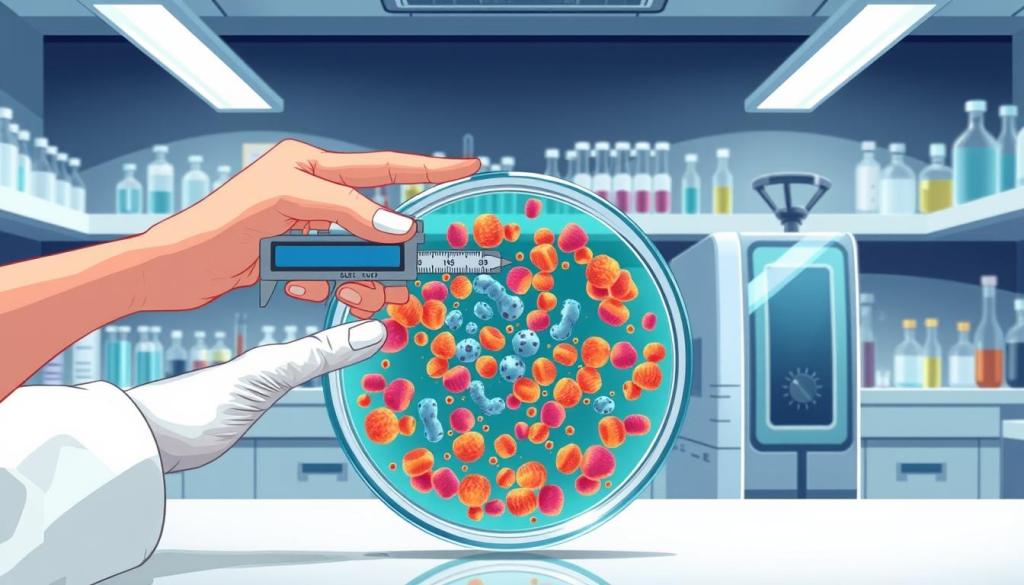
Today, food safety uses advanced ways to measure bacteria. Techniques like colony forming units (CFU) and ATP bioluminescence are key. They help us understand how much bacteria is in our food.
Critical Importance of Bacterial Measurement
Measuring bacteria is very important in food making:
- It helps find health dangers
- It makes sure food meets rules
- It checks food quality
- It stops food illnesses
Common Measurement Units in Food Microbiology
Experts use several ways to measure bacteria:
- Colony Forming Units (CFU/g): Counts living bacteria
- ATP bioluminescence: Finds bacteria fast
- Most Probable Number (MPN): Guesses how many bacteria there are
“Precision in bacterial measurement is the first line of defense in food safety.” – Food Science Research Institute
Labs use special ways to share their findings. For example, “100 CFU/g” means 100 bacteria per gram. They use logs to show big numbers, with each log being ten times more.
Advanced Detection Techniques
Today’s food safety rules focus on understanding how accurate these measurements are. New methods can spot bacteria quickly, often in just 24-48 hours. They say if bacteria are there or not.
Technology in Bacterial Measurement
Modern science has seen big steps forward in measuring bacteria. Now, scientists use advanced tools that make analysis faster and more accurate.
New technologies have changed how scientists study bacteria. Two big ones have made a huge difference:
Advanced Measurement Platforms
- Flow cytometry enables rapid cellular analysis
- qPCR provides precise genetic quantification
- Automated cell counters increase measurement efficiency
Technological Impact on Bacterial Research
Flow cytometry has changed the game for studying bacteria. Scientists can now look at thousands of bacteria at once. This gives them deep insights into microbial life. qPCR adds to this by detecting and counting genes at a molecular level.
“Technology is reshaping our understanding of bacterial dynamics through unprecedented precision and speed.” – Microbiology Research Consortium
Accuracy and Reproducibility
Technologies like flow cytometry and qPCR have made measurements more accurate. They cut down on mistakes and give consistent results. This is a big step up from old methods.
Some key improvements include:
- Real-time monitoring of bacterial growth
- Automated data collection
- Enhanced sensitivity in detecting low-concentration samples
Future Technological Directions
New tech like microfluidics and AI-assisted image analysis will keep changing how we study bacteria. These advancements will give us even more detailed information about microbes.
Research and Bacteria Measurement
Scientific research depends on accurate ways to measure bacteria. This helps us understand how microbes work and find new discoveries. Researchers use different methods to count and study bacteria. They make sure their findings are reliable and exact.
Measuring bacteria is key in many scientific fields. It ranges from basic microbiology to health research. Scientists use methods like viable plate counts and colony forming units (CFU) to measure bacteria.
Role of Measurement in Scientific Studies
Researchers follow strict measurement rules to get consistent results. They use several main ways to measure bacteria:
- Colony Forming Units (CFU)
- Cell Counts
- Optical Density (OD)
- Direct microscopic counting
Implications for Public Health
Measuring bacteria is vital for tackling public health issues. Viable plate counts are used to track:
- Antibiotic resistance patterns
- Pathogen detection in food and water
- Environmental microbiological assessments
- Disease transmission dynamics
Accurate bacterial measurement is the cornerstone of microbiological research and public health protection.
Today, research uses new technologies for better and faster bacterial measurement. These advancements help us learn more about microbes and their effects on health.
| Measurement Technique | Accuracy | Primary Application |
|---|---|---|
| Viable Plate Counts | High | Quantifying Live Bacteria |
| Optical Density | Medium | Growth Monitoring |
| Flow Cytometry | Very High | Detailed Cell Analysis |
Summary of Measurement Units
Bacterial measurement techniques have grown a lot. They now help researchers understand microbial populations better. From old-school microscopy to new tech, we can count cells with great detail. Now, we can spot bacterial levels from 10^5 to 10^8 cells per milliliter very accurately.
There are many ways to measure bacteria, each with its own benefits. For example, optical density can spot growth at around 10^7 CFU/ml. Meanwhile, tools like Archimedes can measure tiny masses with incredible precision. These tools help scientists learn more about bacteria’s mass, how well they’re doing, and what they’re like.
Key Takeaways
Choosing the right method to measure bacteria is key. It depends on the sample’s concentration, how precise you need to be, and what you want to find out. New tech keeps getting better, giving us clearer views of bacteria and how they work together.
Future Directions in Bacterial Measurement
Future tech will likely focus on analyzing single cells better, being more precise, and finding bacteria fast. New microscopy and molecular methods will change how we study bacteria. Scientists hope for tools that give quicker, more detailed info on bacterial groups in many fields.
FAQ
What are Colony Forming Units (CFU)?
Colony Forming Units (CFU) measure the number of live bacterial cells in a sample. They count the number of bacterial colonies that grow from a single cell on a solid medium. CFU is a key method for counting live bacteria in fields like microbiology, food safety, and medical research.
How do scientists measure bacterial concentration?
Scientists use several ways to measure bacterial concentration. These include Colony Forming Units (CFU), Optical Density (OD), and flow cytometry. They also use microscopy, ATP bioluminescence, and quantitative PCR (qPCR) for different purposes.
What is the difference between CFU and direct cell counting?
CFU counts only live bacteria that can reproduce and form colonies. Direct cell counting by microscopy can count both live and dead bacteria. CFU shows how many cells are actively reproducing, while direct counting gives a total cell count, including dead cells.
Why is accurate bacterial measurement important?
Accurate bacterial measurement is vital in many areas. It helps in medical diagnostics, food safety, environmental monitoring, research, and industrial processes. It ensures product quality and safety, and helps understand bacterial growth and behavior.
What is optical density (OD) in bacterial measurement?
Optical density (OD) measures bacterial concentration by how much light a bacterial suspension absorbs. It’s a quick way to monitor bacterial growth. However, it has limitations like not being able to tell if cells are live or dead, especially at high cell densities.
What challenges exist in measuring environmental bacteria?
Measuring environmental bacteria is challenging. Many can’t be cultured using traditional methods. There are diverse species in complex microbial communities. Environmental conditions affect survival, and molecular techniques like Most Probable Number (MPN) and qPCR are needed. Getting representative samples is also hard.
How are technological advances improving bacterial measurement?
New technologies are changing how we measure bacteria. They include automated cell counting systems, high-throughput flow cytometry, and advanced molecular techniques. AI-assisted image analysis, microfluidic technologies, and real-time monitoring are also improving.
What is the Most Probable Number (MPN) method?
The Most Probable Number (MPN) method estimates bacterial concentration in environmental and food samples. It’s used when cell numbers are low or variable. It involves dilutions and calculates the probable number of viable cells based on growth results.





Leave a Comment
Your email address will not be published. Required fields are marked *