



Ever wondered how precise measurements can change research? The serological pipette video guide will show you how to master lab tools with great accuracy.
Laboratory experts know that handling liquids is an art. A serological pipette is more than a tool—it’s key for finding new things. Scientists use these devices to move liquids from 0.1 to tens of milliliters very accurately.
This video guide will change how you see serological pipette techniques. It will help researchers and lab techs get better results. By learning these skills, you’ll make your experiments more reliable and repeatable.
Key Takeaways
- Learn essential techniques for accurate liquid transfer
- Understand the critical role of serological pipettes in laboratory equipment
- Discover how precision impacts scientific research
- Master proper handling and operation methods
- Reduce potential errors in experimental procedures
Introduction to Serological Pipettes
Serological pipettes are key tools in science and labs. They help move liquids with great accuracy. This makes them vital in many scientific fields.
Scientists use serological pipettes to measure and move liquids from 1 mL to 50 mL. Their design lets researchers do this safely and with little chance of contamination.
Definition and Core Purpose
A serological pipette is a special lab tool. It has:
- Clear milliliter (mL) graduations along the side
- The ability to transfer precise liquid volumes
- A sterile, single-use design for critical applications
Importance in Scientific Research
These tools are essential in many research areas, including:
- Cell Culture: Ensuring precise liquid transfers
- Microbiological Testing
- Medical Research
- Pharmaceutical Development
Most serological pipettes are made from polystyrene for one-time use or borosilicate glass for reuse. Their design helps keep experiments consistent and reduces errors.
Components of a Serological Pipette
Serological pipettes are key tools in cell culture labs. They help scientists move liquids with great precision. These pipettes come in many designs, each suited for different lab needs.
Knowing what makes up a serological pipette is crucial. It helps researchers pick the best tool for their work in life science videos and experiments.
Design Features
Serological pipettes have several important features:
- Graduated markings for accurate volume measurement
- Color-coded rings indicating specific volume ranges
- Smooth, sterile surface to prevent liquid contamination
- Ergonomic design for comfortable handling
Types of Serological Pipettes
There are two main types of serological pipettes:
- Disposable Plastic Pipettes
- Single-use design
- Reduces cross-contamination risk
- Available in volumes from 1 ml to 50 ml
- Reusable Glass Pipettes
- Can be sterilized and reused
- More environmentally friendly
- Suitable for specific chemical applications
Both types are made to give precise volumes. They range from 0.1 ml to 25 ml. This makes them vital for today’s scientific research.
Understanding Pipetting Techniques
Mastering pipetting techniques is key for those in biomedical training and scientific research. It’s all about precision and skill when working with delicate liquids in labs.

Successful liquid handling needs both technical knowledge and practice. Scientists must hone their skills to get accurate results.
Aseptic Technique Fundamentals
Keeping things sterile is crucial when working with sensitive biological samples. Proper pipetting techniques help avoid contamination by careful handling:
- Always use clean, sterile pipette tips
- Work in a designated clean environment
- Wear appropriate personal protective equipment
- Use gentle, controlled movements during liquid transfer
Consistent Pipetting Pressure
Getting accurate volume measurements means keeping pressure even. Researchers should aim for consistent technique through practice.
| Pipetting Parameter | Recommended Practice |
|---|---|
| Aspiration Speed | Slow and steady |
| Tip Immersion Depth | 1-2mm below liquid surface |
| Waiting Time | 1 second after liquid contact |
| Volume Adjustment | Clockwise turn method |
Regular practice in pipetting can greatly improve accuracy and cut down on errors. Professionals should focus on developing muscle memory through consistent training and mindful technique.
Preparing for the Video Demonstration
Scientific video tutorials need careful planning, especially for lab protocol demos. The success of any lab experiment depends on the right setup and safety steps.
Getting ready for a serological pipette demo involves key steps for accuracy and safety.
Required Equipment
First, collect these important items:
- Multiple sizes of serological pipettes
- Pipette dispenser
- Personal protective equipment (PPE)
- Clean workspace surface
- Sterile containers
Laboratory Safety Protocols
Safety is crucial in scientific videos. Researchers must focus on personal protection and precise methods.
- Wear proper protective eyewear
- Use disposable gloves
- Work in a clean, organized area
- Check equipment calibration
- Follow standard hygiene practices
Choosing the right pipette tips is key. Studies show that up to 50% of pipetting errors come from bad tips. Using high-quality, recommended tips can lower experiment errors.
Precision starts with preparation: A tidy workspace is key to successful scientific demos.
By carefully preparing equipment and following strict safety rules, researchers can make reliable and educational lab demos. These demos show off professional scientific skills.
Step-by-Step Guide to Using a Serological Pipette
Learning to use serological pipettes is key for accurate lab work. These tools help scientists move liquids with great precision. They can handle volumes from a few microliters to 100 milliliters.
Watching a serological pipette video can help you learn the right way to use it. This is important for getting reliable results in your science work.
Preparation of the Pipette
Choosing the right pipette is the first step in your lab work. Here are some important tips to follow:
- Choose a pipette that fits your volume needs
- Check the pipette for any damage
- Make sure it’s clean and sterile
- Connect it to a pipette controller
Drawing Up Liquid
Aspirating liquid needs precision and the right technique:
- Hold the pipette straight up at a 90-degree angle
- Press the plunger gently to the first stop
- Put the tip just below the liquid’s surface
- Slowly let go of the plunger to take in the liquid
Dispensing Liquid
The last step is to dispense the liquid carefully:
- Place the pipette tip against the container
- Release the plunger smoothly
- Make sure all the liquid is transferred
- Touch the tip to the container wall to get rid of extra droplets
Pro tip: Practice using the same pressure and technique to reduce measurement errors in your lab work.
Common Mistakes When Using Serological Pipettes
Working with microbiology tools and cell culture instruments needs precision. Serological pipettes require careful handling for accurate research. Lab professionals often make mistakes that can ruin experiments.
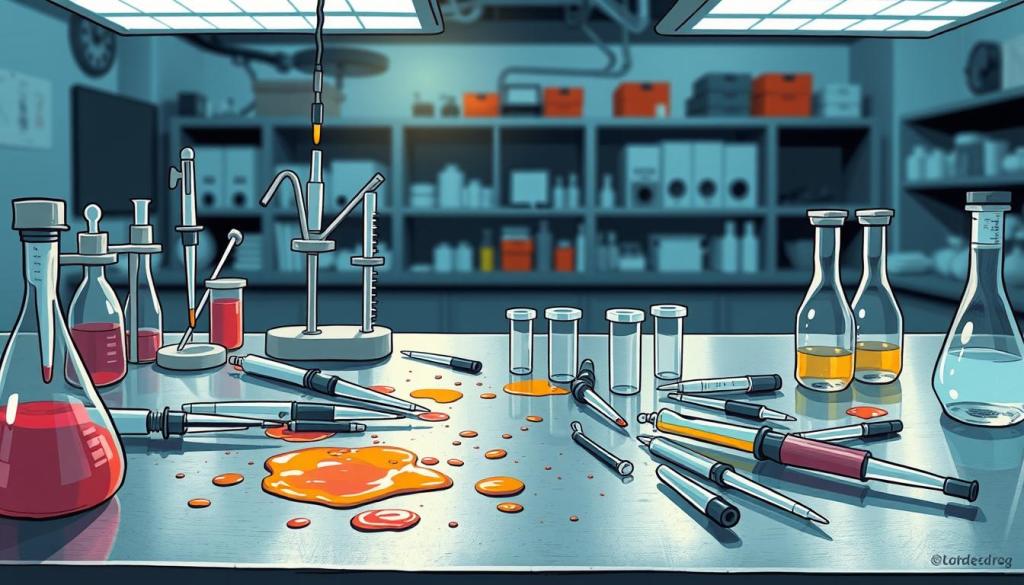
Knowing these mistakes helps keep lab work high quality. Here are some errors that can mess up results:
- Overfilling the pipette tip
- Incorrect pipetting angle
- Inconsistent dispensing technique
- Failing to pre-wet pipette tips
Consequences of Overfilling
Overfilling serological pipettes is risky for contamination and wrong measurements. Small volume pipetting involves volumes from 0.2 to 20 μL. Precision is key here.
| Mistake | Potential Consequences |
|---|---|
| Overfilling | Contamination risks, volume inaccuracy |
| Incorrect Angle | Altered sample volume, reduced precision |
| No Pre-Wetting | Increased evaporation, lower delivery volumes |
Improper Angle Techniques
Keeping a consistent pipetting angle is vital for accurate handling. Introducing an angle during pipetting can change the aspirated volume, especially for samples smaller than 50 μL. A steady, vertical approach is best to avoid errors.
By avoiding these mistakes, lab professionals can make their work more reliable. This ensures more consistent and valuable scientific research.
Maintaining and Cleaning Serological Pipettes
Keeping serological pipettes in good shape is key for accurate results in life science videos and training. Labs need precise liquid handling. So, taking care of pipettes is vital for researchers and technicians.
Different pipettes need different care. It’s important for researchers to know how to take care of both disposable and reusable ones. This keeps their work reliable.
Critical Cleaning Considerations
Effective pipette care includes several important steps:
- Find and remove contaminants like:
- Radioactive compounds
- Viruses
- DNA/RNA
- Aqueous solutions
- Clean pipettes based on their use
- Use the right ways to decontaminate
Decontamination Techniques
Lab workers have many ways to decontaminate:
- Chemical Decontamination
- 10% bleach solution for DNA/RNA removal
- Soak in sodium hypochlorite for 15 minutes
- UV Radiation Method
- 300 nm UV light for 15-60 minutes
- Reduces contamination risks
Best Practices for Pipette Care
Researchers should follow these key care tips:
- Make sure pipette parts are dry
- Use ultrasonic cleaning for single-channel pipettes
- Limit soaking for multichannel pipettes
- Get professional help if unsure about care
By following strict cleaning and maintenance rules, scientists can ensure their results are trustworthy in life science videos and training.
Troubleshooting Serological Pipette Issues
Mastering serological pipette techniques is key to lab precision. Scientific video tutorials show common challenges in liquid handling. Knowing these issues can greatly improve lab work and accuracy.
Air bubbles are a big problem for reliable measurements. Most bubble issues come from operator mistakes. This can harm research results.
Identifying Air Bubbles
To spot air bubbles, you need to watch closely and use certain methods:
- Look at the pipette tip before you use it
- Check if the liquid column looks odd
- See if the tip looks clear of air pockets
Preventing Liquid Retention
To handle liquids well, you need to avoid retention and boost accuracy:
- Aspire liquids slowly and carefully
- Make sure the tip is fully in the liquid
- Choose the right pipette tip for the job
| Pipette Volume Range | Recommended Immersion Depth | Bubble Prevention Strategy |
|---|---|---|
| 1 – 100 µl | 2 – 3 mm | Slow aspiration |
| 100 – 1,000 µl | 2 – 4 mm | Pre-wet tip |
| 1,000 – 5,000 µl | 2 – 5 mm | Reverse pipetting |
Pro tip: Training staff often and using top-notch polypropylene tips can cut down on pipetting mistakes and air bubbles a lot.
The Role of Serological Pipettes in Research
Serological pipettes are key in scientific progress. They help in precise liquid handling in labs. This is crucial for complex experiments.
Scientific breakthroughs need exact pipetting. Serological pipettes help in this. They allow for the accurate handling of tiny liquid amounts.
Applications in Medical Laboratories
Medical labs use serological pipettes for many important tasks:
- Cell culture preparation
- Sample allocation for diagnostic testing
- Creating density gradients
- Cell isolation procedures
Contribution to Scientific Discovery
Serological pipettes are vital in many scientific areas:
| Research Field | Specific Application |
|---|---|
| Microbiology | Bacterial colony transfer |
| Immunology | Antibody concentration measurements |
| Cancer Research | Cellular mutation studies |
These pipettes can handle liquids from 0.1 milliliters to tens of milliliters. They are essential for precise work in labs. This helps in many scientific discoveries.
Conclusion: Mastering Serological Pipette Use
Getting better at using lab equipment takes time and effort. Serological pipettes are key tools in microbiology that need skill and careful technique.
To get good at using serological pipettes, you need to learn a few important things:
- Develop a consistent technique
- Keep your equipment in top shape
- Keep improving your skills
- Always aim for accuracy
Key Performance Insights
When using these important tools, scientists should pay attention to a few key areas:
| Pipette Size | Volume Range | Accuracy Margin |
|---|---|---|
| 1 mL Pipette | 1-2 mL | ±0.02 mL |
| 50 mL Pipette | 10-50 mL | ±0.60 mL |
Skill Progression Strategy
Getting better at lab equipment needs a plan. Practice makes perfect. Scientists should see every chance to practice as a way to get better.
- First, learn the basics
- Watch how experts do it
- Practice a lot
- Learn from small mistakes
- Keep up with new tech
Mastery is not about being perfect, but about always getting better.
Getting good at using serological pipettes is a never-ending journey. See every challenge as a chance to grow in your science career.
Additional Resources
Researchers and lab professionals can find many educational materials to improve their skills with cell culture instruments. These resources help make working with serological pipettes more precise and effective. They are key to mastering the techniques needed in labs.
For those who learn better by watching, life science videos are a great resource. They show how to do pipetting techniques step by step. Scientific journals and online learning sites offer detailed tutorials on everything from basic to advanced techniques.
Online training, webinars, and guides from top research institutions are also available. They cover important topics like using pipettes correctly and avoiding injuries. By learning more, scientists can keep up with new technologies and improve their work.
Lab workers should use academic databases, recordings from scientific conferences, and special online platforms. These help deepen their understanding of pipette techniques. Spending time on these resources can lead to better skills and more accurate research.
FAQ
What is a serological pipette?
A serological pipette is a tool for precise liquid handling in labs. It has graduated markings and is made of plastic or glass. It’s used in research, medical tests, and cell cultures.
How do I choose the right size of serological pipette?
Choose a pipette based on the liquid volume you need. They range from 1 mL to 50 mL. Pick one where your volume is in the middle third for best accuracy.
What are the key differences between disposable and glass serological pipettes?
Disposable plastic pipettes are single-use and sterile. They reduce contamination risks. Glass pipettes are reusable and eco-friendly. They’re used in research and can be cleaned well.
How can I prevent air bubbles when using a serological pipette?
To avoid air bubbles, use a steady, gentle motion. Hold the pipette straight and don’t draw liquid too fast. Make sure the tip is fully in the liquid. If bubbles appear, tap the pipette or try again.
What personal protective equipment (PPE) should I wear when using serological pipettes?
Wear lab coats, gloves, and safety glasses. You might need more protection, like face shields, for dangerous materials.
How often should serological pipettes be calibrated?
Reusable glass pipettes need annual calibration or as the maker suggests. Disposable ones come pre-calibrated. Check them visually often to keep them accurate.
What are the most common mistakes when using serological pipettes?
Don’t hold the pipette wrong, use uneven pressure, or touch the tip. Not pre-wetting or not being clean can also cause problems. These mistakes lead to wrong measurements and contamination.
How do I properly clean and maintain a reusable serological pipette?
Wash glass pipettes right after use with lab cleaners. Rinse with distilled water and sterilize. Check for damage before each use and replace if needed.
Can serological pipettes be used for different types of liquids?
Serological pipettes work well with water-like liquids. But, they’re not for thick or harmful substances. Always check if it’s safe before using.
What scientific disciplines commonly use serological pipettes?
Many fields use serological pipettes, like microbiology and cell culture. They’re also used in immunology, molecular biology, and more. Their precision is key for accurate work.






Leave a Comment
Your email address will not be published. Required fields are marked *