



Ever thought about how scientists mix samples in complex experiments? The laboratory orbital shaker is key. It offers unmatched mixing skills in many research areas.
Laboratory orbital shakers mix samples in a circular motion. They make sure everything in culture dishes, flasks, and beakers is mixed well. This makes sample preparation reliable and consistent.
Today’s research needs to be very precise. Laboratory orbital shakers meet this need. They create controlled motion. This helps keep cell cultures, chemical reactions, and analytical processes at their best.
Key Takeaways
- Laboratory orbital shakers provide consistent and precise sample mixing
- Versatile equipment used across multiple scientific disciplines
- Enables uniform agitation for complex research protocols
- Supports advanced research methodologies
- Critical tool for maintaining experimental integrity
Introduction to Laboratory Orbital Shakers
Laboratory orbital shakers are key tools in scientific research. They offer precise mixing across many fields. These tools move smoothly, which is vital for many biological and chemical tasks.
Today’s biological labs use orbital mixers a lot. They move in circles to mix samples well without harming them.
Definition and Core Functionality
An orbital shaker mixes samples with gentle circular motion. It has important features like:
- Consistent circular motion at controlled speeds
- Ability to accommodate multiple vessel types
- Precise speed and direction adjustments
- Minimal sample disturbance during mixing
Applications in Life Sciences
Biological shakers are crucial in many scientific areas. They help with:
- Microbiology: Growing bacteria
- Cell Biology: Keeping cells mixed
- Molecular Research: Studying proteins
- Biochemical Analysis: Mixing solutions
| Research Field | Primary Orbital Shaker Application | Typical Speed Range |
|---|---|---|
| Microbiology | Bacterial Culture Propagation | 100-250 RPM |
| Cell Biology | Cell Suspension Maintenance | 50-200 RPM |
| Molecular Research | Protein Expression Studies | 75-300 RPM |
These tools help with uniform mixing. They make experiments more reliable. They support detailed research in many fields.
Key Features of Laboratory Orbital Shakers
Laboratory orbital shakers are key tools in scientific research. They offer advanced mixing capabilities for various experiments. These tools let researchers control sample mixing and conditions precisely.
Speed and Motion Control
The quality of a benchtop orbital shaker depends on its motion control. It can adjust speeds from 30 to 300 rpm. This range supports both gentle and intense mixing needs.
- Precise speed settings for different sample types
- Uniform circular orbital motion
- Digital displays for accurate speed monitoring
Capacity and Design Variations
Incubator shakers vary to meet different research needs. They range from small microplate platforms to big culture containers. These designs are flexible and adaptable.
- Multiple platform sizes
- Adaptable for different sample volumes
- Compact and space-efficient designs
Temperature Control Options
Advanced laboratory orbital shakers have top-notch temperature control. Precision temperature control is vital for keeping sensitive biological experiments at the right temperature. This includes cell culture and enzyme kinetics.
“Temperature stability is crucial for reproducible scientific results.” – Research Laboratory Standards Manual
- Built-in heating and cooling systems
- Digital temperature regulation
- Consistent environmental conditions
Benefits of Using Laboratory Orbital Shakers
Laboratory orbital shakers have changed scientific research a lot. They offer unmatched mixing abilities in many biological fields. These tools give researchers big advantages that make their work more precise and reliable.

More and more research labs use cell culture shakers and microplate shakers. These devices are key to getting better results. Here’s why they’re so important:
Enhanced Mixing Efficiency
Orbital shakers move in a smooth, steady way. This makes sure samples mix well. The main benefits are:
- Even distribution of nutrients in cell cultures
- Better oxygen for biological samples
- Control over how much and how long to shake
- Gentle shaking for delicate biological materials
Consistency in Sample Preparation
Getting the same results is key in science. Microplate shakers help a lot by:
- Keeping mixing the same way every time
- Lowering mistakes in making samples
- Allowing exact control over shaking speed and time
- Working with many different research methods
Reduced Risk of Contamination
Today’s cell culture shakers are designed to keep samples safe. They have sealed areas, easy-to-clean surfaces, and controlled environments. This keeps sensitive biological samples safe.
By choosing top-notch laboratory orbital shakers, scientists can greatly improve their work. They can make sure their data is reliable and make complex research easier.
Choosing the Right Laboratory Orbital Shaker
Choosing the right orbital shaker is key for good scientific research. It’s important to think about what your lab needs. This ensures your experiments work well.
When picking a benchtop incubator shaker, several factors matter a lot. These factors can really affect how well your research goes.
Essential Factors to Consider
When looking at orbital shakers, there are a few important things to check:
- Platform size and load capacity
- Speed range capabilities
- Temperature control requirements
- Specialized environmental needs
Types of Orbital Shakers Available
There are many types of orbital shakers for different research needs:
- Benchtop incubator shakers for small spaces
- Floor models for more stuff
- CO2-resistant units for special needs
- Refrigerated shaking platforms
“The right orbital shaker transforms experimental precision from possibility to reality.” – Research Laboratory Insights
Matching Shaker to Research Requirements
Different research needs different shakers. Microplate shakers are great for lots of tests at once. Big models are better for lots of cells.
Think about the shaker’s orbital diameter, max speed, and temperature range. For example, bacteria need 250 rpm, but some staining needs only 15-70 rpm.
By looking at your research and what the shaker needs, you can pick the best one. This will help your experiments succeed and work more efficiently.
Maintenance and Care for Orbital Shakers
Keeping laboratory orbital shakers in good shape is key for reliable results in biological research. These tools are crucial for scientists to get accurate data. So, regular upkeep is a must for lab management.
- Do monthly cleaning and disinfection
- Check platform and flask clamp screws often
- Make sure to know the weight limits before using
- Calibrate speed and temperature every year
Routine Cleaning Practices
Cleaning your orbital shaker right is essential. 70% ethanol is best for cleaning surfaces. Here’s how to do it:
- Take out all samples and accessories
- Wipe down surfaces well
- Let it dry completely
- Look for any damage
“Regular upkeep stops equipment failures and keeps research quality high.” – Laboratory Equipment Management Guide
Troubleshooting Common Issues
Scientists might face some common problems with orbital mixers. Fixing these issues quickly helps avoid bigger problems:
- Uneven shaking means the platform might be off
- Strange noises could mean worn belts or parts
- Temperature changes might need calibration
Having a set maintenance plan keeps your orbital shaker in top shape. This supports your research and makes your equipment last longer.
Safety Precautions with Laboratory Orbital Shakers
Laboratory safety is key when using advanced tools like biological shakers. It’s important for researchers to know the safety rules. This keeps them safe and their work accurate.
Using a lab shaker needs careful attention to safety rules. The wrong use can harm both the person and the research.
Best Practices for Safe Operation
- Always wear the right personal protective equipment (PPE)
- Check the biological shaker before each use
- Make sure the load is balanced to avoid damage
- Keep your workspace clean and organized
“Safety in the laboratory is not an option, it’s a necessity.” – Scientific Research Principles
Researchers must stick to strict rules when using orbital shakers. About 50% of lab accidents can be stopped with the right training and safety rules.
Importance of Proper Training
| Training Aspect | Safety Impact |
|---|---|
| Equipment Handling | Reduces risk of personal injury by 75% |
| Contamination Prevention | Minimizes sample loss and research disruption |
| Emergency Procedures | Ensures quick response to potential hazards |
Proper training is very important. Only qualified and trained laboratory personnel should use lab shakers. Important safety tips include:
- Turn off power during breaks
- Stay away from moving parts
- Wear protective clothes
- Do regular equipment checks
Knowing the risks of biological shakers is vital. Damage or injury can be greatly lowered with good safety education and following rules.
Innovations in Laboratory Orbital Shaker Technology
The world of lab equipment is changing fast, with orbital shakers leading the way. Today’s research needs tools that are precise, connected, and smart.
Scientific progress has turned simple mixers into powerful research tools. The newest orbital shakers bring advanced tech to labs. They make work more efficient and help manage data better.
Automation and Smart Features
Today’s orbital shakers have amazing features:
- Digital touch controls with programmable settings
- Remote monitoring through mobile apps
- Precise speed control and shaking patterns
- Real-time tracking of performance
Laboratory Information Management System Integration
Thermo Fisher Scientific has made lab equipment more connected. Their orbital shakers now work with LIMS systems. This means:
- Automatic logging of data
- Tracking of experimental conditions
- Better reproducibility of research
- Improved workflow management
The global lab shaker market is expected to grow 7% each year. This shows the need for advanced tech in science.
Case Studies in Research Applications
Laboratory orbital shakers are key in advancing biological research. They help scientists do complex experiments with great precision. These tools are vital in labs for microbiology and molecular biology.
Microbiology Research Applications
In microbiology, orbital shakers are crucial. They help researchers create strong experimental plans. Microplate shakers are used to improve bacterial growth and study microbial interactions.
- Bacterial culture optimization
- Biofilm formation studies
- Fermentation process monitoring
Biochemistry Experimental Techniques
Biochemists use cell culture shakers for important research. These tools help with enzyme studies and protein folding. Specific research techniques involve:
- Recombinant protein production
- Enzymatic reaction monitoring
- Complex protein interaction investigations
Molecular Biology Innovations
Molecular biology researchers rely on advanced orbital shakers. These instruments aid in DNA extraction, plasmid preparation, and cell lysis. They help achieve high precision in sample preparation.
Comparisons with Other Mixing Equipment
Laboratory researchers have to make important choices when picking the best mixing gear for their studies. Knowing the differences between various mixing techs is key to better results and more efficient research.
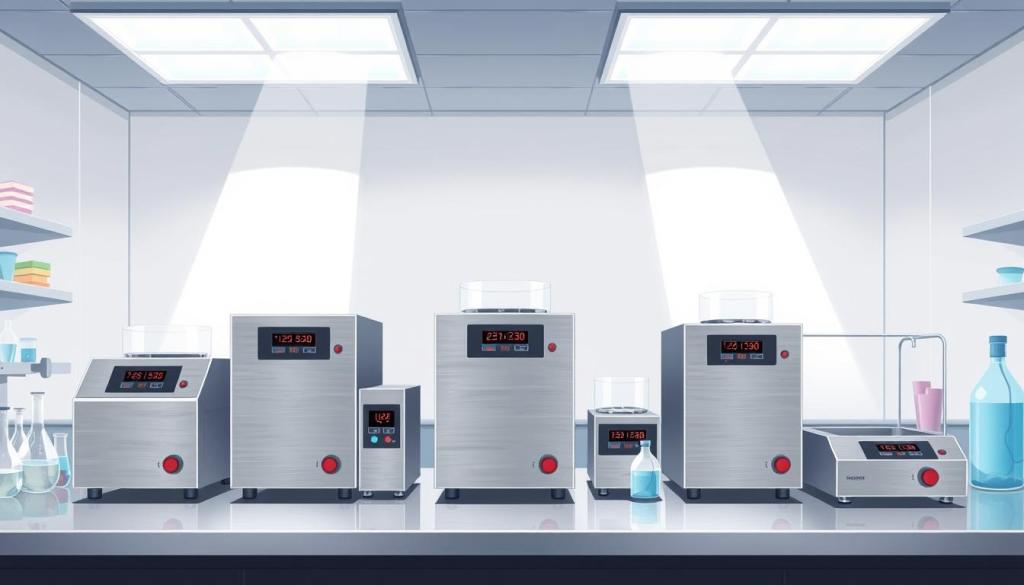
Each mixing device has its own role in science. A detailed comparison shows how lab orbital shakers differ from other mixing tools.
Orbital Shakers vs. Vortex Mixers
Orbital shakers and vortex mixers work in different ways:
- Motion Type: Orbital shakers move in circles, while vortex mixers spin fast in circles
- Sample Volume: Lab shakers can handle up to 2 liters, vortex mixers work with 10-15 ml
- Speed Range: Orbital shakers go from 100-3000 rpm, vortex mixers from 100-3200 rpm
Orbital Shakers vs. Reciprocal Shakers
Orbital and reciprocal lab shakers have main differences:
- Mixing Mechanism: Orbital shakers move in circles, reciprocal shakers move back and forth
- Sample Handling: Orbital shakers mix gently, great for cell cultures
- Temperature Control: Advanced orbital shakers can control temperature from 4°C to 80°C
Choosing the right lab orbital shaker depends on your research needs, the samples, and your experiment’s details.
Future Trends in Laboratory Orbital Shaker Design
The world of lab equipment is changing fast, with orbital and incubator shakers leading the way. New designs in benchtop orbital shakers are set to change science in many fields.
New tech is making lab shakers smarter. IoT and data analytics let researchers watch and control experiments from afar. Companies like Thermo Fisher and Eppendorf are adding smart features. These features track experiments in real-time, turning simple mixers into high-tech tools.
Now, making lab equipment green is key. Future incubator shakers will use eco-friendly materials and save energy. This green push is making shakers better for the planet without losing their power.
The market for automatic orbital shakers is growing, especially in pharma and biotech. Labs want versatile tools that meet their complex needs. This means lab shakers will soon be more advanced, connected, and ready for whatever science throws at them.
FAQ
What is a laboratory orbital shaker?
A laboratory orbital shaker mixes biological samples in a circular motion. It ensures consistent agitation for research. This helps mix liquids in containers evenly, controlling speed and temperature.
What are the primary applications of orbital shakers in biological research?
Orbital shakers are key in many research fields. They help in microbiology, cell culture, molecular biology, biochemistry, and fermentation. They mix samples well, ensuring oxygen and nutrients are evenly distributed.
How do I choose the right orbital shaker for my research?
When picking an orbital shaker, look at speed range, load capacity, and temperature control. Also, consider the orbit diameter and your research needs. Choose from benchtop, floor models, microplate shakers, or specialized ones.
What maintenance is required for a laboratory orbital shaker?
Keep your shaker clean and check its parts regularly. Lubricate moving parts and check calibration. Also, address any unusual noises or performance issues. Annual professional service is recommended for best performance.
What safety precautions should be observed when using an orbital shaker?
Ensure proper load balancing and secure container attachment. Use safety features like lid locks. Wear protective gear and train users. Regularly inspect the device for mechanical issues.
What is the difference between orbital and reciprocal shakers?
Orbital shakers move in circles, mixing gently. They’re best for cell cultures and delicate samples. Reciprocal shakers move back and forth, mixing more aggressively. They’re good for faster homogenization of some samples.
Can orbital shakers be used for temperature-sensitive experiments?
Yes, many orbital shakers have precise temperature control. This is great for experiments needing constant temperature. It’s useful for bacterial growth, enzyme studies, and cell culture.
What technological innovations are emerging in orbital shaker design?
New features include automated systems and remote monitoring. There’s also integration with LIMS, mobile device control, and energy-efficient designs. These innovations aim to improve performance and reduce environmental impact.
How do orbital shakers contribute to research reproducibility?
Orbital shakers ensure consistent mixing, which is key for reproducible research. They maintain precise speed and temperature, reducing contamination risks. This makes research outcomes more reliable.
What are the typical speed ranges for laboratory orbital shakers?
Orbital shakers usually operate between 20 to 300 RPM. Some models offer wider ranges. The speed needed depends on the research, sample type, and mixing intensity required.





Leave a Comment
Your email address will not be published. Required fields are marked *