


Ever wondered about the cells that keep our body’s tissues together? Fibroblasts are the hidden heroes of connective tissue cells. They are key in keeping and fixing our body’s structure.
Fibroblasts are the main cells of connective tissue. They act as the builders of our body’s framework. They make a complex matrix of over 300 proteins, vital for tissue growth and fixing.
So, what kind of cells are fibroblasts? They are mesenchymal cells that build the structure of connective tissues in many organs. Their main protein, collagen type 1, is the core of our body’s structure.
Fibroblasts are very flexible, working in different types of tissues. They create complex signals to keep tissues healthy. This makes them very important for our body’s balance.
Key Takeaways
- Fibroblasts are primary connective tissue cells
- They produce over 300 different extracellular matrix proteins
- Collagen type 1 is their most significant protein output
- Fibroblasts exist in multiple tissue types
- They play crucial roles in tissue development and repair
Introduction to Fibroblasts
Fibroblasts are key cells in our bodies, making up connective tissues. They were first found in 1858 by Rudolf Virchow, a German pathologist. These cells are vital for keeping tissues strong and working right.
Defining Fibroblasts: Nature’s Tissue Architects
Fibroblasts are special cells that make and keep the extracellular matrix. They are among the most common cells in connective tissues. They do more than just hold things together.
- Produce key matrix components like collagen
- Migrate as individual cells
- Respond to tissue damage signals
- Synthesize critical proteins for tissue repair
Importance in Biological Systems
Fibroblasts are very important. They help with healing, growing new tissue, and keeping things in place. They do this by making collagen and managing the extracellular matrix.
Fibroblasts are not just passive structural elements, but active participants in complex cellular communications and tissue maintenance.
Fibroblasts can change and react to their surroundings. They can even turn into different types of cells. They are key players in how our bodies work, making proteins and forces that help us stay healthy.
The Role of Fibroblasts in Connective Tissue
Fibroblasts are vital for keeping our connective tissues healthy and repairing them when needed. These cells are key in making structural proteins. These proteins give strength and support to our tissues.
Types of Connective Tissue
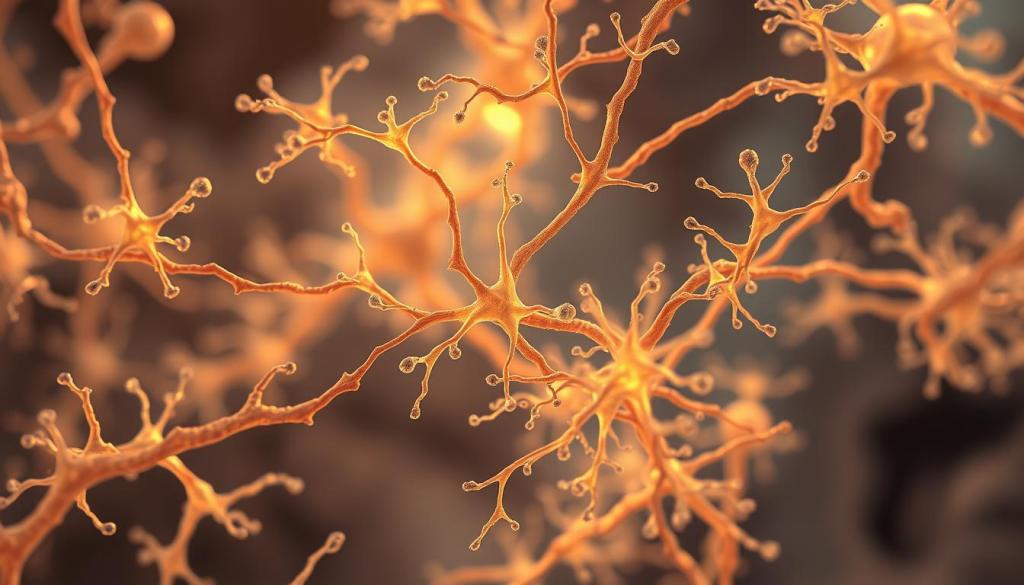
There are many types of connective tissue in our bodies. Fibroblasts are important in this group. They make essential parts like:
- Collagen-rich extracellular matrix
- Elastic fibers
- Glycosaminoglycans
- Reticular fibers
Function in Tissue Repair
Fibroblasts are very good at fixing wounds. They grow and move to the injury site. There, they make a lot of collagen to help fix the tissue.
“Fibroblasts are the architects of tissue regeneration, transforming and responding to local biological signals.”
The healing of a wound goes through three main stages. In each stage, fibroblasts play a big role:
- Inflammation phase
- Proliferation phase (lasting 2-3 weeks)
- Remodeling phase (can extend over a year)
The proteins made by fibroblasts are key to how well a wound heals. Myofibroblasts, a special type, help close the wound by pulling it together. They are influenced by TGF-β, which helps make collagen and scar tissue.
Studies show that how well fibroblasts work can affect healing. Problems can happen if they don’t work right.
Fibroblast Differentiation
Fibroblasts are amazing cells that help fix and work in tissues. They change in complex ways to fit their surroundings.
Fibroblast differentiation is a detailed process. It lets these cells get special traits for their tissue needs. Knowing this helps us understand how cells adapt and heal tissues.
Cellular Transformation Mechanisms
Fibroblast function includes several important steps:
- Epithelial to mesenchymal transition
- Bone marrow-derived cell migration
- Mechanical stress-induced phenotype changes
Factors Influencing Differentiation
Many things affect how fibroblasts change, such as:
- Growth factor stimulation
- Mechanical environmental signals
- Inflammatory cytokine interactions
| Differentiation Factor | Impact on Fibroblast |
|---|---|
| TGF-β Pathway | Triggers myofibroblast transformation |
| Mechanical Stress | Induces cytoskeletal remodeling |
| Inflammatory Signals | Modifies cellular phenotype |
“Fibroblasts show incredible flexibility, changing their cell traits in response to complex signals.” – Research Insights
Tissue repair relies heavily on fibroblast differentiation. Cells adjust their shape and function to help heal and keep tissues strong.
Cellular Structure of Fibroblasts
Fibroblasts are key cells in connective tissue. They help keep our bodies strong. Their unique shape lets them do important jobs in growing and fixing tissues.

Morphological Characteristics
Fibroblasts look different from other skin cells. They have a long, spindle shape with a big nucleus. They also have lots of cytoplasm and extensions.
- Elongated, irregular cell shape
- Prominent nucleus with multiple nucleoli
- Extensive cytoplasmic extensions
Key Organelles and Functional Components
Fibroblasts have a lot of machinery inside them. The rough endoplasmic reticulum (RER) is especially important. It helps make proteins for the tissue outside the cell.
“The cellular structure of fibroblasts reflects their remarkable capacity to synthesize and modify connective tissue components.”
The main parts of fibroblasts include:
- Rough Endoplasmic Reticulum (extensive protein synthesis)
- Golgi apparatus (protein modification)
- Mitochondria (energy production)
- Nucleus (genetic control)
Fibroblasts can change and adapt. Their shape helps them make proteins and help tissues heal.
Fibroblast Functions in Wound Healing
Wound healing is a complex process where fibroblasts play a key role. These cells start working right after an injury. They help fix and grow new tissue.
Stimulation of Collagen Production
Fibroblasts are great at making collagen. They create the essential materials needed for tissue repair. Their work includes:
- Synthesizing type I and III collagen
- Generating fibronectin and proteoglycans
- Supporting granulation tissue formation
Role in Inflammation Response
Fibroblasts are key in the inflammatory response. They work with immune cells and make important inflammatory substances like:
- Interleukin-1 (IL-1)
- Interleukin-6 (IL-6)
- Tumor necrosis factor-α (TNF-α)
“Fibroblasts are not merely passive participants but active orchestrators of the wound healing process.” – Tissue Repair Research Institute
Wound Healing Phases
| Healing Phase | Fibroblast Activity | Duration |
|---|---|---|
| Inflammation | Initial immune response activation | 1-4 days |
| Proliferation | Collagen production, tissue reconstruction | 4-21 days |
| Remodeling | Scar formation, tissue refinement | 21 days – 1 year |
Scar formation depends on fibroblast activity. Factors like age and health can affect the outcome. Knowing how these cells work can lead to better wound healing and less scarring.
Understanding Fibroblast Activation
Fibroblast activation is key in fixing tissues and fighting off infections. These cells wake up and start helping when they get the right signal.
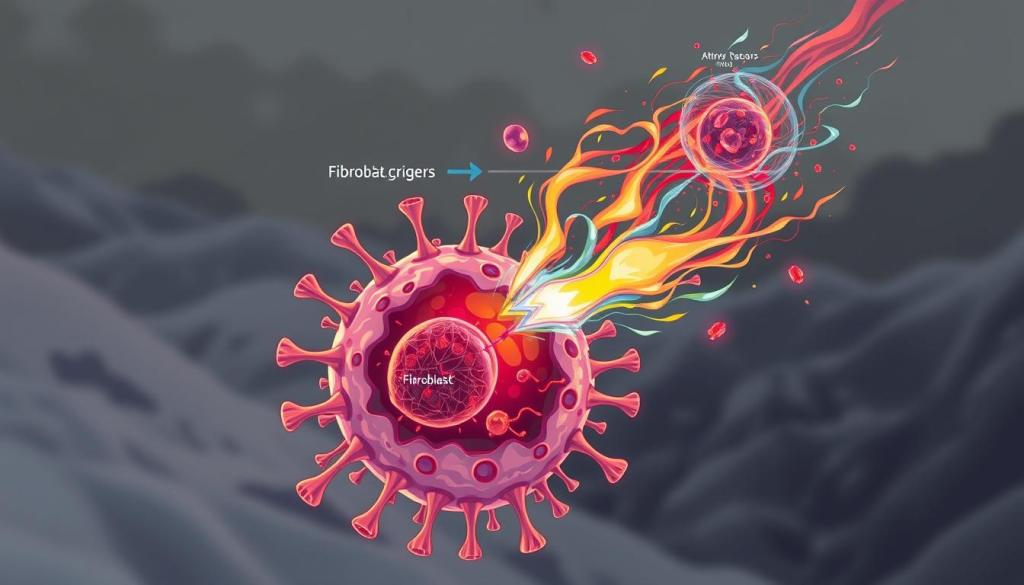
Fibroblast function is complex. It responds to many signals from the environment. Important triggers include:
- Mechanical stress
- Growth factors
- Pro-inflammatory cytokines
- Tissue damage signals
Mechanism of Activation
When activated, fibroblasts change a lot. They start making more proteins and get stronger. Growth factors like TGF-B help control these changes.
| Activation Trigger | Cellular Response |
|---|---|
| Mechanical Stress | Increased ECM Production |
| Growth Factors | Enhanced Proliferation |
| Inflammatory Cytokines | Tissue Repair Initiation |
Importance in Healing Processes
Tissue repair relies on fibroblast activation. These cells move to injuries, make new tissue, and help wounds heal. Their role in rebuilding tissue is vital.
Fibroblasts are not just passive participants but active architects of tissue restoration.
Learning about fibroblast activation helps us understand healing and diseases like scarring or fibrosis.
Fibroblasts in Disease States
Connective tissue cells are vital in understanding complex diseases. Fibroblasts are key players in fibrosis and cancer. They play a big role in these conditions.
Fibroblasts and Fibrotic Conditions
In fibrotic diseases, fibroblasts change a lot. They produce too much tissue scarring. This is because they are too active.
Some key traits of fibrotic fibroblasts are:
- They make a lot of collagen.
- They change the extracellular matrix in bad ways.
- They keep inflammation going.
“Fibroblasts represent the architects of tissue repair and potential disease progression.” – Medical Research Insights
Role in Cancer Progression
Cancer-associated fibroblasts help tumors grow. Tumor-associated fibroblasts do this in several ways:
- They help tumor cells move and spread.
- They support the growth of new blood vessels.
- They make the environment better for cancer to grow.
Fibroblasts are complex cells. In rheumatoid arthritis, they grow with inflammation. This shows how they are involved in disease.
Culturing Fibroblasts in the Laboratory
Fibroblasts are key in scientific research. They are cells that scientists can grow in labs. These cells help us learn about cells and find new medical treatments.
To grow fibroblasts, scientists use special techniques. They need to be very careful and work in controlled spaces. They use different methods to grow these important cells.
Techniques for Isolation and Growth
To get fibroblasts, scientists follow a few steps:
- They collect tissue samples from different places.
- Then, they break down the tissue using special tools and enzymes.
- Next, they use special media to clean and separate the cells.
- Finally, they grow the cells in controlled conditions.
Applications in Research
Scientists use fibroblasts for many research areas. They are especially useful in studying how cells work. Mouse embryonic fibroblasts are often used as “feeder cells” in stem cell studies.
“Fibroblasts are not just passive cells, but active participants in tissue regeneration and scientific discovery.” – Research Insights
Researchers study fibroblast cultures to learn about:
- How wounds heal
- How tissues regenerate
- How diseases progress
- How drugs work
Fibroblasts are very useful in medical research. They help us understand how cells work together.
The Impact of Age on Fibroblast Function
Aging greatly affects how fibroblasts work, changing the body’s structural proteins and collagen. As we get older, these cells change a lot. This impacts how well our skin regenerates and stays healthy.
- Reduced total number of dermal fibroblasts
- Decreased collagen production capacity
- Increased collagen-degrading enzyme levels
- Diminished cellular regenerative potential
Cellular Changes with Aging
Older fibroblasts don’t work as well. A study by Varani et al. found that people over 80 have about 35% fewer dermal fibroblasts than those 18-29.
Impact on Structural Proteins
The aging process messes up structural proteins and collagen production. Older fibroblasts make less collagen and more enzymes that break it down. This creates a cycle of tissue damage.
| Age Group | Collagen Production | Fibroblast Activity |
|---|---|---|
| Young (18-29) | High | Optimal |
| Middle-Aged (40-45) | Moderate | Reduced |
| Elderly (60+) | Low | Significantly Impaired |
“The aging of fibroblasts represents a critical mechanism underlying tissue deterioration and reduced regenerative capacity.” – Dermatological Research Institute
Knowing how fibroblasts change with age helps us find ways to slow down their decline. This opens up new paths for regenerative medicine.
Future Research Directions for Fibroblasts
The study of fibroblasts is growing, opening up new ways to heal wounds and repair tissues. Scientists are finding out how to work with these important cells in new ways.
Recent studies have shown several promising paths for fibroblast research:
- Advanced single-cell RNA sequencing techniques revealing unprecedented cellular heterogeneity
- Exploring genetic markers for specific fibroblast lineages
- Developing targeted interventions for tissue regeneration
Emerging Therapeutic Applications
Researchers have found exciting ways to use fibroblasts in treatments. Out of 820 published papers, only 35 met strict criteria. This shows the field is both selective and full of promise.
“The potential of fibroblasts in regenerative medicine is just beginning to be understood.” – Research Perspective
Potential for Regenerative Medicine
New methods are being explored for healing wounds. Case reports show big improvements in treating diabetic foot ulcers with fibroblast therapies. Researchers have made special matrices using hyaluronic acid and atelocollagen to help repair tissues.
Key research directions include:
- Identifying multipotent mesenchymal cell markers like PDGFRA, DLK1, and LRIG1
- Understanding fibroblast lineage diversity
- Developing targeted interventions to prevent scarring
The future of fibroblast research holds great promise for regenerative medicine. It offers hope for better ways to heal wounds and repair tissues.
Conclusion
Fibroblasts are key cells in our bodies that help keep us healthy. They are important for making the stuff that holds our tissues together. They also help create signals in our tissues.
These cells are vital for making connective tissue. This tissue is crucial for our organs to work right and for healing.
Research shows that fibroblasts are very flexible. They help fix damaged tissues and support stem cells. They also play a big role in healing wounds.
They help grow new cells and keep tissues healthy. This is important for our bodies to stay in good shape.
Fibroblasts are involved in many health issues. They help keep our tissues balanced but can also cause problems like fibrosis. Scientists are studying them a lot.
This research could lead to new ways to fix damaged tissues. It might also help us understand how to slow down aging and treat diseases.
Key Research Insights
Scientists are learning more about fibroblasts. They are finding out how these cells can help fix damaged tissues. This could lead to new treatments for many health problems.
FAQ
What type of cells do fibroblasts make?
Fibroblasts make cells that form connective tissue. They produce proteins like collagen and elastin. These proteins help build the structure of tissues in our body.
What is the primary function of fibroblasts?
Fibroblasts mainly help keep and fix connective tissue. They make the stuff outside cells, help wounds heal, and support tissues and organs.
How do fibroblasts contribute to wound healing?
Fibroblasts are key in healing wounds. They move to injury sites, make collagen, and help repair tissue. They also help create new tissue during healing.
Where are fibroblasts typically found in the body?
You can find fibroblasts in almost all connective tissues. This includes skin, tendons, ligaments, and tissues around organs. They keep these tissues strong.
Can fibroblasts change their function?
Yes, fibroblasts can change what they do. They can adapt to damage, inflammation, or other conditions. This shows their flexibility.
What happens to fibroblasts as we age?
As we get older, fibroblasts make fewer cells and less matrix. This leads to less elastic tissue, slower healing, and changes in tissue structure.
Are fibroblasts involved in any diseases?
Yes, fibroblasts play a part in diseases like fibrosis and cancer. Their wrong activity can cause too much scarring or help tumors grow.
How do researchers study fibroblasts?
Scientists study fibroblasts in labs. They use cell cultures from tissues and cell lines. This helps them understand their structure, function, and behavior.
What makes fibroblasts unique?
Fibroblasts are special because of their shape and how they make proteins. Their spindle shape and lots of rough endoplasmic reticulum help them make lots of matrix proteins.
Do fibroblasts play a role in regenerative medicine?
Yes, fibroblasts are important in regenerative medicine. Research is looking at their use in fixing tissues, healing wounds, and finding new treatments for diseases.





Leave a Comment
Your email address will not be published. Required fields are marked *