


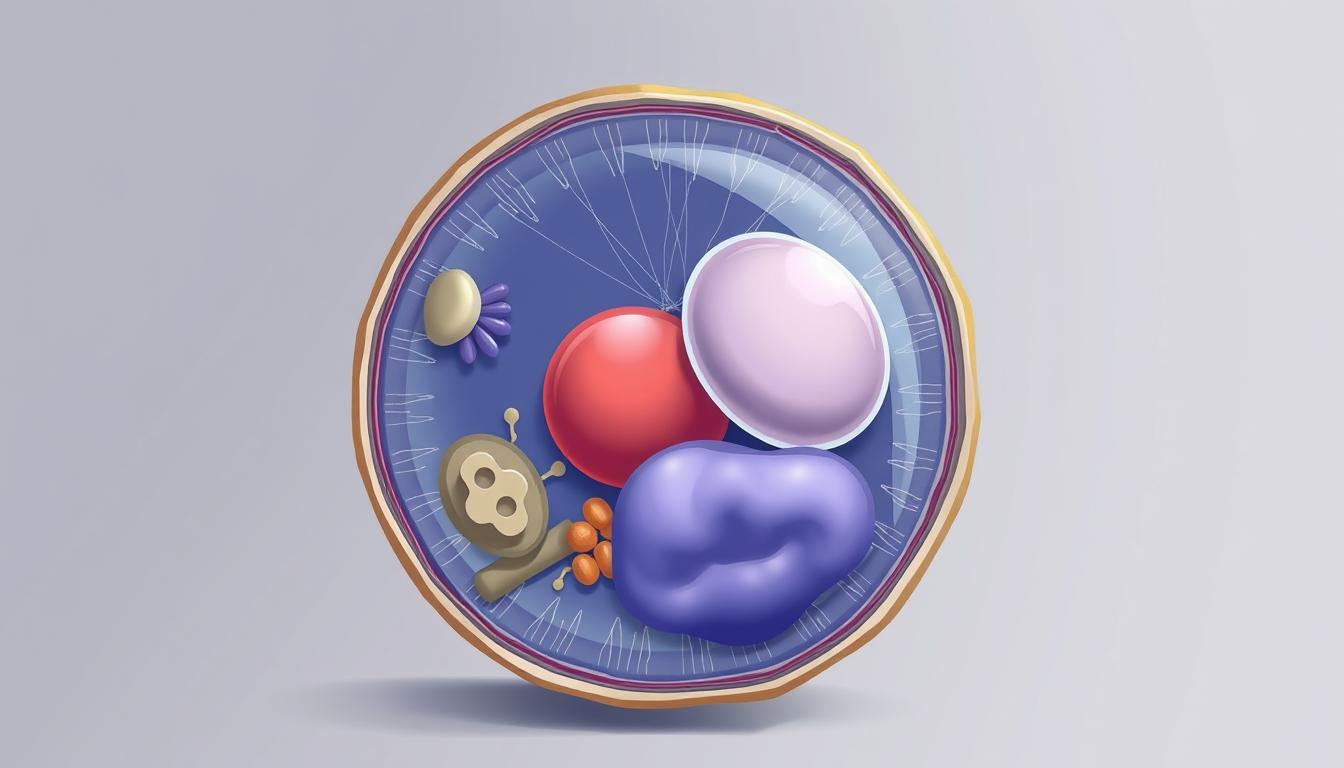
Ever wonder what’s inside a single cell? What makes cells so complex and functional?
Exploring cell composition opens a world where water and organic macromolecules are key. These elements form a dynamic ecosystem that supports life at its core.
Water makes up about 75% of a cell’s mass, crucial for all cellular activities. Organic macromolecules, on the other hand, make up to 90% of the cell’s dry weight. This shows the detailed structure of a cell’s mass.
Cell composition is more than just numbers. Each cell has thousands of unique macromolecules. This complexity drives the cell’s functions.
Key Takeaways
- Water constitutes 75% of total cell mass
- Organic macromolecules represent 90% of cell’s dry weight
- Cells contain thousands of different macromolecule types
- Cell density remains highly regulated
- Cellular mass can vary significantly between individual cells
Introduction to Cell Mass
Cells are like tiny universes, full of complex parts that make up life. Learning about these parts helps us understand how life works.
Inside cells, there are many molecules that help them work and stay healthy. Scientists have found out how these molecules work together.
Importance of Understanding Cell Composition
Studying cell composition helps scientists learn about important biological processes. By looking at how biomolecules are spread out, they can:
- Check on cell health and how it works
- Make new treatments for diseases
- Discover how life starts and grows
Overview of Cellular Components
Cells have many different parts, each with its own size and weight. Scientists have found some interesting things about how these parts are arranged:
| Biomolecule | Density (g/mL) | Dry Mass Percentage |
|---|---|---|
| Proteins | 1.3–1.43 | 50-60% |
| Nucleic Acids | 2.0 | 10-15% |
| Carbohydrates | 1.55–1.62 | 5-10% |
| Lipids | 0.91–1.01 | 10-15% |
Water makes up about 70% of cell mass. This shows how important water is for cells to work and stay alive.
“The complexity of cellular composition reveals nature’s extraordinary design in creating life’s most basic units.” – Cellular Biology Research Collective
Every part of a cell has its own job. This shows how carefully cells are made to keep life going.
The Role of Water in Cellular Mass
Water is key to understanding how cells work. It shows us the amazing complexity of life. Knowing how much water is in cells helps us see the intricate details of biology.
Most of a cell is water, from 60-90% depending on the cell and organism. This water is vital for many cell functions.
Water’s Contribution to Cell Weight
Water does a lot for cells:
- It helps with chemical reactions
- It carries nutrients
- It keeps cells strong
- It controls cell size and pressure
“Water is the most fundamental molecule in biological systems, serving as a universal solvent and critical component of cellular architecture.”
Importance of Water for Cell Function
Different body parts have different amounts of water. This shows how complex cells are:
| Tissue Type | Water Percentage |
|---|---|
| Brain | 73% |
| Lungs | 83% |
| Muscles | 79% |
| Bones | 31% |
Water’s role in cells is not just about volume. It helps keep cells balanced through osmotic pressure and hydraulic systems. It’s involved in ionic exchanges and membrane interactions, showing its deep importance in cell life.
Proteins: The Building Blocks of Life
Proteins are key macromolecules in cells, making up most of the cellular dry mass. They are crucial for structure and function, playing a big role in life.
In humans, proteins make up about 42% of our dry weight. This shows how vital they are for life. With 20 different amino acids, proteins can form countless shapes.
Structural Proteins: Cellular Architecture
Structural proteins give cells the support they need. They are the framework of cells.
- Collagen, which accounts for about 25% of total protein content
- Keratin in skin and hair
- Actin and myosin in muscle tissues
Enzymatic Proteins: Cellular Catalysts
Enzymatic proteins speed up biochemical reactions. They make life-sustaining chemical changes happen.
Signaling Proteins: Cellular Communication
Signaling proteins help cells talk to each other. When a neurotransmitter binds, it changes the protein’s shape. This allows cells to interact.
“Proteins are not just building blocks, they are the dynamic machinery of life itself.” – Cellular Biology Research
Looking at proteins in cells shows how complex and adaptable life is. Each type of protein helps keep cells healthy and working right.
Lipids: Energy Sources and Cell Membranes
Lipids are key in cells, acting as building blocks for structure and function. They are more than just energy storage.
Cells have different types of lipids, each playing a big role in their makeup and how they work. The amount of lipids varies in different living things:
- E. coli: 9-10% of dry mass
- S. cerevisiae: 3-8% of dry mass
- Mammalian cells: 16% of dry mass
Types of Lipids in Cellular Environments
Lipids include important groups that keep cells stable:
- Phospholipids: Main parts of membranes
- Cholesterol: Helps keep membranes fluid
- Triglycerides: Main energy storage
Membrane Formation and Structural Dynamics
Cell membranes have unique lipid features. Plasma membranes usually have:
- More than 50% phospholipids
- About 2% glycolipids
- Cholesterol and other sterols
“Lipids are not just passive components, but active participants in cellular communication and protection.”
The lipid bilayer structure is amazing. It lets cells control what comes in and out. With about 5 × 10^6 lipid molecules in a tiny area, these structures are complex and always changing.
Nucleic Acids: The Genetic Material
Nucleic acids are key parts of cells, acting as the blueprint of life. They carry the genetic information needed for cell function and reproduction.
There are two main types of nucleic acids: DNA and RNA. These molecules are vital for storing and passing on genetic information in living things.
DNA: The Cellular Instruction Manual
DNA holds the genetic information in most cells. It has all the instructions for an organism’s growth and function. DNA is known for:
- Being in a double-helix structure
- Having four nitrogenous bases: adenine (A), guanine (G), cytosine (C), and thymine (T)
- Being found in chromosomes in the cell nucleus
RNA: Protein Synthesis Messenger
RNA is key in making proteins and expressing genes. It’s different from DNA because it’s usually single-stranded. RNA has:
- Uracil (U) instead of thymine (T)
- Many types with different roles
- mRNA, tRNA, and rRNA are examples
“Nucleic acids are the molecular architects of life, encoding the intricate instructions that guide cellular function.” – Cellular Biology Research Team
Nucleic acids make up a big part of a cell’s mass. About 99% of eukaryotic cell volume is nucleic acid. This shows how important they are in cells.
Nucleic Acid Synthesis and Replication
Making nucleic acids is a complex process. Nucleotides, the basic units, are made through many steps. These steps involve many enzymes working together.
Carbohydrates: Energy and Structural Support
Carbohydrates are key in cells and help with energy and structure. They are made of carbon, hydrogen, and oxygen. Knowing about them helps us understand how cells work.
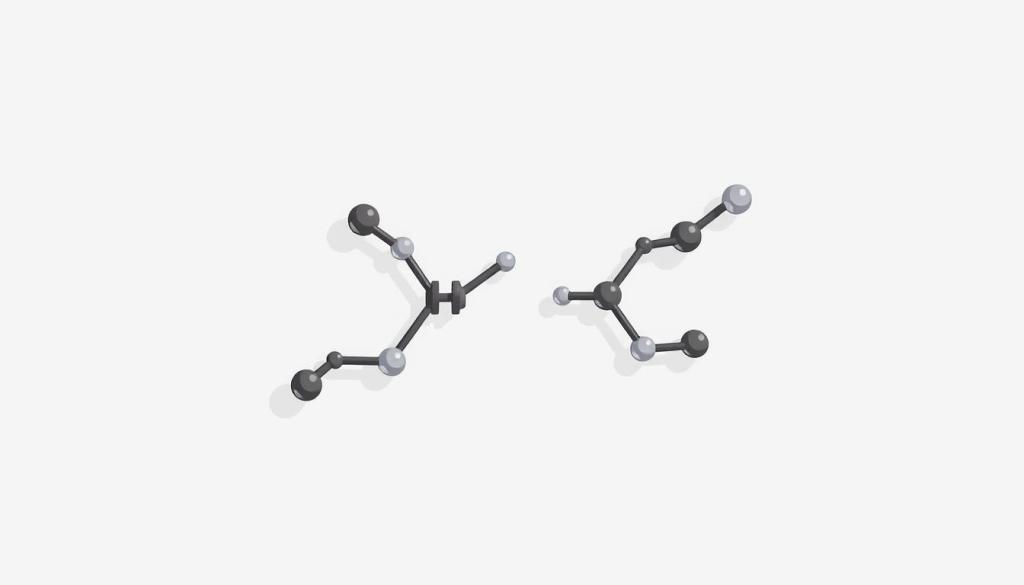
Carbohydrates have a simple formula: (CH2O)n. This shows they have a balanced mix of carbon, hydrogen, and oxygen. They come in different types, each with its own job.
Types of Carbohydrates in Cells
There are three main types of carbohydrates:
- Monosaccharides: Simple sugars with 3-7 carbon atoms
- Disaccharides: Made of two monosaccharide units
- Polysaccharides: Long chains of sugar units
Functions of Carbohydrates in Energy Storage
Carbohydrates are vital for storing energy in cells. Glucose is a common sugar with the formula C6H12O6. It breaks down to make ATP, the cell’s energy source.
“Carbohydrates are nature’s most efficient energy packaging system within living organisms.” – Cellular Biology Research Institute
Animals and plants store energy differently. Animals use glycogen in their cells, while plants store it as starch. Cellulose helps plants stand up straight by giving them structure.
- Glycogen: Highly branched glucose storage in animals
- Starch: Composed of amylose and amylopectin in plants
- Cellulose: Provides structural integrity in plant cells
Carbohydrates are complex and play a big role in how cells work and manage energy.
Organelles and Their Composition
Cells are tiny worlds filled with special structures called organelles. These tiny parts are key to life’s basic processes. Learning about organelle mass and cell composition helps us understand how living things work.
Different cells have unique organelle setups. This affects their mass and how well they work. Each organelle does its own job, making a dynamic inner world.
Key Organelles and Their Functions
- Nucleus: Controls cellular activities and stores genetic information
- Mitochondria: Generates energy through ATP production
- Endoplasmic Reticulum: Facilitates protein and lipid synthesis
- Golgi Apparatus: Packages and distributes cellular products
Mass Contribution of Organelles
Organelle mass changes a lot between cell types. Some cells have more of certain organelles for their special jobs.
| Organelle | Membrane Type | Primary Function |
|---|---|---|
| Mitochondria | Double membrane | Energy production |
| Lysosome | Single membrane | Cellular digestion |
| Ribosome | Non-membrane | Protein synthesis |
The balance of organelles affects a cell’s work. Organelle mass shows a cell’s special tasks. Each part is a wonder of biological design.
Every organelle is like a tiny machine working hard to keep life going.
The Cytoplasm: A Vital Component
Cellular biology shows us how important the cytoplasm is. It’s the main place where cells do their work. It keeps life going by handling key tasks.
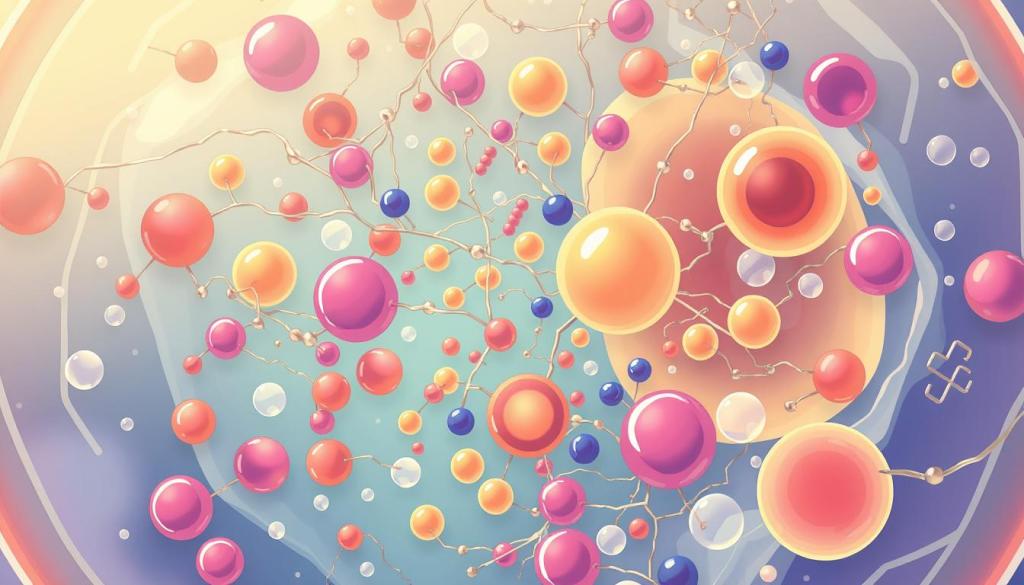
The cytoplasm is a complex mix inside every cell. It was first found by Rudolf von Kölliker in 1863. It’s like a gel that holds many important molecules and structures.
Defining the Cytoplasm
Cytoplasm is a semifluid material that fills cells. It’s mostly water, making up 80-97% of it. It’s where cells do many important things:
- Metabolic reactions
- Protein synthesis
- Intracellular transport
- Waste management
Components of Cellular Cytoplasm
The cytoplasm has many parts that make it work well:
- Cytosol (liquid portion)
- Organelles
- Dissolved molecules
- Cytoskeleton
The cytoplasm keeps a pH of about 7.4. This is perfect for cell functions.
Learning about the cytoplasm helps us understand cells better. Its ability to change quickly lets cells adapt to new situations.
The Extracellular Matrix and Its Role
The extracellular matrix (ECM) is a key part of cell composition. It’s not inside cells but is vital for tissue structure and function.
To understand what makes up most of a cell, we must look at the network around cells. The ECM makes up to 30% of the total protein in multicellular animals. This makes it a big part of our biology.
Significance of the Extracellular Matrix
The ECM has many important roles in our bodies:
- It gives structural support to cells
- It helps cells talk to each other
- It controls how cells behave and interact
- It affects cell movement and change
Composition of the Extracellular Matrix
The ECM is made of complex protein and carbohydrate networks. Key parts include:
- Collagen: The most common protein, with 28 types in vertebrates
- Proteoglycans: Gel-like substances that fill spaces
- Elastin: Makes tissues elastic and springy
The ECM is a dynamic structure that constantly changes. It greatly affects how cells work and tissues function.
Studies show the ECM’s makeup changes in different tissues. It plays a key role in keeping cells healthy and supporting specific tissue functions.
Impact of Cell Mass on Overall Organism Function
Cell mass is key to an organism’s health and function. The balance between dry and wet cell mass affects many life-sustaining processes.
- Cell mass affects metabolic activity
- Changes in dry cell mass can hint at health issues
- Wet cell mass impacts nutrient and energy use
Correlation Between Cell Mass and Cellular Processes
Cells adjust their mass through complex ways. The PI3K/AKT/mTOR pathway controls growth based on nutrients and growth factors. With plenty of nutrients, cells grow and multiply quickly.
“Cell mass is not static but a dynamic process influenced by multiple biological factors.”
Implications for Health and Disease
Changes in cell mass can signal health problems. For example, big changes in wet cell mass might show metabolic issues or stress. Scientists use these signs to track disease.
| Cellular Mass Characteristic | Health Implication |
|---|---|
| Increased Cellular Dry Mass | Potential Hyperplasia |
| Decreased Cellular Wet Mass | Possible Cellular Atrophy |
| Irregular Mass Distribution | Potential Metabolic Dysfunction |
By studying cell mass, scientists can create better treatments. These treatments focus on key cellular processes.
Conclusion: The Significance of Understanding Cell Mass
Exploring cell composition opens a world of complexity and wonder. It shows how our bodies work at a tiny level. Scientists are learning a lot about cells, which are the building blocks of life.
They’ve found out that an adult male has about 36 trillion cells. These cells are part of 60 different tissue systems. It’s amazing to think about how all these cells work together.
Research into cell composition has given us new insights. The human body has cells of all sizes, from tiny red blood cells to big muscle fibers. Scientists use special tools to measure cell mass very accurately.
These tools can even detect tiny amounts, like 100 attograms. This helps scientists track how cells grow and change.
Summary of Key Points
Studying cell mass shows us how important size and number are. Researchers have looked at over 1,500 studies. They found that cells of different sizes follow the same rules.
Every cell size class adds the same amount to the total biomass. This shows how cells grow and work together.
Future Directions in Cellular Research
New technologies in making tiny structures and processing images will change how we study cells. Now, scientists can watch single cells grow over time. This gives us a deeper understanding of how cells behave.
As we get better at studying cells, we’ll find new ways to help people. This makes studying cells very important for science and medicine.
FAQ
What is the primary component of cellular mass?
Water makes up the biggest part of cellular mass, taking up 70-95% of a cell’s weight. It’s key for moving nutrients, helping with chemical reactions, and keeping the cell’s shape.
How do proteins contribute to cell mass?
Proteins are a big part of a cell’s dry mass, making up 15-25% of its weight. They help with structure, enzymes, signaling, and moving things around inside the cell.
What percentage of a cell is composed of lipids?
Lipids make up about 5-10% of cellular mass. They’re important for making cell membranes, storing energy, and sending signals between cells.
Do different cell types have varying mass compositions?
Yes, different cells and organisms have different mass compositions. Things like what the cell does, how active it is, and its environment can change how much water, proteins, lipids, and other stuff it has.
How do nucleic acids contribute to cellular mass?
Nucleic acids (DNA and RNA) make up only 1-3% of cellular mass. But they’re vital for carrying genetic info, controlling protein making, and running the cell’s functions.
What role do carbohydrates play in cell mass?
Carbohydrates add up to 2-5% of cellular mass. They’re important for storing energy, supporting structure, and helping cells talk to each other.
How do organelles impact cell mass?
Organelles like the nucleus, mitochondria, and endoplasmic reticulum add to cellular mass. How much they contribute can change based on the cell type and its needs.
Can cell mass change over time?
Yes, cell mass can change due to things like diet, activity level, growth, division, and environment. These changes show how the cell adapts and works.
Why is understanding cell mass important?
Knowing about cell mass helps us understand how cells work, their metabolism, and health. It gives clues about cell functions, helps spot health issues, and aids in medical and biotech research.
How does the extracellular matrix relate to cell mass?
The extracellular matrix (ECM) isn’t part of cellular mass but is very important. It supports structure, helps cells talk, and affects how cells work and grow.






Leave a Comment
Your email address will not be published. Required fields are marked *