



Ever thought about how scientists grow cells that float in liquid? Suspension cell culture is a new way to grow cells without them sticking to surfaces.
In this method, single cells or small groups grow and multiply in a shaking liquid. Unlike cells that stick to surfaces, these cells stay suspended. This lets researchers study and change cellular processes easily.
Cell lines like SP2/0, NS0, CHO, BHK, and HEK293 are key in making proteins. Scientists use these lines for drug making and studying cells.
This technique lets cells like lymphocytes grow without sticking to surfaces. It opens up new ways for scientists to do research and study biology.
Key Takeaways
- Suspension cell culture enables cells to grow freely in liquid media
- Multiple cell lines can be cultivated using suspense cell culture techniques
- Researchers use this method for protein production and biomedical research
- Cells like lymphocytes can grow without surface attachment
- The technique offers enhanced flexibility in cellular studies
Understanding Suspense Cell Culture
Suspense cell culture is a cutting-edge method in cell research. It lets scientists grow and work with cells in liquid. This way, they can study and use cell groups without needing them to stick to surfaces.
Scientists use suspense cell culture to study different cell behaviors in many fields. This method makes it easier to design and carry out experiments with cells.
Definition and Core Characteristics
Suspense cell culture keeps cells moving in liquid, so they don’t settle at the bottom. About 20% of mammalian cell lines are grown this way. It’s a special technique for research.
- Primarily used for nonadhesive cell lines
- Includes hematopoietic, plant, and insect cells
- Requires specialized equipment for continuous agitation
Key Operational Features
To work with suspense cell culture, you need to control the environment well and use special techniques. Keeping the right cell density is key to avoid cell death and get good results.
| Culture Type | Key Characteristics | Primary Applications |
|---|---|---|
| Spinner Flasks | Magnetic spinner bar | Cellular circulation |
| Shaker Flasks | Rotation mechanism | Gas exchange |
| Bioreactors | Large-volume cultivation | Protein production |
“Suspense cell culture represents a transformative approach in cellular research, enabling unprecedented insights into cellular dynamics.”
The suspense cell culture methods keep getting better. They give scientists new ways to study how cells work in many fields.
Importance of Suspense Cell Culture in Research
Suspense cell culture is a key method in today’s biomedical research. It lets scientists study cells in new ways and find medical breakthroughs. This method allows for growing and studying different cell types with great detail and flexibility.

This technique is used in many areas of science. It gives researchers tools to understand complex biological processes.
Applications in Biomedical Research
Suspense cell culture has changed how we study cells. It helps scientists look at various cell types. Some key uses include:
- Looking at how blood cells work
- Studying how the immune system reacts
- Understanding cancer cells
- Examining how cells interact
Role in Drug Development
In drug research, suspense cell culture is very useful. Scientists use it for important tasks like:
- Making proteins for medicine
- Creating vaccine candidates
- Testing new drugs
- Seeing how cells react to treatments
*”Suspense cell culture represents a transformative approach in modern biomedical research, enabling unprecedented insights into cellular behavior.”*
Researchers can grow hard-to-culture cells like lymphocytes and leukemia cells. This method supports growing cells in high density. It’s great for making lots of proteins and doing detailed research.
Methods of Suspense Cell Culture
Suspense cell culture techniques are advanced methods for growing cells in liquid. They let scientists study how cells behave and interact. This is crucial for understanding cell biology.
To master suspense cell culture, researchers need to focus on several key areas. They must learn specific techniques to ensure cells grow well.
General Techniques for Cell Cultivation
Effective suspense cell culture involves several steps:
- Preparing specialized growth media
- Selecting the right culture vessels
- Keeping the environment just right
- Checking on cell health and growth
Specific Cultivation Protocols
Each cell type needs its own suspense cell culture method. Researchers must adjust their methods based on the cell’s unique traits.
“Precision in cell culture technique determines experimental success” – Cell Biology Research Institute
| Cell Type | Cultivation Method | Optimal Temperature |
|---|---|---|
| Mammalian Cells | Shaker Flasks | 37°C |
| Suspension Lymphocytes | Spinner Flasks | 37°C |
| Industrial Cell Lines | Bioreactors | 37°C |
Success in suspense cell culture comes from keeping conditions steady. Researchers must watch cell density, change media often, and avoid contamination.
Passaging and Maintenance
Passaging for suspension cells usually involves:
- Centrifugation at 1000 rpm for 5 minutes
- Removing supernatant carefully
- Resuspending cells in fresh medium
- Keeping the right cell density
Successful cell culture requires careful attention and consistent care.
Advantages of Suspense Cell Culture
Suspense cell culture is a key method in today’s biology research. It offers great flexibility and better cell growth. These benefits make it stand out from older cell culture methods.
Enhanced Cell Growth Potential
Suspension cell culture allows for amazing cell growth. It has big advantages:
- Cells can grow in much bigger amounts than before
- It supports high-density cell populations in one flask
- Cells multiply quickly
Flexibility in Experimental Techniques
Researchers love suspense cell culture for its flexibility. It lets them:
- Grow cells and make biological products on a large scale
- Make proteins and antibodies efficiently
- Produce metabolites easily
“Suspense cell culture changes how we do cellular research. It offers unmatched growth and flexibility.” – Cellular Biology Research Team
Specialized cells like lymphocytes and hematological cells are used in suspension cultures. Key industrial applications include cell lines like SP2/0, NS0, CHO, and HEK293. These are great for making recombinant proteins.
The main benefits of suspense cell culture are fast cell growth, easy scaling, and keeping cells in the same environment. This makes experiments more reliable.
Challenges Faced in Suspense Cell Culture
Suspense cell culture techniques come with unique challenges. These challenges can affect the success of cell-based experiments and research outcomes.
Critical Technical Difficulties
Researchers face several technical difficulties in suspense cell culture. These require precision and expertise. The main challenges include:
- Maintaining optimal cell agitation without causing cellular damage
- Controlling precise pH and oxygen levels
- Preventing unwanted cell clumping
- Managing complex suspension cell culture techniques
Contamination Risks in Suspension Cultures
Suspension cell culture methods have higher contamination risks. This is because they require open handling. These cultures need strict sterile techniques due to their delicate nature.
| Contamination Source | Potential Impact | Prevention Strategy |
|---|---|---|
| Frequent Handling | High Risk of Microbial Introduction | Strict Aseptic Techniques |
| Media Preparation | Potential Bacterial Contamination | Sterile Filtration |
| Equipment | Cross-Contamination | Regular Sterilization |
Understanding these challenges helps researchers create strong protocols. These protocols help reduce risks and keep cultures intact.
“The success of suspension cell culture lies in meticulous attention to detail and proactive risk management.” – Research Insights
By using careful monitoring and advanced techniques, scientists can tackle the complex challenges of suspense cell culture.
Comparison with Other Cell Culture Techniques
Cell culture techniques vary a lot. Researchers need to know the differences to get the best results. This is especially true for those using suspense cell culture methods.
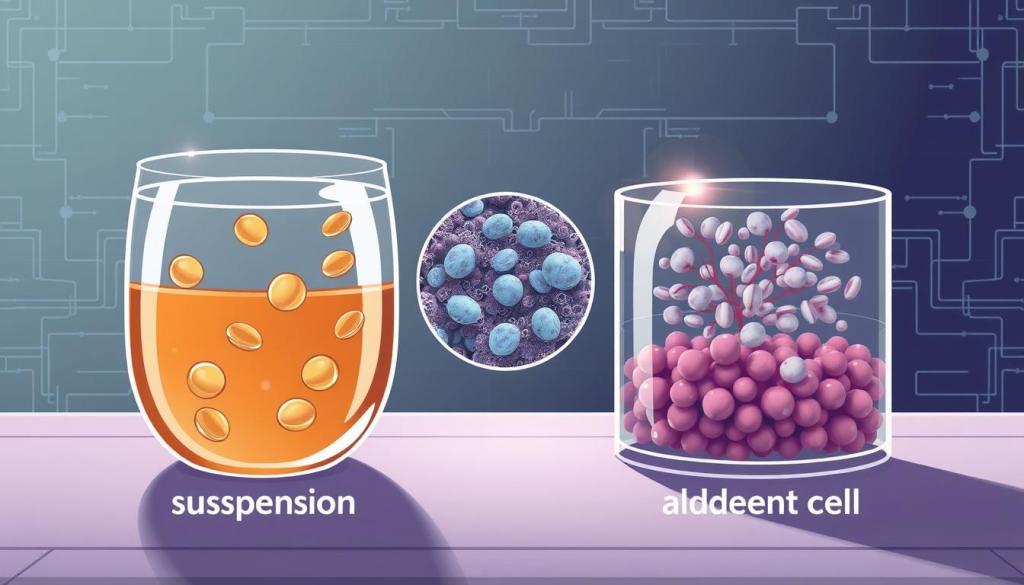
To understand suspense cell culture, it’s important to compare it with other methods. This includes looking at adherent cell culture techniques.
Distinctive Characteristics of Cell Culture Methods
Suspension cell culture has some big advantages over adherent cell culture:
- Scalability for large-volume production
- More efficient cell growth dynamics
- Reduced surface attachment requirements
- Easier monitoring and control processes
Suspension vs Adherent Cell Culture
The main differences between these methods are:
| Parameter | Suspension Cell Culture | Adherent Cell Culture |
|---|---|---|
| Cell Growth | Freely floating | Attached to surface |
| Scalability | High | Limited |
| Passaging | Direct transfer | Requires enzymatic detachment |
Suspension cell culture methods are more flexible for researchers. They work well with specific cell lines. These include SP2/0, NS0, CHO, BHK, and HEK293, which are used a lot in making recombinant proteins.
“The choice between suspension and adherent cell culture depends on specific research requirements and cellular characteristics.” – Cell Biology Research Institute
Using suspension cell culture techniques can lead to better and more scalable results. This is true for many areas of biomedical research.
Future Trends in Suspense Cell Culture
The world of suspense cell culture is changing fast. It’s leading to new discoveries in medicine and science. Scientists are exploring new ways to grow cells, which could change how we understand and treat diseases.
Emerging Innovations in Culture Techniques
New ideas in suspense cell culture are changing how we study cells. Some of these include:
- Advanced bioreactor designs with better monitoring
- New media formulas to help cells grow
- AI systems to manage cell cultures
Potential Revolutionary Applications
Suspense cell culture is opening up new areas of research. Scientists are finding exciting uses in:
- Creating new tissues for repair
- Custom treatments for each person
- Building new life forms in labs
Breakthrough Research Directions
The future of suspense cell culture is all about teamwork. By combining genetics and computer models, scientists can learn more about how cells work together.
“The next frontier of cell culture will transform our understanding of biological systems through integrated technological approaches.” – Leading Cell Biology Research Consortium
| Research Area | Potential Impact | Projected Timeline |
|---|---|---|
| Regenerative Medicine | High | 2-5 Years |
| Personalized Therapeutics | Medium-High | 3-7 Years |
| Synthetic Biology | Medium | 5-10 Years |
These new trends show how suspense cell culture can change science and medicine. It’s an exciting time for discovery and innovation.
Best Practices for Suspense Cell Culture
Keeping suspense cell culture successful needs careful attention and precision. Researchers must follow strict protocols for the best cell growth and reliable results.

Creating a good suspense cell culture protocol involves many important steps. Success comes from several key strategies:
- Maintain consistent suspense cell culture media composition
- Monitor cell density regularly
- Practice rigorous sterile techniques
- Implement precise feeding schedules
Sterile Technique Guidelines
Stopping contamination is key to successful suspense cell culture. Researchers must keep their work area clean and controlled to avoid microbes.
- Use sterile personal protective equipment
- Sanitize work surfaces thoroughly
- Handle materials with laminar flow hoods
- Utilize high-quality, validated culture media
“Precision in technique determines the success of cell culture experiments” – Research Laboratory Standard
Culture Monitoring and Maintenance
Checking cell health regularly is vital in suspense cell culture. It’s important to track cell viability, growth, and metabolic activity for accurate results.
Key monitoring techniques include:
- Daily cell count assessments
- Microscopic morphology evaluation
- Periodic viability staining
- Consistent media replacement
Proper documentation of all culture conditions remains essential for reproducible research outcomes.
Conclusion: The Future of Suspense Cell Culture
Suspension cell culture is a key technology in today’s biotechnology. It opens up new chances for scientific study and medical breakthroughs. The latest methods in suspense cell culture have changed how scientists study cells. They can now do their work more accurately and quickly.
New equipment in suspense cell culture has boosted research abilities. Scientists can now keep cells growing evenly and study them better. They’ve seen better cell growth and more metabolites by controlling the environment and the medium.
New technologies point to a bright future for suspension cell culture. Automation and artificial intelligence will change how research is done. This could lead to new treatments, more proteins, and a deeper understanding of life’s mysteries.
Breakthrough Potential
As biotechnology grows, suspension cell culture will become even more important. It can help solve big health problems. It lets us make disease-free cells, track how cells make things, and find new treatments.
FAQ
What exactly is suspense cell culture?
Suspense cell culture is a way to grow cells in liquid media. Unlike traditional methods, cells don’t stick to a surface. This lets them grow freely in a nutrient-rich solution. It’s great for more dynamic and scalable research and production.
How does suspense cell culture differ from traditional adherent cell culture?
Suspense cell culture lets cells grow in liquid, not attached to a surface. This is different from traditional methods. It’s more flexible, supports higher cell densities, and makes large-scale production easier. It’s especially useful for biopharmaceuticals and vaccines.
What types of cells can be grown using suspense cell culture?
Many cell types can be grown in suspense culture. This includes mammalian cells, insect cells, and some plant cells. Examples are hybridoma cells, certain cancer cell lines, stem cells, and cells for protein production.
What equipment is needed for suspense cell culture?
You’ll need specialized bioreactors, orbital shakers, and centrifuges. Also, sterile culture flasks, precise pipettes, cell counters, and incubators. Advanced setups might have automated systems for managing the culture.
What are the primary advantages of suspense cell culture?
The main benefits are higher cell density and easier scale-up. It also offers uniform nutrient distribution and enhanced metabolic activity. Plus, it reduces surface attachment constraints and boosts large-scale production of proteins and vaccines.
What are the main challenges in suspense cell culture?
Challenges include keeping cells agitated without damage and preventing clumping. You also need to control pH and oxygen levels and manage contamination risks. Ensuring consistent cell growth and viability is also key.
How is media prepared for suspense cell culture?
Media preparation involves choosing nutrient-rich solutions for specific cells. You need to balance pH, add growth factors, maintain sterility, and adjust nutrient levels. This supports cell growth and meets their metabolic needs.
What applications does suspense cell culture have in research?
It’s used in many areas, like studying blood cells and immune responses. It’s also for cancer research, making monoclonal antibodies, producing vaccines, and drug screening. It helps in protein production and advancing regenerative medicine.
How do researchers monitor cell health in suspense cultures?
Researchers use cell counting, viability assessments, and metabolic activity measurements. They track growth rates, analyze nutrient consumption, and monitor pH. Advanced imaging and flow cytometry are also used.
What are the future trends in suspense cell culture?
Future trends include better bioreactor designs and automated monitoring systems. There will be more use of artificial intelligence for optimization. New media formulations and applications in personalized medicine and synthetic biology are also expected.






Leave a Comment
Your email address will not be published. Required fields are marked *