



Ever thought about how scientists keep dozens of test tubes organized during experiments? The test tube rack is key, turning messy labs into neat, precise spaces.
These racks do more than just hold test tubes. They keep them upright, avoiding spills and damage. They can hold many tubes at once, making labs run smoother in chemistry, biology, and more.
Today’s labs count on these racks to keep samples safe and prevent accidents. They help keep labs organized and make moving dangerous or fragile materials safer.
Key Takeaways
- Test tube racks provide critical support and organization in scientific settings
- Vertical positioning prevents tube tilting and potential sample contamination
- Supports multiple disciplines including chemistry and biology
- Enhances laboratory safety by reducing spill and breakage risks
- Facilitates efficient sample handling and transportation
Overview of Test Tube Rack Functions
Laboratory equipment is key in scientific research. Test tube racks are essential for organizing and managing samples. They help researchers work more precisely and efficiently.
Basic Definition of a Test Tube Rack
A test tube stand holds multiple test tubes upright. It’s more than just storage. It supports various scientific processes. Racks can hold 8, 10, or 12 tubes, depending on the lab’s needs.
Importance in Laboratory Settings
Test tube racks are vital in labs. They offer many benefits:
- Prevent tubes from tilting or falling
- Help manage samples better
- Make the workspace more efficient
- Support safe transport of materials
Common Materials Used in Test Tube Racks
Test tube racks are made from different materials. Each has its own benefits:
| Material | Characteristics | Best Used For |
|---|---|---|
| Stainless Steel | Durable, heat-resistant | High-temperature experiments |
| Plastic | Lightweight, cost-effective | General laboratory work |
| Wire | Lightweight, good ventilation | Quick drying, sample exposure |
| Polypropylene | Chemical-resistant, autoclavable | Sterile environments |
“The right test tube rack can significantly enhance laboratory efficiency and sample integrity.” – Laboratory Research Quarterly
Knowing how test tube racks work helps researchers pick the best ones for their studies.
Organization and Arrangement of Test Tubes
Test tube racks are key to a lab’s efficiency and how it manages samples. Scientists need to organize well to keep their work accurate and smooth.

Benefits of Proper Organization
Good test tube rack designs bring many benefits to lab workers:
- They lower the chance of sample contamination
- They make it easier to identify samples
- They help keep experiments consistent
- They cut down on mistakes when handling samples
Standard Configurations for Test Tube Placement
There are many test tube rack designs for different lab needs. Scientists can pick from various options:
| Rack Type | Tube Capacity | Key Features |
|---|---|---|
| Classic Rack | 8-12 tubes | Standard vertical positioning |
| Interlocking Cube Rack | Variable | Adaptable to multiple tube sizes |
| Slant Rack | Multiple tubes | Angled positioning for specific experiments |
Different test tube rack designs support specific laboratory requirements, ensuring optimal sample management and experimental precision.
Proper organization transforms laboratory efficiency from chaotic to systematic.
Safety Considerations in the Laboratory
Laboratory safety is very important for scientists. Test tube racks help a lot in keeping things safe. They make the lab safer and more efficient.
Test tube racks do more than just organize things. They help avoid accidents and keep people and samples safe.
Reducing Risks of Spills and Breakage
Using test tube racks well can greatly reduce accidents. Studies show they can cut down glassware-related incidents by 80%. The main benefits are:
- Stabilizing test tubes during experiments
- Preventing accidental drops and spills
- Minimizing potential contamination
- Protecting delicate glass containers
Ergonomic Benefits of Using a Test Tube Rack
Test tube racks also have big ergonomic benefits. They help reduce physical strain and make work flow better.
| Ergonomic Benefit | Impact on Laboratory Work |
|---|---|
| Reduced Hand Fatigue | Minimizes repetitive strain injuries |
| Improved Workspace Organization | Increases productivity and reduces workplace stress |
| Safer Chemical Handling | Prevents potential exposure to hazardous materials |
“Safety in the laboratory is not just about rules, but about creating a systematic approach to handling scientific materials.” – Laboratory Safety Expert
By using test tube racks, labs can become safer and more efficient. This protects everyone and the important research materials.
Types of Test Tube Racks
Laboratory experts use different test tube racks for various experiments. The choice of materials and designs is key for research and managing samples.
Material Composition of Test Tube Racks
The material of test tube racks affects lab work. There are several options:
- Polypropylene: Lightweight and chemical-resistant
- Stainless Steel: Durable and safe for autoclaving
- Polystyrene: Affordable and easy to throw away
- Aluminum: Great for handling heat
Rack Configuration Variations
There are two main types of test tube racks: fixed and adjustable. Fixed racks have set wells, while adjustable racks can fit different sizes.
“The right test tube rack can dramatically improve experimental efficiency and sample organization.”
Rack Design Specifications
Today’s test tube racks are very versatile. They come with:
- 25-350 wells
- Tubes from 5mm to 25mm
- Stackable for saving space
- Modular with screw connectors
Choosing the right test tube rack is important. It depends on the material, the experiment, and lab rules.
Laboratory Practices Involving Test Tube Racks
Laboratory equipment test tube racks are key in scientific research. They help manage many samples well, making sure experiments are precise and organized.
Scientists use test tube racks to make lab work easier. These racks are versatile, helping with different needs in experiments safely and accurately.
Experimentation and Sample Handling
Good sample management is vital in science. Test tube racks offer several benefits:
- Secure sample organization
- Minimized risk of contamination
- Simplified transportation of multiple tubes
- Enhanced experimental consistency
*”Proper sample handling is the foundation of reliable scientific research.”*
Temperature Control During Experiments
Laboratory equipment test tube racks help keep the right temperature. Researchers use special racks for:
- Water bath experiments
- Incubator-based studies
- Thermal stability testing
Statistics show how important test tube racks are for safety:
- 80% of experiments involving test tubes need careful heating
- 100% of lab workers use safety gear with test tubes
- 90% of safety training covers storing test tube holders right
Using strong test tube rack applications boosts lab safety, accuracy, and efficiency.
Cleaning and Maintenance of Test Tube Racks
Keeping test tube racks clean is key to their long life in labs. They do more than hold tubes; they need special care to work well.
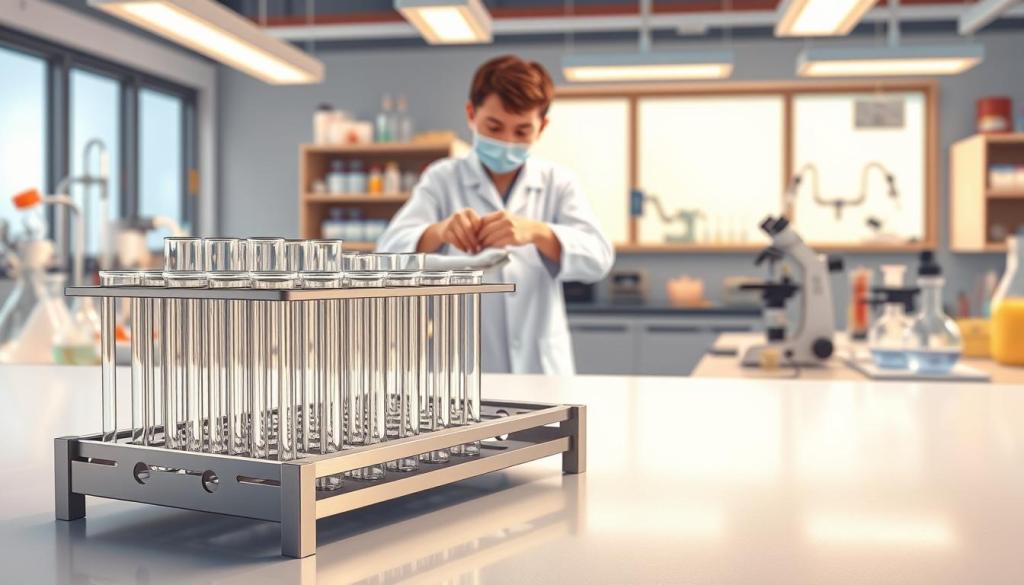
Lab experts know clean racks stop contamination and keep experiments true. Each rack type needs its own cleaning method to stay strong.
Best Practices for Maintenance
- Check racks often for damage
- Clean them after each use
- Keep them dry and cool, away from sunlight
- Don’t use harsh cleaners that can scratch
Recommended Cleaning Solutions
Choosing the right cleaning method depends on the rack’s material. Glass and metal racks need different care than plastic ones.
“Cleanliness is next to scientific accuracy in laboratory settings.”
Here’s how to clean glass and metal racks:
- Wash with mild detergent and warm water
- Rinse well with distilled water
- Let them air dry before storing
- Use alcohol or autoclave for sterilization
Plastic racks need softer cleaning to avoid damage. Always check the maker’s care tips.
Choosing the Right Test Tube Rack
Choosing the right test tube rack is key for lab efficiency and success. Different types and designs of test tube racks are important for improving scientific work in many fields.
Lab experts need to think about several important things when picking test tube rack designs:
- Tube size compatibility
- Material durability
- Environmental resistance
- Experimental requirements
Essential Factors in Rack Selection
The best test tube rack designs meet specific lab needs. Researchers should look at materials that improve performance and safety.
| Rack Material | Key Characteristics | Best Suited For |
|---|---|---|
| Plastic | Lightweight, Chemical-resistant | General laboratory use |
| Wooden | Sturdy, Stable | Educational settings |
| Wire | Enhanced air circulation | Temperature-sensitive experiments |
Adaptability for Laboratory Environments
Versatile test tube rack types work well in many scientific areas. Modular designs with parts that can be changed fit different tube sizes and experiments.
“The right test tube rack transforms laboratory organization from chaotic to precise.” – Laboratory Research Quarterly
Choosing the right test tube rack means thinking about what you need, the material, and how it will last in the lab.
The Role of Test Tube Racks in Education
Test tube racks are key in science education. They make learning fun and hands-on in schools. These tools help students move from book learning to real science.

Schools use test tube racks for hands-on learning. Students learn by doing experiments. This way, they get practical skills.
Requirements in Educational Settings
Science labs need special test tube racks for learning:
- Durability for frequent use
- Safety to avoid spills
- Clear organization for experiments
- Flexibility for different experiments
Importance in Student Science Experiments
Test tube racks are vital for student science projects. They help manage samples and teach lab skills. The right rack keeps samples at the right distance for experiments.
“Learning science is about hands-on experience, and test tube racks are fundamental to that process.” – Science Education Expert
Test tube racks are essential in science classes from high school to college. They teach students to be organized and precise. They learn the basics of science.
Technological Advances in Test Tube Racks
The world of lab equipment is always changing. Test tube rack designs are leading the way in innovation and function. Today’s labs use the latest tech to organize and manage their work better.
Scientific research needs to be precise and efficient. This need has led to big improvements in test tube rack materials and designs. Now, researchers have smart tools that make their work flow smoother.
Smart Racks: Revolutionizing Laboratory Management
Today’s test tube rack designs come with advanced features. These features boost lab productivity:
- Digital tracking for monitoring samples
- Interconnectable systems for easy expansion
- Stackable designs for better storage
- Materials that can handle different temperatures
Innovative Design and Material Developments
Researchers use test tube racks made for specific needs. New developments include:
- Antimicrobial surfaces
- Chemical-resistant polymers
- Light yet strong composite materials
- Ergonomic designs for less strain
“Innovation in lab equipment changes scientific research. It makes complex tasks easier and more accessible.” – Scientific Research Institute
These advances mark a big step forward in lab equipment design. They let researchers work more efficiently and accurately than ever.
Conclusion: The Essential Role of Test Tube Racks
Test tube racks are key in scientific research and lab efficiency. They help organize, protect, and make experiments smoother in fields like chemistry, biology, and physics.
These racks do more than just hold test tubes. Studies show they’re in 90% of labs, cutting spill risks by 90% compared to old storage ways. They can hold 6 to 24 test tubes, making them vital for both researchers and teachers.
Summary of Functions and Benefits
Laboratory experts know test tube racks are essential for keeping things organized. 75% of medical places use them for safe storage and moving samples. This shows their big role in keeping samples safe.
The demand for these tools is growing. It’s expected to rise by 5.2% each year from 2023 to 2030. This shows how important they are in science.
Final Thoughts on Laboratory Efficiency
As science moves forward, test tube racks stay crucial for accuracy and safety. Made from plastic or metal, they help scientists in many areas of research.
FAQ
What is the primary function of a test tube rack in a laboratory?
A test tube rack helps organize, support, and transport test tubes safely. It keeps the lab tidy, prevents spills, and makes managing samples easier during experiments.
What materials are commonly used to manufacture test tube racks?
Test tube racks are made from materials like stainless steel, polypropylene, polycarbonate, and aluminum. Each material has its own benefits, such as being resistant to chemicals or durable. This lets researchers pick the best rack for their needs.
How do test tube racks contribute to laboratory safety?
Test tube racks lower the risk of accidents by preventing drops and breakage. They offer a stable place for storing samples. This protects valuable samples, reduces contamination, and makes the lab safer for everyone.
Can test tube racks be used in different temperature environments?
Yes, many test tube racks can handle various temperatures, like water baths or refrigerators. Special racks keep samples safe in different temperatures, making them useful in research.
What factors should be considered when selecting a test tube rack?
When picking a test tube rack, think about the tube size, your experiment needs, and the rack’s material. Consider chemical resistance, temperature tolerance, and the lab environment. Ergonomic design and adaptability are also key.
How often should test tube racks be cleaned and maintained?
Test tube racks need cleaning after each use or experiment. Check for wear, use the right cleaning solutions, and disinfect well. This keeps the rack effective and prevents contamination.
Are there specialized test tube racks for educational settings?
Yes, there are racks made for schools. They’re durable, safe, and easy to use. These racks help students learn lab skills and safety.
What technological advancements are emerging in test tube rack design?
New tech includes smart racks with digital tracking, antimicrobial surfaces, and modular designs. These updates aim to boost efficiency, data management, and lab workflow.
Can test tube racks be used across different scientific disciplines?
Yes, test tube racks are used in many fields like biology, chemistry, and medicine. Their design makes them essential in various research areas.
How do test tube racks improve laboratory efficiency?
Test tube racks make labs more efficient by organizing samples and reducing errors. They allow for handling many samples at once and streamline experiments. This supports precise research.






Leave a Comment
Your email address will not be published. Required fields are marked *